What does female hair thinning look like?
Widening parting or sudden shedding? Two different diseases
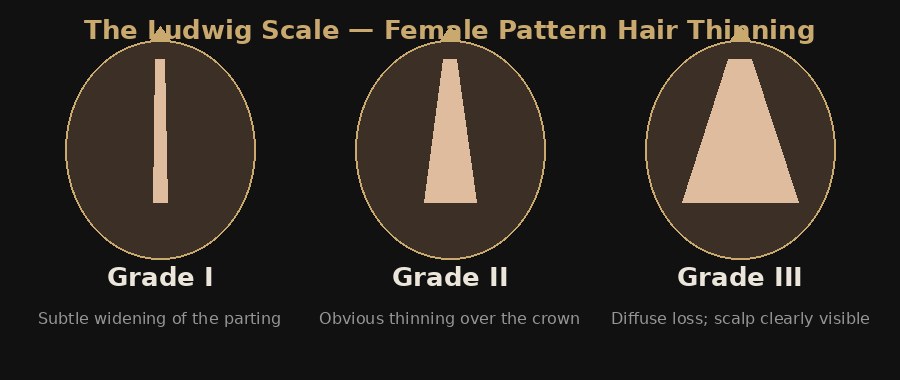
Female pattern hair loss (FPHL) is a follicle-miniaturisation disorder: hairs over the crown and parting become progressively finer and shorter with each cycle, widening the parting while the frontal hairline holds — the Ludwig pattern described in clinical reviews [1]. Telogen effluvium (TE) is a cycle disturbance: a stressor — childbirth, high fever, surgery, crash dieting, severe psychological stress — pushes a large cohort of follicles into the resting phase together, and 2–3 months later they shed together [2]. FPHL is gradual and patterned; TE is abrupt and diffuse. They can coexist — a TE episode often unmasks underlying FPHL — which is why the distinction is made by a physician, not a shampoo aisle.
Why does blood work come before hair treatment?
Iron deficiency (screened via ferritin) and thyroid dysfunction are treatable contributors that no topical will fix; context may add hormonal evaluation. Reviews of female hair loss are explicit that work-up precedes therapy [1,3]. Dr Sin Yong's female hair loss programme is built in that order: diagnose, correct the correctable, then treat the follicles — with topical minoxidil as the evidence anchor and adjuncts like Regenera Activa and the H2LT laser protocol selected per case.
What doesn't work for female hair thinning?
“Thickening” shampoos coat the shaft — cosmetic, temporary, fine as makeup but not treatment. Cutting hair short does not change follicles. Fear-driven supplement stacks without a deficiency do nothing measurable. And waiting is costly in FPHL specifically: miniaturised follicles are progressively harder to rescue — no treatment regrows a dead follicle; the work is saving the ones still alive.
“Female hair loss is a diagnosis, not a shampoo choice — blood work comes before treatment.”
— Dr Sin Yong
Dr Sin Yong’s Viewpoint
I do not treat female hair loss without blood work. Iron, thyroid and hormonal contributors hide behind 'stress' constantly, and a treatment plan that skips the screen can polish the leaves while the roots starve. The test is simple; skipping it is not.
Prefer Not to Use WhatsApp?
Use the short enquiry form instead →
Leave your name, mobile number and email and the clinic will contact you directly. No obligation.
Prefer a preliminary view first? You can also WhatsApp a photo of the area for Dr Sin Yong to review before you decide on a visit.