Dr Sin Yong · MBBS (NUS) · MRCS (Edin) · MSc Aesthetic Medicine with Distinction (Queen Mary, London) · MSc Practical Dermatology (Cardiff) · Global Key Opinion Leader
Sculptra is injectable poly-L-lactic acid. It adds no lasting volume of its own; it is a scaffold the skin builds collagen around over months, and it cannot be dissolved. It is assessed and placed by Dr Sin Yong on Orchard Road, Singapore.
Sculptra is injectable poly-L-lactic acid, a collagen biostimulator rather than a filler. It adds little volume on the day; the change builds gradually as the skin lays down new collagen. In Singapore its cost depends on the assessment, how much product is planned and how treatment is staged, and it cannot be dissolved once placed.
What poly-L-lactic acid is: a scaffold, not a filler
Sculptra is poly-L-lactic acid (PLLA), a biodegradable synthetic polymer manufactured by Galderma and used in dissolvable sutures and orthopaedic implants for decades. For aesthetic use it is supplied as a sterile powder of microparticles, reconstituted with sterile water before injection and placed in the deeper layers of the skin or just beneath them. It received US FDA approval in 2004 for HIV-associated facial lipoatrophy and in 2009 for nasolabial fold contour deficiencies.
It is not a filler in the ordinary sense. A hyaluronic acid filler is a gel that occupies space the moment it is placed. Poly-L-lactic acid occupies very little space of its own. Fibroblasts treat the particles as a scaffold and lay down new type I collagen around them gradually, while the particles slowly break down by hydrolysis. What remains is your own collagen, not resident product. That distinction decides the timing of the result, the areas it suits, and what can be done if it goes wrong.
“"Sculptra only tightens." It doesn't. Collagen is tissue. It takes up space.”
Dr Sin YongOn what collagen stimulators actually do
Why the first week is not the result
The fullness visible straight after treatment is almost entirely the water it was mixed with, plus the swelling that follows any injection. Both settle, and the face often looks much as it did before. This is normal, and it is the point at which people who were not warned decide the treatment has failed. The real change is slower: collagen is produced gradually, so the product cannot be judged on the day, and it is the wrong choice for anyone who needs a change before a near event. Because the response continues after the appointment, placing enough on the day to see a result is the commonest route to too much later, and too much cannot be taken back.
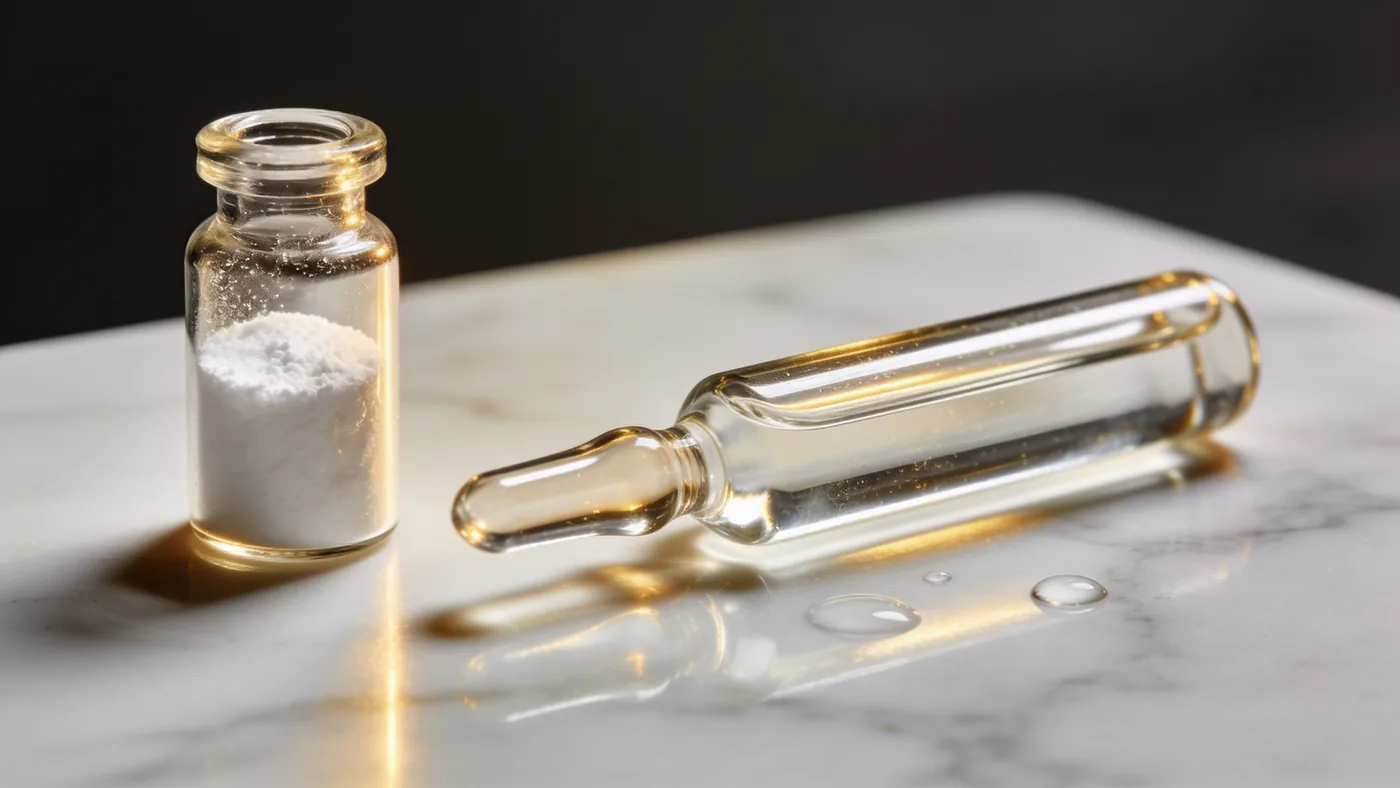
Illustrative. Poly-L-lactic acid is supplied as a dry powder and reconstituted with sterile water before it is placed; the fullness seen on the day is mostly that water.
If a lump forms after treatment, the guide to hard filler lumps explains how it is assessed.
Who it suits, and who should not have it
It suits diffuse, structural volume loss: the overall deflation of the mid-face, temples and lower face that comes with age or after significant weight loss, in a patient who can wait for a gradual result and understands it cannot be reversed. It is particularly logical where the face reads tired rather than lined. Thin faces, full faces, age and the under-eye exclusion are covered under am I suitable for a biostimulator.
Who it suits, who should wait, who should not have it
Group
Typical situation
What usually happens
Tends to suit
Diffuse deflation of the mid-face, temples and lower face; a face that reads tired rather than lined; able to wait and attend review
Staged, conservative placement with reassessment
Should not have it
Known hypersensitivity to any component; a history of, or tendency to, keloid or hypertrophic scarring (both contraindications in the US FDA labelling)
Not used
Better to wait
Pregnancy or breastfeeding; active infection or inflammation in the area, including an acne flare or a cold sore
Deferred
Assessed first
Immune suppression or an active autoimmune condition; a bleeding tendency or blood-thinning medicines; earlier non-dissolvable or unknown filler in the area
Discussed carefully; earlier filler scanned first, which may rule it out
Poor candidates by expectation
A visible change needed before a near event; unable to return for review; uneasy with a result that cannot be reversed
Another option, or no treatment
Referred on
A jowl or loose jawline from laxity; lumps or heaviness from earlier filler
Focused ultrasound or VF Lift – Vertical Facelift assessment; ultrasound scan and filler correction
Where it is placed, and how it compares with CaHA, PCL and HA
Where it is placed, and where it is not
Sculptra is a collagen biostimulator, not a filler: it is placed as a dilute suspension and the body builds collagen around the particles over the following months. Because it cannot be dissolved and keeps building after the appointment, it goes only where the tissue is thick enough to hide a particle and where a gradual, diffuse change is wanted. The published consensus favours a more dilute suspension and deeper placement, on or near the bone, where the skin is thin, and allows a less dilute product in the deeper subcutaneous plane of the fuller cheek.
Where poly-L-lactic acid is placed, and where it is not
Thin, mobile skin shows every particle, and a nodule there cannot be dissolved; a reversible hyaluronic acid product is used instead
Not applicable
PLLA, CaHA, PCL and hyaluronic acid compared
Material
What it is
How it works
Can it be dissolved?
Where it is typically considered
PLLA (poly-L-lactic acid)
Microparticles reconstituted in sterile water
Prompts the body's own collagen gradually; little immediate volume
No
Diffuse volume loss in the temples, cheeks and jawline, placed in stages
CaHA (calcium hydroxylapatite)
Microspheres in a gel carrier
The gel gives immediate support; collagen forms around the spheres; also used diluted for skin quality
No
Support on bone, such as the jawline, chin and nose
PCL (polycaprolactone)
Microspheres in a gel carrier
Immediate correction from the gel, with collagen stimulation around the spheres
No
Contour and support on bone
Hyaluronic acid (HA)
Cross-linked gel
Fills and binds water to add volume straight away
Yes, with hyaluronidase
Areas where reversibility matters, such as the lips and under-eye
Which material suits you is an anatomical decision made at assessment, not a preference. The options are compared in more depth on collagen biostimulators in Singapore and collagen injection vs collagen biostimulator. For a single discrete temple hollow, hyaluronic acid is used at this practice because it can be dissolved.
What it cannot do, and the alternatives
It does not lift. A jowl or a loose jawline is a laxity problem and belongs to focused ultrasound or the VF Lift – Vertical Facelift, Dr Sin Yong's radiofrequency protocol on Volnewmer, not to an injectable.
It does not shape a chin, a nose or a lip. Projection needs a product with form on the day.
It does not suit the lips, the tear troughs or fine superficial lines, areas that punish a non-dissolvable product placed close to the surface.
It does not give a change on the day, so it does not suit a near event.
It is not lifelong. Poly-L-lactic acid is broken down over time, and the skin returns to its own trajectory as the collagen it produced ages like the rest.
It cannot be dissolved
Hyaluronidase, the enzyme used to reverse hyaluronic acid filler, has no action on poly-L-lactic acid. If it is placed too superficially, in the wrong plane or in excess, the options are time, targeted treatment of any nodules, and in some cases procedural removal. None of those is equivalent to dissolving.
Two myths we hear in clinic
“It only tightens skin.”
Collagen is tissue and takes up space, so it builds gradual volume rather than tightening.
“If the result is not right, it can be dissolved like hyaluronic acid filler.”
Hyaluronidase acts on hyaluronic acid only, so poly-L-lactic acid cannot be dissolved and is planned conservatively.
Risks and side effects
The common findings are those of any deep injectable: swelling, bruising, tenderness and temporary asymmetry while the water settles. Papules and nodules are the specific risk of this product: the US pivotal trial reported them in 17.2% of patients, typically appearing months after treatment and mostly resolving on their own. Dilution, depth of placement and post-treatment massage all influence that figure, which is why technique rather than brand is the variable that matters. The serious risks are the vascular ones that attend any product placed near facial vessels, which is why plane and anatomy matter more than the product.
Tell the clinic about every previous filler or biostimulator, with dates and areas if you know them.
Declare pregnancy, breastfeeding, autoimmune conditions and any history of keloid scarring.
Mention blood thinners, aspirin, fish oil or supplements that increase bruising.
Avoid fresh sun exposure, pause strong skincare actives as advised, and bring photos of your face over the years.
On the day
Previous filler is mapped with ultrasound first. Dilution and plane are then set region by region, the product is placed, and the treated areas are massaged as instructed. The day in sequence, including the massage rules, is set out under what to expect at a biostimulator visit.
What recovery looks like
The sequence below describes phases, not a timetable: how quickly each passes depends on the area and the person, and is discussed at consultation.
Immediately after. Fullness from the injected water and swelling, with tenderness and possibly bruising; this early volume is not the result.
The first evening. Massage the treated areas as instructed and avoid pressure, heat and alcohol; a cool compress limits swelling.
The following days. The water is absorbed and the face returns almost to its starting point; bruising fades and temporary asymmetry settles.
As the skin settles. Collagen builds gradually around the microparticles over the following weeks and months, so the change appears slowly.
Follow-up. Any further placement is decided at review from what the skin has produced, and any late papule or nodule is assessed.
The cost of Sculptra in Singapore depends on how much product your face needs and how that is staged, which can only be judged at assessment. There is no fixed number of vials for a face, and a figure quoted before an examination would describe a plan that does not yet exist. The extent of the volume loss matters most: diffuse deflation across the temples, mid-face and lower face needs more than a single area. Face size, skin thickness and the dilution chosen for each region also change how much is used, and earlier filler may need to be scanned and sometimes dissolved first.
Staging is the other variable. Because poly-L-lactic acid keeps building collagen after the appointment and cannot be dissolved, Dr Sin Yong under-corrects deliberately and decides any further placement at review. The number of vials is therefore an outcome of the plan rather than something chosen in advance. Prices are discussed at consultation rather than published, in line with Singapore's rules on medical advertising. What sets the fee, vial by vial, is on cost factors, and how quotes work is on how we quote.
How Dr Sin Yong places it, and why he scans first
Poly-L-lactic acid is a planning product more than an injecting product. The decisions that determine the result are made before the needle: how much water the powder is reconstituted with, which plane each region is placed in, and how much is placed at a first visit against how much is left for reassessment. Dr Sin Yong plans dilution and plane region by region, because the temple, the mid-face and the pre-jowl area are different depths and different tissues. He under-corrects deliberately, reviews as the collagen response develops, and decides any further placement from what the skin has actually produced rather than from a pre-sold plan.
Noticed lumps or heaviness? Scan before you add
A face that has been injected more than once often arrives with a complaint that sounds like it needs more product: a heaviness in the lower face, a fullness under the eyes, a lump months after the last visit. In Dr Sin Yong's experience the problem is more often what is already there, and the answer is subtraction, not addition. So before any further placement, he scans. High-frequency ultrasound shows what material is in the tissue, how deep it is, whether it has migrated, and whether a lump is poly-L-lactic acid, old hyaluronic acid filler, a cyst or scar. If the scan shows that less is what you need, that is filler correction, a different procedure. If it shows a clean field, placement can go ahead. Nothing is added to a face that has not been looked beneath.
Poly-L-lactic acid: questions patients ask
Is Sculptra a filler?+
Not in the usual sense. A filler is a gel that occupies space the day it is placed. Sculptra is poly-L-lactic acid microparticles that occupy very little space themselves; they prompt the skin to build collagen around them gradually. The fullness seen on the day is mostly the water it was mixed with.
Can Sculptra be dissolved?+
No. Hyaluronidase breaks down hyaluronic acid only and has no effect on poly-L-lactic acid. Problems are managed with time, targeted treatment of nodules and, in some cases, procedural options. This is the single most important fact to understand before choosing it.
How long does Sculptra take to work?+
Gradually. The injected water and swelling settle first, and the collagen response builds afterwards, so the change appears slowly. If you need a visible change before a near event, this is the wrong product and you will be told so.
Does Sculptra cause lumps?+
Papules or nodules were reported in 17.2% of patients in the US pivotal trial, typically months after treatment and mostly resolving on their own. Dilution, depth and aftercare influence the risk. A lump that is growing, painful or red should be examined, not massaged on faith.
How much Sculptra is needed, and what decides it?+
There is no fixed number of vials for a face. The amount follows the extent of volume loss, how many regions are involved, face size, skin thickness and the dilution chosen for each region. Earlier filler may need scanning, and sometimes dissolving, first. Because poly-L-lactic acid cannot be dissolved, Dr Sin Yong under-corrects and decides further placement at review.
Can Sculptra be used under the eyes or in the lips?+
These are the areas where a non-dissolvable product placed near the surface is most likely to cause trouble, and they are not where Dr Sin Yong uses it. A reversible hyaluronic acid product is the more defensible choice there.
Who is the right doctor for Sculptra in Singapore, and what should I check?+
No register ranks doctors, so check credentials rather than claims. Confirm the doctor is on the Singapore Medical Council register and the clinic is licensed under the Healthcare Services Act. Ask who assesses and injects, whether existing filler is scanned first, and how dilution and plane are planned. Dr Sin Yong holds MBBS (NUS), MRCS (Edinburgh), MSc Aesthetic Medicine (University of London) and MSc Practical Dermatology (Cardiff).
How much does Sculptra cost in Singapore?+
The cost depends on the areas treated, the amount of product your anatomy calls for, how the plan is staged, and whether it is combined with another treatment. Because the result builds after you leave and cannot be reversed, a written quote is given at consultation after assessment, and the consultation decides whether it is advised at all.
Vleggaar D, Fitzgerald R, Lorenc ZP. Composition and mechanism of action of poly-L-lactic acid in soft tissue augmentation. Journal of Drugs in Dermatology 2014;13(4 Suppl):s29-s31. source
Consensus recommendations on the use of injectable poly-L-lactic acid for facial and nonfacial volumization (Vleggaar D, Fitzgerald R, Lorenc ZP et al.). Journal of Drugs in Dermatology, 2014. pubmed.ncbi.nlm.nih.gov
US Food and Drug Administration. SCULPTRA® Aesthetic (injectable poly-L-lactic acid): summary of safety and effectiveness and labelling, P030050/S002, 2009. source
Medically reviewed by Dr Sin Yong, MBBS (NUS), MRCS (Edinburgh) · Last updated 23 October 2026 · Editorial policy
Where Dr Sin Yong consults: Orchard Road, Singapore (unit on booking) · Orchard MRT · Mon–Fri 10am–8pm, Sat 11am–3pm · WhatsApp +65 8023 7170 · Getting here · How fees are quoted
Assessed before it is injected
Whether a non-dissolvable biostimulator is the right answer depends on the anatomy, on what has been injected before, and on how much time you have. Dr Sin Yong assesses that first.