Published 26 October 2026 · Reviewed by Dr Sin Yong
Filler that has moved shows at the edges: puffiness under the eyes, a heavy cheek, a chin that has spread, a blurred lip line, sometimes years after the injection. Hyaluronic acid can be dissolved where it has moved. Other fillers cannot, and patients are often told surgery is the only option. Cutting filler out leaves a scar and can cause dents or nerve injury. Get assessed first.
Short answerFiller migration is filler found outside the area or tissue layer where it was placed. It can appear years later: around the eyes, retained hyaluronic acid has been found up to 9 years after injection (Chang 2017). Ultrasound shows where the filler sits and what it is likely made of; at one reference centre, scanning helped avoid unnecessary treatment (Gonzalez 2024). Dr Sin Yong dissolves hyaluronic acid where it has moved, after a skin test, and treats collagen stimulators, mixed products and silicone with the Sculpting mode of Time Freeze Laser LCLR®, without an incision.
Filler found outside the area or tissue layer where it was placed, usually noticed at the edges of a treated area.
Years later
Hyaluronic acid has been found up to 9 years after injection around the eyes, and 50–86% was still present at 24 months in a review of 1,410 patients.
Where problems show
Under the eyes (23%) and the smile lines (22%) were the commonest sites of 52 non-vascular hyaluronic acid complications on ultrasound; migration was among them.
Hyaluronic acid
Mapped with ultrasound and dissolved where it has moved, after a skin test that Dr Sin Yong always does first.
Other fillers
Collagen stimulators, mixed products and silicone are treated with the Sculpting mode of Time Freeze Laser LCLR®, without an incision.
Before surgery
Get assessed. Cutting filler out leaves a scar, can cause dents or nerve injury, and cannot be undone.
Filler migration is filler that has ended up outside the area, or the tissue layer, where it was placed. It rarely shows as a lump in the middle of a treated area. It shows at the edges: a puffy ridge below the under-eye hollow, fullness that has drifted lower in the cheek, a chin that looks wider or longer than it did, a bridge of the nose that has broadened, a blurred lip line. Some people notice swelling well away from where they were injected, such as the upper eyelids after brow or temple filler. Others notice only that their face in photographs no longer looks like them.
Migration is a recognised finding, not a myth. In an ultrasound study of 52 non-vascular complications after hyaluronic acid filler, the commonest sites were under the eyes (23%) and the smile lines (22%), migration was among the problems found, and scanning with blood-flow imaging helped avoid unnecessary treatment (Gonzalez 2024). It happens with collagen stimulators, silicone and other non-absorbable gels too, and those do not dissolve. When migrated product has formed a hard lump, see hard lumps after filler or skin boosters.
60-second filler migration check
Not for emergencies. A change in vision or eye pain after filler: call 995 now. Difficulty breathing, a tight throat, swelling of the tongue or throat, or swelling that spreads quickly across the face: call 995 now. Pale, dusky or mottled skin, or pain that is getting worse: go now to the doctor who injected you, or to A&E. A red, hot or draining lump, or a fever: a doctor the same day; if no doctor can see you today, A&E. Do not use this check or WhatsApp for these signs.
Answer three questions and send them straight to the clinic on WhatsApp. Dr Sin Yong will let you know whether an ultrasound assessment is worthwhile. No obligation.
1 · When was it injected?
2 · What bothers you most?
3 · Have you been offered surgery for it?
Your answers open in your own WhatsApp app; nothing is stored on this page.
Migrated filler, and only offered surgery? Read this first
Patients come to Dr Sin Yong after being told that filler which has moved has to be cut out, usually because it is not hyaluronic acid, because it has hardened, or because nobody knows what was injected. Before you agree to an operation, know what it means:
A scar. Every cut through the skin of the face heals with a scar.
A dent. Cutting out a lump takes tissue with it, and the area can heal hollow or uneven.
Nerve injury. Nerves that give the face feeling and movement run close to where filler sits. An injured nerve can leave numbness, or weakness in a smile, a lip or a brow.
Product left behind. Filler spread through tissue is hard to remove completely.
No way back. Tissue that has been cut out cannot be put back.
A treatment review places surgical excision last for a reason: granulomas, the reaction some fillers provoke, grow finger-like into the surrounding tissue (Lemperle and Gauthier-Hazan 2009). A scan before any operation matters too. In one case, filler that had travelled from the temples into the upper eyelids was found only during eyelid surgery; the authors note that surgery was needed because the diagnosis was delayed, whereas cases of filler placed around the eyes had resolved with hyaluronidase (El Feghaly 2026).
Dr Sin Yong maps migrated filler with ultrasound, dissolves hyaluronic acid where it has moved, and treats collagen stimulators, mixed products, silicone and other non-absorbable fillers with the Sculpting mode of Time Freeze Laser LCLR®, without an incision. In Dr Sin Yong's practice, almost every hard lump is treated without surgery. If yours is one of the few that needs surgery, you are told plainly, and why. More on what an operation involves is in filler removal surgery.
“For hard lumps from mixed products, I use one tool, Time Freeze Laser LCLR®, to target the material without surgery.”
Dr Sin YongOn hard lumps from mixed fillers and skin boosters
Filler migration signs by area
Each area moves differently and sits next to different structures, so migration looks different in each. This is what to look for, and what it is often mistaken for.
Swipe sideways to see the whole table.
Area
What migration looks like
Often mistaken for
More detail
Under the eyes and tear trough
A ridge or puffiness below the hollow that is there all day; fullness in the lower eyelid or upper cheek; a blue-grey tint
Under-eye filler sits under the thinnest skin of the face, beside an area that drains fluid poorly. Migration shows as a ridge or puffiness below the hollow that is there all day, fullness spreading into the lower eyelid or the top of the cheek, or a blue-grey tint where filler sits close to the surface, often called the Tyndall effect. In a systematic review of 52 patients with delayed complications after tear trough filler, swelling was the commonest (42%), followed by lumps (25%), with migration and discoloration also reported, on average 16.8 months after injection (Trinh, Facial Plast Surg 2022). Large volumes, and placement superficial to the malar septum, are linked with malar oedema, fluid held in the upper cheek (Baranska-Rybak 2026). More is in under-eye filler gone wrong and the blue tint of filler under the eye.
Temple, brow and forehead filler migration
Filler in the temples, along the brows or in the forehead can travel down into the upper eyelids, sometimes years later, where the swelling is easily taken for something else. A woman with swelling of both upper eyelids, which looked like excess eyelid skin, had migrated hyaluronic acid found 5.5 years after brow filler, and hyaluronidase treated it (Lin 2021). Upper-eyelid swelling has also followed temple filler by 2 years, with the filler tracking along the tissue planes of the temple (El Feghaly 2026). In the forehead, product that has spread shows as a soft ridge or bulge above the brows that moves with expression.
Cheek filler migration
Cheek filler that has moved shows as fullness that sits lower or further forward than intended, a heavy midface when you smile, or a face that looks wider. A review of facial overfilling describes this as ‘chipmunk’ cheeks, and a face filled all over as a ‘pillow’ face (Lim 2024). Poly-L-lactic acid (Sculptra) placed in the cheek can also move from where it was injected; see Sculptra migration. Where the whole face looks heavy rather than one area shifted, see pillow face.
Chin and jaw filler migration
Chin filler that has moved spreads downwards or sideways, making the chin look heavier, longer, wider or more pointed, the ‘witch’ chin of facial overfilling (Lim 2024), or blurring the line of the jaw. Chin and jaw fillers are not always hyaluronic acid: calcium hydroxylapatite, and hybrids of calcium hydroxylapatite with hyaluronic acid, are also used in this area (Moradi 2019), and calcium hydroxylapatite does not dissolve. The scan shows what the material is likely to be before anything is decided. See chin and jaw filler dissolving and Radiesse lumps.
Nose filler migration
Filler on the bridge of the nose can spread sideways over the years, broadening the bridge and blurring the line between the eyes. In three patients, a broad nasal bridge developed years after a single session of hyaluronic acid nose filler, which is expected to last 6 to 12 months; portable ultrasound confirmed retained filler, and ultrasound-guided hyaluronidase dissolved it (Lau 2025). The nose is also an area where filler can block a blood vessel, so it is scanned and treated with particular care. See nose filler dissolving.
Lip filler migration
Lip filler that has moved beyond the border blurs the lip line or forms a shelf above the top lip, the filler moustache. In an ultrasound study of 126 people, lip filler ended up inside the lip muscle in most of those treated, and vertical injection techniques were linked with signs of migration (Harris 2026). Lips, including silicone in the lips, are covered in lip filler migration.
Filler migration years later
Migration is often noticed long after the injection, which is why it is so often mistaken for ageing or for a new problem. Hyaluronic acid lasts far longer than many people expect: in a systematic review of 1,410 patients, 3D imaging found 60–86.4% still present at 12 months and 50–86% at 24 months, and ultrasound showed filler for 12 to 36 months (de Castro Costa 2025). Around the eyes, retained hyaluronic acid has been documented up to 9 years after injection; it had moved into more superficial layers without inflammation or a capsule, and the swelling it caused can mimic serious disease (Chang 2017).
Other late presentations in the literature include a broad nasal bridge years after one session of nose filler (Lau 2025), and eyelid swelling 5.5 years after brow filler (Lin 2021) and 2 years after temple filler (El Feghaly 2026). In the same report as the brow case, a polyalkylimide gel placed in the cheeks had also migrated into the area around the eye, and it needed excision (Lin 2021). Non-absorbable fillers stay for life, so they can move or react at any time.
A face that has been topped up regularly can be carrying far more product than anyone intended. Bring whatever records you have; having none is fine, because the scan helps show what is there.
Why filler migrates
There is rarely a single cause. These factors usually act together:
Too much in one place. Large volumes, in one visit or built up over years, push filler along the path of least resistance. A review of facial overfilling attributes it to excessive filler and poor technique, and advise attention to filler pressure and migration (Lim 2024).
Top-ups on filler that has not gone. Because hyaluronic acid lasts longer than expected, a top-up is often added to filler that is still there.
The wrong layer. Filler placed too close to the surface spreads and shows. Under the eye, high volumes and placement superficial to the malar septum are listed as technique risks for malar oedema (Baranska-Rybak 2026).
Movement. Filler in areas that move all day, such as the lips and the forehead, is pushed along by the muscles beneath it.
Anatomy. The layers of the face are not sealed compartments. Hyaluronic acid can track from the temples into the upper eyelids (El Feghaly 2026), and from the brows into the lids (Lin 2021).
Technique. In lips, vertical injection techniques were linked with deeper deposits and signs of migration (Harris 2026).
The product. Fillers differ in firmness, in how much water they draw in and in how they are made, which changes how they sit and spread.
Pressure on the area. Firm massage or squeezing does not dissolve filler and can push it further.
Migration, swelling or ageing? Ultrasound mapping
Not every fullness is migrated filler. Swelling soon after an injection, fluid that comes and goes, a delayed reaction, fat that has descended with age and filler that has moved can all look alike. Fluid tends to vary through the day and with salt and sleep, while filler tends to stay constant, but the scan is what separates them.
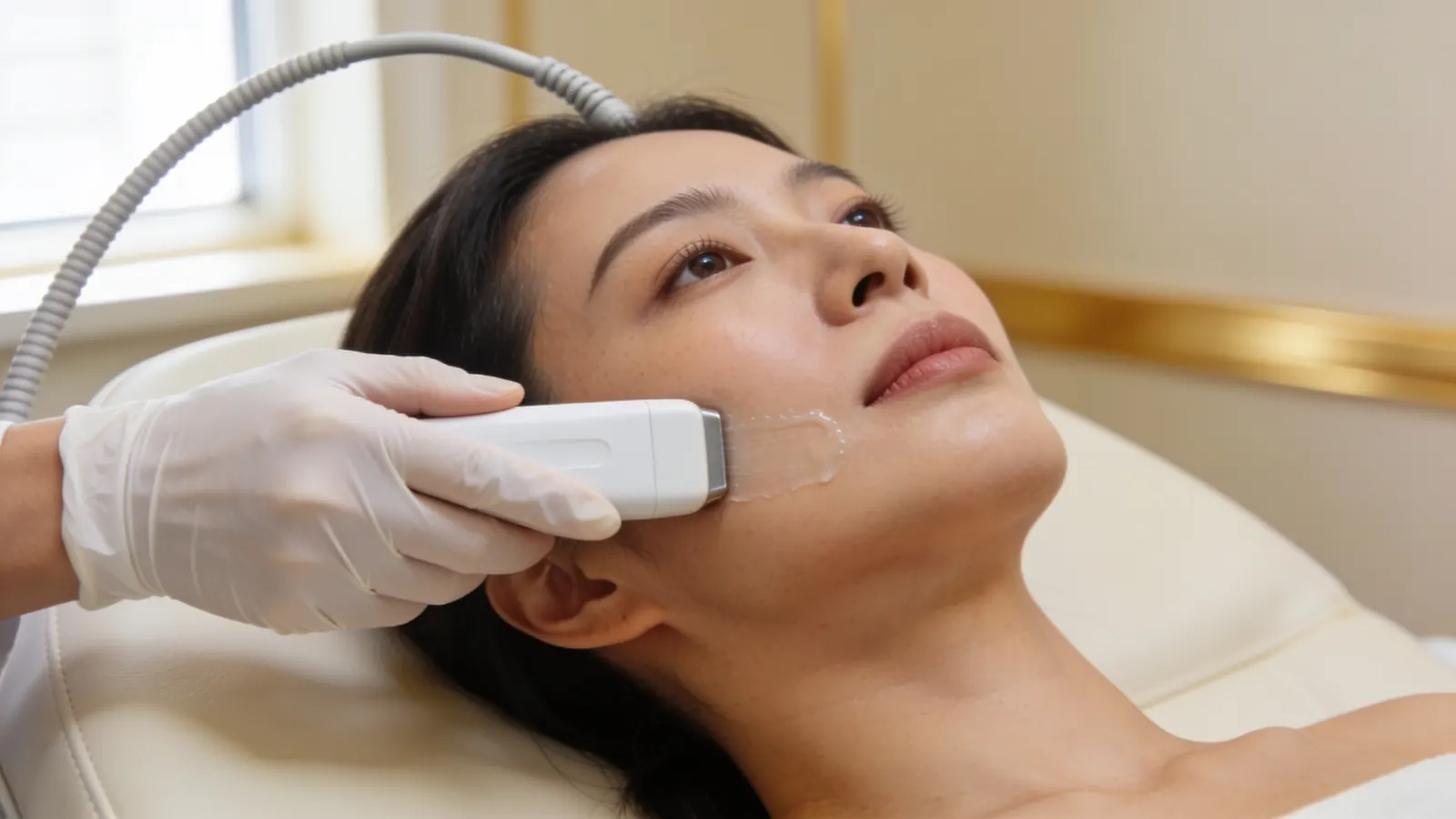
Illustrative image — not a patient.
High-frequency ultrasound shows where filler sits, how deep it is, how far it has spread, what it is likely made of and which vessels run nearby. Before treatment it shows earlier filler and maps blood vessels; when there is a problem, it shows the filler, its displacement and the tissue around it, and it lets hyaluronidase be placed directly into a deposit (Schelke 2018). In the study of 52 complications, scanning helped avoid unnecessary treatment (Gonzalez 2024). Dr Sin Yong performs the scan himself, and the plan follows what it finds: what has moved, what has not, and what is better left alone. Swelling that appears months after filler is covered in filler swelling months later.
Dissolving migrated hyaluronic acid
Hyaluronidase is an enzyme that breaks down hyaluronic acid. It acts on hyaluronic acid only, which is why the scan comes first. Dr Sin Yong uses it in this order:
Ultrasound mapping of the filler that has moved, so the enzyme goes into it and not into filler that is still where it belongs.
Allergy history. Allergy to bee or wasp stings raises the risk of an allergic reaction to hyaluronidase (Murray 2021), and previous hyaluronidase injections are asked about too.
A skin test. Before planned dissolving, Dr Sin Yong always does a skin test: a small amount of hyaluronidase is injected just under the skin to check for a reaction. In an emergency such as a blocked blood vessel, dissolving is never delayed for a test (King 2018).
A small first dose into the mapped deposit, with a fine needle.
A review at about 48 hours, with any further dose matched to what remains.
Different hyaluronic acid fillers respond differently to the enzyme, so dosing is staged rather than given all at once. Dissolving more than the excess can leave a hollow, so the aim is the product that has moved, not every trace of filler. If you want filler again, wait at least two weeks after hyaluronidase, and have it placed only after the migrated product has been addressed. More is in filler dissolving and hyaluronidase allergy and the skin test.
Collagen stimulators, mixed products and silicone: the Sculpting mode
Hyaluronidase does nothing to filler that is not hyaluronic acid: collagen stimulators such as Sculptra, Radiesse and Ellansé, the poly-D,L-lactic acid in Juvelook, silicone and other non-absorbable gels, and fat graft. This is where patients are often told that surgery is the only option.
Swipe sideways to see the whole table.
Product
Examples
Dissolved by hyaluronidase?
How Dr Sin Yong approaches migrated product
More detail
Hyaluronic acid filler
Most under-eye, lip, cheek and nose fillers
Yes
Ultrasound-guided hyaluronidase, after a skin test
For all of these, Dr Sin Yong maps the material with ultrasound and uses the Sculpting mode of Time Freeze Laser LCLR®, without an incision. Where hyaluronic acid sits on top of an older collagen stimulator, the hyaluronic acid part is dissolved first and what remains is treated afterwards. The laser can cause blistering or a change in skin colour, so settings are chosen for your skin, and a red, hot or tender area is treated medically first.
How filler migration is prevented
Know what is already there. Before any top-up, ask whether earlier filler is still present; ultrasound shows it. A review of facial overfilling advises scanning the fat layers before injecting (Lim 2024).
Smaller amounts, in the right layer. Under the eye, expert recommendations favour soft fillers that draw in little water and are approved for that area, and list large volumes and placement superficial to the malar septum as risks (Baranska-Rybak 2026).
Fewer top-ups. Wait until filler has genuinely gone before adding more; hyaluronic acid often lasts well beyond its label (de Castro Costa 2025).
Hands off. Do not massage or squeeze filler yourself unless the doctor who placed it has told you to.
Keep records. Product names, dates and areas make any later problem easier to assess.
Think twice about non-absorbable fillers. They stay for life, and if they move or react, they cannot be dissolved.
When migrated filler needs urgent care
Migration develops gradually and is not an emergency on its own. These are different:
An area that becomes red, hot, painful or swollen, with or without fever, can be infection or an inflammatory reaction and needs prompt medical review. It is treated medically first, before any dissolving or laser.
Difficulty breathing, a tight throat, swelling of the tongue or throat, or swelling that spreads quickly across the face, after any injection, including hyaluronidase, can be a serious allergic reaction: call 995 now. Itch, hives or swelling that spreads beyond the treated area: contact the clinic that injected you the same day.
Urgent: a change in vision or eye pain after filler: call 995 now. Skin that turns pale, dusky or mottled, or pain that is getting worse, needs urgent assessment by the doctor who injected you, or at A&E, now. See the warning signs of a blocked blood vessel after filler.
Tried other treatments and almost given up?
Many patients who come to see Dr Sin Yong about filler migration tell him they have tried almost everything else and had given up hope. Having tried other treatments does not mean nothing more can be done: what is done next depends on what the scan shows.
That history is useful. Knowing what was injected, when, and what has already been tried often explains why a problem has stayed: hyaluronidase acts only on hyaluronic acid and only where it reaches, some fillers are not hyaluronic acid at all, and swelling or fluid can look like filler. Ultrasound helps show which of these applies, and the plan starts from there. For material that cannot be dissolved, Dr Sin Yong uses the Sculpting mode of Time Freeze Laser LCLR® for nodules large and small, without an incision. How each person responds varies.
If you have been told nothing more can be done, it is still worth having the area scanned: ultrasound helps show what is there, and the plan is made from that. Bring any records of past treatments, product names and dates if you have them. More on this is in when filler dissolving has not worked.
How Dr Sin Yong treats migrated filler without surgery
Dr Sin Yong examines the whole face at rest and in expression, because migration in one area changes how the next one looks. He performs the ultrasound scan, any dissolving and every Sculpting mode treatment himself on Orchard Road. He developed the Time Freeze Laser LCLR® protocol himself, on a long-pulsed 755 nm and 1064 nm laser platform, and has been invited to share his clinical expertise in Seoul, Dubai, Bangkok and São Paulo, including as a Global Key Opinion Leader.
He does not add filler to balance out filler that has moved. Volume is considered again only after the migrated product has been addressed, so that new material is not placed on top of old. More on the laser is in the Sculpting mode of Time Freeze Laser LCLR®.
Your next step
Not for emergencies. A change in vision or eye pain after filler: call 995 now. Pale, dusky or mottled skin, or pain that is getting worse: go now to the doctor who injected you, or to A&E. Do not message or book for these signs.
1. MessageWhatsApp +65 8023 7170 with what is bothering you. A reply comes from the clinic, not a bot.
2. AssessmentDr Sin Yong examines you himself on Orchard Road, with ultrasound where earlier filler is involved.
3. A plan in writingWhat he would do, what he would not, the fee factors, and the option of no treatment.
Every treatment is performed by Dr Sin Yong personally. Singapore Medical Council registered · invited to share his clinical expertise internationally for CLASSYS, DEKA, Fotona, Hironic and Ilooda.
Yes. Filler can end up outside the area or tissue layer where it was placed, and it is a recognised finding on scans, not a myth. It shows most at the edges of treated areas: under the eyes, in the cheeks and chin, on the bridge of the nose and above the lips. Around the eyes, hyaluronic acid has been found up to 9 years after injection, having moved into more superficial layers (Chang 2017).
Many of the patients Dr Sin Yong sees have tried other treatments first. A treatment that did not help can still leave options open: hyaluronidase may not have reached the filler, the filler may not be hyaluronic acid, or what looks like filler may be swelling or fluid. Ultrasound helps show which applies, and the plan follows what it finds.
Do not add more filler to balance it, and do not massage it. Get it assessed, and bring any records you have: product names, dates and areas. Dr Sin Yong maps the filler with ultrasound to see what has moved and what it is likely made of. Hyaluronic acid is dissolved where it has moved, after a skin test. Collagen stimulators, mixed products and silicone are treated with the Sculpting mode of Time Freeze Laser LCLR®, without an incision.
The usual signs are a ridge or puffiness below the hollow that is there all day, fullness spreading into the lower eyelid or the top of the cheek, and a blue-grey tint under thin skin, often called the Tyndall effect. They can appear more than a year after injection: delayed complications after tear trough filler appeared on average 16.8 months later in a systematic review (Trinh, Facial Plast Surg 2022). Fluid and eye bags look similar, so the area is scanned before anything is dissolved.
A chin that looks heavier, longer, wider or more pointed than it did, with filler that has spread down towards the jaw or out to the sides. Chin and jaw fillers are not always hyaluronic acid: calcium hydroxylapatite and hybrids are also used there (Moradi 2019), and calcium hydroxylapatite does not dissolve. Ultrasound shows what the material is likely to be before anything is decided. Swelling under the chin with pain or redness is assessed for infection first.
Yes. Cheek filler can drift lower or further forward, or spread towards the lower eyelid, leaving a heavy midface when you smile or a face that looks wider. A review of facial overfilling describes ‘chipmunk’ cheeks and link them to excessive filler and to how it was placed (Lim 2024). Collagen stimulators such as Sculptra can move too. The scan shows what has moved and what it is likely made of, and the plan follows from that.
Yes. Hyaluronic acid lasts far longer than many people expect: 3D imaging in a systematic review found 50–86% still present at 24 months (de Castro Costa 2025), and around the eyes it has been found 9 years after injection. Eyelid swelling has appeared 5.5 years after brow filler and 2 years after temple filler. Non-absorbable fillers stay for life, so they can move or react at any time.
Yes, if it is hyaluronic acid. Hyaluronidase acts on hyaluronic acid only, so the scan comes first. Dr Sin Yong always does a skin test first, places a small first dose into the mapped filler and reviews at about 48 hours. Collagen stimulators, silicone and other non-absorbable fillers do not dissolve; he treats them with the Sculpting mode of Time Freeze Laser LCLR®, without an incision. Where products are mixed, the hyaluronic acid part is dissolved first.
Usually not. Hyaluronic acid is dissolved, and collagen stimulators, mixed products and silicone are treated by Dr Sin Yong with the Sculpting mode of Time Freeze Laser LCLR®, without an incision. Surgery leaves a scar, can leave a dent, risks nerve injury and can leave product behind, and published reviews place excision last (Lemperle and Gauthier-Hazan 2009). In Dr Sin Yong's practice, almost every hard lump is treated without surgery; if yours needs surgery, you are told plainly, and why.
Not reliably. Hyaluronic acid breaks down slowly and often lasts years, so migrated product tends to stay; around the eyes it has been found 9 years after injection (Chang 2017). Collagen stimulators do not dissolve, and the collagen they provoke can last for years, while silicone and other non-absorbable fillers stay for life. A small area of migration that does not bother you can reasonably be watched, and the scan helps decide that.
No. Massage does not dissolve filler or move it back into place. Pressing hard can spread it, bruise the skin and irritate the tissue, and it delays the assessment that shows what is actually there. Fresh filler is sometimes moulded by the doctor who placed it soon after injection, but established migration is mapped and treated: hyaluronic acid with hyaluronidase, other materials with the Sculpting mode of Time Freeze Laser LCLR®.
Not necessarily. Once the migrated product is mapped with ultrasound, hyaluronidase is placed where the filler has moved, not across the whole face, so filler that is still where it belongs can stay. Dissolving more than the excess can leave a hollow, which is why doses are small and reviewed at about 48 hours. Whether to dissolve more, keep what remains or add filler later is decided at review.
Fewer, smaller treatments placed in the right layer, and no top-ups on filler that has not gone. Ask whether earlier filler is still present before more is added; ultrasound shows it. Under the eyes, large volumes and placement superficial to the malar septum are listed as risks for swelling (Baranska-Rybak 2026). Keep a record of product names and dates, avoid massaging filler yourself, and think twice before choosing a non-absorbable filler.
Usually not; it develops gradually. A change in vision or eye pain after filler is an emergency: call 995. Skin that turns pale, dusky or mottled, or pain that is getting worse, needs urgent assessment by the doctor who injected you, or at A&E. An area that becomes red, hot, painful or swollen, with or without fever, can be infection and needs prompt medical review.
References
Delayed Superficial Migration of Retained Hyaluronic Acid Years Following Periocular Injection. Ophthalmic Plastic and Reconstructive Surgery, 2017. source
Ultrasonographic features of non-vascular complications of hyaluronic acid fillers: a retrospective study at a reference center for dermatologic ultrasonography. Clinics in Dermatology, 2024. source
Foreign body granulomas after all injectable dermal fillers: part 2. Treatment options. Plastic and Reconstructive Surgery, 2009. source
Late-Onset Upper Eyelid Edema Following Temporal Hollow Correction With Hyaluronic Acid. Plastic and Reconstructive Surgery Global Open, 2026. source
Delayed Complications following Dermal Filler for Tear Trough Augmentation: A Systematic Review. Facial Plastic Surgery, 2022. source
Malar Edema after Hyaluronic Acid Dermal Fillers: Expert Recommendations on Etiology, Prevention, and Management. Dermatology and Therapy, 2026. source
Delayed migration of soft tissue fillers in the periocular area masquerading as eyelid and orbital pathology. BMJ Case Reports, 2021. source
Exploring facial overfilled syndrome from the perspective of anatomy and the mismatched delivery of fillers. Journal of Cosmetic Dermatology, 2024. source
Nonsurgical Chin and Jawline Augmentation Using Calcium Hydroxylapatite and Hyaluronic Acid Fillers. Facial Plastic Surgery, 2019. source
Persistent HA Fillers and Nasal Broadening: Role of Ultrasound in Managing "Avatar Nose". Journal of Craniofacial Surgery, 2025. source
Ultrasound Evaluation of Lip Anatomy and Filler Placement: A Cross-Sectional Study of Injection Accuracy, Migration, and Demographic Variation. Plastic and Reconstructive Surgery, 2026. source
Clinical Durability of Hyaluronic Acid-Based Dermal Fillers for Facial Application: A Systematic Review. Aesthetic Plastic Surgery, 2025. source
Ultrasound to improve the safety of hyaluronic acid filler treatments. Journal of Cosmetic Dermatology, 2018. source
The Use of Hyaluronidase in Aesthetic Practice (v2.4). Journal of Clinical and Aesthetic Dermatology, 2018. source
Guideline for the Safe Use of Hyaluronidase in Aesthetic Medicine, Including Modified High-dose Protocol. Journal of Clinical and Aesthetic Dermatology, 2021. source
About this page: written and medically reviewed by Dr Sin Yong, MBBS (NUS), MRCS (Edinburgh) · Last reviewed 26 October 2026 · Illustrative images only, not patients · Editorial policy
Not for emergencies. A change in vision or eye pain after filler: call 995 now. Pale, dusky or mottled skin, or pain that is getting worse: go now to the doctor who injected you, or to A&E. Do not message or book for these signs.