Published 26 October 2026 · Reviewed by Dr Sin Yong
Puffy bags, a blue tint, lumps, or filler that has crept into the eyelid: under-eye filler can go wrong months or years after the injection, and many people are then offered eyelid surgery. That operation leaves a scar, can pull the lower lid out of position and is hard to revise. Dr Sin Yong maps the filler with ultrasound and treats it without an incision. Get assessed first.
Short answerGet assessed before you agree to eyelid surgery. Most under-eye filler problems come from hyaluronic acid sitting too close to thin eyelid skin, too much filler, or filler holding fluid where drainage is poor, and they can appear more than a year later (Hirsch 2006; Trinh, Facial Plast Surg 2022; Baranska-Rybak 2026). Ultrasound maps the filler and shows what it is likely made of. Hyaluronic acid is dissolved in small doses after a skin test. Collagen stimulators, fat and silicone, Dr Sin Yong treats with the Sculpting mode of Time Freeze Laser LCLR®, without an incision.
Under-eye filler gone wrong, and offered surgery? Read this first
Patients come to Dr Sin Yong after being told that under-eye filler has to be cut out, that eyelid surgery is the answer, or that nothing more can be done. Before you agree to an operation, know what it means:
A scar. Every cut through the skin of the face heals with a scar.
A dent. Cutting out a lump takes tissue with it, and the area can heal hollow or uneven.
Nerve injury. Nerves that give the face feeling and movement run close to where filler sits. An injured nerve can leave numbness, or weakness in a smile, a lip or a brow.
Product left behind. Filler spread through tissue is hard to remove completely.
No way back. Tissue that has been cut out cannot be put back.
On the lower eyelid there is more. Scar tissue can pull the lid down or turn it outwards, and a second operation on a scarred eyelid is harder than the first. The facts are set out in lower-eyelid surgery for filler below.
In Dr Sin Yong's practice, almost every hard lump is treated without surgery. If yours is one of the few that needs surgery, you are told plainly, and why. He maps the filler with ultrasound, dissolves hyaluronic acid, and treats collagen stimulators, fat and silicone with the Sculpting mode of Time Freeze Laser LCLR®, without an incision.
60-second under-eye filler check
Not for emergencies. A change in vision or eye pain after filler: call 995 now. Difficulty breathing, a tight throat, swelling of the tongue or throat, or swelling that spreads quickly across the face: call 995 now. Pale, dusky or mottled skin, or pain that is getting worse: go now to the doctor who injected you, or to A&E. A red, hot or draining lump, or a fever: a doctor the same day; if no doctor can see you today, A&E. Do not use this check or WhatsApp for these signs.
Answer three questions and send them straight to the clinic on WhatsApp. Dr Sin Yong will let you know whether an ultrasound assessment is worthwhile. No obligation.
1 · When was it injected?
2 · What bothers you most?
3 · Have you been offered surgery for it?
Your answers open in your own WhatsApp app; nothing is stored on this page.
What goes wrong with under-eye filler
Most problems after under-eye filler fall into a few patterns, and many people have more than one.
Swipe sideways to see the whole table.
What you notice
What it usually is
What Dr Sin Yong does
Puffy bags, often worse in the morning
Malar oedema: fluid held in a poorly draining compartment, often with filler holding water
Scans to tell filler from fluid; dissolves the filler that is there
A blue or grey tint under thin skin
Hyaluronic acid sitting too close to the surface (the Tyndall effect)
Maps the superficial gel; dissolves it in small doses
Lumps, bumps, beads or a ridge
Filler placed too superficially or too much in one spot; sometimes a delayed nodule
Maps each lump; dissolves hyaluronic acid; treats the rest with the Sculpting mode
Fullness creeping into the lower eyelid or onto the cheek
Migration: filler that has moved, sometimes years later
Maps how far it has spread; dissolves the migrated part
Too full, a shelf, or a bulge when smiling
Overcorrection: too much filler, or layers added over the years
Dissolves the excess in stages
A new red, hot or tender lump months later
A delayed inflammatory reaction or an infection
Treats it medically first, before any dissolving or laser
A hard lump after Juvelook, Sculptra, Ellansé, Radiesse, fat or silicone
Material that hyaluronidase cannot dissolve
Maps it; treats it with the Sculpting mode of Time Freeze Laser LCLR®, without an incision
Puffiness is the commonest delayed problem after tear trough filler (Trinh, Facial Plast Surg 2022). Late swelling around the eyes after hyaluronic acid filler, once rare, is now described as common: it can start weeks to years after the injection, spread across the eyelids and upper cheek, and flare with triggers such as an infection (Eshraghi 2024). More on this pattern is in swelling months after filler.
The blue tint comes from gel sitting too superficially: hyaluronic acid placed too close to the surface can show through the skin as a discoloration, known as the Tyndall effect (Hirsch 2006). It does not fade like a bruise, because the gel is still there. A dedicated guide covers the blue tint after under-eye filler.
“Dissolving filler is not an undo button.”
Dr Sin YongOn what dissolving can and cannot do
How often under-eye filler goes wrong, and how late
Most under-eye filler problems are mild, but they are not rare, and the figures depend on how closely and how long people are followed.
Across published studies. A meta-analysis of 31 reports covering 2,556 people found swelling in 19.2%, bruising in 18.4%, a lump or uneven contour in 5.3% and a blue tint in 0.9% (Liu 2023).
With at least five years' follow-up. In 147 people, masked grading of photographs found malar oedema in 11%, a blue-grey tint in 31.3% and an uneven contour in 30.5%; about nine in ten of these problems were mild and needed no treatment (Mustak 2018).
Delayed problems. A systematic review of 52 people with delayed complications after tear trough filler found swelling in 42% and lumps in 25%, with migration and discoloration also reported, on average 16.8 months after the injection (Trinh, Facial Plast Surg 2022).
At an ultrasound reference centre. Among 52 non-vascular problems after hyaluronic acid filler, the area under the eye was the commonest site (23%) and the blue tint the commonest problem (25%); migration and overcorrection were also seen (Gonzalez 2024).
A problem that appears a year or more after the injection is a recognised pattern, and it is assessed in the same way.
Why the under-eye is so unforgiving
The infraorbital hollow has been described as the area of the face most prone to filler problems, and malar oedema as a significant, long-lasting and frequently reported problem there (Funt 2011). Three things make it unforgiving:
Thin skin. Eyelid skin is among the thinnest on the body, with little fat beneath it, so a small bead of filler or a superficial layer of gel shows.
Poor drainage. Between two ligaments of the upper cheek lies a compartment whose lymphatic drainage is poor. Expert recommendations list a high volume of filler and placement superficial to the malar septum among the technique risks for malar oedema, and older age, earlier surgery around the eyes, allergies, infection and some general medical conditions among the personal ones (Baranska-Rybak 2026).
Little room for error. A volume that would pass unnoticed in the cheek can show under the eye as a ridge, a bead or a bag.
Filler may also press on the small veins that drain the area. In 26 eyes with swelling after filler, ultrasound placed the filler within the SMAS layer in 23, and the authors propose that filler pressing on veins and lymphatics may cause the swelling (Schelke, J Cosmet Dermatol 2023).
Under-eye filler migration: years later, and into the eyelid
Filler does not always stay where it was placed. Under the eye, migrated filler shows as fullness creeping up into the lower eyelid, a puffy band along the lashes, or swelling spreading onto the cheek.
Hyaluronic acid can last far longer than people are often told. In patients whose swelling around the eyes began years after the injection, the hyaluronic acid had persisted for up to nine years and had spread into more superficial layers without inflammation, and the swelling could be mistaken for serious disease (Chang 2017). Migration is among the delayed problems reported after tear trough filler (Trinh, Facial Plast Surg 2022), and it was seen at an ultrasound reference centre alongside overcorrection (Gonzalez 2024).
Because migrated filler can look like eye bags, an allergy or a problem with the eyelid itself, the scan matters: it shows whether the fullness is filler, how far it has spread and how deep it sits. Migrated hyaluronic acid is dissolved where it lies. Migration elsewhere in the face is covered in filler migration.
Ultrasound first: what the scan shows under the eye
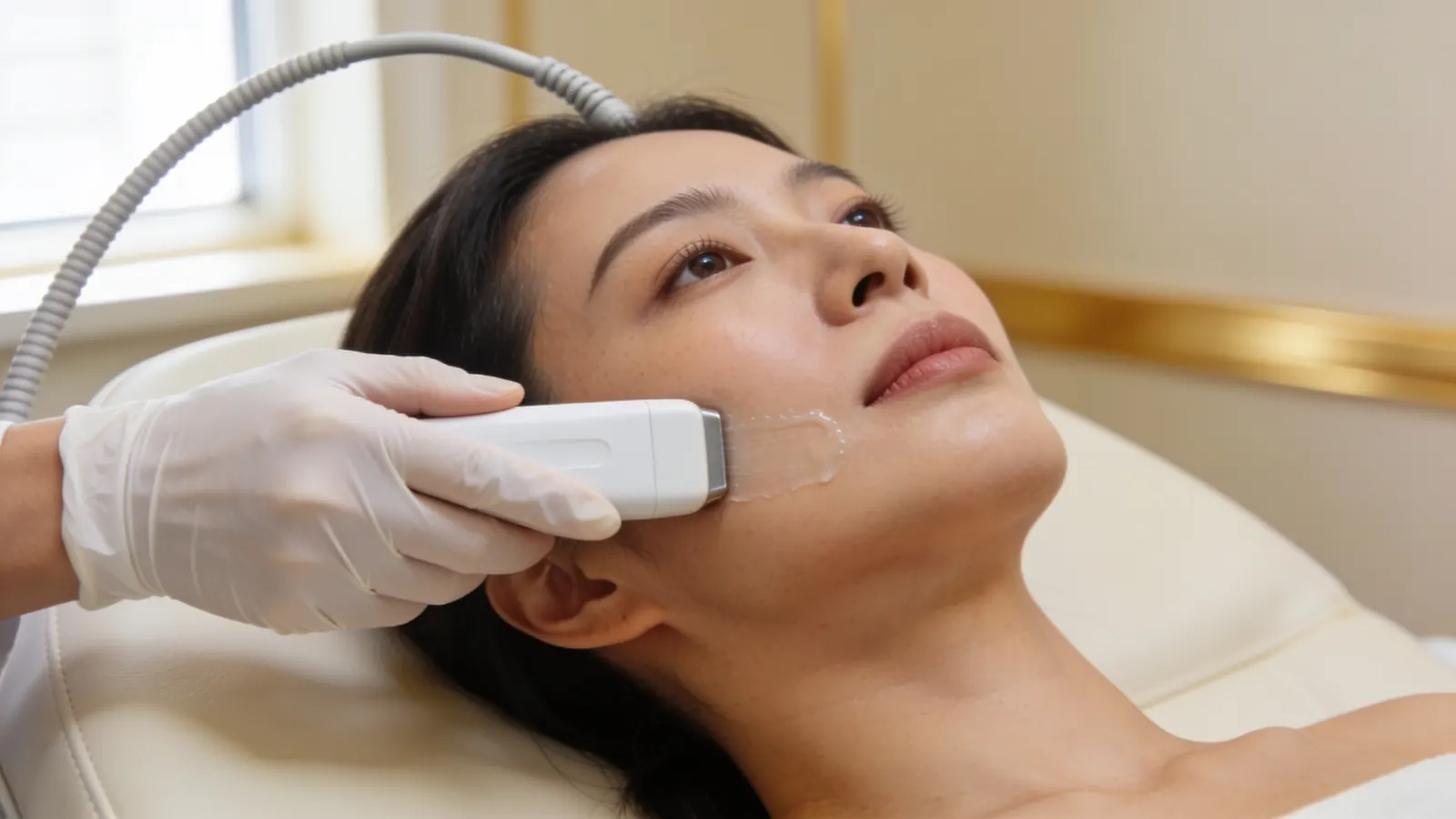
High-frequency ultrasound shows where under-eye filler sits, how deep, whether there is one pocket or several, whether it has spread into the eyelid, and which vessels run beside it. It also shows what the material is likely made of, because hyaluronic acid, collagen stimulators, fat and silicone look different on the scan, and it shows when a bulge is fluid or the eye's own fat rather than filler.
Illustrative image — not a patient.
That changes the plan. In eyes with swelling after filler, removing the filler under duplex ultrasound guidance was followed by restored venous flow and less swelling (Schelke, J Cosmet Dermatol 2023). At an ultrasound reference centre, ultrasound with Doppler helped avoid unnecessary treatment (Gonzalez 2024), and a review of late swelling around the eyes describes ultrasound as a guide to treatment (Eshraghi 2024).
Dr Sin Yong performs the scan himself, and the plan follows what it finds. Sometimes the scan shows that nothing needs dissolving at all.
Dissolving under-eye hyaluronic acid: skin test, small doses, review
Most under-eye filler is hyaluronic acid, which can be dissolved with hyaluronidase, an enzyme that acts on hyaluronic acid only. Under the eye, Dr Sin Yong dissolves in steps:
Allergy history. Reactions to bee or wasp stings, which raise the risk of allergy to the enzyme (Murray 2021), and any earlier hyaluronidase injections are asked about.
Skin test. Before planned dissolving, Dr Sin Yong always does a skin test: a small amount of hyaluronidase is injected just under the skin to check for a reaction. It is never allowed to delay treatment in an emergency such as a blocked blood vessel.
A small first dose goes into the mapped filler, aimed at the excess rather than the whole lower eyelid, and the dose is titrated to the filler and the area (King 2018).
Review at about 48 hours, once the enzyme has acted, with any further dose based on what remains.
Refilling, if wanted at all, waits at least two weeks.
Dissolving more than the excess can leave a hollow, and whatever the filler was hiding, such as a hollow, a dark circle or an eye bag, can show again once it has gone. That is why the dose is small and staged. Step-by-step detail is in under-eye filler dissolving, and the skin test in hyaluronidase allergy and the skin test.
Collagen stimulators, fat or silicone under the eyes
Hyaluronidase has no effect on poly-D,L-lactic acid (Juvelook), poly-L-lactic acid (Sculptra), polycaprolactone (Ellansé), calcium hydroxylapatite (Radiesse), fat graft, silicone or other non-absorbable fillers. Under thin eyelid skin these lumps show easily, and patients with them are often told they must be cut out.
Dr Sin Yong maps them with ultrasound and treats them with the Sculpting mode of Time Freeze Laser LCLR®, for nodules large and small, without an incision. Around the eyes he keeps the laser settings conservative and uses eye protection. Where hyaluronic acid sits with other material, as it often does after several treatments, the hyaluronic acid is dissolved first and the rest is treated with the Sculpting mode.
Surgery to remove filler or fat from under the eye is an operation on the lower eyelid. It is done through a cut just below the lashes, which heals as a fine scar, or through the inside of the eyelid. Either way, filler that has spread through the eyelid tissue is hard to separate from it, and the eyelid has to heal in the right position.
Swipe sideways to see the whole table.
Approach
What it involves
Incision
What to weigh up
Lower-eyelid surgery
Cutting out filler, fat or a granuloma through the skin below the lashes or the inside of the lid
Yes
A scar; a dent where tissue is removed; the lid pulled down or turned outwards; product left behind; harder to revise; cannot be undone
Hyaluronidase
Enzyme injected into mapped hyaluronic acid
None; fine needle
Acts on hyaluronic acid only; skin test first; too much can leave a hollow
Sculpting mode of Time Freeze Laser LCLR®
Laser directed at mapped material that cannot be dissolved
None
Can cause blistering or a change in skin colour, so settings are chosen for your skin and kept conservative around the eyes
Medical treatment
Treatment for inflammation or infection
None
Comes first for a red, hot or tender lump
Waiting
Review over time
None
Reasonable for mild changes that do not bother you
The published cases show why revision is hard. After fat was placed in the tear troughs, the surgery to repair the lower-lid deformity that followed was described as very difficult and led to a temporary outward-turned lower eyelid (ectropion) along the way, before the patient was satisfied (Spector 2008). When fat nodules in the tear trough were removed through the inside of the eyelid, 29 of 33 patients were satisfied, but a localised dent was reported in 18.18% and 3 of 66 eyelids needed a second procedure (Li 2024). In a published case of granulomas in both lower eyelids after poly-D,L-lactic acid, saline, radiofrequency and medical treatment injected into the lumps did not settle them, the injections thinned the skin, and two operations were needed (Garlaschi 2026).
Where surgery is wanted for the eyelid itself, such as eye bags, a review of late swelling around the eyes places lower-eyelid surgery after the hyaluronic acid has been dissolved (Eshraghi 2024). Get assessed before you agree to an operation: it can still be done later if it is ever needed, but it cannot be undone.
When to act at once
Most under-eye filler problems are not emergencies, but some are. A lump or swelling that is red, hot, painful or growing, especially with a fever, can be inflammation or infection, and it is treated medically first, before any dissolving or laser. Late swelling can flare with triggers such as an infection (Eshraghi 2024). Do not press hard on an under-eye lump or try to break it up yourself.
Urgent: a change in vision or eye pain after filler: call 995 now. Skin that turns pale, dusky or mottled, or pain that is getting worse, needs urgent assessment by the doctor who injected you, or at A&E, now. See the warning signs of a blocked blood vessel after filler.
Tried other treatments and almost given up?
Many patients who come to see Dr Sin Yong about under-eye filler problems tell him they have tried almost everything else and had given up hope. Having tried other treatments does not mean nothing more can be done: what is done next depends on what the scan shows.
That history is useful. Knowing what was injected, when, and what has already been tried often explains why a problem has stayed: hyaluronidase acts only on hyaluronic acid and only where it reaches, some fillers are not hyaluronic acid at all, and swelling or fluid can look like filler. Ultrasound helps show which of these applies, and the plan starts from there. For material that cannot be dissolved, Dr Sin Yong uses the Sculpting mode of Time Freeze Laser LCLR® for nodules large and small, without an incision. How each person responds varies.
If you have been told nothing more can be done, it is still worth having the area scanned: ultrasound helps show what is there, and the plan is made from that. Bring any records of past treatments, product names and dates if you have them. More on this is in when filler dissolving has not worked.
How Dr Sin Yong treats under-eye filler gone wrong
Dr Sin Yong developed the Time Freeze Laser LCLR® protocol himself and performs every scan, every dissolving injection and every Sculpting mode treatment himself on Orchard Road. He has been invited to share his clinical expertise in Seoul, Dubai, Bangkok and São Paulo, including as a Global Key Opinion Leader.
He does not add more filler to disguise a puffy or lumpy under-eye. The excess is dealt with first, the area is reviewed once it has settled, and only then is anything else discussed, from treating the skin to leaving it alone. You do not need to have been treated here, and having no records of what was injected is fine. More on the laser is in the Sculpting mode of Time Freeze Laser LCLR®.
Your next step
Not for emergencies. A change in vision or eye pain after filler: call 995 now. Pale, dusky or mottled skin, or pain that is getting worse: go now to the doctor who injected you, or to A&E. Do not message or book for these signs.
1. MessageWhatsApp +65 8023 7170 with what is bothering you. A reply comes from the clinic, not a bot.
2. AssessmentDr Sin Yong examines you himself on Orchard Road, with ultrasound where earlier filler is involved.
3. A plan in writingWhat he would do, what he would not, the fee factors, and the option of no treatment.
Every treatment is performed by Dr Sin Yong personally. Singapore Medical Council registered · invited to share his clinical expertise internationally for CLASSYS, DEKA, Fotona, Hironic and Ilooda.
Usually not. Hyaluronic acid, the usual under-eye filler, is dissolved with hyaluronidase. Juvelook, Sculptra, Ellansé, Radiesse, fat and silicone cannot be dissolved, and Dr Sin Yong treats them with the Sculpting mode of Time Freeze Laser LCLR®, without an incision. In his practice, almost every hard lump is treated without surgery; if yours is one of the few that needs it, you are told plainly, and why. Lower-eyelid surgery leaves a scar and can pull the lid out of position, so get assessed first.
Many of the patients Dr Sin Yong sees have tried other treatments first. A treatment that did not help can still leave options open: hyaluronidase may not have reached the filler, the filler may not be hyaluronic acid, or what looks like filler may be swelling or fluid. Ultrasound helps show which applies, and the plan follows what it finds.
Yes, if it is hyaluronic acid, which most tear trough filler is. The filler is mapped with ultrasound, Dr Sin Yong does a skin test, and a small first dose of hyaluronidase goes into the excess, with a review at about 48 hours before any more. Dissolving more than the excess can leave a hollow, so it is done in steps. Refilling, if wanted, waits at least two weeks.
Usually malar oedema: fluid held in a compartment of the upper cheek that drains poorly, often with hyaluronic acid filler holding water there. A high volume of filler and placement superficial to the malar septum raise the risk (Baranska-Rybak 2026), and filler pressing on the small veins may add to it (Schelke, J Cosmet Dermatol 2023). It can start weeks to years after the injection. Ultrasound shows whether filler is the cause; if it is, the filler is dissolved.
It is the name given to a blue or grey tint under the eye after filler, from hyaluronic acid sitting too close to the thin eyelid skin (Hirsch 2006). It does not fade like a bruise, because the gel is still there. With at least five years' follow-up, a blue-grey tint was graded in 31.3% of people after filler around the eyes (Mustak 2018). Ultrasound shows how superficial the gel is, and Dr Sin Yong dissolves it in small doses.
Yes. Filler placed under the eye can spread up into the lower eyelid or out onto the cheek, sometimes years later. Hyaluronic acid has been found around the eyes up to nine years after injection, having spread into more superficial layers (Chang 2017), and migration is among the delayed problems reported after tear trough filler (Trinh, Facial Plast Surg 2022). Ultrasound shows how far it has spread, and migrated hyaluronic acid is dissolved where it lies.
Start with a scan, not more filler and not an operation. Ultrasound shows what is under the eye: hyaluronic acid, another filler, fat, fluid or the eye's own fat pad. Hyaluronic acid is dissolved in small, reviewed doses. What cannot be dissolved, Dr Sin Yong treats with the Sculpting mode of Time Freeze Laser LCLR®, without an incision. Adding filler to hide filler is not part of the plan, and the plan is set out in writing before anything is done.
Late problems are well recognised. In a systematic review, delayed complications after tear trough filler appeared on average 16.8 months after the injection, with swelling in 42% and lumps in 25% (Trinh, Facial Plast Surg 2022). Hyaluronic acid can persist for years and spread into the eyelid (Chang 2017), and swelling can flare with triggers such as an infection (Eshraghi 2024). A problem that appears late is assessed in the same way: history, examination and ultrasound.
It can, if more is dissolved than was in excess, or if the filler was hiding a hollow that is still there. That is why Dr Sin Yong maps the filler first, uses a small first dose aimed at the excess, and reviews at about 48 hours before giving more. If a hollow shows once things settle, the options are discussed then, including leaving it alone. Any new filler waits at least two weeks.
Then hyaluronidase will not dissolve it, apart from the hyaluronic acid carrier in Juvelook. These materials are mapped with ultrasound, and Dr Sin Yong treats them with the Sculpting mode of Time Freeze Laser LCLR®, without an incision, using conservative settings and eye protection around the eyes. Surgery for these lumps in the lower eyelid can mean more than one operation (Garlaschi 2026). A red, hot or tender lump is treated medically first.
The operation is done through a cut below the lashes, which leaves a scar, or through the inside of the lid. The risks include a dent where tissue is removed, the lid being pulled down or turned outwards, filler left behind and the need for a second operation. In one series of fat nodules removed from the tear trough, a localised dent was reported in 18.18% and 3 of 66 eyelids needed a second procedure (Li 2024). Surgery cannot be undone.
Usually not, but some signs are. A change in vision or eye pain after filler is an emergency: call 995 or go to the nearest emergency department. Skin that turns pale, dusky or mottled, or pain that is getting worse, needs urgent assessment by the doctor who injected you, or at A&E. Swelling that is red, hot and painful, especially with a fever, needs prompt medical review.
Dr Sin Yong performs the ultrasound scan, the dissolving and every Sculpting mode treatment himself, on Orchard Road. It is not delegated to another doctor, a nurse or a therapist, so the same doctor follows the area from the first scan to the last review.
References
Filling the periorbital hollows with hyaluronic acid gel: Long-term review of outcomes and complications. Journal of Cosmetic Dermatology, 2018. source
The Efficacy and Safety of Hyaluronic Acid Injection in Tear Trough Deformity: A Systematic Review and Meta-analysis. Aesthetic Plastic Surgery, 2023. source
Delayed Complications following Dermal Filler for Tear Trough Augmentation: A Systematic Review. Facial Plastic Surgery, 2022. source
Ultrasonographic features of non-vascular complications of hyaluronic acid fillers: a retrospective study at a reference center for dermatologic ultrasonography. Clinics in Dermatology, 2024. source
Avoiding malar edema during midface/cheek augmentation with dermal fillers. Journal of Clinical and Aesthetic Dermatology, 2011. source
Malar Edema after Hyaluronic Acid Dermal Fillers: Expert Recommendations on Etiology, Prevention, and Management. Dermatology and Therapy, 2026. source
Periorbital venous stasis may be involved with filler induced malar edema: a duplex ultrasound-imaging-based case series. Journal of Cosmetic Dermatology, 2023. source
Late-onset periorbital edema in patients with a history of facial hyaluronic acid injection: A review on diagnosis and management. Journal of Plastic, Reconstructive & Aesthetic Surgery, 2024. source
Delayed Superficial Migration of Retained Hyaluronic Acid Years Following Periocular Injection. Ophthalmic Plastic and Reconstructive Surgery, 2017. source
Management of injected hyaluronic acid induced Tyndall effects. Lasers in Surgery and Medicine, 2006. source
The Use of Hyaluronidase in Aesthetic Practice (v2.4). Journal of Clinical and Aesthetic Dermatology, 2018. source
Guideline for the Safe Use of Hyaluronidase in Aesthetic Medicine, Including Modified High-dose Protocol. Journal of Clinical and Aesthetic Dermatology, 2021. source
Lower lid deformity secondary to autogenous fat transfer: a cautionary tale. Aesthetic Plastic Surgery, 2008. source
Surgical Removal of Fat Nodules Formed in the Tear Trough After Autologous Fat Grafting. Aesthetic Plastic Surgery, 2024. source
Complex Surgical Management of PDLLA-Induced Lower Eyelid Granulomas. Journal of Craniofacial Surgery, 2026. source
About this page: written and medically reviewed by Dr Sin Yong, MBBS (NUS), MRCS (Edinburgh) · Last reviewed 26 October 2026 · Illustrative images only, not patients · Editorial policy
Not for emergencies. A change in vision or eye pain after filler: call 995 now. Pale, dusky or mottled skin, or pain that is getting worse: go now to the doctor who injected you, or to A&E. Do not message or book for these signs.