What does back and body acne look like?
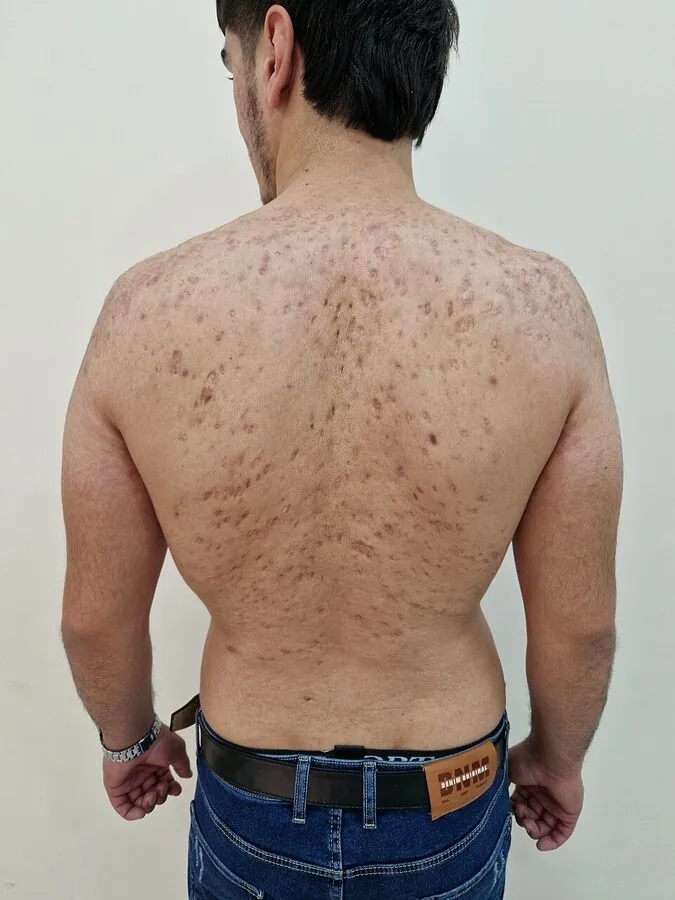
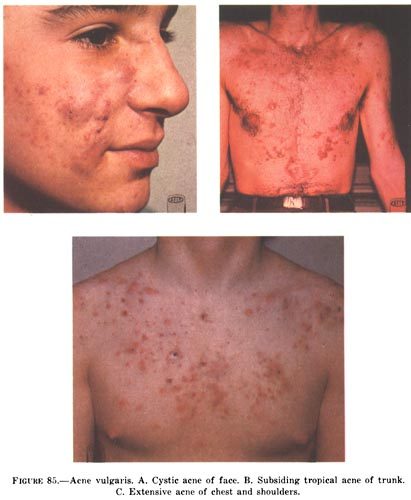
Why does the back break out — and scar harder?
The truncal reviews describe a follicular landscape different from the face: larger, denser sebaceous units set in thicker skin, occluded daily by clothing and — in a gym-going, tropical population — hours of sweat-soaked compression wear [1]. The same reviews flag the asymmetric stakes: the chest, shoulders and upper back are the body's most keloid-prone territory, and truncal post-inflammatory pigment outlasts its facial cousin. A backne cycle tolerated for years often bills its cost in permanent raised or pigmented marks that the acne itself never warned about.
Acne, fungal folliculitis, or both?
The trunk hosts the classic impostor. True acne is polymorphic — comedones, papules, pustules and deeper lesions of mixed ages. Malassezia folliculitis is monomorphic — crops of near-identical, often itchy bumps across the upper back, chest and shoulders — and it laughs at benzoyl peroxide while worsening under oral antibiotics. The two frequently coexist in the same patient, which is why a trunk that has defeated years of acne products deserves a diagnosis before another product: half the failure stories are simply the wrong organism.
What actually works for back acne?
The consensus recommendations for truncal acne support the same evidence architecture as facial disease, adapted for acreage [2]: wash-format topicals (benzoyl peroxide washes suit large surfaces), topical retinoids in trunk-practical formats, and earlier escalation to systemic therapy — antibiotic courses in defined roles, hormonal therapy where the pattern indicates, and isotretinoin for severe or scarring disease — because reach and adherence limit what creams achieve across a back. In-clinic, the back acne programme adds laser- and light-based control of active lesions, with the acne programme covering the medical arm; leftover marks are triaged between PIH and true scarring. Habits earn their keep here: showering out of sweaty kit promptly, breathable fabrics, and not scrubbing.
What doesn't work for back acne?
Scrubbing brushes and loofahs on inflamed follicles — mechanical insult on a field already inflamed. Harsh soaps 'to dry it out' — barrier damage without follicular effect. Antibiotics alone, indefinitely — resistance and the fungal-overgrowth trap. Sunbathing the back clear — a temporary blur bought with pigment risk on PIH-prone skin. And ignoring it because nobody sees it — the trunk is exactly where quiet acne leaves loud, keloid-shaped receipts.
“Back acne is the quiet half of the disease with the loudest scars — the chest and shoulders forgive breakouts worst of anywhere on the body.”
— Dr Sin Yong
Dr Sin Yong’s Viewpoint
Back acne is the quiet half of the disease with the loudest scars — the chest and shoulders keloid more readily than anywhere else. Half the failed bacne stories I hear were treating the wrong organism entirely; fungal folliculitis shrugs at every acne wash. Diagnose the trunk before buying a fourth product for it.
Prefer Not to Use WhatsApp?
Use the short enquiry form instead →
Leave your name, mobile number and email and the clinic will contact you directly. No obligation.
Prefer a preliminary view first? You can also WhatsApp a photo of the area for Dr Sin Yong to review before you decide on a visit.