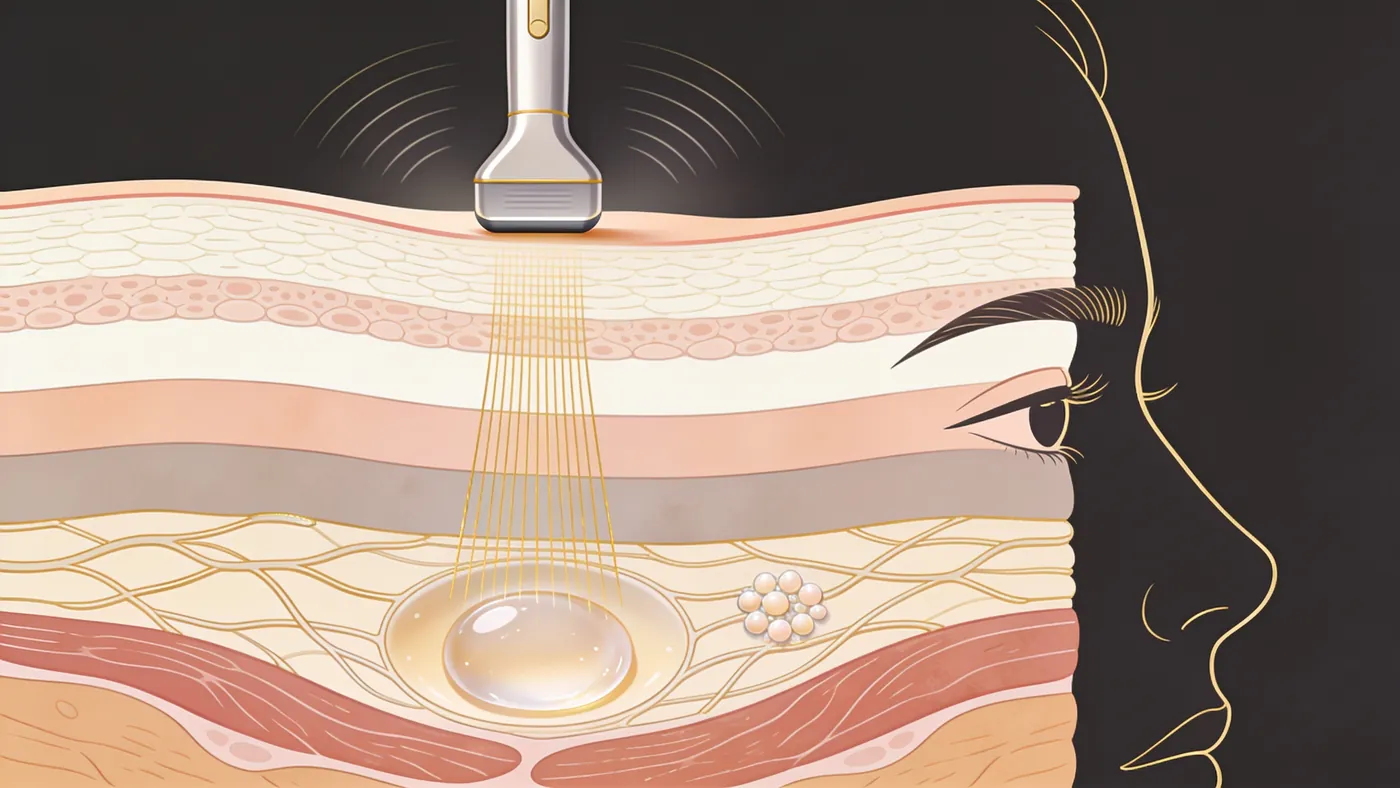
What is Ultraformer MPT and how does it work?
Microfocused ultrasound works like sunlight through a magnifying glass: acoustic energy passes harmlessly through the surface and converges to a point at a chosen depth, where it creates a tiny zone of thermal coagulation. Each point triggers contraction and months of collagen remodelling; thousands of points, placed in lines at the dermis and the SMAS layer, produce the lifting effect documented in the systematic-review literature on MFU [1,2]. MPT — Micro-Pulsed Technology — changes the delivery: instead of firing discrete shots point by point, the transducer glides while emitting rapid micro-pulses, laying energy in a smoother, denser, faster line. In practice that means shorter treatments, more uniform energy distribution, and a comfort profile that patients who remember older shot-based HIFU notice immediately.
How does MPT differ from Ultraformer III and other HIFU?
Same physics, different engineering generation. The Ultraformer III — long a workhorse in Asian practices — delivers classic spot-by-spot MFU. MPT's continuous micro-pulsed glide changes treatment dynamics: line placement is faster and smoother, and energy per unit area is more evenly distributed, which matters at the comfort-precision frontier. Against the broader HIFU field, the Pan-Asian expert consensus emphasises what actually determines results regardless of badge: correct depth selection for the patient's anatomy, adequate line counts, and operator skill in mapping facial danger zones [2]. The device is the instrument; the assessment and the operator are the treatment.

What actually works — where MPT fits in Dr Sin Yong's protocols
As a CLASSYS Global KOL, Dr Sin Yong uses the Ultraformer platform inside sequenced protocols rather than as a standalone menu item: it is kept separate from the VF Lift (Vertical Facelift), which runs on Volnewmer monopolar radiofrequency and does not use focused ultrasound, and appears across the HIFU programme, sagging face pathway and neck protocols. Candidacy is the honest gate: MFU suits mild-to-moderate laxity — early jowls, softening jawlines, neck laxity — while advanced, heavily mobile laxity is surgical territory that no ultrasound reaches, and the assessment says so plainly [1].
Ultraformer Singapore — which generation are you actually being offered?
Patients searching for Ultraformer Singapore are rarely comparing like with like. Three generations circulate in this market: Ultraformer III, Ultraformer MPT, and a number of unbranded HIFU devices sold under other names. They share a mechanism — focused ultrasound delivered to a fixed depth — but not a cartridge range, not a pulse-delivery method, and not a service history.
The question worth asking a clinic is not whether they have “Ultraformer”, but which generation, which cartridges, and who is holding the handpiece. A platform is only as good as the depth selected for the tissue in front of it.
What doesn't work — and what to ask any clinic
HIFU 'facial packages' priced by the shot with no physician mapping — line placement decides both result and safety. Treating advanced laxity with more passes — beyond the indication, more energy is not more lift. Expecting filler-style instant change — MFU's collagen response builds over roughly 8–12 weeks; the day-one change is modest by design. And any clinic that cannot tell you which depths they are treating and why — depth selection is the treatment, and the person guiding it should be able to explain your anatomy back to you.
“The device is the instrument, not the treatment — two clinics with identical Ultraformers can deliver entirely different results, because the lift is in the mapping.”
— Dr Sin Yong
Prefer Not to Use WhatsApp?
Use the short enquiry form instead →
Leave your name, mobile number and email and the clinic will contact you directly. No obligation.
Prefer a preliminary view first? You can also WhatsApp a photo of the area for Dr Sin Yong to review before you decide on a visit.