Where the fold is cast by descended tissue, RVR ProLift restores support along vertical vectors.
Published 28 October 2026 · Reviewed by Dr Sin Yong
Time Freeze Laser LCLR®
I want to see the Time Freeze before and after
Singapore's advertising rules do not allow before-and-after photos on a clinic website, so they are not shown here. Tap the button and a WhatsApp message to the clinic opens with the request already written; send it and the team will reply with the Time Freeze Laser LCLR® before-and-after PDF.
WhatsApp +65 8023 7170 · replies within clinic hours · results vary and are assessed in person
Marionette lines usually mark where a descended jowl folds against the chin. So Dr Sin Yong starts with lifting, most often the VF Lift – Vertical Facelift and Time Freeze Laser LCLR®, rather than filling the sides of the line. A muscle pulling the mouth corners down can be relaxed. Filler is not the default and is kept for a dip that lifting cannot reach. Where the line comes from a jowl, see jowl treatment Singapore.
Short answerMarionette lines, the creases running down from the corners of the mouth towards the jaw, usually mark where a descended jowl folds against the chin, so Dr Sin Yong treats them with lifting first, most often the VF Lift – Vertical Facelift and Time Freeze Laser LCLR®, rather than filling the sides of the line. Where the mouth corners are pulled down, the muscle can be relaxed. Filler is not the default, because it adds weight where the jowl is gathering. He examines the face at rest and in a smile before advising.
Marionette lines form where the jowl meets the chin. Facial fat is not one sheet but a set of separate compartments, and with age the compartments of the cheek and jowl deflate and slide downward and inward (Rohrich 2007). Tissue that once sat over the cheekbone gathers along the jaw, and the crease below the mouth corner is the line where that moving tissue folds against firmer tissue around the chin.
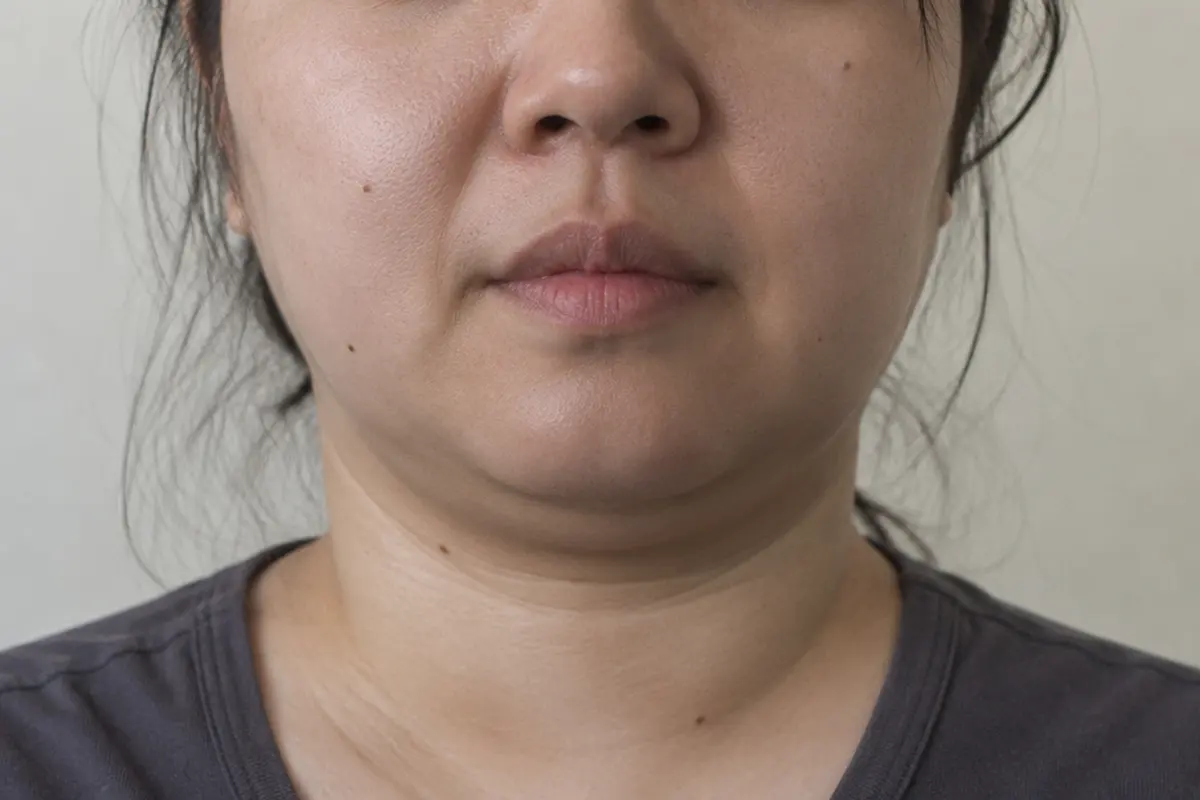
Jowls, the jawline and the area under the chin are assessed together. Illustrative image, not a patient.
Four things usually add to the line, and most faces show more than one:
Jowl descent. The jowl drops and fills the space beside the chin, so the line deepens from the side. This is the lower part of the same descent that deepens the smile lines above it.
Thinning support beside the chin. The bone and soft tissue just in front of the jowl lose some projection, and a shallow dip forms. The line looks deeper because the area next to it has sunk.
Muscle pull. The depressor anguli oris, the muscle that draws the mouth corners down, can become dominant, giving a downturned or stern look even at rest. A 2026 randomised, double-blind trial found that botulinum toxin placed low in this muscle raised the mouth corners more than an injection placed higher up.
Skin quality. Sun damage, thinning skin and weight change make the crease etch into the surface, so it stays visible when the face is still.
Earlier filler can also be part of the picture. Product placed in or around the folds can add weight that pulls the mouth corners lower, which is why a heavy-looking lower face is examined with ultrasound before anything new is added. The way the jowl itself changes is set out on jowls and lower face sagging, and the anatomy of both lines is explained in the guide to smile lines and marionette lines.
Marionette lines or smile lines? Lookalikes that change the plan
Marionette lines are often confused with smile lines, jowls and other creases around the mouth. They sit close together but have different drivers, so telling them apart decides which treatment is relevant.
Line or look-alike
Where it sits
What usually drives it
What it needs
Marionette line
From the mouth corner down towards the jaw
Jowl descent, thin support beside the chin, muscle pull
Lifting, support and muscle relaxation, matched to the driver
A quick way to see the difference at home: smile lines deepen most when you smile, while marionette lines are clearest at rest and when you look down. If gently lifting the jowl back towards the ear softens the line, descent is a large part of it. If the line stays and the area beside the chin looks sunken, support is part of it too. Neither test replaces an examination, but both explain why one product rarely answers every crease around the mouth.
“A marionette line is usually a jowl that has dropped. I lift the jowl; filling the sides of the line is not where I start.”
Dr Sin YongOn treating marionette lines
Marionette lines treatment options: lifting first
Marionette lines treatment in Singapore is offered in many ways, and the most common elsewhere is filler placed beside the line. Here the plan starts with lifting, because in most faces the line is the fold where a descended jowl meets the chin. The table sets out the options Dr Sin Yong uses or discusses, in the order they are usually considered.
Relaxes the muscle that pulls the mouth corners down
Downturned mouth corners
Treat descent
Support beside the chin
Product placed on the bone in front of the jowl
A clear dip beside the chin that lifting does not reach
Lift a heavy jowl; it is not the default here
Surgical facelift, by referral
Repositions deeper tissue and removes excess skin
Marked laxity with skin excess
Restore volume on its own
Lifting the jowl changes what folds into the line. Filling the sides of the line adds weight in the same place the jowl is gathering, which is why it is not where the plan starts. Where the jowl dominates, the zones of the jawline are set out on VF Lift for the jawline and jowls.
Most plans combine lifting with relaxing the mouth-corner muscle where it pulls. A small amount of support is discussed only when the examination shows a dip beside the chin that lifting cannot reach. Combining energy devices and injectables in one plan is described in the published consensus on facial treatment, provided each is chosen for a reason (Fabi 2016).
Why filling the sides of a marionette line can make it look worse
Filling the marionette line is the request heard most often, and the one that most often disappoints when it is the whole plan. The line is usually the symptom of tissue moving down from above. Filler placed only in the crease lifts the floor of the line towards tissue that keeps arriving, and each top-up adds weight beside the mouth.
That weight shows in predictable ways:
The mouth corners look pulled lower, because the product sits where the jowl is already gathering.
The lower face looks wide or heavy, and the border between cheek, jowl and chin blurs.
Product can spread towards the jaw or form lumps that can be felt.
That is why lifting comes first here. When the jowl is lifted, less tissue folds into the line, and the question of filling it often does not arise. Filler is kept for the occasional dip beside the chin that lifting cannot reach.
If filler is already in the area and the lower face looks heavier than before, the first step is not more product. Ultrasound shows what is there and where it sits. Hyaluronic acid can be dissolved with hyaluronidase; other materials need a different approach. These problems are covered in detail on smile line and marionette filler gone wrong, and an overfilled face as a whole on pillow face treatment.
How Dr Sin Yong assesses marionette lines
Dr Sin Yong examines the lower face himself on Orchard Road before any plan is written. The assessment separates the drivers, because the same line can come from different combinations.
At rest and in animation. The face is viewed from the front, in profile and at three-quarter angle, still and smiling, to see whether the line is mostly descent, muscle pull or both.
The jowl. A gentle pinch shows whether the jowl is lax tissue or a compact fat pad, which decides between lifting and a fat-directed protocol.
Support beside the chin. The jawline in front of the jowl and the chin are judged against the rest of the face.
The muscle. Pulling the mouth corners down shows how much the depressor anguli oris contributes.
Earlier treatment. Any filler, threads or energy treatment is recorded, and ultrasound is used where earlier product is present.
The plan follows in writing: what would be done and in which order, what would not be done, and the option of no treatment. Some lines need very little; a line that is part of a normal smile is not a problem to fix. The consultation process page describes the visit step by step.
Who suits non-surgical marionette line treatment, and what decides the plan
Non-surgical treatment suits mild to moderate marionette lines in a face whose skin can still redrape, in someone who prefers gradual change without incisions. Treatment waits during pregnancy or breastfeeding and while there is infection, a cold sore or inflamed skin in the area. A bleeding tendency, blood thinners, a keloid tendency or recent filler or threads change the timing or the method. Heavy skin excess on the lower face and neck is beyond non-surgical reach and is referred to a plastic surgery specialist.
What decides the plan
How much of the line is jowl descent, which decides the lifting plan, and how much is muscle pull.
Whether earlier filler needs to be dissolved or addressed first.
Tissue thickness along the jaw, which decides the energy and depth used.
Skin quality, sun exposure and recent weight change.
Whether the smile lines and jowls are planned at the same time.
Fees are not published; a written quote follows the examination, as how fees are quoted explains.
Afterwards, in broad terms
Injections can leave swelling, tenderness or a bruise at the injection points. Energy treatments usually leave redness, warmth and tenderness that settle. Skin that turns pale, dusky or blotchy after filler, increasing pain, or any change in vision needs urgent attention; the signs are listed on warning signs after filler.
Your next step
1. MessageWhatsApp +65 8023 7170 with what is bothering you. A reply comes from the clinic, not a bot.
2. AssessmentDr Sin Yong examines you himself on Orchard Road, with ultrasound where earlier filler is involved.
3. A plan in writingWhat he would do, what he would not, the fee factors, and the option of no treatment.
Every treatment is performed by Dr Sin Yong personally. Singapore Medical Council registered · invited to share his clinical expertise internationally for CLASSYS, DEKA, Fotona, Hironic and Ilooda.
Book an assessment with Dr Sin Yong on Orchard Road. Bring the names and dates of any earlier filler in the lower face. How consultations work.
Time Freeze Laser LCLR®, in one line. Dr Sin Yong uses it to lift every zone of the face and neck, to take away excess filler in the same session, and to reduce loose fat in sagging areas while the skin tightens. The three uses, explained · Sculpting mode for excess filler.
A device is only a device. Ultherapy Prime, Thermage or a filler syringe is a tool, like a suture; technique, experience and customisation to the face decide the result. Why technique, not the device, decides the result.
Frequently Asked Questions
Marionette lines are the creases that run down from the corners of the mouth towards the jaw, named after a puppet’s hinged mouth. They usually form where a descended jowl folds against firmer tissue beside the chin. A 2024 anatomical review linked them to bone resorption, fat compartment changes, muscle pull, ligament tethering and skin ageing, and noted that East Asian facial structure predisposes to sagging around the mouth corners.
In Singapore, medical devices, which include most aesthetic lasers, energy devices and injectable fillers, must be registered with the Health Sciences Authority (HSA) before they can be supplied; only the lowest-risk class A devices are exempt. Ask which filler, laser or radiofrequency device will be used and check it on HSA’s medical device register, and check that the clinic holds an MOH licence.
When the lines bother you at rest, give a downturned or stern look, or a heavy fold appears after earlier filler. An assessment at rest and in a smile shows whether jowl descent, thinning support beside the chin, muscle pull or skin quality is driving the line. A heavy-looking lower face after filler is examined with ultrasound first, and marked skin excess is referred to a plastic surgery specialist.
Not from product, because nothing is injected. The VF Lift – Vertical Facelift and Time Freeze Laser LCLR® use heat to work on the lax jowl that folds into the line, so there is no filler to overfill, migrate or form lumps beside the mouth. Heat has its own risks, such as redness, tenderness and, rarely, a blister or pigment change, which are explained before treatment. A dip that lifting cannot reach is assessed separately.
It depends on what drives the line, and in most faces that is a jowl that has dropped. So the plan starts with lifting, usually the VF Lift – Vertical Facelift and Time Freeze Laser LCLR®, rather than filling the sides of the line. Mouth corners pulled down by a muscle can be relaxed with small doses of botulinum toxin. Filler is considered only for a dip that lifting cannot reach. An examination decides the mix.
Usually, yes. Lifting is the first approach here: the VF Lift – Vertical Facelift and Time Freeze Laser LCLR® work on the lax jowl that folds into the line, and botulinum toxin can relax the muscle that pulls the mouth corners down. Filling the sides of the line is not the default, because it adds weight where the jowl is already gathering. Support is discussed only for a dip that lifting cannot reach.
It can help one part of them. The depressor anguli oris pulls the corners of the mouth down, and relaxing it with small doses can soften a downturned, stern look. It does nothing for jowl descent or lost support, so it is usually one element of a plan rather than the whole of it. It is a prescription medicine, given after assessment by a doctor.
Yes, when the line is deepened by a lax jowl, which is the common pattern. The VF Lift – Vertical Facelift heats lax tissue with monopolar radiofrequency, Time Freeze Laser LCLR® works on dermal laxity and compact jowl fat, and focused ultrasound reaches the SMAS. As the jowl firms, less tissue folds into the line. Lifting does not relax the mouth-corner muscle, which is a separate question.
Early marionette lines usually reflect bone structure, a dominant muscle at the mouth corner, a slimmer face or weight loss rather than marked ageing. Sun exposure and thin skin add to it. The plan still starts from the cause: lifting where tissue has begun to drop, muscle relaxation where the corners pull down, and support only where the examination shows a short or receding area beside the chin.
Not completely, and trying to erase them usually means too much product. Some crease below the mouth corner is part of a normal adult face, especially when looking down. The realistic aim is a lighter shadow and mouth corners that no longer look pulled down, approached by lifting the jowl and relaxing the muscle rather than filling the line until it disappears.
References
The fat compartments of the face: anatomy and clinical implications for cosmetic surgery. Plastic and Reconstructive Surgery, 2007. source
Consensus Recommendations for Combined Aesthetic Interventions Using Botulinum Toxin, Fillers, and Energy-Based Devices. Dermatologic Surgery, 2016. source
Why do marionette lines appear? Exploring the anatomical perspectives and role of thread-based interventions. Skin Research and Technology (Hong GW, et al.), 2024. pubmed.ncbi.nlm.nih.gov
Optimizing injection sites of botulinum toxin type A for improving oral commissure position: a two-stage, prospective, double-blind, randomized trial. Plastic and Reconstructive Surgery (Zhang M, et al.), 2026. pubmed.ncbi.nlm.nih.gov
About this page: written and medically reviewed by Dr Sin Yong, MBBS (NUS), MRCS (Edinburgh) · Last reviewed 7 November 2026 · Illustrative images only, not patients · Editorial policy