To dissolve fillers in Singapore, hyaluronic acid filler is broken down with an enzyme called hyaluronidase, also known by the brand name Hyalase. Dr Sin Yong first maps the filler with ultrasound, then places hyaluronidase into the excess only, so filler you want to keep is left alone. The enzyme, its timing and side effects are explained on the hyaluronidase page.
Filler dissolving uses hyaluronidase, an enzyme that breaks down hyaluronic acid filler. It works on hyaluronic acid only: Sculptra, Ellansé and Radiesse do not dissolve. Dr Sin Yong scans the area with ultrasound first, places a small dose into the filler he can see, reviews it, and adds more only where filler remains. This lowers the risk of leaving the face hollow.
The material decides everything. Hyaluronidase breaks down hyaluronic acid and nothing else, so the first question in any filler dissolving consultation is what was injected. The table sets out the common fillers and what is considered for each.
Swipe sideways to see the whole table.
Common filler types and whether hyaluronidase dissolves them
Filler
Common examples
Dissolved by hyaluronidase?
What is considered
Hyaluronic acid
Most lip and under-eye fillers; many cheek, chin and nose fillers
Yes
Ultrasound-guided hyaluronidase into the excess
Hyaluronic acid skin boosters
Boosters made of hyaluronic acid
Yes
Usually only needed if a lump forms; ultrasound first
Poly-L-lactic acid
Sculptra
No
Mapping; the Sculpting mode of Time Freeze Laser LCLR® for nodules and migrated product
Silicone, PMMA, often from older or overseas treatments
No
Mapped with ultrasound; the Sculpting mode of Time Freeze Laser LCLR®, without an incision
Hyaluronidase digests hyaluronic acid; poly-lactic acid and calcium hydroxylapatite are broken down by the body through other, slower processes, and non-absorbable fillers stay (Wollina 2024). Where a filler cannot be dissolved, the plan is still built around mapping it first, and the Sculpting mode of Time Freeze Laser LCLR® is described on its own page. Lumps made of several products are common after years of treatment; see hard lumps after filler.
How hyaluronidase injection works
Hyaluronidase is an enzyme that breaks the long chains of hyaluronic acid into small fragments that the body clears. Injected into hyaluronic acid filler, it softens and reduces the gel. It starts working soon after it is placed and keeps acting for a while afterwards, which is why the result is judged at the review rather than on the day. The term is explained in the glossary under hyaluronidase.
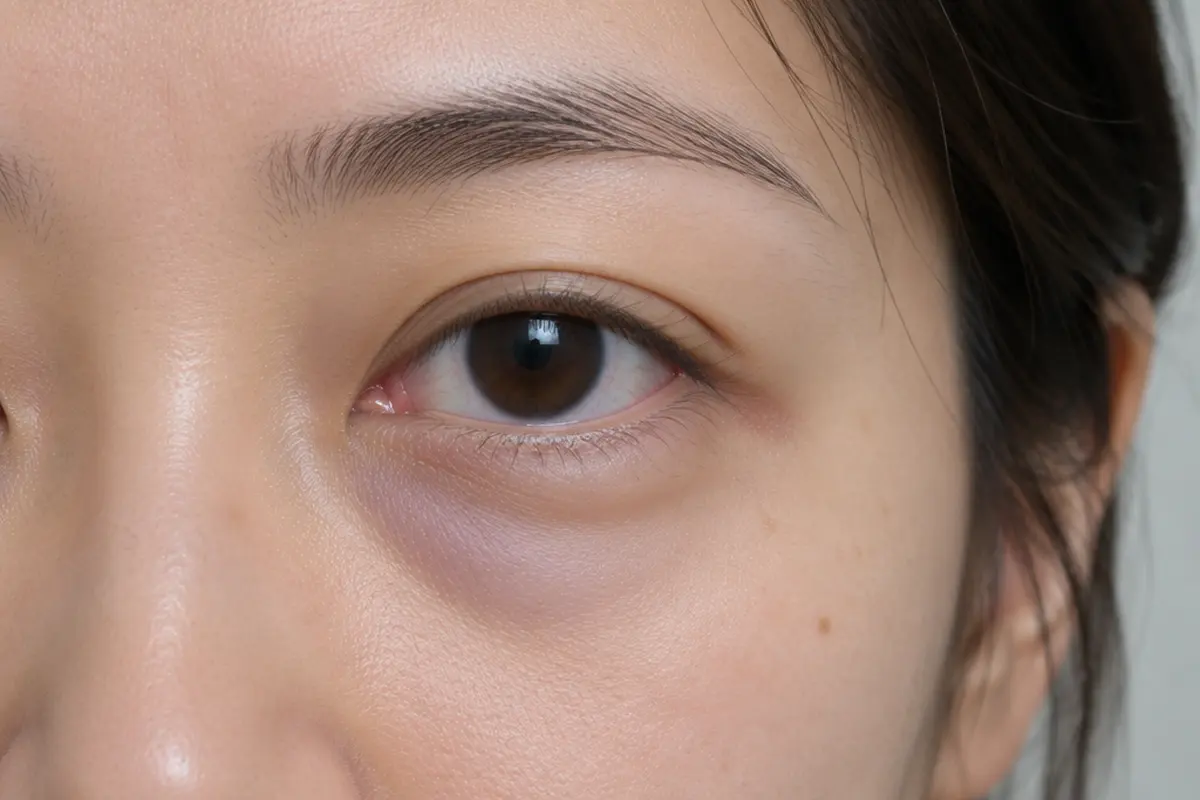
Under-eye puffiness after filler can persist and is checked before more is added. Illustrative image, not a patient.
Why the dose is not fixed
Hyaluronic acid products differ in how easily the enzyme breaks them down (Landau 2015). So published guidance advises titrating to effect, meaning the dose is adjusted to the response, rather than giving a set number of units. For a non-urgent correction, a low dose is placed directly into the lump or excess (King 2018; Landau 2015; Kroumpouzos and Treacy 2024).
An emergency is different
A blocked blood vessel after filler is treated with a separate high-dose protocol, not the conservative approach described on this page (Murray 2021). Pale, dusky or mottled skin, or pain that is getting worse after filler, needs urgent assessment by the doctor who injected you, or at A&E, now.
Does filler dissolving work? What trials of hyaluronidase show
Dissolving hyaluronic acid filler with hyaluronidase is supported by randomised trials, though by few of them. A 2024 scoping review found five, all conducted in the United States, with 53 participants in total. They showed hyaluronidase to be effective in removing uncomplicated hyaluronic acid nodules, and the review concluded that the ideal dose and protocol are not yet established.
In the largest of the trials, published in JAMA Dermatology, even very small doses reduced filler compared with saline, and higher doses worked faster. Imaging adds a practical point: in a magnetic resonance imaging study, filler was still present in all 33 people at least two years after injection. Old filler is therefore often still there to be dissolved, and ultrasound is used to find it.
Ultrasound-guided hyaluronidase: seeing the filler first
Without imaging, hyaluronidase is placed by feel, by the shape of the area and by the injection record, if there is one. With ultrasound, the filler is seen as a dark, well-defined pocket before anything is injected (Wortsman 2015).
Illustrative image — not a patient.
What the scan shows
How deep the filler sits: under the skin, in the fat, within the muscle or on the bone.
How large it is, and whether there is one pocket or several from different treatments.
Whether it looks like hyaluronic acid or a collagen-stimulating filler.
The blood vessels beside it, which guide the path of the needle.
Under ultrasound guidance, hyaluronidase can be injected directly into the filler deposit (Schelke 2018). An expert review notes that guidance can make dissolving more effective (Kroumpouzos and Treacy 2024). One study looked at 39 patients with blocked vessels after filler. The region was first flooded with hyaluronidase. Where there was little or no improvement, the enzyme was then placed into the filler seen on ultrasound. The targeted injections used a mean of 122.5 units, against 1,519.4 for the earlier flooding (Schelke, Aesthet Surg J 2023). Dr Sin Yong performs the scan and the injection himself in the same visit. The step-by-step detail is on ultrasound-guided filler dissolving.
How to dissolve fillers in Singapore: what happens at the visit
History. The products, areas and dates, and any previous dissolving, as far as you know.
Examination. At rest and in expression, with photographs for your own comparison.
Allergy check. Previous reactions are asked about, and a skin test is always done first: a small amount of hyaluronidase is injected just under the skin to check for a reaction.
Ultrasound. Each area is mapped.
A plan in writing. What would be dissolved, what would be left, and what decides the fee.
A small first dose. Hyaluronidase is placed into the mapped filler with a fine needle.
Review. A check at about 48 hours; the decision on a second dose is made at about two weeks, titrated to what remains. Refilling is not encouraged: once the excess has gone, loose skin or a hollow is usually treated with the VF Lift – Vertical Facelift, which lifts your own tissue with nothing added.
Before you book
Pregnancy and breastfeeding: non-urgent dissolving is usually deferred.
An infection or a cold sore near the area is settled first.
Bring product names, dates and any clinic notes if you have them. If you do not, the assessment still goes ahead.
Hyaluronidase allergy and the skin test
Allergic reactions to hyaluronidase are uncommon but real. A systematic review looked at 37 studies describing 106 patients with hyaluronidase allergy (Guliyeva 2024). It found two main risk factors: previous hyaluronidase injections, and sensitisation from insect or wasp stings. Many reactions happened at a second injection, and the reactions responded to treatment.
Bee and wasp venom contain a similar enzyme. Guidance lists a history of sting allergy as a reason for extra care (Murray 2021), so previous injections and reactions to stings are asked about. Before any planned dissolving, Dr Sin Yong always does a skin test. A small amount of hyaluronidase is injected just under the skin and checked for a reaction. The first treatment dose is then kept small. In an emergency, such as a blocked blood vessel, treatment is not delayed for a skin test.
Dissolve, wait or do nothing?
Dissolving is not always the first step.
Recent filler. Early swelling and unevenness often settle on their own, so a review is usually wiser than dissolving straight away, unless there are signs of a blocked vessel.
A small irregularity you can live with. Sometimes the honest advice is to leave it. Why massage, heat and creams do not dissolve filler is covered in how to dissolve filler naturally.
Old filler that has built up. Staged dissolving of the excess usually makes more sense than adding filler elsewhere to balance it; see pillow face.
A lump that is red, hot or tender. This can be inflammation or infection: it needs a doctor the same day, or A&E if no doctor can see you today, and it is treated medically first.
Dr Sin Yong explains which of these applies and puts the plan in writing, including the option of no treatment. Consensus guidance on filler complications supports this staged, cause-first approach (Signorini 2016; Urdiales-Gálvez 2018). If dissolving elsewhere has not given the result you expected, see when filler dissolving has not worked.
After filler dissolving: aftercare and what comes next
Swelling, redness or bruising at the injection points is common and settles. Avoid massaging the area unless you have been told to. Difficulty breathing, a tight throat, swelling of the tongue or throat, or swelling that spreads quickly across the face, after any injection, including hyaluronidase, can be a serious allergic reaction: call 995 now. Itch, hives or swelling that spreads beyond the treated area: contact the clinic that injected you the same day. An area that becomes hot or painful needs a doctor the same day; if no doctor can see you today, A&E. The first days are set out day by day in what to expect after filler dissolving.
When can filler be added again?
Not on the same day, and usually not at all. Dr Sin Yong decides at about two weeks whether a second dose is needed. He does not encourage refilling; once the swelling has settled, any remaining looseness or hollow is usually addressed with the VF Lift – Vertical Facelift, which lifts your own tissue without adding filler, and sometimes the answer is to leave the area as it is.
Risks of hyaluronidase injection
Swelling, redness, itch or bruising at the injection site.
Over-correction: dissolving more than intended can leave a hollow, which staged dosing is designed to avoid.
Allergic reaction: uncommon; usually local swelling and itch, rarely more serious.
Breakdown of some of the skin's own hyaluronic acid near the injection site, which the body replaces.
No effect on fillers that are not hyaluronic acid.
Like any medical treatment, dissolving has its own risks and limits, which Dr Sin Yong explains at the assessment alongside the alternatives (Funt and Pavicic 2013).
Filler dissolving by area
Each part of the face behaves differently, so each has its own guide.
Dr Sin Yong examines you, performs the scan and places the enzyme himself. The aim is to dissolve what is in excess, in stages, to reduce the risk of over-correction. You do not need to have been treated here: filler placed elsewhere in Singapore or overseas is assessed in the same way (see filler done overseas), and doctors can refer patients through for GPs. The wider options for filler that looks heavy, puffy or misplaced are on filler correction in Singapore.
Watch
In his words
“A real part of my week is dissolving filler someone else put in.”Dr Sin Yong
People think that dissolving filler resets you to zero. It doesn't, and you should know that before you start. It has to be done in stages, judged by anatomy, because tissue that has been stretched for years doesn't snap back on its own. Rushed dissolution can leave you looking more deflated than when you walked in. It's a sequence, not a single appointment. Ask whoever you see to walk you through the whole plan first.
Transcript of Dr Sin Yong's video, lightly edited for reading.
Filler dissolving: sessions, downtime and how long it lasts
Filler dissolving in Singapore at a glance
How many sessions
Hyaluronidase: 1–2 sessions; a check at about 48 hours, and the decision on a second dose at about two weeks.
Downtime
Swelling for 1–3 days after hyaluronidase.
How long it lasts
Dissolved filler does not return. Refilling is not encouraged; where lift is needed afterwards, the VF Lift – Vertical Facelift uses your own tissue instead of adding more filler.
Figures are typical ranges from Dr Sin Yong's practice and the published literature; your plan, including the number of sessions, is set after the assessment and may differ. Fees are given in writing after the assessment: see how we quote.
Hyaluronic acid filler can usually be broken down completely with hyaluronidase, although a larger or older deposit may need more than one session, spaced a few days to two weeks apart. Fillers that are not hyaluronic acid cannot be dissolved this way. Dr Sin Yong checks with ultrasound what is left before deciding whether another session is needed.
Only hyaluronic acid filler responds to hyaluronidase. Collagen-stimulating fillers such as Ellansé (polycaprolactone), Sculptra (poly-L-lactic acid) and Radiesse (calcium hydroxylapatite), and permanent fillers such as silicone, cannot be dissolved; how they are managed is covered on the filler correction page.
Often, yes. Treatment is directed at the specific area that the ultrasound shows, rather than the whole face. Hyaluronic acid filler can be dissolved in a targeted way; products that cannot be dissolved are managed area by area. What suits your case is decided at the assessment.
Yes. A small bump may be product, swelling or a nodule, and each is managed differently. Dr Sin Yong examines it himself, with ultrasound, before anything is done.
Hyaluronic acid filler is dissolved with hyaluronidase, an enzyme injected into the filler. To dissolve filler precisely, Dr Sin Yong first maps where it sits with ultrasound, does a skin test to check for a reaction to the enzyme, and then places the hyaluronidase under ultrasound guidance. Fillers that are not hyaluronic acid, such as Ellansé, Sculptra, Radiesse and silicone, are not dissolved by hyaluronidase.
Yes. Filler dissolving is usually targeted: ultrasound shows where the excess or misplaced gel sits, and hyaluronidase is placed into that part only, so filler you want to keep elsewhere is left alone. One area, or even one part of an area such as a ridge in the upper lip, can be treated on its own. Dissolving is staged and reviewed, so more can be dissolved later if needed, but what has gone cannot be put back.
Hyaluronidase starts to work within hours. Swelling from the injection settles over the next few days; the area is checked at about 48 hours and reviewed at about two weeks before deciding whether a second dose is needed.
Yes, if it is hyaluronic acid. Hyaluronic acid filler can stay in the tissue for years, and old filler is dissolved with the same enzyme, after a skin test. Ultrasound shows whether filler from earlier treatments is still there, how much there is and where it sits, which matters because layers from several treatments are common. Filler that is not hyaluronic acid is not dissolved by hyaluronidase; Dr Sin Yong treats it with the Sculpting mode of Time Freeze Laser LCLR®, without an incision.
It depends on how much filler there is, how dense it is and how many areas are involved. Dissolving is deliberately staged: a small first dose, a check at about 48 hours, and a decision on a second dose at about two weeks, only where filler remains. Dr Sin Yong explains the likely plan after the scan, in writing, together with what decides the fee.
Dissolving removes filler; it does not age the skin. If filler was hiding a hollow or loose skin, that may show again once the excess has gone, which is why the enzyme is aimed at the excess and the result is reviewed. Options for the skin, usually the VF Lift – Vertical Facelift rather than more filler, are discussed after the face has settled, not on the same day.
No. Massage, heat, facial devices, supplements and creams do not dissolve hyaluronic acid filler, and some can irritate the area or push the filler elsewhere. Hyaluronic acid fillers do break down in the body over time, but often far more slowly than people expect. If filler is bothering you now, have it assessed rather than trying home methods.
Yes. Hyaluronic acid filler can be dissolved soon after it was placed, and in an emergency such as a blocked blood vessel it should be. For cosmetic concerns, early swelling and unevenness often settle on their own, so a review is usually wiser before dissolving, unless something is clearly wrong.
For hyaluronic acid filler they mean the same thing: the enzyme breaks the filler down and the body clears it. For fillers that cannot be dissolved, other approaches are used instead, such as the Sculpting mode of Time Freeze Laser LCLR® for excess collagen-stimulator material and for nodules large and small, without an incision. The scan decides which applies.
Yes, if it is hyaluronic acid. Filler placed in Korea, Bangkok or elsewhere is assessed in the same way, often without records. Ultrasound helps show whether the material looks like hyaluronic acid, how deep it sits and how much there is. Bring any product stickers, receipts or messages from the clinic, and plan your visit through the international patients page if you are travelling.
Each injection is a quick sting from a fine needle, and some people notice brief warmth or itch where the enzyme goes in. Tenderness, swelling or a bruise afterwards is common and settles.
Filler removal in Singapore is almost always done by dissolving rather than surgery. Hyaluronic acid filler is located with ultrasound and dissolved with hyaluronidase placed into it; products that do not dissolve are reduced with the Time Freeze Laser LCLR®. Surgery is kept for the rare lump that cannot be managed any other way.
Either can be used. A fine needle places the enzyme into a deposit the scan has shown, which suits small, precise doses. A blunt cannula reaches a wider area through fewer entry points and tends to bruise less. Dr Sin Yong uses both. When he dissolves filler, the choice follows where the filler sits on ultrasound and how much of the area needs treating. Reaching the right depth matters more than the instrument or the hyaluronidase preparation.
References
The Use of Hyaluronidase in Aesthetic Practice (v2.4). Journal of Clinical and Aesthetic Dermatology, 2018. source
Guideline for the Safe Use of Hyaluronidase in Aesthetic Medicine, Including Modified High-dose Protocol. Journal of Clinical and Aesthetic Dermatology, 2021. source
Hyaluronidase Caveats in Treating Filler Complications. Dermatologic Surgery, 2015. source
Allergic Complications of Hyaluronidase Injection: Risk Factors, Treatment Strategies, and Recommendations for Management. Aesthetic Plastic Surgery, 2024. source
Hyaluronidase for Dermal Filler Complications: Review of Applications and Dosage Recommendations. JMIR Dermatology, 2024. source
Ultrasound to improve the safety of hyaluronic acid filler treatments. Journal of Cosmetic Dermatology, 2018. source
Identification and Complications of Cosmetic Fillers: Sonography First. Journal of Ultrasound in Medicine, 2015. source
Ultrasound-Guided Targeted vs Regional Flooding: A Comparative Study for Improving the Clinical Outcome in Soft Tissue Filler Vascular Adverse Event Management. Aesthetic Surgery Journal, 2023. source
Spontaneous and induced degradation of dermal fillers: A review. Journal of Cutaneous and Aesthetic Surgery, 2024. source
Global Aesthetics Consensus: Avoidance and Management of Complications from Hyaluronic Acid Fillers-Evidence- and Opinion-Based Review and Consensus Recommendations. Plastic and Reconstructive Surgery, 2016. source
Dermal fillers in aesthetics: an overview of adverse events and treatment approaches. Clinical, Cosmetic and Investigational Dermatology, 2013. source
Borzabadi-Farahani A, Mosahebi A, Zargaran D. A Scoping Review of Hyaluronidase Use in Managing the Complications of Aesthetic Interventions. Aesthetic Plastic Surgery, 2024. doi.org
Alam M, Hughart R, Geisler A, Paghdal K, Maisel A, Weil A, et al. Effectiveness of Low Doses of Hyaluronidase to Remove Hyaluronic Acid Filler Nodules: A Randomized Clinical Trial. JAMA Dermatology, 2018. doi.org
Master M, Azizeddin A, Master V. Hyaluronic Acid Filler Longevity in the Mid-face: A Review of 33 Magnetic Resonance Imaging Studies. Plastic and Reconstructive Surgery. Global Open, 2024. doi.org
About this page: written and medically reviewed by Dr Sin Yong, MBBS (NUS), MRCS (Edinburgh) · Last reviewed 8 November 2026 · Illustrative images only, not patients · Editorial policy
Not for emergencies. A change in vision or eye pain after filler: call 995 now. Pale, dusky or mottled skin, or pain that is getting worse: go now to the doctor who injected you, or to A&E. Do not message or book for these signs.