Published 26 October 2026 · Reviewed by Dr Sin Yong
Nose filler can be dissolved if it is hyaluronic acid, but many noses are treated with calcium hydroxylapatite or polycaprolactone, which do not dissolve. A bridge that has widened, a bump, asymmetry or filler that has moved are the usual reasons. Dr Sin Yong scans the nose with ultrasound first, then dissolves hyaluronic acid in small, staged doses, because the nose leaves little margin for error.
Short answerHyaluronic acid filler in the nose can be dissolved with hyaluronidase, an enzyme that breaks it down. Calcium hydroxylapatite, polycaprolactone and older non-absorbable fillers cannot. Ultrasound comes first: it helps show what the filler looks like, where it sits and which vessels run beside it (Schelke 2018). A small first dose goes into the mapped excess, the nose is reviewed at about 48 hours, and any further dose is titrated to what remains (King 2018). Any change in vision after nose filler is an emergency: call 995.
Nose filler is meant to add a narrow line of height along the bridge, or a little support at the tip. The nose has thin skin, little soft tissue over the bone and a profile that is judged to the millimetre, so filler that spreads, moves or sits in the wrong layer shows quickly. These are the concerns that bring people to ask for nose filler to be dissolved.
Swipe sideways to see the whole table.
What you notice
Likely cause
What is considered
A bridge that looks wide and flat from the front, sometimes called ‘avatar nose’
Hyaluronic acid that has spread sideways, often after several top-ups
Mapping the width of the deposit, then staged dissolving of the excess
A bump or step along the bridge
Filler placed unevenly or in excess at one point; sometimes the nose's own bone or cartilage
Examination and ultrasound to tell filler from bone or cartilage; targeted dissolving if it is hyaluronic acid
Fullness between the eyes, where the bridge begins
Filler that has moved upwards from where it was placed
Mapping where it sits now; dissolving the migrated part
A tip that looks round, heavy or lower than before
Filler that has gathered in the tip, or too much placed there
Small, careful doses, because the skin over the tip is thin
One side fuller, or a bridge that looks bent
Unequal amounts, or filler that has shifted
Mapping both sides; dissolving the fuller part, then a review
A bluish tint along the bridge
Hyaluronic acid sitting too close to the surface (the Tyndall effect)
A low dose of hyaluronidase into the superficial deposit
A firm lump that does not soften
Calcium hydroxylapatite, polycaprolactone or an older non-absorbable filler
Ultrasound to help show which material it looks like; the Sculpting mode of Time Freeze Laser LCLR® for nodules large and small
A red, hot, tender or growing lump
Inflammation or infection
Medical treatment first
Most of these come down to how much filler there is, what it is made of and where it sits. Hyaluronic acid placed too close to the surface can show as discolouration, the Tyndall effect (Hirsch 2006), and a low dose of hyaluronidase into the superficial gel is among the published options (Kroumpouzos and Treacy 2024). The term is explained in the glossary under the Tyndall effect.
60-second nose filler check
Answer three questions and send them straight to the clinic on WhatsApp. Dr Sin Yong will let you know whether an ultrasound assessment is worthwhile. No obligation.
1 · When was the filler done?
2 · What bothers you most?
3 · Have you had filler dissolved before?
Your answers open in your own WhatsApp app; nothing is stored on this page.
The nose is a high-risk area: warning signs that cannot wait
The nose has a dense network of small arteries, some of which connect with the artery that supplies the eye. Filler that enters or presses on one of these vessels can cut off the blood supply to the skin of the nose and, rarely, affect vision. That is why a problem after nose filler is not treated as purely cosmetic until a blocked vessel has been ruled out.
A blocked vessel is an emergency, whatever the filler. Where the filler is hyaluronic acid, it is treated straight away with high doses of hyaluronidase under a separate protocol, not with the small, staged doses described on the rest of this page (Landau 2015; Murray 2021). Signs usually appear during or soon after the injection, but they can come later, so do not wait for a scheduled review.
Urgent: a change in vision or eye pain after filler means calling 995 or going to the nearest emergency department now. Skin that turns pale, dusky or mottled, or pain that is getting worse, needs urgent assessment by the doctor who injected you, or at A&E. See the warning signs of a blocked blood vessel after filler.
“Natural is not a look I can promise you. It is a set of things I refuse to do to your face: fill what should be lifted, add over what I have not scanned, and stop a face from moving.”
Dr Sin YongOn scanning before anything is added or dissolved
Wide nose after filler (‘avatar nose’), migration and bumps
A wider, flatter bridge
Soft hyaluronic acid placed in larger amounts, or added again before earlier filler has gone, can spread sideways. From the front the bridge then looks broad and flat rather than defined, a look some people call ‘avatar nose’. Hyaluronic acid can stay in the tissue far longer than many people expect, so each top-up adds to what is already there. The scan helps show how wide the deposit is, and the excess is dissolved in stages, with a review between doses so that the shape can be judged before any more is used.
Filler that has moved
Filler placed high on the bridge can end up between the eyes, filling the angle where the nose meets the forehead, and filler at the tip can gather into a rounded, heavy tip. Ultrasound helps show where the product sits now, which is often not where it was placed, so the enzyme can be aimed at the migrated part. Signs of migration elsewhere in the face are covered in filler migration signs.
A bump: filler, or the nose itself?
A bump after nose filler can be filler placed unevenly or in excess at one point. It can also be the nose's own bone or cartilage, which dissolving does not change. Examination and ultrasound help tell the two apart. Dissolving acts only on hyaluronic acid filler; a hump in the bone or cartilage stays, and the routes for that are compared in nose filler, nose thread or rhinoplasty.
Ultrasound mapping before nose filler is dissolved
Without imaging, hyaluronidase is placed by feel and by the shape of the nose. On high-frequency ultrasound, hyaluronic acid usually shows as a dark, well-defined pocket (Wortsman 2015), and different filler materials have different patterns, which matters because many people do not know what was injected (Wortsman 2012).
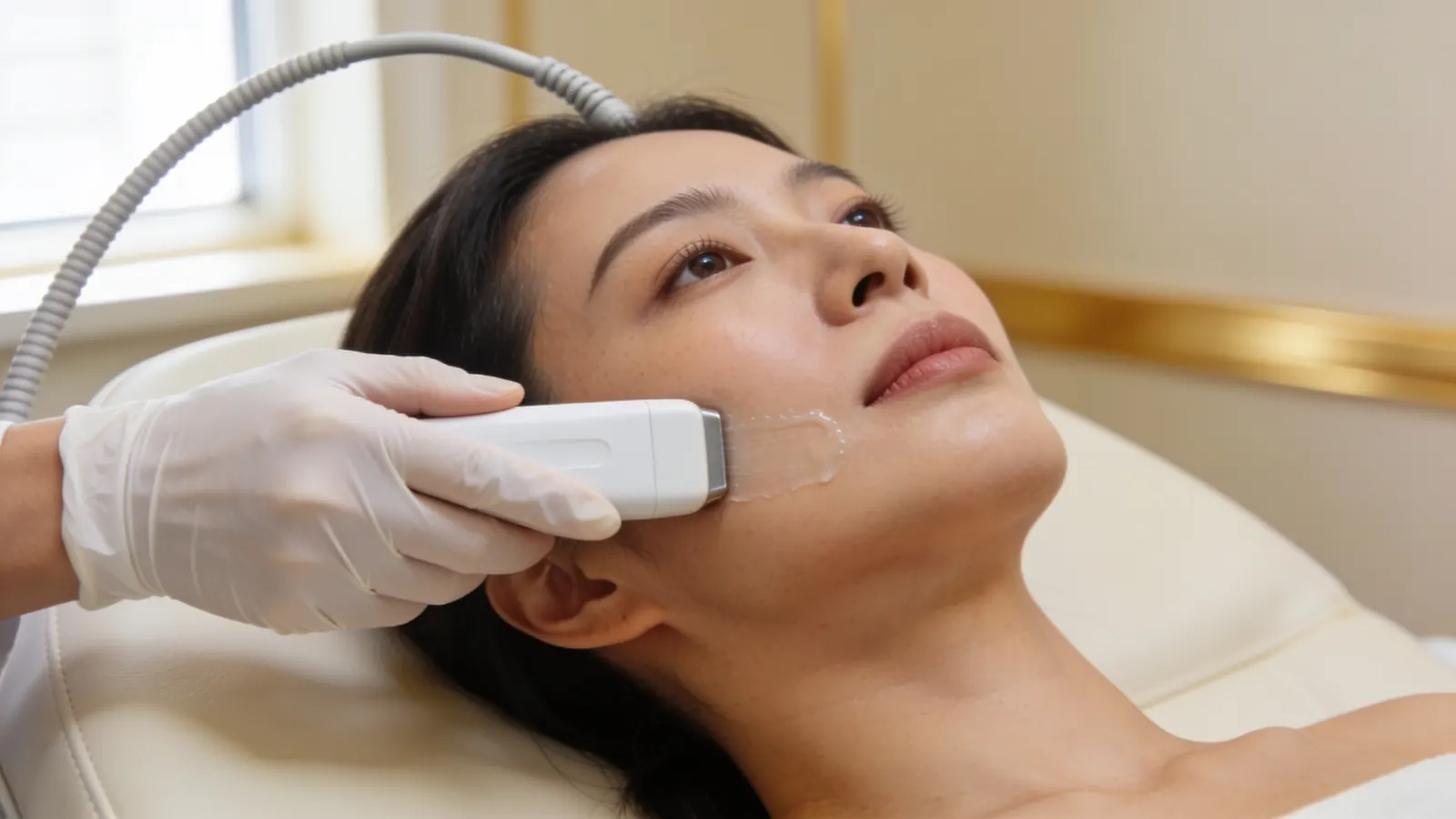
Illustrative image — not a patient.
What the scan shows in the nose
How deep the filler sits: on the bone, in the soft tissue or just under the skin.
How wide the deposit is, and whether it has spread sideways from the midline.
Whether filler has moved up between the eyes or down into the tip.
Whether it looks like hyaluronic acid, calcium hydroxylapatite or another material.
The blood vessels nearby, which guide the path of the needle.
Ultrasound can map blood vessels before treatment, and under ultrasound guidance hyaluronidase can be injected directly into the filler deposit (Schelke 2018); an expert review notes that guidance can make dissolving more effective (Kroumpouzos and Treacy 2024). When treating blocked vessels after filler, an ultrasound-targeted approach used a mean of 122.5 units of hyaluronidase against 1,519.4 for flooding the whole region (Schelke, Aesthet Surg J 2023). Dr Sin Yong performs the scan and the injection himself in the same visit; the steps are set out on ultrasound-guided filler dissolving.
How nose filler is dissolved, step by step
History. What was injected, when and how often, any earlier dissolving, and any rhinoplasty, implant or threads in the nose. Having no records is fine.
Examination. From the front, the side and below, with photographs for your own comparison.
Allergy check. Previous reactions to hyaluronidase and to bee or wasp stings are asked about, and a skin test is offered where there is any concern.
Ultrasound. The bridge, the tip and the area between the eyes are mapped.
A plan in writing. What would be dissolved, what would be left, and what decides the fee.
A small first dose. Hyaluronidase is placed into the mapped excess with a fine needle.
Review. At about 48 hours, with any further dose titrated to what remains.
Why the doses are small
Hyaluronic acid products differ in how easily the enzyme breaks them down (Landau 2015), and for a non-urgent correction published guidance advises a low dose placed into the excess and titrated to effect (King 2018). In the nose there is little tissue between the skin and the bone, and the enzyme spreads a little from where it is placed, so small doses also lower the risk of dissolving filler that was holding the line of the bridge.
Allergy
Allergic reactions to hyaluronidase are uncommon but real. A systematic review of 106 patients with hyaluronidase allergy found that previous hyaluronidase injections and sensitisation from insect or wasp stings were the main risk factors (Guliyeva 2024). For a planned correction, a skin test is offered where there is concern (King 2018). In an emergency, treatment is not delayed for a skin test.
What hyaluronidase cannot dissolve in the nose
Calcium hydroxylapatite, polycaprolactone and older fillers
Not all nose filler is hyaluronic acid. Calcium hydroxylapatite (Radiesse) and polycaprolactone (Ellansé) are firm fillers that spread little, and they are often chosen for the bridge. When Dr Sin Yong adds height to a nose he usually uses one of them, and hyaluronic acid where a patient would rather have a filler that can be dissolved; see CaHA nose filler. Older or overseas treatments sometimes used non-absorbable fillers such as silicone. Hyaluronidase has no effect on any of these: calcium hydroxylapatite is broken down by the body through other, slower processes, and non-absorbable fillers stay (Wollina 2024). On ultrasound, calcium hydroxylapatite looks bright rather than dark (Wortsman 2015).
Nodules large and small
Nodules are the commonest problem reported with calcium hydroxylapatite: in a review of 5,081 treatments, about 3% had adverse events, 96% of them nodules, and most settled without treatment (Kadouch 2017). For nodules large and small from calcium hydroxylapatite, polycaprolactone or layered products, which cannot be dissolved, Dr Sin Yong uses the Sculpting mode of Time Freeze Laser LCLR®, without an incision; how each person responds varies. Non-absorbable fillers such as silicone are assessed individually. Where hyaluronic acid has been layered over another filler, the hyaluronic acid part can be dissolved first and the rest reassessed. A lump that is red, hot, tender or growing quickly is treated medically first. How the Sculpting mode is used is set out on Time Freeze Laser LCLR® Sculpting mode, and lumps after calcium hydroxylapatite on Radiesse lumps and nodules.
Nose threads are not filler
A nose thread lift places fine absorbable threads of polydioxanone (PDO) along the bridge and sometimes the columella, the strip of tissue between the nostrils. Threads are not filler, and hyaluronidase does not dissolve them. Where threads and hyaluronic acid filler were placed together, only the filler responds to the enzyme. How the threads behave is explained on nose thread lift.
When to wait before dissolving nose filler
Dissolving is not always the first step.
Recent filler. Swelling and slight unevenness in the first days often settle, so a review is usually wiser than dissolving straight away, unless there are signs of a blocked vessel, which need urgent care.
A small irregularity you can live with. Sometimes the honest advice is to leave it.
A bump in the bone or cartilage. Dissolving changes filler only.
Infection, a cold sore or broken skin on or near the nose. This is settled first.
Pregnancy and breastfeeding. Non-urgent dissolving is usually deferred.
A lump that is red, hot or tender. This can be inflammation or infection, and it is treated medically first.
Dr Sin Yong explains which of these applies and puts the plan in writing, including the option of no treatment.
After nose filler is dissolved: aftercare and refilling
Swelling, redness or a small bruise at the injection points is common and settles. Avoid pressing on or massaging the nose unless you have been told to, and contact the clinic promptly if swelling increases, itching spreads, or the skin over the nose changes colour or becomes hot or painful.
The nose is judged at the review, not in the first hours: the injections themselves cause some swelling, and a bridge that has carried filler for years can look different from how you remember it. What to expect in the days after is set out in aftercare after filler dissolving.
When can filler be added again?
Not on the same day. Published guidance recommends waiting at least two weeks after hyaluronidase, until the swelling has settled, before any refilling (Murray 2021). Whether to add anything back is decided then, and sometimes the answer is to leave the nose as it is. If height is wanted again, the material, the amount and the depth are planned around what caused the problem the first time.
Risks of dissolving nose filler
Swelling, redness, itch or bruising at the injection points, which settle.
Over-correction: dissolving more than intended can leave the bridge lower or less even than wanted, which is why the dose is staged.
Allergy: uncommon, from local swelling and itch to, rarely, a more serious reaction.
Breakdown of some of the skin's own hyaluronic acid near the injection site, which the body replaces.
No effect on calcium hydroxylapatite, polycaprolactone, non-absorbable fillers or threads.
Like any medical treatment, dissolving has its own risks and limits, which Dr Sin Yong explains at the assessment alongside the alternatives, including no treatment. The warning signs of a blocked vessel are set out above: a change in vision after nose filler means calling 995 or going to the nearest emergency department now.
Tried other treatments and almost given up?
Many patients who come to see Dr Sin Yong about nose filler problems tell him they have tried almost everything else and had given up hope. Having tried other treatments does not, on its own, rule out further options; what can be done depends on what the scan shows.
That history is useful. Knowing what was injected, when, and what has already been tried often explains why a problem has stayed: hyaluronidase acts only on hyaluronic acid and only where it reaches, some fillers are not hyaluronic acid at all, and swelling or fluid can look like filler. Ultrasound helps show which of these applies, and the plan starts from there. For material that cannot be dissolved, Dr Sin Yong uses the Sculpting mode of Time Freeze Laser LCLR® for nodules large and small, without an incision. How each person responds varies.
If you have been told nothing more can be done, it is still worth having the area scanned: ultrasound helps show what is there, and what, if anything, can be done is discussed from that. Bring any records of past treatments, product names and dates if you have them. More on this is in when filler dissolving has not worked.
How Dr Sin Yong approaches nose filler correction
The nose leaves little margin for error, so the approach is deliberately cautious: find out what is there and where it sits, dissolve only hyaluronic acid and only the excess, and leave time between steps. Dr Sin Yong examines you, performs the scan and places the enzyme himself, and the plan, including what he would not do and what decides the fee, is set out in writing.
1. MessageWhatsApp +65 8023 7170 with what is bothering you. A reply comes from the clinic, not a bot.
2. AssessmentDr Sin Yong examines you himself on Orchard Road, with ultrasound where earlier filler is involved.
3. A plan in writingWhat he would do, what he would not, the fee factors, and the option of no treatment.
Every treatment is performed by Dr Sin Yong personally. Singapore Medical Council registered · invited to share his clinical expertise internationally for CLASSYS, DEKA, Fotona, Hironic and Ilooda.
Yes, if it is hyaluronic acid. Hyaluronidase breaks it down, usually in small, staged doses with a review at about 48 hours. Calcium hydroxylapatite, polycaprolactone and older non-absorbable fillers such as silicone do not respond to the enzyme, and many noses are treated with these firmer fillers. Ultrasound helps show which material is present before anything is injected.
Many of the patients Dr Sin Yong sees have tried other treatments first. A treatment that did not help can still leave options open: hyaluronidase may not have reached the filler, the filler may not be hyaluronic acid, or what looks like filler may be swelling or fluid. Ultrasound helps show which applies, and the plan follows what it finds. What can be done varies from person to person.
Hyaluronic acid placed along the bridge can spread sideways, especially when top-ups are added before earlier filler has gone, so the bridge looks broad and flat from the front, a look sometimes called ‘avatar nose’. Ultrasound helps show how wide the deposit is and whether it looks like hyaluronic acid. If it is, the excess can be dissolved in stages, with the shape reviewed between doses.
Filler placed high on the bridge can end up between the eyes, softening the angle where the nose meets the forehead. Ultrasound helps show where it sits now, which is often not where it was placed. If it is hyaluronic acid, the migrated part can be dissolved with small doses and reviewed at about 48 hours before any more is used.
It can be either. A bump after nose filler may be filler placed unevenly or in excess at one point, or the nose's own bone or cartilage, which dissolving does not change. Examination and ultrasound help tell them apart. Dissolving acts only on hyaluronic acid filler, so a hump in the bone or cartilage stays, and the options for it are discussed separately.
Dissolving is a medical treatment with its own risks. The common effects are swelling, redness, itch and bruising, which settle; allergy is uncommon; and staging the dose aims to lower the risk of over-correction. Because the nose has a dense blood supply, the vessels are mapped with ultrasound before the needle goes in. The serious risk in the nose comes from the filler itself blocking a vessel, not from the enzyme, and that is an emergency.
Not on the same day. Published guidance recommends waiting at least two weeks after hyaluronidase, until the swelling has settled, before refilling (Murray 2021). If height is wanted again, the material, the amount and the depth are planned around what caused the problem, and sometimes the better answer is no new filler at all.
If it is hyaluronic acid, yes, and it often lasts longer than people expect. Older and overseas treatments sometimes used other materials, including silicone, which do not dissolve. Ultrasound helps show whether the material looks like hyaluronic acid, how deep it sits and how much there is. Bring any records, product names or messages from the clinic if you have them.
Then hyaluronidase will not dissolve it: calcium hydroxylapatite (Radiesse) and polycaprolactone (Ellansé) are broken down by the body slowly. For nodules large and small, Dr Sin Yong uses the Sculpting mode of Time Freeze Laser LCLR®, without an incision; how each person responds varies. If hyaluronic acid was layered over it, that part can be dissolved first and the rest reassessed.
No. The threads used in a nose thread lift are fine absorbable threads of polydioxanone, not filler, and hyaluronidase does not act on them. If threads and hyaluronic acid filler were placed together, only the filler responds to the enzyme. The threads are absorbed by the body over time, and a thread that can be seen or felt at the surface is assessed at the clinic.
Skin on the nose or nearby cheek that turns pale, grey, dusky or mottled, pain that is getting worse rather than settling, or any change in vision. These can mean a blocked blood vessel. A change in vision or eye pain means calling 995 or going to the nearest emergency department now; skin changes or worsening pain need urgent assessment by the doctor who injected you, or at A&E.
Each injection is a brief sting from a fine needle, sometimes followed by a short warm or itchy feeling where the enzyme goes in. The nose can feel tender afterwards, and swelling or a small bruise is common and settles. Tell the clinic if swelling increases, itching spreads or the skin over the nose changes colour.
References
The Use of Hyaluronidase in Aesthetic Practice (v2.4). Journal of Clinical and Aesthetic Dermatology, 2018. source
Guideline for the Safe Use of Hyaluronidase in Aesthetic Medicine, Including Modified High-dose Protocol. Journal of Clinical and Aesthetic Dermatology, 2021. source
Hyaluronidase Caveats in Treating Filler Complications. Dermatologic Surgery, 2015. source
Allergic Complications of Hyaluronidase Injection: Risk Factors, Treatment Strategies, and Recommendations for Management. Aesthetic Plastic Surgery, 2024. source
Hyaluronidase for Dermal Filler Complications: Review of Applications and Dosage Recommendations. JMIR Dermatology, 2024. source
Management of injected hyaluronic acid induced Tyndall effects. Lasers in Surgery and Medicine, 2006. source
Ultrasound to improve the safety of hyaluronic acid filler treatments. Journal of Cosmetic Dermatology, 2018. source
Identification and Complications of Cosmetic Fillers: Sonography First. Journal of Ultrasound in Medicine, 2015. source
Ultrasound detection and identification of cosmetic fillers in the skin. Journal of the European Academy of Dermatology and Venereology, 2012. source
Ultrasound-Guided Targeted vs Regional Flooding: A Comparative Study for Improving the Clinical Outcome in Soft Tissue Filler Vascular Adverse Event Management. Aesthetic Surgery Journal, 2023. source
Spontaneous and induced degradation of dermal fillers: A review. Journal of Cutaneous and Aesthetic Surgery, 2024. source
Calcium hydroxylapatite: A review on safety and complications. Journal of Cosmetic Dermatology, 2017. source
About this page: written and medically reviewed by Dr Sin Yong, MBBS (NUS), MRCS (Edinburgh) · Last reviewed 26 October 2026 · Illustrative images only, not patients · Editorial policy