Published 26 October 2026 · Reviewed by Dr Sin Yong
Most Radiesse lumps are calcium hydroxylapatite, the material in the filler, gathered in one place. Some appear in the first weeks, others months later, and a few are inflammatory. None dissolves with hyaluronidase. Dr Sin Yong maps each lump with ultrasound, treats a red or tender lump medically first, and uses the Sculpting mode of Time Freeze Laser LCLR® for nodules large and small.
Short answerA Radiesse lump is usually a focal accumulation: calcium hydroxylapatite microspheres gathered in one place. Less often it is inflammation or, rarely, a granuloma. In a review of 5,081 treatments, 3% had adverse events, nearly all nodules, and most resolved (Kadouch 2017). Hyaluronidase does not dissolve calcium hydroxylapatite, and there is no reversal agent for it (McCarthy 2024). A lump that persists is mapped with ultrasound, a red or tender one is treated medically first, and for nodules large and small Dr Sin Yong uses the Sculpting mode of Time Freeze Laser LCLR®.
What Radiesse is, and why its lumps behave differently
Radiesse is calcium hydroxylapatite, a mineral similar to the one in bone and teeth, made into tiny smooth spheres (microspheres) and suspended in a water-based gel carrier. On the day, the volume comes mostly from the gel. Over the following months the body absorbs the gel, and the microspheres remain as a scaffold around which the skin lays down its own collagen. The spheres themselves are broken down slowly, by processes quite different from the enzyme that dissolves hyaluronic acid (Wollina 2024).
That two-stage behaviour explains most Radiesse lumps. A lump that persists is usually microspheres gathered in one place rather than the gel, which is absorbed over several months (McCarthy 2024). As collagen forms around them, the cluster becomes bound together and firmer, which is why acting early matters when a collection needs treatment (McCarthy 2024). Because none of it is hyaluronic acid, a Radiesse lump cannot be dissolved, and the first step is to find out what it is. How Radiesse is chosen and placed, undiluted for structure or diluted for skin quality, is explained on Radiesse in Singapore, and the material itself in the glossary under calcium hydroxylapatite.
60-second Radiesse lump check
Answer three questions and send them straight to the clinic on WhatsApp. Dr Sin Yong will let you know whether an ultrasound assessment is worthwhile. No obligation.
1 · When was the filler done?
2 · What bothers you most?
3 · Have you already tried other treatments for this?
Your answers open in your own WhatsApp app; nothing is stored on this page.
Types of Radiesse lumps, and when they appear
When people say their Radiesse has gone wrong, they usually mean a lump, a ridge or an area that feels harder than the rest. Not every lump is the same problem. The type, and when it appeared, decide what is considered.
Swipe sideways to see the whole table.
Type of lump
When it tends to appear
What it usually is
What is considered
Swelling or firmness
The first days after treatment
Normal swelling and the gel carrier, not a nodule
Review once it has settled, unless there are urgent signs
Early product collection
Usually within the first several weeks
Microspheres gathered in one place, often from placement close to the surface, a single large deposit or a muscle that moves a lot
Ultrasound; a lump that is felt but not seen is often watched; massage only if the treating doctor advises it at this stage
Visible lump or ridge
As the early swelling settles
Product showing through thin skin, as on the backs of the hands or under the eyes
Mapping; the Sculpting mode of Time Freeze Laser LCLR® for nodules large and small
Late nodule
Months after treatment
A cluster of microspheres bound together by collagen, firmer than it was at first
Ultrasound; the Sculpting mode of Time Freeze Laser LCLR®, without an incision
Inflammatory nodule
Usually delayed, weeks to months after treatment
Infection, a biofilm or an immune reaction; the lump is red, tender or swollen
Medical treatment first; reassessed once it has settled
Foreign-body granuloma (rare)
Can appear long after treatment, sometimes years
An inflammatory reaction of the body to the material
Medical treatment first, after assessment
Mixed lump
Any time, after several treatments in one area
Radiesse layered with hyaluronic acid or skin boosters
Ultrasound to separate the materials; hyaluronidase acts on the hyaluronic acid part only
Radiesse lumps months later
A lump that appears or becomes noticeable months after treatment is well recognised with collagen stimulators. In a series of 55 complications from this group, including calcium hydroxylapatite, nodules were the most frequent problem and usually appeared more than a month after treatment (Ianhez 2024). Inflammatory nodules also tend to be delayed, and are typically red, tender and swollen (McCarthy 2024). Rarely, a foreign-body granuloma develops long after the injection (Wang 2025).
How common are Radiesse nodules?
In a review of 21 studies covering 5,081 calcium hydroxylapatite treatments, 3% had an adverse event and 96% of those were nodules. Nearly half were in so-called dynamic areas, which move a lot, and in most cases the nodules were not visible and resolved without intervention. Inflammatory problems were much rarer: persistent inflammation or swelling accounted for 4 of the 173 adverse events (Kadouch 2017). Lumps that do not settle on their own can be persistent, as they often were in the 55-case series (Ianhez 2024).
“For hard lumps from mixed products, I use one tool, Time Freeze Laser LCLR®, to target the material without surgery.”
Dr Sin YongOn hard lumps from Radiesse and mixed products
Can Radiesse be dissolved?
No. Hyaluronidase, the enzyme used to dissolve filler, breaks down hyaluronic acid, and Radiesse contains none: neither the calcium hydroxylapatite nor the gel that carries it responds to the enzyme. An expert panel states that there is no reversal agent for calcium hydroxylapatite (McCarthy 2024). One medicine has been reported to speed up its breakdown, but it acts slowly (Wollina 2024) and is not regarded as a reversal agent. The table sets Radiesse against hyaluronic acid and the other collagen stimulators.
Swipe sideways to see the whole table.
Material
Example
How it gives volume
Can it be dissolved?
What is considered for a lump
Calcium hydroxylapatite
Radiesse
Gel on the day; the microspheres then act as a scaffold for collagen
No; there is no reversal agent
Ultrasound; medical treatment first if inflamed; the Sculpting mode of Time Freeze Laser LCLR® for nodules large and small
Hyaluronic acid
Most lip and under-eye fillers
A gel that holds water
Yes, with hyaluronidase
Ultrasound-guided hyaluronidase in small doses titrated to effect (King 2018); see filler dissolving
Polycaprolactone
Ellansé
Gel on the day; the microspheres then stimulate collagen
No
Mapping; the Sculpting mode of Time Freeze Laser LCLR®; see Ellansé lumps
Combined products, or layers from different visits
Both
Only the hyaluronic acid part
Hyaluronic acid dissolved selectively; the calcium hydroxylapatite reassessed
When hyaluronidase still helps
Where Radiesse has been combined or layered with hyaluronic acid, the enzyme can act on that part. In the series of 55 collagen-stimulator complications, it helped only where calcium hydroxylapatite had been combined with hyaluronic acid (Ianhez 2024). Ultrasound helps show whether that applies. If it does, a small first dose goes into the hyaluronic acid part after the usual allergy questions, it is reviewed at about 48 hours, and the calcium hydroxylapatite is reassessed afterwards.
Where Radiesse lumps show: hands, lips, under the eyes and jawline
Where a lump sits changes how visible it is and what it is likely to be.
Radiesse lumps in the hands
Radiesse is used on the backs of the hands, undiluted for volume or diluted for crepey skin. The skin there is thin and the tendons and veins lie close beneath it, so product that sits near the surface, or has gathered in one spot, can be seen or felt. Diluted product spread for skin quality can also leave unevenness or small nodules in the thin skin. Ultrasound helps show each lump's depth and its relation to the tendons and veins before anything is planned. How the hands are assessed is on hand rejuvenation with fillers.
Lips and around the mouth
Radiesse is not meant for the lips themselves, although the folds and lines around the mouth have been treated with it. The muscle around the mouth moves constantly, and focal accumulations have been linked with placement near ring-shaped muscles like this one and with product placed as a deposit into the lining of the lip (McCarthy 2024). Lumps here can be felt inside the lip or seen around the mouth. If the lip filler turns out to be hyaluronic acid, see lip filler dissolving.
Radiesse under the eyes
Radiesse is not meant for the tear troughs. Where it has been placed there, the thin skin and the moving muscle make even small collections easy to see and feel. Dr Sin Yong uses the Sculpting mode of Time Freeze Laser LCLR® under the eye too, after assessment and ultrasound; whether it suits a particular under-eye is decided then. Collagen-stimulator lumps in this area are covered in non-hyaluronic acid lumps under the eye.
Jawline and chin
The jawline and chin are common areas for Radiesse, used on its own or with hyaluronic acid, including as a hybrid of the two (Moradi 2019); for structure it is placed deep, close to the bone. A lump here can be product placed too superficially or gathered in one spot, a step in the contour, or something else altogether, such as a lymph node under the jaw, which is one reason the scan comes first. Options for this area are also covered in chin and jaw filler dissolving.
Ultrasound mapping of a Radiesse lump
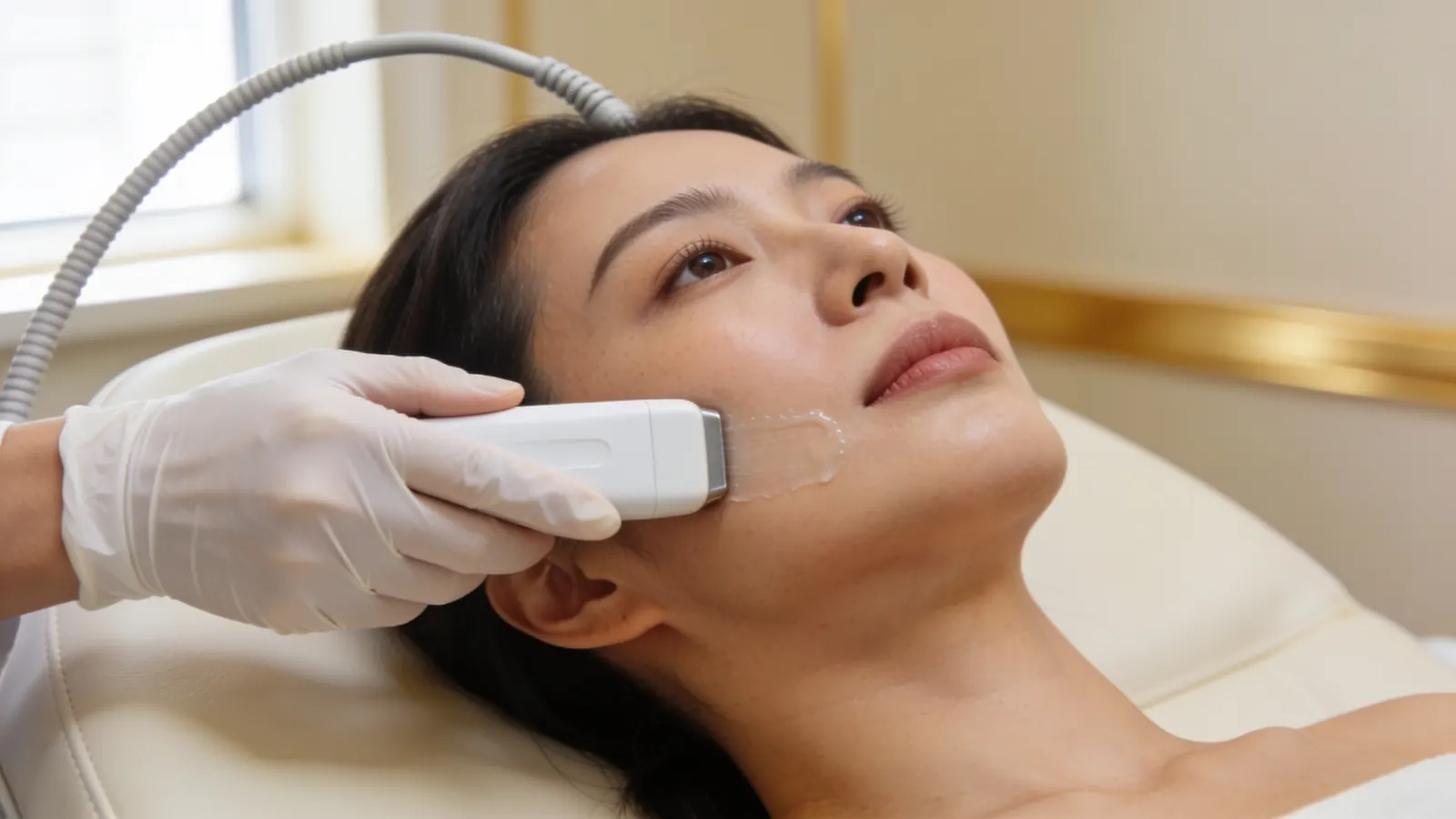
Ultrasound is the first-line imaging test for cosmetic fillers: it can detect the common types and help tell them apart, and calcium hydroxylapatite shows as bright deposits, quite unlike the dark pockets of hyaluronic acid (Wortsman 2015). That makes Radiesse one of the easier fillers to recognise on a scan, even when nobody knows what was injected.
Illustrative image — not a patient.
The scan helps show:
whether a lump looks like calcium hydroxylapatite, hyaluronic acid, both, or neither;
how deep it sits, how large it is, and whether there is one collection or several;
signs of inflammation around it;
something unrelated, such as a cyst or a lymph node, that can feel similar under the finger;
the vessels nearby, which matter for any treatment.
Dr Sin Yong performs the scan himself, and the plan follows what it shows. Calcium hydroxylapatite also shows up on X-rays and CT scans, so it is worth telling a radiologist or dentist that you have had it. More on scanning before any correction is on ultrasound-guided filler correction.
A structured approach to Radiesse focal accumulations
Calcium hydroxylapatite lumps that are not inflamed are often called focal accumulations. An expert consensus panel has published a structured approach to them, arranged in levels from no intervention upwards (McCarthy 2024). In general terms:
Watching. A lump that can be felt but not seen is often left alone, because accumulations tend to resolve as the product is broken down, which can take up to about two and a half years.
Dispersing the material. For a non-inflamed accumulation that needs treatment, the first-line step is to place fluid into it and work it firmly by hand to spread the microspheres; massage on its own has limited effect.
Further levels. These include medicines injected into the lump and other measures, used sparingly and chosen case by case.
The panel favours acting early when an accumulation does need treatment, because collagen gradually binds the microspheres together. An inflamed lump is a different problem and is treated as inflammation or infection first. Consensus recommendations on filler complications likewise advise identifying the type of lump before choosing a treatment (Urdiales-Gálvez 2018). Dr Sin Yong explains these published options at the assessment alongside his own approach, including the option of no treatment.
Time Freeze Laser LCLR® for Radiesse nodules, large and small
For calcium hydroxylapatite nodules, large and small, Dr Sin Yong uses the Sculpting mode of Time Freeze Laser LCLR®, without an incision. LCLR® stands for Laser Collagen Lipo Remodelling, a protocol he developed on a long-pulsed 755 nm and 1064 nm laser platform and performs himself. The Sculpting mode is designed to target excess material. Unlike hyaluronidase, it does not depend on the material being hyaluronic acid, so it is used both where Radiesse sits on its own and where it has been layered with hyaluronic acid or skin boosters.
Motion graphic, not to scale: how a hard lump forms after filler and skin boosters, how ultrasound maps it, and how the Sculpting mode of Time Freeze Laser LCLR® targets the excess.Video transcript
How a hard lump forms after filler and skin boosters. Diagram, not to scale.
A cross-section of facial tissue builds up layer by layer: skin, fat, muscle and bone.
Different products, same area: hyaluronic acid filler, skin booster and collagen stimulator, placed at different times.
They merge into one firm lump with a thin capsule, pressing on surrounding tissue. Small red vessels can show above it.
An ultrasound probe glides across the skin, mapping the material and its depth; the lump outline is traced in gold.
Time Freeze Laser LCLR®, Sculpting mode: laser energy is directed at the mapped area, built to target the excess material.
Ultrasound first. No incision. Response varies from person to person. Dr Sin Yong, Orchard Road, Singapore.
The energy is directed at the area the ultrasound has mapped.
No incision and no stitches.
No redness, no downtime.
The area is reassessed before you leave, and any further visit is planned from what is seen.
A lump that is red, hot, tender or growing is treated medically before the laser is considered. How each nodule responds varies, and like any medical treatment, laser has its own risks and limits, which are explained at the assessment alongside the alternatives. More on the mode itself is on the Sculpting mode of Time Freeze Laser LCLR®, and on the protocol as a whole on Time Freeze Laser LCLR®.
Massage, home remedies and what not to do
Massage
Massage is sometimes advised in the first weeks after Radiesse for an early, soft unevenness, but only by the doctor who examined you and only at that stage. It does not break up a nodule that collagen has bound together, and firm pressure can irritate a lump that is inflamed.
What not to do
Do not have more filler placed to even out or hide a lump; product added over it makes the area harder to read and to treat.
Do not expect hyaluronidase to dissolve Radiesse; it helps only where hyaluronic acid is also present.
Do not squeeze, pierce or try to drain a lump yourself.
Do not rely on creams, supplements or home devices sold to dissolve filler; none acts on calcium hydroxylapatite.
Do not have a lump treated before it has been assessed.
Do not wait with a lump that is red, hot, tender or growing.
If a lump is still there once the early weeks have passed, have it assessed rather than pressing on it.
When a lump after Radiesse is urgent
A lump that is red, hot, tender or growing, or that comes with a fever or feeling unwell, can be inflammation or infection. It is treated medically first, and nothing else is done to it until it has settled and been reassessed. These lumps can appear weeks or months after treatment, so a late change matters as much as an early one.
Urgent: a change in vision or eye pain after filler means calling 995 or going to the nearest emergency department now. Skin that turns pale, dusky or mottled, or pain that is getting worse, needs urgent assessment by the doctor who injected you, or at A&E. See the warning signs of a blocked blood vessel after filler.
Tried other treatments and almost given up?
Many patients who come to see Dr Sin Yong about Radiesse lumps tell him they have tried almost everything else and had given up hope. Having tried other treatments does not, on its own, rule out further options; what can be done depends on what the scan shows.
That history is useful. Knowing what was injected, when, and what has already been tried often explains why a problem has stayed: hyaluronidase acts only on hyaluronic acid and only where it reaches, some fillers are not hyaluronic acid at all, and swelling or fluid can look like filler. Ultrasound helps show which of these applies, and the plan starts from there. For material that cannot be dissolved, Dr Sin Yong uses the Sculpting mode of Time Freeze Laser LCLR® for nodules large and small, without an incision. How each person responds varies.
If you have been told nothing more can be done, it is still worth having the area scanned: ultrasound helps show what is there, and what, if anything, can be done is discussed from that. Bring any records of past treatments, product names and dates if you have them. More on this is in when filler dissolving has not worked.
How Dr Sin Yong approaches Radiesse lumps
He starts by finding out what the lump is. Dr Sin Yong takes the history, examines the area at rest and in movement, and performs the ultrasound himself. A lump that is red, hot, tender or growing is treated medically first. Any hyaluronic acid layered in the same area can be dissolved selectively, and for calcium hydroxylapatite nodules large and small he uses the Sculpting mode of Time Freeze Laser LCLR®, without an incision. He does not add filler to disguise a lump. The plan, what he would not do and what decides the fee are set out in writing, and no treatment is always one of the options.
You do not need to have been treated here: Radiesse placed elsewhere in Singapore or overseas is assessed in the same way (see filler done overseas), and doctors can refer patients: see for GPs. Lumps after other collagen stimulators are covered in Sculptra lumps and Ellansé lumps, and hard lumps after mixed products in filler complications.
Your next step
1. MessageWhatsApp +65 8023 7170 with what is bothering you. A reply comes from the clinic, not a bot.
2. AssessmentDr Sin Yong examines you himself on Orchard Road, with ultrasound where earlier filler is involved.
3. A plan in writingWhat he would do, what he would not, the fee factors, and the option of no treatment.
Every treatment is performed by Dr Sin Yong personally. Singapore Medical Council registered · invited to share his clinical expertise internationally for CLASSYS, DEKA, Fotona, Hironic and Ilooda.
Book a Radiesse lump assessment and ultrasound mapping with Dr Sin Yong on Orchard Road. How consultations work.
No. Hyaluronidase breaks down hyaluronic acid, and Radiesse contains none: it is calcium hydroxylapatite microspheres in a gel carrier, and neither responds to the enzyme. An expert panel notes that there is no reversal agent for calcium hydroxylapatite (McCarthy 2024). Lumps are managed rather than dissolved: they are mapped with ultrasound, an inflamed lump is treated medically, and for nodules large and small Dr Sin Yong uses the Sculpting mode of Time Freeze Laser LCLR®, without an incision.
Many of the patients Dr Sin Yong sees have tried other treatments first. A treatment that did not help can still leave options open: hyaluronidase may not have reached the filler, the filler may not be hyaluronic acid, or what looks like filler may be swelling or fluid. Ultrasound helps show which applies, and the plan follows what it finds. What can be done varies from person to person.
Many do. In a review of 5,081 treatments, most calcium hydroxylapatite nodules were not visible and resolved without intervention (Kadouch 2017), and accumulations tend to settle as the product is broken down, which can take up to about two and a half years (McCarthy 2024). A lump that is visible or bothering you is worth having scanned rather than waiting, and one that is red, tender or growing needs prompt assessment.
A lump that appears or becomes noticeable months after Radiesse is usually a late nodule: microspheres gathered in one place and bound together by the collagen that forms around them (McCarthy 2024). Less often it is inflammation or infection and, rarely, a foreign-body granuloma, which can develop long after treatment (Wang 2025). Ultrasound helps tell these apart. A late lump that is red, hot, tender or growing is treated medically first.
Dr Sin Yong's approach to Radiesse lumps does not involve surgery. For calcium hydroxylapatite nodules large and small, he uses the Sculpting mode of Time Freeze Laser LCLR®, directed at the area mapped on ultrasound, with no incision. Published approaches also include watching, dispersing the material and injected medical treatment (McCarthy 2024). An inflamed lump is treated medically first, and how each nodule responds varies.
Only if hyaluronic acid is also present. Hyaluronidase breaks down hyaluronic acid, not calcium hydroxylapatite, and in a series of 55 collagen-stimulator complications it helped only where calcium hydroxylapatite had been combined with hyaluronic acid (Ianhez 2024). Ultrasound helps show whether a lump contains hyaluronic acid, so the enzyme can be placed into that part in small doses and the rest reassessed afterwards.
Only if the doctor who examined you advises it, and usually only in the first weeks, for an early, soft unevenness. Massage on its own has limited effect on an established accumulation (McCarthy 2024), it does not break up a nodule that collagen has bound together, and firm pressure can irritate an inflamed lump. If a lump is still there after the early weeks, have it assessed rather than pressing on it.
The skin on the back of the hand is thin, with tendons and veins close beneath it, so product placed near the surface or gathered in one spot can be seen or felt, and diluted product can leave small nodules in thin skin. Ultrasound helps show how deep each lump sits and how it relates to the tendons and veins. What suits a particular hand, including the Sculpting mode of Time Freeze Laser LCLR®, is decided after the scan.
A change in vision means calling 995 or going to the nearest emergency department now, and skin that turns pale, dusky or mottled, or pain that is getting worse, needs urgent assessment. A lump that is red, hot, tender or growing needs prompt medical care. Otherwise, avoid pressing on it, adding filler or trying home remedies, and have it assessed with ultrasound. Bring any records of the treatment if you have them.
Not every lump after Radiesse is Radiesse. It can be hyaluronic acid or a skin booster from another visit, swelling, inflammation, or something unrelated, such as a cyst or a lymph node. On ultrasound, calcium hydroxylapatite shows as bright deposits, unlike the dark pockets of hyaluronic acid (Wortsman 2015), so the scan helps tell them apart before anything is treated.
Radiesse is not meant for the tear troughs, but some people have had it placed there, where thin skin and constant movement make small collections easy to see and feel. Dr Sin Yong uses the Sculpting mode of Time Freeze Laser LCLR® under the eye too, after assessment and ultrasound; whether it suits a particular under-eye depends on the depth and amount of product and on the skin. Eye protection is used during laser treatment near the eyes.
They are lumps made of calcium hydroxylapatite, the material in Radiesse. Most are focal accumulations, where the microspheres have gathered in one place, often after placement close to the surface, a single large deposit or injection near a muscle that moves a lot; collagen then forms around them. Fewer are inflammatory nodules, which are red, tender and swollen, and rarely a granuloma. Each is managed differently, so the type is identified first.
References
Calcium hydroxylapatite: A review on safety and complications. Journal of Cosmetic Dermatology, 2017. source
A Structured Approach for Treating Calcium Hydroxylapatite Focal Accumulations. Aesthetic Surgery Journal, 2024. source
Complications of collagen biostimulators in Brazil: Description of products, treatments, and evolution of 55 cases. Journal of Cosmetic Dermatology, 2024. source
Identification and Complications of Cosmetic Fillers: Sonography First. Journal of Ultrasound in Medicine, 2015. source
Spontaneous and induced degradation of dermal fillers: A review. Journal of Cutaneous and Aesthetic Surgery, 2024. source
Foreign Body Granulomas Reaction Related to Collagen Stimulatory Cosmetic Fillers: A Systematic Review. Journal of Cosmetic Dermatology, 2025. source
The Use of Hyaluronidase in Aesthetic Practice (v2.4). Journal of Clinical and Aesthetic Dermatology, 2018. source
Nonsurgical Chin and Jawline Augmentation Using Calcium Hydroxylapatite and Hyaluronic Acid Fillers. Facial Plastic Surgery, 2019. source
About this page: written and medically reviewed by Dr Sin Yong, MBBS (NUS), MRCS (Edinburgh) · Last reviewed 26 October 2026 · Illustrative images only, not patients · Editorial policy