Published 26 October 2026 · Reviewed by Dr Sin Yong
Skin boosters are placed as many small injections close to the surface, so small bumps straight afterwards are expected and usually settle within a few days. A firm lump that stays for weeks, or appears later, is different. Get it scanned, especially where boosters and fillers share an area. Dr Sin Yong treats lumps from any skin booster without surgery, so get assessed before you agree to an operation.
Short answerA lump that stays after a skin booster is usually product that has gathered in one place or sits too close to the surface, or a delayed reaction to it; with hyaluronic acid products, delayed-onset nodules can appear weeks to months later (Convery 2021). Ultrasound helps show what the lump is likely made of (Wortsman 2015). Hyaluronic acid boosters can be dissolved; polynucleotides and collagen-stimulating boosters cannot, and for those Dr Sin Yong uses the Sculpting mode of Time Freeze Laser LCLR®, without an incision.
Most skin boosters are injected as many small deposits just under the skin, so the treated area looks bumpy for a short time afterwards. That is expected: in a study of polynucleotide injections, every participant had swelling shortly afterwards, and the reactions were mostly mild and transient (Rho 2025). What matters is what happens next.
Motion graphic, not to scale: how a hard lump forms after filler and skin boosters, how ultrasound maps it, and how the Sculpting mode of Time Freeze Laser LCLR® targets the excess.Video transcript
How a hard lump forms after filler and skin boosters. Diagram, not to scale.
A cross-section of facial tissue builds up layer by layer: skin, fat, muscle and bone.
Different products, same area: hyaluronic acid filler, skin booster and collagen stimulator, placed at different times.
They merge into one firm lump with a thin capsule, pressing on surrounding tissue. Small red vessels can show above it.
An ultrasound probe glides across the skin, mapping the material and its depth; the lump outline is traced in gold.
Time Freeze Laser LCLR®, Sculpting mode: laser energy is directed at the mapped area, built to target the excess material.
Ultrasound first. No incision. Response varies from person to person. Dr Sin Yong, Orchard Road, Singapore.
Swipe sideways to see the whole table.
When
What you notice
Likely cause
What to do
The first few days
Small raised bumps at each injection point
The product settling
Usually nothing; follow your aftercare
After the first few days
A bump that has not flattened
Product gathered in one spot or placed too close to the surface
Have it reviewed
Weeks or months later
A new firm lump
A delayed reaction, or product layered with filler
Have it scanned
Any time
Redness, heat, pain, drainage or a lump that grows
Possible inflammation or infection
Prompt medical review
60-second skin booster lump check
Not for emergencies. A change in vision or eye pain after filler: call 995 now. Difficulty breathing, a tight throat, swelling of the tongue or throat, or swelling that spreads quickly across the face: call 995 now. Pale, dusky or mottled skin, or pain that is getting worse: go now to the doctor who injected you, or to A&E. A red, hot or draining lump, or a fever: a doctor the same day; if no doctor can see you today, A&E. Do not use this check or WhatsApp for these signs.
Answer three questions and send them straight to the clinic on WhatsApp. Dr Sin Yong will let you know whether an ultrasound assessment is worthwhile. No obligation.
1 · When was it injected?
2 · What bothers you most?
3 · Have you been offered surgery for it?
Your answers open in your own WhatsApp app; nothing is stored on this page.
A lump after a skin booster, and only offered surgery?
Patients come to Dr Sin Yong after being told that a lump left by skin boosters or fillers has to be cut out. Before you agree, know what surgery means: a scar, a possible dent where tissue is removed, a risk to the nerves that give the face feeling and movement, and no way back.
Dr Sin Yong starts with an ultrasound scan. Hyaluronic acid is dissolved, and material that cannot be dissolved is treated with the Sculpting mode of Time Freeze Laser LCLR®, which Dr Sin Yong uses for nodules large and small, without an incision. Lumps from any filler or skin booster are covered in hard lumps after filler or skin boosters.
“For hard lumps from mixed products, I use one tool, Time Freeze Laser LCLR®, to target the material without surgery.”
Dr Sin YongOn hard lumps from mixed fillers and skin boosters
Which skin boosters can leave lumps?
Any injected product can leave a lump. What the booster is made of decides what can be dissolved.
Swipe sideways to see the whole table.
Booster type
Examples
Dissolved by hyaluronidase?
How a lasting lump is approached
Hyaluronic acid boosters
Non-cross-linked or lightly cross-linked hyaluronic acid, including hybrid complexes such as Profhilo
Yes
Ultrasound-guided hyaluronidase, after a skin test
Polynucleotide boosters
Rejuran and other polynucleotide or PDRN injections
No
Scan first; many bumps settle; the Sculpting mode for a nodule that stays
Collagen-stimulating boosters
Diluted poly-D,L-lactic acid or poly-L-lactic acid
No
Scan first; the Sculpting mode for nodules large and small
Boosters over filler
A booster placed where filler already sits
Only the hyaluronic acid parts
Dissolving and the Sculpting mode in a planned order
A booster lump that stays is usually product that has gathered in one place, was placed deeper or more superficially than intended, or sits with other products from earlier treatments. Imaging work on non-inflammatory nodules has looked at the tissue layer in which product sits when nodules form (Schelke, Dermatol Surg 2023).
Hyaluronic acid products can also cause delayed-onset nodules, an immune reaction that can appear weeks to months after treatment (Convery 2021). Collagen-stimulating boosters can form nodules in the same way as the fuller-strength products: after collagen stimulators, nodules were the most common problem in a published series of 55 complications (Ianhez 2024).
Lasting lumps are uncommon. In post-marketing data for one hybrid hyaluronic acid booster, adverse events were reported in a very small proportion of treatments and were mostly swelling, redness and discomfort (Salti 2025); a few late local reactions such as nodules were reported and resolved (Cassuto 2020).
Ultrasound first: what the scan helps show
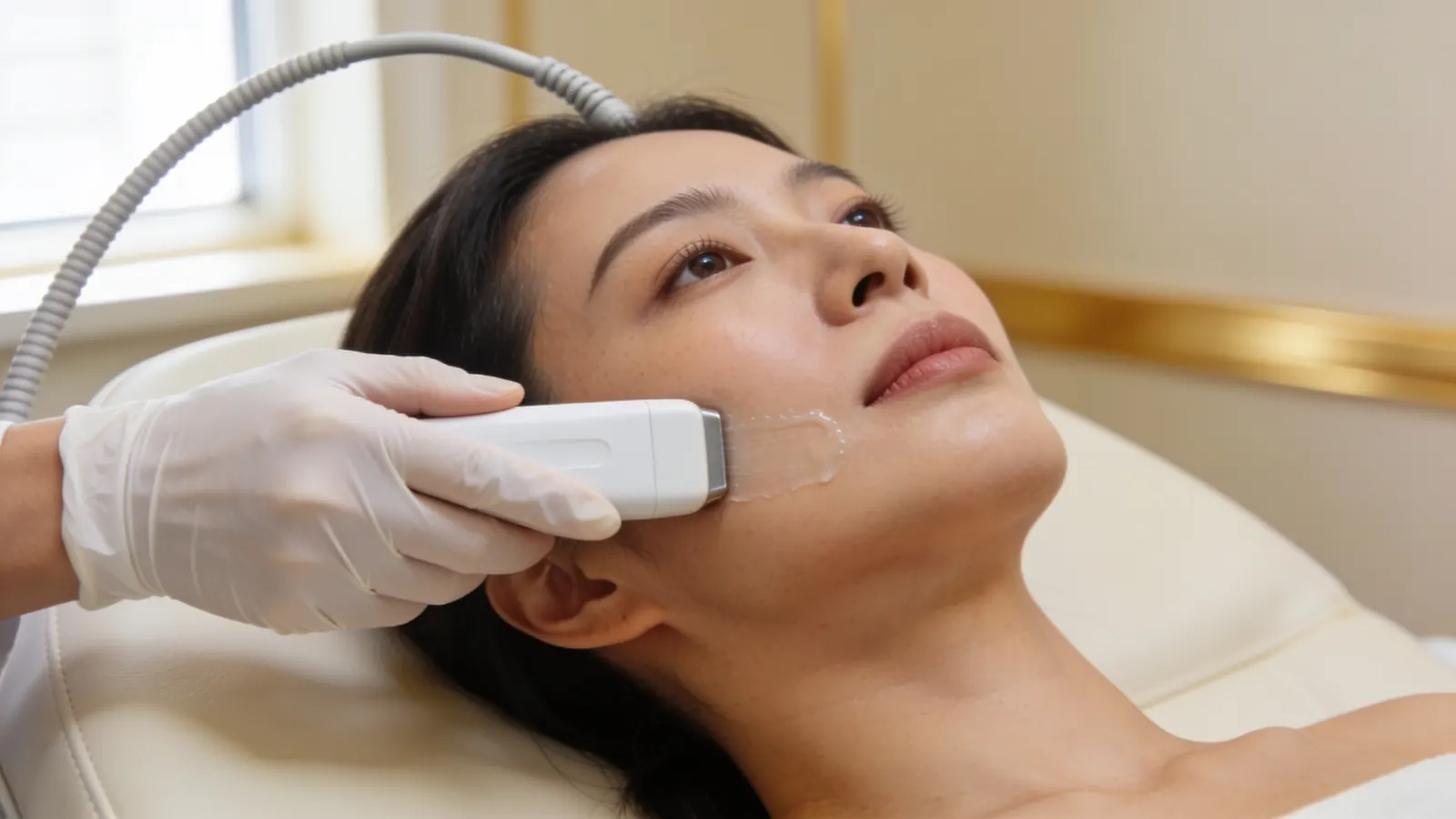
Ultrasound helps show whether a lump is product, swelling or fluid, how deep it sits, and whether filler from earlier treatments is in the same area. Different products tend to look different on the scan (Wortsman 2015). Dr Sin Yong performs the scan himself, and the plan follows what it finds.
Illustrative image — not a patient.
What is done for a lump that has stayed
Hyaluronic acid. Before planned dissolving, Dr Sin Yong always does a skin test: a small amount of hyaluronidase is injected just under the skin to check for a reaction. Ultrasound-guided hyaluronidase follows, with a small first dose and a review at about 48 hours (King 2018); see hyaluronidase allergy and the skin test.
Material that cannot be dissolved. Polynucleotide or collagen-stimulating material is treated with the Sculpting mode of Time Freeze Laser LCLR®, without an incision.
Several products together. Dissolving and the Sculpting mode are planned in order.
A small lump that cannot be seen. Sometimes reasonably left alone and reviewed.
Like any medical treatment, each option has risks and limits; laser can cause blistering or a change in skin colour, and dissolving can cause swelling and bruising. These are explained at the assessment.
Red, hot or tender lumps after a skin booster
A lump that is red, hot, tender, draining or growing quickly may be inflammation or infection. It is treated medically first, before any device is considered, as expert consensus recommends (Urdiales-Gálvez 2018). After mesotherapy-type injections, painful, red, draining nodules from infection have been described (Regnier 2009), as have foreign-body granulomas, for which ultrasound helped with diagnosis (Zhang 2023).
Urgent: a change in vision or eye pain after filler: call 995 now. Skin that turns pale, dusky or mottled, or pain that is getting worse, needs urgent assessment by the doctor who injected you, or at A&E, now. See the warning signs of a blocked blood vessel after filler.
When a lump may not be the booster
Not every lump after a skin booster is the product. A lump that keeps growing, sits where nothing was injected, feels fixed to deeper tissue or comes with swollen glands elsewhere is assessed for other causes, and further tests are arranged where the scan does not look like product. More on this is in abnormal lumps after filler or skin boosters.
Tried other treatments and almost given up?
Many patients who come to see Dr Sin Yong about lumps after skin boosters tell him they have tried almost everything else and had given up hope. Having tried other treatments does not, on its own, rule out further options; what can be done depends on what the scan shows.
That history is useful. Knowing what was injected, when, and what has already been tried often explains why a problem has stayed: hyaluronidase acts only on hyaluronic acid and only where it reaches, some fillers are not hyaluronic acid at all, and swelling or fluid can look like filler. Ultrasound helps show which of these applies, and the plan starts from there. For material that cannot be dissolved, Dr Sin Yong uses the Sculpting mode of Time Freeze Laser LCLR® for nodules large and small, without an incision. How each person responds varies.
If you have been told nothing more can be done, it is still worth having the area scanned: ultrasound helps show what is there, and what, if anything, can be done is discussed from that. Bring any records of past treatments, product names and dates if you have them. More on this is in when filler dissolving has not worked.
How Dr Sin Yong treats lumps after skin boosters without surgery
Dr Sin Yong performs the scan, any dissolving and every Sculpting mode treatment himself on Orchard Road. He developed the Time Freeze Laser LCLR® protocol himself and has been invited to share his clinical expertise in Seoul, Dubai, Bangkok and São Paulo, including as a Global Key Opinion Leader.
He does not add more product over a lump. Skin quality treatments are considered again only after any lump has been addressed.
Your next step
Not for emergencies. A change in vision or eye pain after filler: call 995 now. Pale, dusky or mottled skin, or pain that is getting worse: go now to the doctor who injected you, or to A&E. Do not message or book for these signs.
1. MessageWhatsApp +65 8023 7170 with what is bothering you. A reply comes from the clinic, not a bot.
2. AssessmentDr Sin Yong examines you himself on Orchard Road, with ultrasound where earlier filler is involved.
3. A plan in writingWhat he would do, what he would not, the fee factors, and the option of no treatment.
Every treatment is performed by Dr Sin Yong personally. Singapore Medical Council registered · invited to share his clinical expertise internationally for CLASSYS, DEKA, Fotona, Hironic and Ilooda.
Yes. Small raised bumps at the injection points are expected straight after most skin boosters, because the product is placed as many small deposits just under the skin. They usually settle within a few days. A bump that has not flattened after several days, or a new lump later, is worth having reviewed.
Many of the patients Dr Sin Yong sees have tried other treatments first. A treatment that did not help can still leave options open: hyaluronidase may not have reached the filler, the filler may not be hyaluronic acid, or what looks like filler may be swelling or fluid. Ultrasound helps show which applies, and the plan follows what it finds. What can be done varies from person to person.
Yes. A firm lump can form where product has gathered in one place, sits too close to the surface, or meets filler from earlier treatments. Hyaluronic acid products can also cause delayed-onset nodules weeks to months later. A lump that lasts for weeks is worth an ultrasound scan.
Only if the product is hyaluronic acid. Hyaluronidase dissolves hyaluronic acid boosters, including hybrid complexes, but not polynucleotides or collagen-stimulating boosters. Before any planned dissolving, Dr Sin Yong always does a skin test, injecting a small amount just under the skin to check for a reaction.
Profhilo is placed at a small number of points on each side, and raised bumps at those points are expected straight afterwards. They usually settle within a few days as the product spreads. A firm lump that remains after that is worth having reviewed.
Rejuran is injected as many small blebs, so the skin looks bumpy afterwards and the bumps usually settle within a few days. Polynucleotides are not hyaluronic acid and do not dissolve with hyaluronidase, so a lump that stays is scanned before anything is decided.
Yes. Get assessed before you agree to it: cutting a lump out leaves a scar and can leave a dent. Ultrasound shows what the lump is made of. Hyaluronic acid is dissolved, and material that cannot be dissolved is treated by Dr Sin Yong with the Sculpting mode of Time Freeze Laser LCLR®, without an incision.
Not into the same area until the lump has been assessed. Adding more product over a lump can make it harder to treat. Dr Sin Yong considers skin quality treatments again only after any lump has been addressed.
That can be inflammation or infection and needs prompt medical review, not a planned laser visit. Skin that turns pale, dusky or mottled, or pain that is getting worse after an injection, needs urgent assessment by the doctor who injected you, or at A&E. A change in vision or eye pain is an emergency: call 995.
Dr Sin Yong performs the ultrasound scan, the dissolving and every Sculpting mode treatment himself, on Orchard Road. It is not delegated to another doctor, a nurse or a therapist, so the same doctor follows each lump from the first scan to the last review.
References
Clinical Efficacy and Safety of a Highly Purified Polynucleotide for Dry and Chapped Lips: A Prospective, Multicenter Study. Journal of Cosmetic Dermatology, 2025. source
Delayed-onset Nodules (DONs) and Considering their Treatment following use of Hyaluronic Acid (HA) Fillers. Journal of Clinical and Aesthetic Dermatology, 2021. source
Investigating the anatomic location of soft tissue fillers in noninflammatory nodule formation: an ultrasound-imaging-based analysis. Dermatologic Surgery, 2023. source
Complications of collagen biostimulators in Brazil: Description of products, treatments, and evolution of 55 cases. Journal of Cosmetic Dermatology, 2024. source
Hyaluronic Acid Hybrid Cooperative Complexes Nearing 10 Years of Use: Update on Safety Assessment Based on Post-Marketing Surveillance Data. Journal of Cosmetic Dermatology, 2025. source
Safety Assessment of High- and Low-Molecular-Weight Hyaluronans (Profhilo®) as Derived from Worldwide Postmarketing Data. BioMed Research International, 2020. source
Identification and Complications of Cosmetic Fillers: Sonography First. Journal of Ultrasound in Medicine, 2015. source
Clinical management of rapidly growing mycobacterial cutaneous infections in patients after mesotherapy. Clinical Infectious Diseases, 2009. source
Mesotherapy-Induced Cutaneous Foreign Body-Type Granulomatous Reaction in the Face Treated with Minocycline: Case Report and Literature Review. Clinical, Cosmetic and Investigational Dermatology, 2023. source
The Use of Hyaluronidase in Aesthetic Practice (v2.4). Journal of Clinical and Aesthetic Dermatology, 2018. source
About this page: written and medically reviewed by Dr Sin Yong, MBBS (NUS), MRCS (Edinburgh) · Last reviewed 26 October 2026 · Illustrative images only, not patients · Editorial policy
Not for emergencies. A change in vision or eye pain after filler: call 995 now. Pale, dusky or mottled skin, or pain that is getting worse: go now to the doctor who injected you, or to A&E. Do not message or book for these signs.