Published 26 October 2026 · Reviewed by Dr Sin Yong
Hyaluronidase is the enzyme used to dissolve hyaluronic acid filler, and like any medicine it can cause an allergic reaction. Reactions are uncommon, and earlier hyaluronidase injections and bee or wasp sting allergy raise the risk. This page explains who is at higher risk, the skin test Dr Sin Yong always does before planned dissolving, the signs of a reaction, and why emergencies are handled differently.
Short answerAllergy to hyaluronidase, the enzyme that dissolves hyaluronic acid filler, is uncommon but real. In a systematic review of 106 patients with hyaluronidase allergy, earlier hyaluronidase injections and insect or wasp sting sensitisation were the main risk factors, and many reactions happened at a second injection (Guliyeva 2024). Before any planned dissolving, Dr Sin Yong always does a skin test: a small amount is injected just under the skin to check for a reaction. A known allergy usually rules out planned dissolving (Murray 2021); in an emergency, treatment is not delayed for a test.
Hyaluronidase, also called hyalase, is an enzyme that breaks down hyaluronic acid. Injected into hyaluronic acid filler, it softens and reduces the gel, which is how filler is dissolved. It acts on hyaluronic acid only: collagen-stimulating fillers, fat and non-absorbable fillers do not respond to it. It has been in medical use since 1949 and is widely used for dissolving hyaluronic acid filler (Murray 2021). The enzyme itself is explained in the glossary under hyaluronidase.
Like any medicine, it can cause an allergic reaction. Reactions are uncommon and usually local, but allergy matters for two reasons. A reaction can, rarely, be serious, and a person who reacts may not be able to have filler dissolved in the usual way, which changes the plan for any filler that is causing a problem. That is why the allergy history comes before any dissolving, and why Dr Sin Yong always does a skin test before planned treatment.
Is hyaluronidase safe?
Hyaluronidase is widely used, but it is a medicine with risks of its own, and these are explained before any treatment.
Common and expected: swelling, redness, itch or bruising at the injection points, which settle.
Over-correction: dissolving more than was in excess can leave an area hollow, which is why the dose is small and staged.
The skin's own hyaluronic acid: some of it near the injection site is broken down too, and the body replaces it.
Allergic reaction: uncommon; usually local swelling and itch, rarely more serious.
No effect on other fillers: material that is not hyaluronic acid does not respond.
For a planned correction, published guidance advises a low first dose placed into the filler and titrated to effect, with a review at about 48 hours, rather than a set number of units (King 2018). Hyaluronic acid products differ in how easily the enzyme breaks them down (Landau 2015), and an expert review favours low to moderate doses for non-urgent problems (Kroumpouzos and Treacy 2024).
The trial evidence for dissolving is thinner than many people assume: a 2024 scoping review found just five randomised trials, in 53 subjects and on arm or back skin, supporting hyaluronidase for hyaluronic acid nodules, and no trial evidence for facial reversal or over-correction (Borzabadi-Farahani 2024). That is one reason dissolving is planned in stages rather than treated as a simple reversal.
“Dissolving filler is not an undo button.”
Dr Sin YongOn what dissolving can and cannot do
Who is at higher risk of a hyaluronidase allergy?
A systematic review of 37 studies describing 106 patients with hyaluronidase allergy found that previous hyaluronidase injections and sensitisation from insect or wasp stings were the main risk factors, that many reactions happened at a second injection, and that the reactions responded to treatment (Guliyeva 2024).
Earlier hyaluronidase injections
If you have had hyaluronic acid filler dissolved before, at any clinic or overseas, you have had hyaluronidase, even if you were not told the name. Having had it without a problem does not rule out a reaction next time, because many reported reactions happened at a second injection (Guliyeva 2024). Any itch, rash or swelling after an earlier dose is worth mentioning, even if it seemed minor.
Bee or wasp sting allergy
Bee and wasp venom contain a similar enzyme. Guidance lists a history of sting allergy as a reason for extra care, and strong reactions to bee or wasp stings, or earlier hyaluronidase injections, call for careful assessment first, sometimes with an allergy specialist (Murray 2021). A sting allergy is asked about in detail, including how severe the reaction was.
What you are asked before any dissolving
Whether you have had hyaluronidase before, and where and when, as far as you know.
Any reaction to it: itch, rash, hives or swelling beyond the treated area.
Any allergy to bee or wasp stings, and how severe the reaction was.
Other allergies and the medicines you take.
Pregnancy or breastfeeding, when non-urgent dissolving is usually deferred.
The skin test Dr Sin Yong always does before planned dissolving
Before planned dissolving, Dr Sin Yong always does a skin test: a small amount of hyaluronidase is injected just under the skin to check for a reaction. This applies before any planned dissolving, whether or not you have a sting allergy or have had hyaluronidase before.
What is watched for
Redness, swelling or itching at the test site.
A raised, itchy weal where the test was placed.
Any reaction beyond the test site, such as hives or swelling elsewhere.
You are observed after the test, and what it shows decides the next step. If there is no reaction, dissolving can go ahead, with a small first dose placed into the mapped filler and a review at about 48 hours (King 2018). If there is a reaction, planned dissolving is usually not done; what happens then is set out below.
What the test can and cannot tell you
A test without a reaction is reassuring, but no test rules out every reaction. A reaction can appear later, sometimes a day or more afterwards, and many reported reactions happened at a second injection (Guliyeva 2024). That is why any itch, rash or swelling after a dose should be reported before more is given.
Guidance and practice
Published guidance lists a history of sting allergy as a reason for extra care, and advises careful assessment after strong reactions to stings or earlier hyaluronidase injections (Murray 2021). Doing a skin test before every planned treatment is Dr Sin Yong's own practice. In an emergency, such as a blocked blood vessel, treatment is not delayed for a test.
What an allergic reaction to hyaluronidase looks like
Most reactions are mild and local, but the signs are worth knowing, because a reaction can begin soon after the injection or appear later, sometimes a day or more afterwards.
Local swelling and itch. Some swelling, redness and itch at the injection points is expected after any dissolving. What makes it expected is that it stays within the treated area and settles rather than worsens.
Spreading swelling or itching. Swelling or itching that extends beyond the treated area or keeps increasing.
Hives. Raised, itchy welts on the face or body.
Rarely, a severe reaction. Breathing difficulty, a tight throat, or swelling of the face, lips, tongue or throat that is spreading.
For spreading swelling, itching or hives, contact the clinic straight away or, if you cannot reach the clinic, see a doctor or go to A&E the same day. Breathing difficulty, a tight throat, or spreading swelling of the face, lips, tongue or throat means calling 995 now. Call first, and let the clinic know afterwards. In the published review, the reactions responded to treatment (Guliyeva 2024).
If the skin test reacts, or you know you are allergic
If the skin test reacts, planned dissolving is usually not done. A known allergy to hyaluronidase usually rules out planned dissolving too, and strong reactions to bee or wasp stings, or earlier hyaluronidase injections, call for careful assessment first, sometimes with an allergy specialist (Murray 2021). Any reaction is treated as needed and noted in your records, and it is worth telling any doctor who might inject or dissolve filler for you in future.
What can be considered instead
Leaving the filler. Filler that is not causing a problem can be left. Hyaluronic acid does break down in the body over time, although often more slowly than people expect.
Filler that cannot be dissolved. Options include the Sculpting mode of Time Freeze Laser LCLR®, which Dr Sin Yong uses for nodules large and small, without an incision. Whether it suits a particular lump is decided after an ultrasound scan, and how each person responds varies. More detail is on the Sculpting mode page.
An allergy assessment. Where the history is unclear, assessment with an allergy specialist is sometimes arranged before any decision.
A red, hot or tender lump. This is treated medically first, whatever the filler.
More filler is not added to disguise a problem that cannot be dissolved; the plan starts from what the scan shows. Lumps that have built up over years of treatment are covered in hard lumps after filler or skin boosters.
Emergencies: why treatment is not delayed for a test
A blocked blood vessel after hyaluronic acid filler is a different situation from planned dissolving. Where the filler is hyaluronic acid, it is treated straight away with high doses of hyaluronidase under a separate protocol, not with the small, staged doses used for a planned correction (Landau 2015; Murray 2021). Treatment is not delayed for a skin test.
The signs of a blocked vessel relate to the filler rather than to the enzyme, and they need action straight away.
Urgent: a change in vision or eye pain after filler: call 995 now. Skin that turns pale, dusky or mottled, or pain that is getting worse, needs urgent assessment by the doctor who injected you, or at A&E, now. See the warning signs of a blocked blood vessel after filler.
Planned dissolving and emergency use compared
The same enzyme is used in two very different situations, and the steps around it differ.
Swipe sideways to see the whole table.
What differs
Planned dissolving
Emergency: a blocked blood vessel
Why it is used
Hyaluronic acid filler that is lumpy, puffy, misplaced or too much
A blocked blood vessel after hyaluronic acid filler
Skin test
Always done first
Treatment is not delayed for a test
Dose
A small first dose into the mapped filler, titrated to effect (King 2018)
High doses under a separate protocol (Murray 2021)
Timing
By appointment; non-urgent dissolving is usually deferred in pregnancy, while breastfeeding or with infection near the area
Straight away
Where to go
An assessment on Orchard Road
A change in vision or eye pain: call 995 or go to the nearest emergency department. Pale, dusky or mottled skin, or worsening pain: the doctor who injected you, or A&E
Planned dissolving can wait for an allergy history, a skin test, an ultrasound scan and a plan in writing. An emergency cannot, which is why the two are handled differently.
After dissolving: signs to report
Some swelling, redness, itch and small bruises at the injection points are expected after dissolving, and they settle. What matters is a change in pattern: signs that spread or keep getting worse rather than settling. The first days are set out in what to expect after filler dissolving.
Expected: swelling, redness, itch or small bruises at the injection points that settle over the following days.
Contact the clinic straight away: swelling or itching that spreads beyond the treated area or keeps increasing, or hives.
Call 995 now: breathing difficulty, a tight throat, or swelling of the face, lips, tongue or throat that is spreading.
Contact the clinic the same day: redness, warmth, pain or swelling that increases after the first day or two, pus from an injection point, or fever.
Before a further dose
Any further dose is decided at the review at about 48 hours (King 2018). Because many allergic reactions happen at a second injection (Guliyeva 2024), mention any itch, rash or swelling after the first dose before more is given.
Refilling
Published guidance recommends waiting at least two weeks after hyaluronidase, until the swelling has settled, before any refilling (Murray 2021). Whether to add any filler is decided then, and sometimes the answer is to leave the area as it is.
How Dr Sin Yong approaches safety when dissolving filler
Dr Sin Yong takes the allergy history, performs the skin test and the ultrasound scan, and places the enzyme himself on Orchard Road. The aim is to dissolve what is in excess, in stages, with allergy considered at every step.
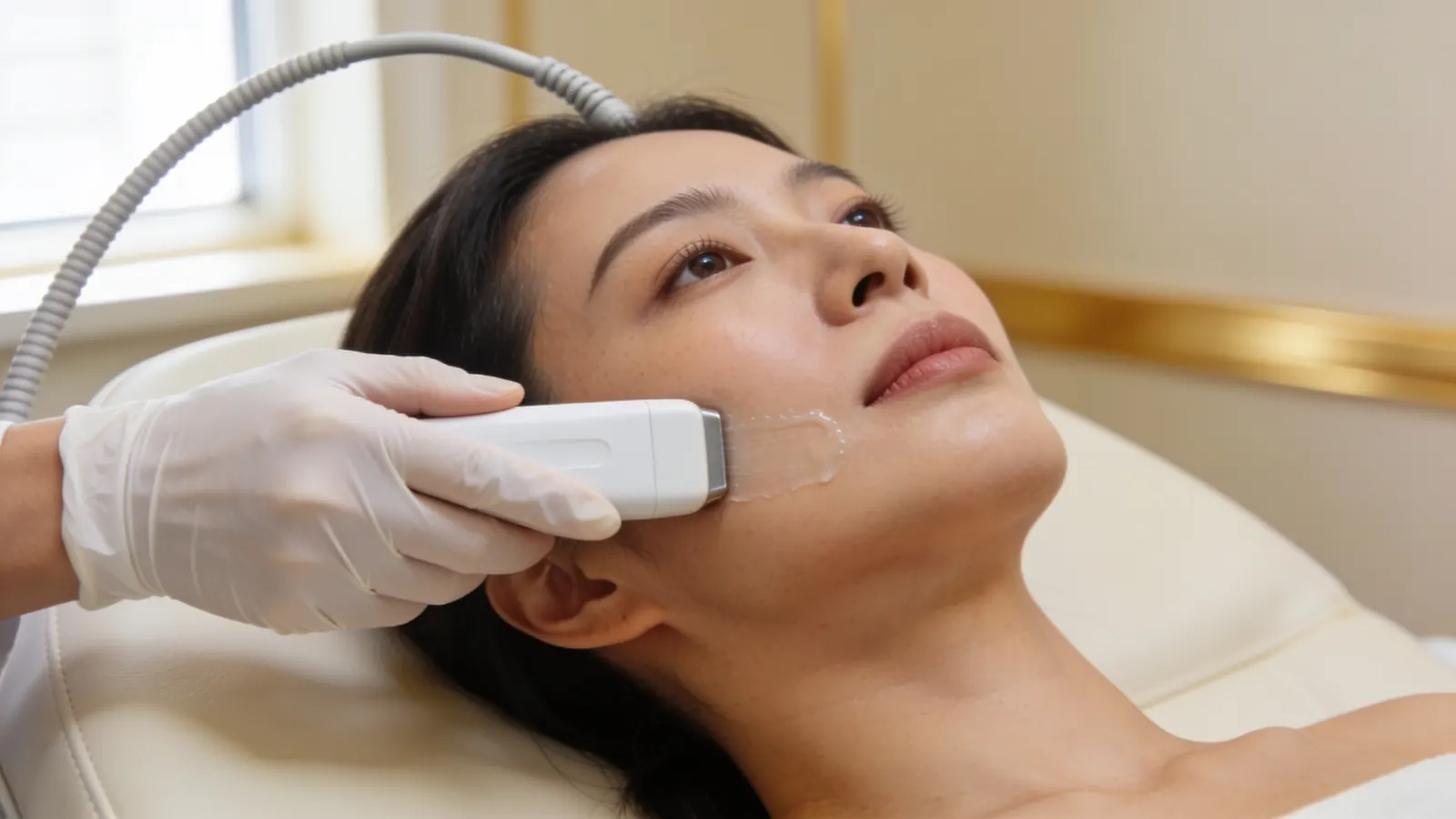
Illustrative image — not a patient.
History. Earlier hyaluronidase and any reaction to it, bee or wasp sting allergy, other allergies and medicines.
Skin test. Always, before any planned dissolving.
Ultrasound. The filler is mapped to see where it sits and whether it looks like hyaluronic acid, since the enzyme acts on nothing else.
A small first dose. Placed into the mapped filler, with a review at about 48 hours and further doses titrated to what remains (King 2018).
Consensus guidance on filler complications supports this staged, cause-first approach (Signorini 2016). If you know you have reacted to hyaluronidase before, or have a strong sting allergy, mention it when you book, so that the assessment can be planned around it. You do not need to have been treated here: filler placed elsewhere in Singapore or overseas is assessed in the same way. The wider guide is filler dissolving in Singapore, and if earlier dissolving did not help, see when filler dissolving has not worked.
Your next step
Not for emergencies. A change in vision or eye pain after filler: call 995 now. Pale, dusky or mottled skin, or pain that is getting worse: go now to the doctor who injected you, or to A&E. Do not message or book for these signs.
1. MessageWhatsApp +65 8023 7170 with what is bothering you. A reply comes from the clinic, not a bot.
2. AssessmentDr Sin Yong examines you himself on Orchard Road, with ultrasound where earlier filler is involved.
3. A plan in writingWhat he would do, what he would not, the fee factors, and the option of no treatment.
Every treatment is performed by Dr Sin Yong personally. Singapore Medical Council registered · invited to share his clinical expertise internationally for CLASSYS, DEKA, Fotona, Hironic and Ilooda.
Yes. Hyaluronidase, also called hyalase, can cause an allergic reaction, although this is uncommon. A systematic review of 106 patients with hyaluronidase allergy found that previous hyaluronidase injections and sensitisation from insect or wasp stings were the main risk factors, that many reactions happened at a second injection, and that the reactions responded to treatment (Guliyeva 2024).
Hyaluronidase has been in medical use since 1949 and is widely used for dissolving hyaluronic acid filler (Murray 2021). Swelling, redness, itch and bruising at the injection points are common and settle. Allergic reactions are uncommon. Dissolving more than was in excess can leave an area hollow, which is why doses are small and staged. Like any medicine, it has risks, and these are explained before any treatment.
For planned dissolving, Dr Sin Yong always does one: a small amount of hyaluronidase is injected just under the skin to check for a reaction before any treatment dose. Guidance lists bee or wasp sting allergy as a reason for extra care, and strong reactions to stings or earlier hyaluronidase injections call for careful assessment (Murray 2021). In an emergency, such as a blocked blood vessel, treatment is not delayed for a test.
A small amount of hyaluronidase is injected just under the skin, and the site is watched for redness, swelling, itching or a raised weal, and for any reaction elsewhere, such as hives. If there is no reaction, dissolving can go ahead with a small first dose. A test without a reaction is reassuring, but it cannot rule out a later reaction, so any itch, rash or swelling afterwards should be reported.
Tell the clinic before any treatment. Bee and wasp venom contain a similar enzyme, and guidance lists a history of sting allergy as a reason for extra care (Murray 2021). How severe your reaction to stings was matters: a strong reaction calls for careful assessment first, sometimes with an allergy specialist. Before any planned dissolving, Dr Sin Yong always does a skin test, and if it reacts, planned dissolving is usually not done.
Usually local swelling and itch around the injection points. Swelling or itching that spreads beyond the treated area or keeps increasing, or hives, which are raised, itchy welts on the face or body, need a call to the clinic straight away. Rarely, a reaction is severe: breathing difficulty, a tight throat, or spreading swelling of the face, lips, tongue or throat means calling 995 now.
Yes. A reaction can begin soon after the injection or appear later, sometimes a day or more afterwards, so watch for spreading swelling, itching or hives in the days after dissolving. Many reported reactions happened at a second injection (Guliyeva 2024), which is why any itch, rash or swelling after a first dose should be mentioned before more is given, even if it seemed minor.
If the skin test reacts, planned dissolving is usually not done, and a known allergy to hyaluronidase usually rules it out too (Murray 2021). The reaction is treated if needed and noted in your records, and it is worth telling any doctor who might treat you with filler in future. Strong or unclear reactions are sometimes assessed with an allergy specialist before any further decision.
Hyaluronic acid filler is normally dissolved with hyaluronidase, so a known allergy changes the plan. Hyaluronic acid does break down in the body over time, often more slowly than expected, and filler that is not causing a problem can be left. For filler that cannot be dissolved, Dr Sin Yong uses the Sculpting mode of Time Freeze Laser LCLR® for nodules large and small, without an incision; whether it suits a particular lump is decided after an ultrasound scan.
Yes. A blocked blood vessel after hyaluronic acid filler is an emergency, and treatment is not delayed for a skin test. Where the filler is hyaluronic acid, it is treated straight away with high doses under a separate protocol, not the small, staged doses of planned dissolving (Landau 2015; Murray 2021). A change in vision or eye pain after filler means calling 995 or going to the nearest emergency department now.
For planned dissolving, yes. Earlier hyaluronidase injections are one of the main risk factors for allergy, and many reported reactions happened at a second injection (Guliyeva 2024), so having had it before does not rule out a reaction. Dr Sin Yong always does a skin test before any planned dissolving, and asks about any itch, rash or swelling after earlier doses, including doses given at other clinics or overseas.
References
Allergic Complications of Hyaluronidase Injection: Risk Factors, Treatment Strategies, and Recommendations for Management. Aesthetic Plastic Surgery, 2024. source
Guideline for the Safe Use of Hyaluronidase in Aesthetic Medicine, Including Modified High-dose Protocol. Journal of Clinical and Aesthetic Dermatology, 2021. source
The Use of Hyaluronidase in Aesthetic Practice (v2.4). Journal of Clinical and Aesthetic Dermatology, 2018. source
Hyaluronidase Caveats in Treating Filler Complications. Dermatologic Surgery, 2015. source
Hyaluronidase for Dermal Filler Complications: Review of Applications and Dosage Recommendations. JMIR Dermatology, 2024. source
A Scoping Review of Hyaluronidase Use in Managing Complications of Aesthetic Interventions. Aesthetic Plastic Surgery, 2024. source
Global Aesthetics Consensus: Avoidance and Management of Complications from Hyaluronic Acid Fillers-Evidence- and Opinion-Based Review and Consensus Recommendations. Plastic and Reconstructive Surgery, 2016. source
About this page: written and medically reviewed by Dr Sin Yong, MBBS (NUS), MRCS (Edinburgh) · Last reviewed 26 October 2026 · Illustrative images only, not patients · Editorial policy
Not for emergencies. A change in vision or eye pain after filler: call 995 now. Pale, dusky or mottled skin, or pain that is getting worse: go now to the doctor who injected you, or to A&E. Do not message or book for these signs.