Filler complications Singapore: lumps, nodules, migration, a blue Tyndall tint and, rarely, vascular occlusion are the problems seen after filler and skin boosters. Pain, blanching or vision change is urgent and needs same-day care; a firm lump weeks or years later is assessed with ultrasound before anything is dissolved or treated. Dr Sin Yong sees filler done anywhere.
Why the nose is planned with particular care is explained in the nose filler Singapore guide.
Main guideDermal fillers — what it treats, who it suits, sessions, downtime and what decides the cost, by Dr Sin Yong.
Published 25 October 2026 · Reviewed by Dr Sin Yong
Filler nodule removal starts with identifying what the nodule is: filler, swelling, a reaction or a different product. Filler complications range from swelling and bruising to hard lumps, nodules, migration and, rarely, a blocked blood vessel. Hard lumps are more likely when filler, skin boosters and collagen stimulators have been layered in one area. Dr Sin Yong assesses them with ultrasound and, where it suits, targets the excess with the Sculpting mode of Time Freeze Laser LCLR®, without an incision.
Filler complications: what they are and how they show
Most filler treatments settle without trouble. When something does go wrong, it usually falls into one of a handful of patterns, and each has a different first step. The table sets out the common filler complications, when they tend to appear, what you notice and where each one is covered in detail.
Swipe sideways to see the whole table.
Complication
When it tends to show
What you notice
Read next
Swelling and bruising
The first days
Puffiness, tenderness, a bruise at the injection point
The last row is an emergency and is covered below and on the complication care page. The rest of this page is about the problem Dr Sin Yong is seeing more of: hard lumps that stay, often after filler and skin boosters have been mixed in the same part of the face.
Short answerFiller complications in Singapore include swelling, bruising, hard lumps, nodules, migration and, rarely, a blocked blood vessel, which is urgent. Hard lumps after filler and skin boosters are assessed with ultrasound first. Where it suits, Dr Sin Yong treats them with the Sculpting mode of Time Freeze Laser LCLR®, his own protocol, which is built to target the excess with no incision.
Filler, skin boosters and collagen stimulators placed in the same area can form hard lumps, nodules or changes in facial shape.
Compression
A hard lump can press on the surrounding tissue, and small red blood vessels can become visible over it.
Ultrasound first
The scan helps show what a lump is likely made of and how deep it sits before anything is planned.
Time Freeze Laser LCLR®
Dr Sin Yong's own protocol; its Sculpting mode is built to target excess material with no incision. No redness, no downtime.
Urgent signs
A change in vision means calling 995 or going to the nearest emergency department now; white, dusky or mottled skin or worsening pain means contacting the doctor who injected you straight away, or A&E.
Hard lumps after filler or skin boosters, and only offered surgery? Get assessed first: cutting filler out leaves a scar and can cause dents or nerve injury. Find out how Dr Sin Yong treats them without surgery.
Filler complications by problem, area and product
Whatever was injected, and whatever you were offered, get assessed first. Each page covers one problem: what it is, what the medical journals report, and what Dr Sin Yong does.
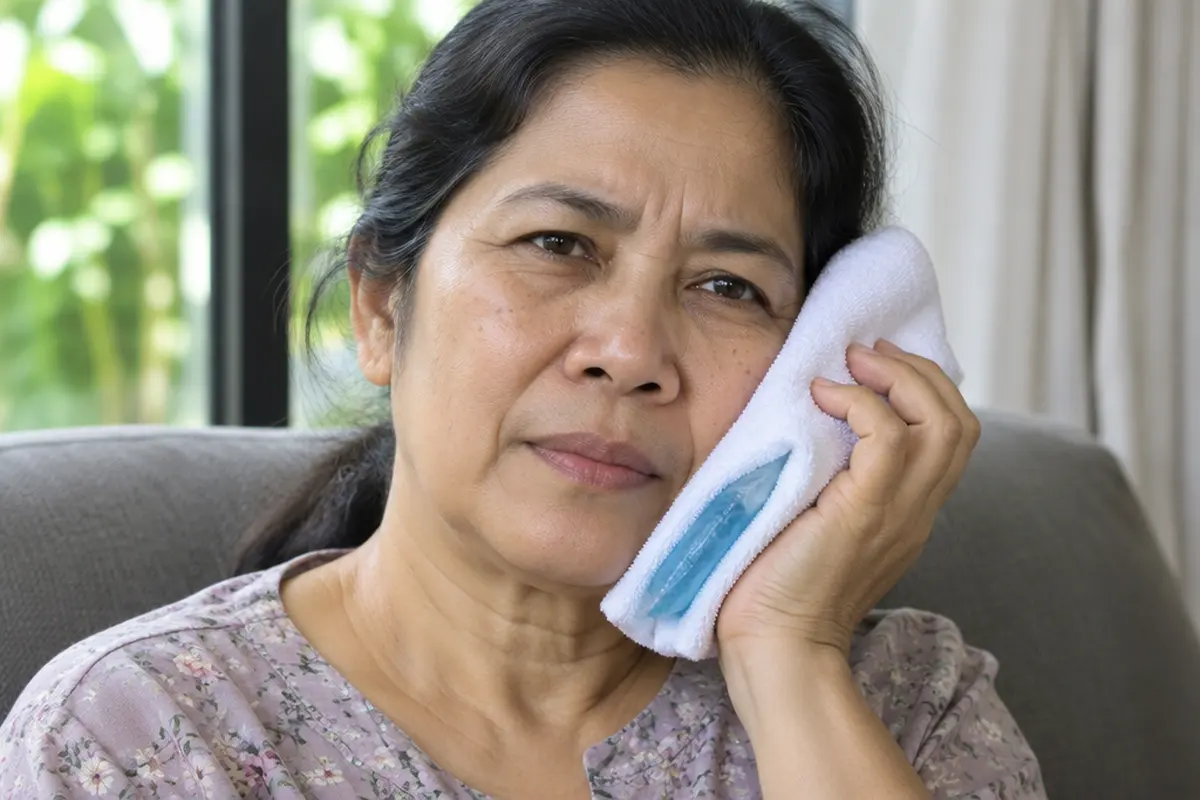
Dated photographs help show whether a change is settling or progressing. Illustrative image, not a patient.
A lump after filler is not one condition. It can be product placed too close to the surface or in too large an amount, product that has clustered or moved, a collagen response around the particles of a collagen-stimulating filler, inflammation linked to bacteria or an immune reaction, or a mix of all of these. What makes a lump feel hard is usually dense material, a capsule of collagen around it, or long-standing inflammation.
Illustrative image — not a patient.
Lumps after filler mixed with skin boosters
Dr Sin Yong has recently been seeing more patients whose lumps followed a mix of filler and skin boosters, sometimes placed over several years: a hyaluronic acid filler for volume, a skin booster for quality, and a collagen stimulator such as poly-L-lactic acid (PLLA), polycaprolactone (PCL), calcium hydroxylapatite (CaHA) or poly-D,L-lactic acid (PDLLA) for support. Each behaves differently in the tissue. Some stay where they are placed, some draw in water, and some prompt the body to lay down collagen around them.
The pattern is consistent: firm nodules that can be felt and sometimes seen, puffiness, heaviness or distortion that changes the natural shape of the face, and in some areas hard lumps that press on the tissue around them. Where that pressure sits close to the surface, small red blood vessels can become visible over the lump. Reports in the medical literature also describe lumps containing several different filler materials in the same sample, which makes them harder to diagnose by feel alone.
Why mixed lumps cannot simply be dissolved
Hyaluronidase dissolves hyaluronic acid and nothing else. Collagen stimulators, skin boosters that are not made of hyaluronic acid, and the collagen the body has built around them do not respond to it, so a lump made of mixed material cannot simply be dissolved. That is why the first question is always what the lump is made of, and why ultrasound comes before any plan.
“For hard lumps from mixed products, I use one tool, Time Freeze Laser LCLR®, to target the material without surgery.”
Dr Sin YongOn hard lumps after filler and skin boosters
Hard lumps by product: filler, collagen stimulators and skin boosters
The material inside a lump decides what can act on it. This is how the common products behave when they form a lump, and what is considered here.
Swipe sideways to see the whole table.
Product
Examples
Dissolved by hyaluronidase?
What is considered here
Hyaluronic acid filler
Most lip, under-eye and cheek fillers
Yes
Ultrasound-guided hyaluronidase for a deposit of hyaluronic acid alone; Time Freeze Laser LCLR® where it is layered with other products
Skin boosters
Hyaluronic acid boosters, polynucleotides
Only those made of hyaluronic acid
Ultrasound first; the Sculpting mode of Time Freeze Laser LCLR® for mixed or layered lumps
Calcium hydroxylapatite (CaHA)
Radiesse
No
The Sculpting mode of Time Freeze Laser LCLR® for excess collagen-stimulator material
Polycaprolactone (PCL)
Ellansé
No
The Sculpting mode of Time Freeze Laser LCLR® for nodules
Poly-L-lactic acid (PLLA)
Sculptra
No
The Sculpting mode of Time Freeze Laser LCLR® for nodules and migrated product
Poly-D,L-lactic acid (PDLLA)
Juvelook
No
The Sculpting mode of Time Freeze Laser LCLR® for excess product
Non-absorbable fillers
Silicone, PMMA, often from older or overseas treatments
No
Assessed individually with ultrasound
A lump that is infected or actively inflamed is treated medically before any device is considered. This does not mean skin boosters commonly cause lumps on their own; the pattern Dr Sin Yong is seeing involves products layered together. For more on the collagen-stimulator group, see collagen-stimulator nodules and migration and lumps after poly-L-lactic acid; lumps after calcium hydroxylapatite are covered in Radiesse lumps.
Hard lumps by area: lips, under the eyes, cheeks, chin and jawline
Where a lump sits changes what it is likely to be and how carefully it has to be approached.
Illustrative image — not a patient.
Lumps in the lips after filler
The lips are where lumps are noticed most, because the tissue is thin and constantly moving. A lump in the lip after filler can be a bead of product placed too superficially, an overfilled area, product that has moved beyond the lip border, or a late inflammatory nodule. A small pale bump inside the lip may be product or another lip condition, such as a mucous cyst, so it is examined before anything is done. See lip filler for how the lips are planned.
Lumps under the eyes
Under-eye skin is thin, so even a small amount of product can show as a ridge, puffiness or a blue tint. The under-eye filler lumps and nodules guide covers this area in full. Dr Sin Yong uses the Sculpting mode of Time Freeze Laser LCLR® under the eye too, after assessment and ultrasound.
Cheek, temple and mid-face lumps
Product in the cheeks and temples usually sits deeper, and collagen stimulators are often used here, so layered material is common. Lumps can be felt along the cheekbone or show as heaviness in the mid-face. See cheek fillers for how the area is normally treated.
Chin, jawline and nose
These areas take firm products placed on bone, so a lump can be product, a step in the contour or the bone itself, which is one reason ultrasound helps. The nose has a vessel pattern that calls for particular care. See chin enhancement for how the chin is assessed.
Is it normal to have a lump after filler?
In the first days after filler, some firmness, swelling and small irregularities are common, especially in the lips, and they usually settle as the swelling goes down. A lump is worth having assessed if it stays after the swelling has settled, appears later, feels hard, grows, or changes the shape of your face. What happens at that assessment, product by product, is set out on lump after filler.
Swipe sideways to see the whole table.
What you notice
What it can be
What is done first
A firm or hard lump you can feel
A nodule of filler or collagen-stimulator material, or a collagen response around it
Ultrasound to help show the material and its depth
Puffiness or heaviness that changes your face shape
Layered or excess product, sometimes with water drawn into it
Assessment of where the volume sits and which product it is
Small red vessels over a lump
A firm lump pressing on the surrounding tissue near the surface
The lump is assessed first, as the cause
Lumps in several areas after repeated treatments
Mixed products placed in the same areas over time
A history of what was injected, where and when, with ultrasound mapping
A lump that becomes red, hot, painful or quickly larger
Possible inflammation or infection
Prompt medical review, not a planned treatment visit
Should you massage a filler lump?
Only if the doctor who examined you has advised it. Gentle massage can help a soft, early irregularity of hyaluronic acid, but it does not help a hard nodule and can irritate an inflamed one. There is no safe way to dissolve filler at home: do not inject anything, apply heat devices or press hard on a lump. Contact a doctor instead.
When a lump or change after filler is urgent
Most lumps are not emergencies, but some changes after filler are. Skin that turns white, dusky or mottled, pain that is severe or getting worse, or blister-like spots can mean a blood vessel is affected: contact the doctor who injected you straight away, or go to A&E if you cannot reach them. Any change in vision after filler is an emergency: go to the nearest hospital emergency department or call 995.
How are filler complications managed? What consensus guidelines say
Two expert consensus papers set out how late reactions to hyaluronic acid filler are handled. A 2024 recommendation advises hyaluronidase for reactions that are not inflamed and not infected. For inflamed reactions it advises watchful waiting or steroid treatment. Infections need drainage, a bacterial culture and antibiotics, and hyaluronidase is not the first step.
A 2020 panel reached a similar stepwise approach, with some members preferring to wait from 48 hours to two weeks before dissolving. On frequency, one centre's review of 1,029 patients found delayed nodules in 1.0% of those given one type of gel. Both papers stress that each case is assessed individually, which is why a lump is examined, and scanned where needed, before anything is injected into it.
Is surgery the only option for hard filler lumps?
Surgical removal is one route for hard lumps, but not the only one. Dr Sin Yong uses the Sculpting mode of Time Freeze Laser LCLR® for nodules large and small, after mapping them with ultrasound, without an incision. Surgery carries its own risks, set out below.
Swelling after an injection is expected for a few days; swelling that is worsening is not. Illustrative image, not a patient.
What surgical removal of filler can involve
Nerve injury. Facial nerves run close to many filler areas. Injury can cause numbness, facial weakness or asymmetry.
Scarring. Removing material through the skin leaves a scar, and on the face a scar can be visible.
Dents and contour change. Where the lump is woven into deeper structures, removing it can disturb them and leave a dent or an irregular contour.
Published options for filler nodules also include medical treatment for infection or inflammation, and laser-based treatment, which has been described in the medical literature with ultrasound used to plan it. Those studies used a different technique, with a laser fibre placed inside the lump. The question at assessment is whether the material can be targeted without an incision first, and that is decided from the ultrasound, the type of product and where it sits, not from the size of the lump alone.
How Time Freeze Laser LCLR® targets hard lumps without an incision
LCLR® stands for Laser Collagen Lipo Remodelling. It is a proprietary protocol developed by Dr Sin Yong on a long-pulsed 755 nm and 1064 nm laser platform, and he performs every treatment himself. Its Sculpting mode is built to target excess material. For filler complications, it is the tool he uses on hard lumps from mixed products: PCL nodules, excess PDLLA, layered hyaluronic acid and migrated PLLA, including where these have been combined with skin boosters.
Motion graphic, not to scale: how a hard lump forms after filler and skin boosters, how ultrasound maps it, and how the Sculpting mode of Time Freeze Laser LCLR® targets the excess.Video transcript
How a hard lump forms after filler and skin boosters. Diagram, not to scale.
A cross-section of facial tissue builds up layer by layer: skin, fat, muscle and bone.
Different products, same area: hyaluronic acid filler, skin booster and collagen stimulator, placed at different times.
They merge into one firm lump with a thin capsule, pressing on surrounding tissue. Small red vessels can show above it.
An ultrasound probe glides across the skin, mapping the material and its depth; the lump outline is traced in gold.
Time Freeze Laser LCLR®, Sculpting mode: laser energy is directed at the mapped area, built to target the excess material.
Ultrasound first. No incision. Response varies from person to person. Dr Sin Yong, Orchard Road, Singapore.
Why it suits mixed material
Because it does not depend on dissolving one particular product, the same approach can be used where hyaluronic acid, a skin booster and a collagen stimulator sit together. The energy is directed at the area ultrasound has mapped, and the skin is not opened or cut.
What the treatment is like
No incision and no stitches.
No redness, no downtime.
The treated area is reassessed before you leave, and the plan for any further visit is set from what is seen.
Every face and every lump is different, so the response varies from person to person. Like any medical treatment, laser has its own risks and limits, which Dr Sin Yong explains at the assessment alongside the alternatives. How it compares with dissolving is set out in hyaluronidase vs Time Freeze Laser LCLR®. Which nodules the mode is used for, and when it is not, are set out in the Sculpting mode of Time Freeze Laser LCLR®.
Why skin-tightening devices are not the tool for hard lumps
Some patients arrive having already tried skin-tightening treatments for their lumps. High-intensity focused ultrasound, such as Ultherapy, and monopolar radiofrequency, such as Thermage, heat chosen layers of tissue so that the skin tightens over time. They are designed and studied for tightening loose skin, not for removing filler, so they are not a reliable way to treat a hard lump.
Dr Sin Yong uses these devices for what they are built for, loose skin, and uses the Sculpting mode of Time Freeze Laser LCLR® for excess material, because it is directed at the area ultrasound has mapped. What each lifting device actually does is compared on HIFU in Singapore.
What happens at a filler complications assessment
History. What was injected, where, when and by whom, as far as is known, along with any treatment already tried.
Examination and ultrasound. Each lump is felt, photographed and mapped with ultrasound to help show what it is and how deep it sits.
The plan. Dr Sin Yong explains what he would treat, what he would not, and what decides the fee, in writing.
Treatment. Where it suits, the Sculpting mode of Time Freeze Laser LCLR® is applied to the mapped areas.
Before you leave. The area is reassessed and aftercare is explained.
Ultrasound first: what the scan shows
Different fillers look different on ultrasound. The scan helps tell hyaluronic acid from collagen-stimulator material, even when you do not know what was injected. It also shows how deep a lump sits and how it relates to nearby vessels.
Illustrative image — not a patient.
It helps show whether a lump is filler at all, because a lymph node, cyst or swelling can feel similar under the finger. Where the picture is still unclear, further tests may be needed.
What to bring
The names of the products used, the dates and the clinic notes or receipts if you have them, photos from before treatment, and a list of your medicines. If you have no records, the assessment still goes ahead.
Treated elsewhere or overseas
You do not need to have been treated here. Doctors can refer patients with suspected filler complications, as set out on for GPs: when to refer, and patients travelling from overseas can plan their visit through international patients.
Aftercare in broad terms
Normal skincare and make-up can be resumed as advised on the day. Avoid massaging or pressing on treated lumps unless you have been told to, and contact the clinic promptly if an area becomes red, hot, painful or larger.
What decides the plan for filler complications
There is no single plan for every lump. The approach and the fee are set from what the assessment finds:
The products involved, and whether they are mixed or layered.
How many lumps there are, how large they are and how deep they sit.
The area: the lips, under the eyes, the cheeks, the chin, the jawline or elsewhere.
Whether the lump is stable or shows signs of inflammation or infection.
How long ago the products were placed, and what has already been tried.
Fees are explained at the consultation once the lumps have been assessed. See how we quote for what is and is not included.
Filler complications: further questions
These further questions about filler complications in Singapore are answered as at an assessment.
How common are filler complications?
Mild effects such as swelling, tenderness and bruising are common after any filler and usually settle. Lumps, migration, a bluish tint and delayed swelling are less common, and serious events such as a blocked blood vessel are rare but recognised in every area of the face. The risk rises with large volumes, repeated layering over old product, placement close to the surface, and the area treated, which is why planning matters as much as technique.
Which filler complications are serious?
A blocked blood vessel is the one that cannot wait: skin that turns pale, dusky or mottled, or pain that is getting worse, needs the injecting doctor or A&E now, and any change in vision or eye pain means calling 995. Infection, with a red, hot, painful or swelling lump and sometimes fever, also needs prompt medical care. Most other complications, such as lumps or migration, are assessed and planned rather than treated as emergencies.
Can filler complications be prevented?
The risk can be lowered, not removed. Choosing the material for the area, placing it in the right layer, keeping amounts modest, scanning for old filler before adding more, avoiding treatment over active infection, and having hyaluronidase on hand all help. So does knowing when not to inject. Dr Sin Yong lifts first where tissue has dropped and uses filler sparingly, which keeps the total amount of product in the face lower.
Tried other treatments and almost given up?
Many patients who come to see Dr Sin Yong about filler lumps and nodules tell him they have tried almost everything else and had given up hope. Having tried other treatments does not, on its own, rule out further options; what can be done depends on what the scan shows.
That history is useful. Knowing what was injected, when, and what has already been tried often explains why a problem has stayed: hyaluronidase acts only on hyaluronic acid and only where it reaches, some fillers are not hyaluronic acid at all, and swelling or fluid can look like filler. Ultrasound helps show which of these applies, and the plan starts from there. For material that cannot be dissolved, Dr Sin Yong uses the Sculpting mode of Time Freeze Laser LCLR® for nodules large and small, without an incision. How each person responds varies.
If you have been told nothing more can be done, it is still worth having the area scanned: ultrasound helps show what is there, and what, if anything, can be done is discussed from that. Bring any records of past treatments, product names and dates if you have them. More on this is in when filler dissolving has not worked.
How Dr Sin Yong approaches filler complications
Dr Sin Yong examines every patient himself on Orchard Road and maps each lump with ultrasound before anything is planned. His approach is to use the least invasive route that suits the material: hyaluronidase for hyaluronic acid and, for material that cannot be dissolved, the Sculpting mode of Time Freeze Laser LCLR®, which he uses for nodules large and small, without an incision.
He developed the LCLR® protocol himself and has presented it to international key opinion leaders in laser dermatology, and he has been invited to share his clinical expertise in Seoul, Dubai, Bangkok and São Paulo. He does not add more product to hide a lump. Where the face has lost shape because of the lumps, that is considered only after they have been addressed, so that new material is not placed on top of old.
Your next step
1. MessageWhatsApp +65 8023 7170 with what is bothering you. A reply comes from the clinic, not a bot.
2. AssessmentDr Sin Yong examines you himself on Orchard Road, with ultrasound where earlier filler is involved.
3. A plan in writingWhat he would do, what he would not, the fee factors, and the option of no treatment.
Every treatment is performed by Dr Sin Yong personally. Singapore Medical Council registered · invited to share his clinical expertise internationally for CLASSYS, DEKA, Fotona, Hironic and Ilooda.
Book a filler complications assessment with Dr Sin Yong on Orchard Road. How consultations work.
The most common filler complications are short-lived: bruising, swelling, redness and tenderness in the first days. Problems that last include lumps and nodules, unevenness, filler that has moved (migration), a bluish tint under thin skin (the Tyndall effect), an overfilled look and swelling that returns months later. Infection and a blocked blood vessel (vascular occlusion) are rare but need a doctor urgently.
In the first days, some firmness and swelling are common and usually settle as the swelling goes down. A lump that stays after that, appears later, feels hard, grows or changes the shape of your face is worth assessing. Ultrasound helps show what the lump is likely made of and how deep it sits, which shapes what can be done.
Some early lumps of hyaluronic acid soften as the product settles. Hard lumps, lumps from collagen stimulators and lumps from mixed products often do not, because dense material or a collagen capsule has formed around them. If a lump is still there once the swelling has settled, or it appeared later, have it examined rather than waiting.
Yes. Lumps can appear months or years after filler: delayed inflammatory nodules after hyaluronic acid, sometimes after an infection, a dental procedure or a vaccination elsewhere in the body, and lumps from collagen-stimulating fillers as collagen builds around the product. A late lump is a symptom rather than a diagnosis (Convery 2021), so one that is new, growing, red or tender should be examined rather than massaged. Ultrasound helps show what it is made of and how deep it sits.
Only if the doctor who examined you advises it. Gentle massage can help a soft, early irregularity of hyaluronic acid, but it does not break down a hard nodule and can irritate an inflamed lump. Do not try to dissolve filler at home, inject anything or use heat devices on a lump.
Lumps are more likely when a skin booster has been placed in the same area as filler or a collagen stimulator, sometimes years apart. The products behave differently in the tissue, and a firm nodule or a collagen response can form around them. Ultrasound helps show which material is involved before a plan is made.
Hyaluronidase dissolves hyaluronic acid only. Collagen stimulators such as PLLA, PCL, CaHA and PDLLA, skin boosters that are not made of hyaluronic acid, and the collagen built around them do not respond to it. That is why a lump made of mixed material needs a different plan, which is decided after ultrasound.
A non-surgical route is considered first. Lumps from Sculptra, Ellansé, Radiesse or Juvelook cannot be dissolved, so Dr Sin Yong maps them with ultrasound and uses the Sculpting mode of Time Freeze Laser LCLR®, which is built to target the excess with no incision, for nodules large and small. How each responds varies.
It depends on what the nodule is made of, which ultrasound helps show. Hyaluronic acid can be dissolved with hyaluronidase placed into the nodule. Nodules from collagen stimulators such as Sculptra, Ellansé, Radiesse or Juvelook cannot be dissolved; for these, Dr Sin Yong uses the Sculpting mode of Time Freeze Laser LCLR® for nodules large and small, without an incision. A nodule that is red, hot or tender is treated medically first. How each nodule responds varies.
Surgical removal can injure facial nerves, causing numbness, facial weakness or asymmetry. It leaves a scar, and where the lump is woven into deeper structures, removing it can leave a dent or an irregular contour. Dr Sin Yong's approach targets nodules large and small without an incision, using the Sculpting mode of Time Freeze Laser LCLR®. How each nodule responds varies, and the laser has its own risks and limits, which are explained at assessment. How each nodule responds varies, and the laser has its own risks and limits, which are explained at assessment.
A hard lump can press on the tissue around it, and where that happens close to the surface, small red blood vessels can become visible over it. The lump is treated as the cause and assessed first, with ultrasound, before anything is planned for the skin.
They are not designed to. High-intensity focused ultrasound, such as Ultherapy, and monopolar radiofrequency, such as Thermage, heat tissue layers to tighten loose skin. They are designed and studied for tightening, not for removing filler, so they are not a reliable way to treat a hard lump. For excess material, Dr Sin Yong uses the Sculpting mode of Time Freeze Laser LCLR®, directed at the area ultrasound has mapped.
No redness, no downtime. There is no incision and no stitches, and the treated area is reassessed before you leave. Aftercare is explained on the day, including avoiding pressing or massaging the treated lumps unless you have been told to.
Any doctor can assess a filler complication, and urgent signs such as a change in vision go straight to a hospital emergency department. Dr Sin Yong sees patients with lumps and other complications after treatment at other clinics, including patients referred by their own doctors, and maps each lump with ultrasound before planning treatment.
Yes. You do not need to have been treated here. Bring the product names, dates and any notes or receipts you have, and photos from before treatment. If you have no records, the assessment still goes ahead, because ultrasound can help show what is there and how deep it lies.
Filler nodules are firm lumps that appear weeks to years after filler, from product that has clumped, migrated or triggered an inflammatory reaction. Dr Sin Yong scans the nodule to identify the product and its depth; hyaluronic acid nodules are dissolved, inflammatory nodules may need medication first, and non-dissolvable nodules are treated with the Time Freeze Laser LCLR®.
Filler complications that patients in Singapore bring to Dr Sin Yong include hard lumps, migration, the Tyndall tint and overfilling, assessed with ultrasound before anything is dissolved. A blocked vessel is an emergency that needs the injecting doctor or A&E immediately, and any change in vision means calling 995.
Many are felt before they are seen: a bead, a firm pea-sized lump or a smooth ridge under the skin, which may show as a bump when you smile or in side light. Soft, even swelling in the first days is usually settling. A lump that is firm, tender, red or growing, or one that appears months later, is different. Dr Sin Yong examines it and scans it with ultrasound to see whether it is filler, which filler, and how deep it sits.
By what they are. Hyaluronic acid lumps are mapped with ultrasound and dissolved with a small dose of hyaluronidase; lumps from collagen stimulators, skin boosters or silicone, which do not dissolve, are treated with Time Freeze Laser LCLR® without an incision; red, warm or tender lumps are treated medically first. Massage is not advised unless the injecting doctor has asked for it.
Rarely, yes. Filler that enters an artery connected to the blood supply of the eye can block it; the nose, glabella and forehead are the commonest sites, and the tear trough and lips are also at risk. Warning signs are sudden severe pain, skin turning white or mottled, blurred or lost vision, or a drooping lid during or soon after injection. These need hyaluronidase and emergency care within minutes to hours, not a review appointment.
First contact the clinic that injected you, because the records show what was placed and where. Adverse events with a medical device such as a filler can be reported to the Health Sciences Authority, and concerns about the conduct of a doctor go to the Singapore Medical Council. If you simply want the problem assessed and treated, bring the product name, date and any photographs; Dr Sin Yong sees filler complications from any clinic or country.
References
Dermal fillers in aesthetics: an overview of adverse events and treatment approaches. Clinical, Cosmetic and Investigational Dermatology, 2013. source
Delayed-onset nodules and considering their treatment following use of hyaluronic acid fillers. Journal of Clinical and Aesthetic Dermatology, 2021. source
Foreign body granulomas after all injectable dermal fillers: part 2. Treatment options. Plastic and Reconstructive Surgery, 2009. source
Granulomatous reactions after injections of multiple aesthetic micro-implants in temporal combinations: a complication of filler addiction. Journal of the European Academy of Dermatology and Venereology, 2015. source
Persistent nodules on necklines following hyaluronic acid filler: a case report. Journal of Cosmetic Dermatology, 2025. source
Ultrasound detection and identification of cosmetic fillers in the skin. Journal of the European Academy of Dermatology and Venereology, 2012. source
Investigating the anatomic location of soft tissue fillers in noninflammatory nodule formation: an ultrasound-imaging-based analysis. Dermatologic Surgery, 2023. source
Intraarterial degradation of calcium hydroxylapatite using sodium thiosulfate: an in vitro and cadaveric study. Aesthetic Surgery Journal, 2021. source
Management of complications caused by permanent fillers in the face: a treatment algorithm. Plastic and Reconstructive Surgery, 2016. source
Aesthetic removal of foreign body granulomas of forehead via pretrichial approach. Journal of Craniofacial Surgery, 2022. source
Safety of radiofrequency treatment over human skin previously injected with medium-term injectable soft-tissue augmentation materials: a controlled pilot trial. Lasers in Surgery and Medicine, 2006. source
The effect of combined hyaluronic acid dermal filler and microfocused ultrasound treatment: a clinicopathological study. Journal of Cosmetic Dermatology, 2023. source
Baranska-Rybak W, Lajo-Plaza JV, Walker L, Alizadeh N. Late-Onset Reactions after Hyaluronic Acid Dermal Fillers: A Consensus Recommendation on Etiology, Prevention and Management. Dermatology and Therapy, 2024. doi.org
Artzi O, Cohen JL, Dover JS, Suwanchinda A, Pavicic T, Landau M, et al. Delayed Inflammatory Reactions to Hyaluronic Acid Fillers: A Literature Review and Proposed Treatment Algorithm. Clinical, Cosmetic and Investigational Dermatology, 2020. doi.org
Sadeghpour M, Quatrano NA, Bonati LM, Arndt KA, Dover JS, Kaminer MS. Delayed-Onset Nodules to Differentially Crosslinked Hyaluronic Acids: Comparative Incidence and Risk Assessment. Dermatologic Surgery, 2019. doi.org
About this page: written and medically reviewed by Dr Sin Yong, MBBS (NUS), MRCS (Edinburgh) · Last reviewed 7 November 2026 · Illustrative images only, not patients · Editorial policy