Published 26 October 2026 · Reviewed by Dr Sin Yong
Ridges on the forehead, a heavy brow, swollen upper eyelids or a puffy temple: forehead and temple filler can go wrong months or years later, and many people are then offered surgery. An operation here leaves a scar and, at the temple, works close to the nerve that lifts the brow. Dr Sin Yong maps the filler with ultrasound and treats it without an incision. Get assessed first.
Short answerGet assessed before you agree to surgery. Forehead and temple filler can leave ridges and bumps, a heavy brow or temple swelling, and it can move into the upper eyelids, sometimes years later (Lin 2021; El Feghaly 2026). Ultrasound shows where the filler sits and what it is likely made of. Hyaluronic acid is dissolved after a skin test. Dr Sin Yong treats Sculptra, Radiesse, silicone and other material that cannot be dissolved with the Sculpting mode of Time Freeze Laser LCLR®, without an incision. Vision change or eye pain after filler: call 995.
Get assessed. Cutting filler out of the forehead or temple leaves a scar, can leave a dent, can injure the nerve branch that lifts the brow, and cannot be undone.
Emergency
A change in vision or eye pain after forehead, glabella or temple filler means calling 995 now; pale, dusky or mottled skin, or pain that is getting worse, needs urgent assessment by the doctor who injected you or at A&E.
Years later
Upper-eyelid swelling from hyaluronic acid that had moved has been reported 5.5 years after brow filler and 2 years after temple filler (Lin 2021; El Feghaly 2026).
Not only hyaluronic acid
Of 116 people with temple filler scanned in Beijing, 48 had polyacrylamide gel, 31 fat, 27 hyaluronic acid, 7 hydroxyapatite and 2 silicone oil (Jiang 2023).
Hyaluronic acid
Dissolved in small, mapped doses after a skin test, with a review at about 48 hours.
Cannot be dissolved
Sculptra, Radiesse, silicone and polyacrylamide gel are treated with the Sculpting mode of Time Freeze Laser LCLR®, without an incision.
Forehead or temple filler gone wrong, and offered surgery? Read this first
Patients come to Dr Sin Yong after being told that filler in the forehead, brows or temples has to be cut out, that eyelid surgery is the answer to swollen upper lids, or that nothing more can be done. Before you agree to an operation, know what it means:
A scar. Every cut through the skin of the face heals with a scar.
A dent. Cutting out a lump takes tissue with it, and the area can heal hollow or uneven.
Nerve injury. Nerves that give the face feeling and movement run close to where filler sits. An injured nerve can leave numbness, or weakness in a smile, a lip or a brow.
Product left behind. Filler spread through tissue is hard to remove completely.
No way back. Tissue that has been cut out cannot be put back.
At the temple there is more. The branch of the facial nerve that lifts the brow crosses the temple near the outer end of the brow (Shin 2023), and an injured branch can leave the brow unable to lift. The facts are set out in surgery for forehead or temple filler below.
In Dr Sin Yong's practice, almost every hard lump is treated without surgery. If yours is one of the few that needs surgery, you are told plainly, and why. He maps the filler with ultrasound, dissolves hyaluronic acid, and treats Sculptra, Radiesse, silicone and other material that cannot be dissolved with the Sculpting mode of Time Freeze Laser LCLR®, without an incision. A red, hot or tender lump is treated medically first.
60-second forehead or temple filler check
Not for emergencies. A change in vision or eye pain after filler: call 995 now. Difficulty breathing, a tight throat, swelling of the tongue or throat, or swelling that spreads quickly across the face: call 995 now. Pale, dusky or mottled skin, or pain that is getting worse: go now to the doctor who injected you, or to A&E. A red, hot or draining lump, or a fever: a doctor the same day; if no doctor can see you today, A&E. Do not use this check or WhatsApp for these signs.
Answer three questions and send them straight to the clinic on WhatsApp. Dr Sin Yong will let you know whether an ultrasound assessment is worthwhile. No obligation.
1 · When was it injected?
2 · What bothers you most?
3 · Have you been offered surgery for it?
Your answers open in your own WhatsApp app; nothing is stored on this page.
What goes wrong with forehead, brow and temple filler
Problems after filler in the upper face fall into a few patterns, and many people have more than one. A review of filler problems that do not involve blood vessels sorts nodules, granulomas, migration and infection into early and delayed, and stresses recognising them by when they appear and managing them early (Hong, Diagnostics 2024).
Swipe sideways to see the whole table.
What you notice
What it usually is
What Dr Sin Yong does
Ridges, bumps or beads on the forehead that move with expression
Filler placed too close to the surface, or too much in one place
Maps each lump; dissolves hyaluronic acid; treats other material with the Sculpting mode
A forehead that looks too full or too rounded
Overfilling, often from layers added over the years
Scans how much is there and what it is; dissolves excess hyaluronic acid in stages
Swollen or hooded upper eyelids, or a heavy brow, sometimes years later
Filler that has moved down from the brows, forehead or temples
Maps how far it has spread; dissolves migrated hyaluronic acid where it lies
A puffy temple, or temple swelling that comes and goes
Too much filler, filler in the wrong layer, or a delayed reaction
Scans to tell filler from swelling; treats according to what the scan shows
A blue or grey tint in the temple
Hyaluronic acid sitting too close to thin skin
Maps the superficial gel; dissolves it in small doses
A firm lump after Sculptra or Radiesse in the temples
A collagen stimulator that has gathered into a nodule
Maps it; treats it with the Sculpting mode of Time Freeze Laser LCLR®, without an incision
Lumps or swelling years after injections of unknown material
Silicone, polyacrylamide gel or another non-absorbable filler
Maps it; treats it with the Sculpting mode, without an incision
A red, hot or tender lump
Inflammation or infection
Treats it medically first, before any dissolving or laser
Pale, dusky or mottled skin, pain getting worse, or any change in vision
A blocked blood vessel
Emergency: see the next section
An overfilled forehead has a name in the literature. A review of facial overfilled syndrome lists ‘flowerhorn’ foreheads among its presentations, attributes the syndrome to excessive filler and poor technique, and notes that it is reported mainly in people of East Asian descent (Lim 2024).
“For hard lumps from mixed products, I use one tool, Time Freeze Laser LCLR®, to target the material without surgery.”
Dr Sin YongOn hard lumps from mixed fillers and skin boosters
Blocked blood vessel after forehead or temple filler: act at once
The forehead, the glabella (the area between the brows) and the temples carry a real risk of filler blocking a blood vessel. The arteries of the forehead and between the brows branch from the artery that supplies the eye, and those of the temple connect with it, so a blocked vessel can starve the skin of blood and, rarely, affect sight. It usually shows during or soon after the injection, sometimes later: act whenever it appears. The warning signs are pain out of proportion to what was done, skin that turns pale, then dusky, mottled or blue-grey, and any change in vision.
Urgent: a change in vision or eye pain after filler: call 995 now. Skin that turns pale, dusky or mottled, or pain that is getting worse, needs urgent assessment by the doctor who injected you, or at A&E, now. See the warning signs of a blocked blood vessel after filler.
Skin that is dying after a blocked blood vessel (necrosis) is an emergency. It needs urgent, more intensive care than a lump does, starting now. Do not wait to see whether these signs settle, and do not wait for an appointment. Hyaluronic acid blocking a vessel is dissolved at once, and a skin test is never allowed to delay it.
Difficulty breathing, a tight throat, swelling of the tongue or throat, or swelling that spreads quickly across the face, after any injection, including hyaluronidase, can be a serious allergic reaction: call 995 now. Itch, hives or swelling that spreads beyond the treated area: contact the clinic that injected you the same day.
A lump or swelling that is red, hot, tender or draining may be infected or inflamed. It is treated medically first, before any dissolving, laser or talk of surgery. Fever, or feeling unwell with a swollen lump, needs review the same day.
Forehead filler lumps, bumps and ridges
Over the forehead there is little soft tissue between the skin and the bone, and the muscle beneath moves every time you raise your brows. Filler placed too close to the surface, or too much in one place, shows as ridges, beads or bumps, often clearer with expression or in overhead light. Hyaluronic acid sitting just under the skin can also show as a blue or grey tint. Do not massage or press on a forehead lump yourself: it does not dissolve filler and can push it further.
Not every bump is misplaced filler. A lump can be a delayed reaction, a granuloma (a reaction around the product), a collagen stimulator or older filler that has gathered, or not filler at all, such as a cyst. Between the brows, the glabella is an area where filler can block a vessel, so a lump there is scanned before any needle goes in.
What decides the treatment is what each lump is made of. Hyaluronic acid ridges are dissolved in small, mapped doses aimed at the ridge rather than the whole forehead, because dissolving more than the excess can leave a hollow. Lumps that are not hyaluronic acid are treated with the Sculpting mode of Time Freeze Laser LCLR®, without an incision. Where the forehead was filled in layers over the years, the hyaluronic acid is dissolved first and what remains is treated afterwards. Lumps from every kind of filler are covered in hard lumps after filler, and what forehead filler is used for, and how it is placed, in forehead filler.
Forehead and brow filler migration: swollen eyelids and a heavy brow
Filler placed along the brows, in the forehead, between the brows or in the temples can move down into the upper eyelids, sometimes years later. It shows as puffy or swollen upper lids, a hooded look or a brow that feels heavy, and it is easily taken for droopy eyelid skin, an allergy or a thyroid problem. The published cases show how long it can take, and how easily it is missed:
Brow filler. A 52-year-old woman had long-standing swelling of both upper eyelids that looked like excess eyelid skin, 5.5 years after hyaluronic acid filler to both brows. Her blood tests were normal, a biopsy of the lid showed migrated hyaluronic acid, and hyaluronidase treated it (Lin 2021).
Below the brow and between the brows. A 54-year-old woman developed swollen upper eyelids, dry eyes and a dry nose 2 months after hyaluronic acid was placed along the bony ridge below the brow and in the glabella. She was seen 2 years after the injection; after tests by several specialists found no other cause, hyaluronidase injected where the filler had been placed, over 3 weeks, resolved her symptoms fully (Khalil 2020).
Temple filler. A 51-year-old woman had lasting swelling of both upper eyelids, with normal thyroid tests and a normal MRI of the eye sockets. Hyaluronic acid was found only during upper-eyelid surgery, and she then remembered having temple filler 2 years earlier. The authors note that hyaluronic acid can track from the temple along its gliding planes, and that surgery was needed because the diagnosis was delayed, unlike cases of filler placed around the eyes that resolved with hyaluronidase (El Feghaly 2026).
Fat in the forehead. In two people, fat injected to shape the forehead was followed by swelling of one upper eyelid, with hard, fixed lumps of 5 to 10 mm lying deep near the rim of the eye socket. The lumps were cut out under general anaesthesia and showed chronic inflammation with scarring, and the swelling, with a moderately drooping lid or a lid that did not close fully, improved afterwards (Paik 2013).
A heavy brow is not always migration: too much filler low on the forehead, or swelling, can weigh on the brow too. The scan shows where filler sits, how far it has spread and how deep it is. Tell whoever assesses you about any filler in the forehead, brows or temples, however long ago. Migrated hyaluronic acid is dissolved where it lies; migration elsewhere in the face is covered in filler migration.
Temple filler swelling and side effects
Some swelling, tenderness and bruising after temple filler is expected; normal swelling eases steadily rather than growing. Swelling that does not settle, keeps coming back or appears months later is different and is worth a scan.
The temple is a stack of thin layers, with arteries and a large vein running through it at known levels, and filler can sit in any of them. Too much filler, or filler in the wrong layer, can widen the upper face, show as a puffy temple or make veins more visible under thin skin, and gel placed too close to the surface can show as a blue tint. Hyaluronic acid can also track from the temple into the upper eyelids (El Feghaly 2026). A temple that is red, hot, swollen or tender may be inflamed or infected, and it is treated medically first.
Temple fillers are not only hyaluronic acid. In 116 people with temple filler scanned in Beijing, the material was polyacrylamide gel in 48, fat in 31, hyaluronic acid in 27, hydroxyapatite in 7 and silicone oil in 2, and each looked different on high-frequency ultrasound (Jiang 2023). Many people do not know what was put in their temples, especially after treatments years ago or overseas, which is one more reason the scan comes first. What temple filler is used for is covered in temple filler, and treatment done abroad in correction of filler done overseas.
Hyaluronic acid, Sculptra, Radiesse or old silicone: what dissolves and what does not
Hyaluronidase acts on hyaluronic acid only. Collagen stimulators used in the temples, such as poly-L-lactic acid (Sculptra) and calcium hydroxylapatite (Radiesse), do not dissolve, and neither do silicone, polyacrylamide gel or fat. When a collagen stimulator gathers into a nodule, or old silicone or gel causes lumps or swelling, patients are often told the only option is to cut it out.
Swipe sideways to see the whole table.
Material
Examples
Dissolved by hyaluronidase?
What a lump usually is
How Dr Sin Yong approaches it
Hyaluronic acid
Used in the forehead, brows and temples
Yes
Gel too close to the surface, too much in one place, or gel that has moved
Maps it; dissolves the excess in small doses after a skin test
Poly-L-lactic acid
Sculptra
No
Product that has gathered into a nodule
Maps it; treats it with the Sculpting mode
Calcium hydroxylapatite
Radiesse
No
Particles that have gathered into a nodule
Maps it; treats it with the Sculpting mode
Hyaluronic acid with calcium hydroxylapatite
HArmonyCa
Only the hyaluronic acid part
A firm lump of mixed material
Dissolves the hyaluronic acid; treats what remains with the Sculpting mode
Silicone, polyacrylamide gel and polyalkylimide
Older injections, often years ago or overseas
No
Oil or gel spread through the tissue, sometimes with a reaction around it
Maps how far it has spread; treats infection medically first; treats the lumps with the Sculpting mode
Fat graft
Fat transfer to the forehead or temples
No
Lumps of graft, sometimes with scarring around them
Maps it; treats excess graft with the Sculpting mode
Layered products
Several products in one area over the years
Only the hyaluronic acid part
Hyaluronic acid sitting over an older filler
Dissolves the hyaluronic acid first, then treats what remains with the Sculpting mode
Material that cannot be dissolved can still be treated without an incision. Dr Sin Yong treats Sculptra, Radiesse, Ellansé, Juvelook, silicone, polyacrylamide gel, PMMA and excess fat graft with the Sculpting mode of Time Freeze Laser LCLR®, his own protocol on a long-pulsed 755 nm and 1064 nm laser platform, directed at the mapped lump. Like any laser, it can cause blistering or a change in skin colour, so settings are chosen for your skin. Near the brows and eyelids, settings are kept conservative and the eyes are protected.
Old silicone and gels need particular care. On the scan, silicone oil in the temple shows as a bright ‘cloud’ that hides the tissue beneath it, and polyacrylamide gel as patchy dark areas that can pool into cysts or spread, and that move under the probe (Jiang 2023). These materials also travel. In a case series with a review of the literature, silicone from facial filler, and in other cases from breast implants, had moved to the eyelids and formed foreign-body granulomas (Neerukonda 2023). In 16 women, polyalkylimide gel (Bio-Alcamid) injected into the bridge of the nose, the temple or the cheek caused eyelid swelling 3 to 7 years later; all had the mass around the eye cut out, 14 had an uneventful course, one was left with a retracted eyelid and one had a recurrence 3 years later (Alharbi 2019). More is in Sculptra lumps, Radiesse lumps and silicone filler lumps.
Ultrasound first: what the scan shows in the forehead and temples
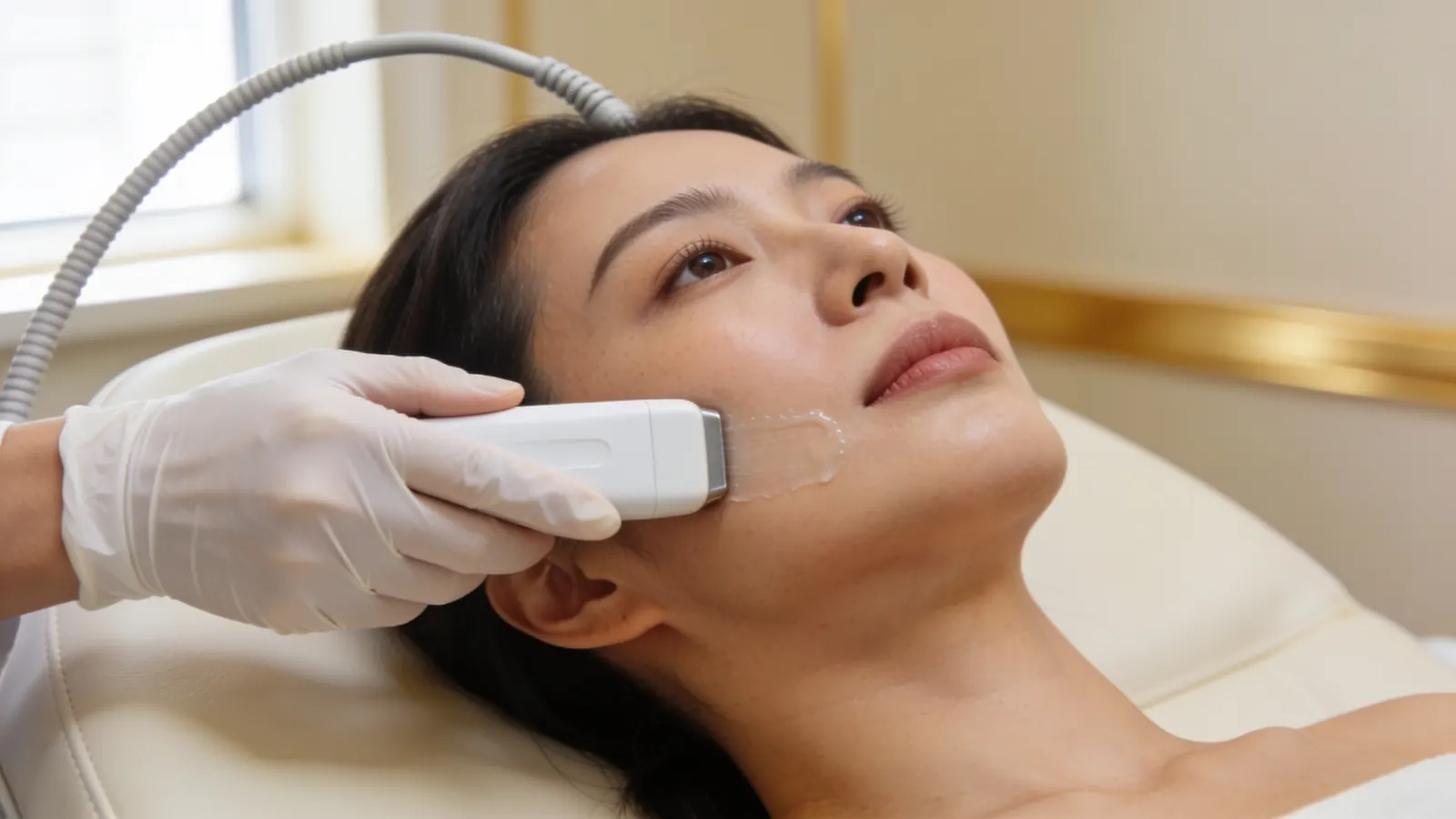
Ultrasound shows where the filler sits, how deep it is and how far it has spread, and what it is likely made of. In the temple, where thin layers and the vessels that cross them lie close together, that matters before any needle goes in. Different temple fillers look different on high-frequency ultrasound: hyaluronic acid as a dark, well-defined pocket without blood flow, fat as darker lobules, hydroxyapatite as bright deposits that cast a shadow, polyacrylamide gel as patchy areas that move under the probe, and silicone oil as a bright cloud (Jiang 2023).
Illustrative image — not a patient.
An international consensus of 15 experts from seven specialties calls ultrasound mandatory for managing filler complications, recommends identifying fillers already in place before injecting, and calls ultrasound guidance necessary for precise injections into a lump (Velthuis 2025). At one ultrasound reference centre, in 52 problems after hyaluronic acid filler that did not involve blood vessels, scanning with blood-flow imaging helped avoid unnecessary treatment (Gonzalez 2024). The scan guides the enzyme in an emergency too: in a study of blocked vessels after filler, ultrasound-targeted hyaluronidase used a mean of 122.5 units, against 1,519.4 units when the whole region was flooded (Schelke, Aesthet Surg J 2023).
The scan shows what a lump is likely made of; it does not prove it, and where a lump does not look like filler, further tests are arranged. Dr Sin Yong performs the scan himself, and the plan follows what it shows. More on scanning is in ultrasound-guided filler correction.
Dissolving forehead and temple hyaluronic acid: skin test, small doses, review
Hyaluronic acid in the forehead, brows or temples can be dissolved with hyaluronidase, an enzyme that acts on hyaluronic acid only. Dr Sin Yong dissolves in steps:
Mapping. The filler is scanned so the enzyme goes into the ridge, the bump or the part that has moved, not into filler that is still where it belongs, and so the needle keeps clear of the vessels that cross the forehead and temple.
Allergy history. Past reactions to bee or wasp stings, and any earlier hyaluronidase injections, are asked about.
Skin test. Before planned dissolving, Dr Sin Yong always does a skin test: a small amount of hyaluronidase is injected just under the skin to check for a reaction. In an emergency such as a blocked blood vessel, dissolving is never delayed for a test.
A small first dose goes into the mapped filler.
Review at about 48 hours, once the enzyme has acted, with any further dose based on what remains.
Refilling, if wanted at all, waits at least two weeks.
Surgery for forehead or temple filler: what it involves
Surgery to remove filler from the forehead or temples means cutting it out, through the skin over it or through incisions placed where scars show less, and separating it from the tissue it has spread into. If filler that has moved into the upper eyelids is removed surgically, it is through eyelid surgery. A group that operated on 231 people with non-absorbable filler in the face, the forehead and glabella among the sites, states that surgical excision is the only way to take such filler out, chose standard cosmetic-surgery approaches to avoid cutting directly over it and leaving visible scars, and reports improved appearance and satisfaction scores (Pascali 2023).
The nerve is the main concern at the temple. The frontal branch of the facial nerve, also called the temporal branch, lifts the brow. In a study of 45 half-faces from Korean cadavers, done to guide brow-lift surgery, it curved forward across the temple near the outer end of the brow, within a thin fascial layer, and divided into three branches; the authors advise keeping the surgical plane closer to the skin about 3 cm above and outside the outer corner of the eye to avoid paralysing the brow (Shin 2023). A review of facial nerve anatomy for surgery, covering the temple and forehead among other regions, describes considerable variation in the nerve's course and branching, with higher surgical risk where it runs superficially or unpredictably (Sagkriotis 2026).
Swipe sideways to see the whole table.
Approach
What it involves
Incision
What to weigh up
Surgical removal from the forehead or temple
Cutting out filler or a granuloma with the tissue it has spread into
Yes
A scar; a dent where tissue is removed; injury to the nerve branch that lifts the brow, or numbness of the forehead; product left behind; cannot be undone
Upper-eyelid surgery
Removing filler that has moved into the eyelid
Yes, in the eyelid
A scar in the lid; a change in the shape or position of the lid; filler left elsewhere; cannot be undone
Hyaluronidase
Enzyme injected into mapped hyaluronic acid
None; fine needle
Acts on hyaluronic acid only; skin test first; too much can leave a hollow
Sculpting mode of Time Freeze Laser LCLR®
Laser directed at mapped material that cannot be dissolved
None
Can cause blistering or a change in skin colour, so settings are chosen for your skin
Medical treatment
Treatment for inflammation or infection
None
Comes first for a red, hot or tender lump
Waiting
Review over time
None
Reasonable for a small change that does not bother you
Surgery has a place. After fat lumps near the eye socket were cut out, the eyelid swelling, and a drooping lid or a lid that did not close fully, improved (Paik 2013), and 14 of 16 women had an uneventful course after migrated gel was removed from around the eyes (Alharbi 2019). Some lumps do need a procedure: an abscess may need draining, and a lump that does not look like filler on the scan may need a tissue sample. The point is the order: the scan first, the decision after. Get assessed before you agree to an operation: it can still be done later if it is ever needed, but it cannot be undone. More is in filler removal surgery.
Tried other treatments and almost given up?
Many patients who come to see Dr Sin Yong about forehead or temple filler problems tell him they have tried almost everything else and had given up hope. Having tried other treatments does not mean nothing more can be done: what is done next depends on what the scan shows.
That history is useful. Knowing what was injected, when, and what has already been tried often explains why a problem has stayed: hyaluronidase acts only on hyaluronic acid and only where it reaches, some fillers are not hyaluronic acid at all, and swelling or fluid can look like filler. Ultrasound helps show which of these applies, and the plan starts from there. For material that cannot be dissolved, Dr Sin Yong uses the Sculpting mode of Time Freeze Laser LCLR® for nodules large and small, without an incision. How each person responds varies.
If you have been told nothing more can be done, it is still worth having the area scanned: ultrasound helps show what is there, and the plan is made from that. Bring any records of past treatments, product names and dates if you have them. More on this is in when filler dissolving has not worked.
How Dr Sin Yong treats forehead and temple filler gone wrong
Dr Sin Yong developed the Time Freeze Laser LCLR® protocol himself and performs every scan, every dissolving injection and every Sculpting mode treatment himself on Orchard Road. He has been invited to share his clinical expertise in Seoul, Dubai, Bangkok and São Paulo, including as a Global Key Opinion Leader.
He does not add more filler to disguise a ridge, a heavy brow or a swollen temple. The excess is dealt with first, the area is reviewed once it has settled, and only then is anything else discussed, including leaving it alone. You do not need to have been treated here, and having no records of what was injected is fine. More on the laser is in the Sculpting mode of Time Freeze Laser LCLR®.
Your next step
Not for emergencies. A change in vision or eye pain after filler: call 995 now. Pale, dusky or mottled skin, or pain that is getting worse: go now to the doctor who injected you, or to A&E. Do not message or book for these signs.
1. MessageWhatsApp +65 8023 7170 with what is bothering you. A reply comes from the clinic, not a bot.
2. AssessmentDr Sin Yong examines you himself on Orchard Road, with ultrasound where earlier filler is involved.
3. A plan in writingWhat he would do, what he would not, the fee factors, and the option of no treatment.
Every treatment is performed by Dr Sin Yong personally. Singapore Medical Council registered · invited to share his clinical expertise internationally for CLASSYS, DEKA, Fotona, Hironic and Ilooda.
Usually not. Get assessed first. If the filler is hyaluronic acid, it is dissolved with hyaluronidase after a skin test. Sculptra, Radiesse, silicone, polyacrylamide gel and fat cannot be dissolved, and Dr Sin Yong treats them with the Sculpting mode of Time Freeze Laser LCLR®, without an incision. In his practice, almost every hard lump is treated without surgery; if yours is one of the few that needs it, you are told plainly, and why. An operation leaves a scar, can leave a dent, can injure the nerve that lifts the brow, and cannot be undone.
Many of the patients Dr Sin Yong sees have tried other treatments first. A treatment that did not help can still leave options open: hyaluronidase may not have reached the filler, the filler may not be hyaluronic acid, or what looks like filler may be swelling or fluid. Ultrasound helps show which applies, and the plan follows what it finds.
Start with a scan, not more filler and not an operation, and do not massage or press on it. Ultrasound shows where the filler sits, how far it has spread and what it is likely made of, which decides what is dissolved and what is treated with the Sculpting mode of Time Freeze Laser LCLR®, without an incision. Emergency signs are different: a change in vision or eye pain means calling 995 now, and skin that turns pale, dusky or mottled, or pain that is getting worse, needs urgent assessment by the doctor who injected you or at A&E now, not a scan appointment.
Usually because filler sits too close to the surface or too much was placed in one spot. Over the forehead there is little soft tissue between the skin and the bone, so it shows as ridges or beads that move with expression. Other lumps are a delayed reaction, a granuloma, or a collagen stimulator or older filler that has gathered. The scan shows which. Hyaluronic acid is dissolved in small doses; other material is treated with the Sculpting mode of Time Freeze Laser LCLR®, without an incision.
Yes. Forehead filler can settle low over the brows and make them feel heavy, and filler along the brows, in the forehead or between the brows can move down into the upper eyelids, sometimes years later. Long-standing swelling of both upper lids that looked like excess eyelid skin was found to be migrated filler 5.5 years after brow filler (Lin 2021), and swollen lids with dry eyes followed filler below the brow and in the glabella (Khalil 2020). Both were hyaluronic acid, treated with hyaluronidase.
Hyaluronic acid can track from the temple along its tissue planes into the upper eyelids. In one woman, swelling of both upper lids, with normal thyroid tests and a normal MRI of the eye sockets, turned out to be hyaluronic acid found during eyelid surgery; she then recalled temple filler 2 years earlier. The authors note that surgery was needed because the diagnosis was delayed (El Feghaly 2026). An ultrasound scan before any operation looks for filler in the lids and the temple and shows where it sits.
Some swelling, tenderness and bruising after temple filler is expected; normal swelling eases steadily rather than growing. Swelling that stays, keeps coming back or appears months later is worth a scan: it can be too much filler, filler in the wrong layer, a delayed reaction or filler that has moved. A temple that is red, hot or tender is treated medically first. A change in vision or eye pain means calling 995 now; pale, dusky or mottled skin, or pain that is getting worse, needs urgent assessment by the doctor who injected you or at A&E.
Bruising, swelling and tenderness are common at first, and some people have brief numbness or tingling. Later problems include lumps, an overfilled temple that widens the upper face, veins that show more under thin skin, a blue tint from gel placed too superficially, filler moving into the upper eyelids, and infection. Rarely, filler blocks a blood vessel, which can damage the skin and affect sight. Sculptra and Radiesse cannot be dissolved, but lumps from them can still be treated without an incision.
Hyaluronic acid can, with hyaluronidase. Dr Sin Yong maps it with ultrasound, does a skin test first, and places a small first dose into the excess, with a review at about 48 hours before any more, because dissolving more than the excess can leave a hollow. Sculptra, Radiesse, silicone, polyacrylamide gel and fat do not dissolve. Material that cannot be dissolved can still be treated without an incision: he uses the Sculpting mode of Time Freeze Laser LCLR®.
Neither dissolves with hyaluronidase, but a lump from either can still be treated without an incision. On ultrasound, hydroxyapatite fillers show as bright deposits that cast a shadow (Jiang 2023). Dr Sin Yong maps the nodules and treats them with the Sculpting mode of Time Freeze Laser LCLR®. Where hyaluronic acid has been placed over them, that part is dissolved first. A red, hot or tender lump is treated medically before anything else.
Yes. Filler along the brows sits just above the upper eyelids and can drift down into them, sometimes years later, leaving swollen or hooded lids that are easily mistaken for droopy eyelid skin (Lin 2021). It can also leave lumps, a heavy brow or a blue tint. The brows and the area between them carry a real risk of a blocked blood vessel: pale, dusky or mottled skin, pain that is getting worse or any change in vision is an emergency, not a scan appointment. Other problems are scanned first, then dissolved or treated without an incision according to what they are.
A scar, a dent where tissue is removed, product left behind, and nerve injury. The branch of the facial nerve that lifts the brow crosses the temple near the outer end of the brow, and the authors of a cadaver study advise keeping the surgical plane closer to the skin in that area to avoid paralysing the brow (Shin 2023). After migrated polyalkylimide gel was cut out from around the eyes in 16 women, one was left with a retracted eyelid and one had a recurrence (Alharbi 2019). Surgery cannot be undone.
Yes, if the skin turns pale, dusky or mottled, or pain is getting worse. After filler in the forehead, between the brows or in the temples, these can mean a blocked blood vessel and need urgent assessment by the doctor who injected you, or at A&E. A change in vision or eye pain means calling 995 now. Skin that is dying after a blocked vessel needs urgent, more intensive care, starting the same day. Do not wait for an appointment.
Dr Sin Yong performs the ultrasound scan, the dissolving and every Sculpting mode treatment himself, on Orchard Road. It is not delegated to another doctor, a nurse or a therapist, so the same doctor follows the area from the first scan to the last review. You do not need to have been treated here, and having no records of what was injected is fine.
References
Topography of the frontal branch of the facial nerve and its clinical implication for temporal direct browplasty. Scientific Reports, 2023. source
Review of the Adverse Effects Associated with Dermal Filler Treatments: Part I Nodules, Granuloma, and Migration. Diagnostics, 2024. source
Exploring facial overfilled syndrome from the perspective of anatomy and the mismatched delivery of fillers. Journal of Cosmetic Dermatology, 2024. source
Delayed migration of soft tissue fillers in the periocular area masquerading as eyelid and orbital pathology. BMJ Case Reports, 2021. source
Chronic eyelid edema and xerophthalmia secondary to periorbital hyaluronic acid filler injection. Journal of Cosmetic Dermatology, 2020. source
Late-Onset Upper Eyelid Edema Following Temporal Hollow Correction With Hyaluronic Acid. Plastic and Reconstructive Surgery Global Open, 2026. source
Eyelid-associated complications after autogenous fat injection for cosmetic forehead augmentation. BMC Ophthalmology, 2013. source
The Application of High-frequency Ultrasonic Imaging in Identifying Fillers in the Temporal Region. Plastic and Reconstructive Surgery Global Open, 2023. source
Silicone Granulomas of the Eyelids-A Case Series Illustrating a Distant Migratory Phenomenon. Ophthalmic Plastic and Reconstructive Surgery, 2023. source
Long-term outcomes of surgically removed migrated polyalkylimide (bio-alcamid) filler to the periorbital area. Saudi Journal of Ophthalmology, 2019. source
The use of ultrasound imaging in aesthetic injectables: A modified Delphi consensus. Journal of Plastic, Reconstructive & Aesthetic Surgery, 2025. source
Ultrasonographic features of non-vascular complications of hyaluronic acid fillers: a retrospective study at a reference center for dermatologic ultrasonography. Clinics in Dermatology, 2024. source
Ultrasound-Guided Targeted vs Regional Flooding: A Comparative Study for Improving the Clinical Outcome in Soft Tissue Filler Vascular Adverse Event Management. Aesthetic Surgery Journal, 2023. source
Extratemporal Facial Nerve: Surgical Landmarks, Risk Zones, and a Practical Framework for Safe Dissection. Laryngoscope Investigative Otolaryngology, 2026. source
About this page: written and medically reviewed by Dr Sin Yong, MBBS (NUS), MRCS (Edinburgh) · Last reviewed 26 October 2026 · Illustrative images only, not patients · Editorial policy
Not for emergencies. A change in vision or eye pain after filler: call 995 now. Pale, dusky or mottled skin, or pain that is getting worse: go now to the doctor who injected you, or to A&E. Do not message or book for these signs.