Published 26 October 2026 · Reviewed by Dr Sin Yong
Liquid silicone and other non-absorbable fillers cannot be dissolved, and they can cause hard lumps or granulomas many years after injection. Many patients are then told the only answer is to cut them out. Silicone spreads into the tissue, so surgery leaves a scar, can leave a dent or injure a nerve, and can leave silicone behind. Dr Sin Yong treats silicone lumps without an incision. Get assessed first.
Short answerGet assessed before you agree to surgery. Silicone cannot be dissolved. It spreads into the surrounding tissue and can provoke foreign-body granulomas, sometimes years after injection (Trinh, Surg J 2022; Neerukonda 2023). Cutting it out leaves a scar, can leave a dent or injure a nerve, and can leave silicone behind. Dr Sin Yong maps silicone lumps with ultrasound and treats them with the Sculpting mode of Time Freeze Laser LCLR®, without an incision. A red, hot, tender or draining lump needs a doctor the same day, or A&E if no doctor can see you today, and is treated medically first.
Get assessed. Cutting silicone out leaves a scar, can cause dents or nerve injury, and can leave silicone behind.
Cannot be dissolved
Hyaluronidase acts on hyaluronic acid only, not on silicone, polyacrylamide gel, polyalkylimide or PMMA.
Late onset
Delayed lip nodules appeared on average 35.2 months after treatment, and silicone was the filler most often reported (Trinh, Surg J 2022).
Triggers
In 28% of 85 patients with late problems from non-absorbable fillers, symptoms began after dental work, more filler or other facial treatments (Kadouch 2013).
Ultrasound first
Dr Sin Yong scans each lump himself to see where the material sits, how far it has spread and what lies around it.
Without an incision
Dr Sin Yong treats silicone lumps with the Sculpting mode of Time Freeze Laser LCLR®; a red, hot or draining lump needs a doctor the same day (A&E if no doctor can see you today) and is treated medically first.
Silicone lumps, and only offered surgery? Read this before you agree to it
Patients come to Dr Sin Yong after being told that silicone, or another filler that cannot be dissolved, has to be cut out, or that nothing can be done. It is true that silicone cannot be dissolved. Before you agree to an operation, know what it means:
A scar. Every cut through the skin of the face heals with a scar.
A dent. Cutting out a lump takes tissue with it, and the area can heal hollow or uneven.
Nerve injury. Nerves that give the face feeling and movement run close to where filler sits. An injured nerve can leave numbness, or weakness in a smile, a lip or a brow.
Product left behind. Filler spread through tissue is hard to remove completely.
No way back. Tissue that has been cut out cannot be put back.
With silicone, the last two weigh most. Silicone does not stay in one neat pocket. It spreads into the tissue around it, so cutting it out takes that tissue too, and silicone can still be left behind.
In Dr Sin Yong's practice, almost every hard lump is treated without surgery. If yours is one of the few that needs surgery, you are told plainly, and why. That includes silicone. Dr Sin Yong maps each silicone lump with ultrasound and treats it with the Sculpting mode of Time Freeze Laser LCLR®, without an incision. Lumps from polyacrylamide gel, polyalkylimide and PMMA are mapped and treated the same way, once any infection has been treated. Lumps from every kind of filler are covered in hard lumps after filler or skin boosters.
60-second silicone or non-absorbable filler check
Not for emergencies. A change in vision or eye pain after filler: call 995 now. Difficulty breathing, a tight throat, swelling of the tongue or throat, or swelling that spreads quickly across the face: call 995 now. Pale, dusky or mottled skin, or pain that is getting worse: go now to the doctor who injected you, or to A&E. A red, hot or draining lump, or a fever: a doctor the same day; if no doctor can see you today, A&E. Do not use this check or WhatsApp for these signs.
Answer three questions and send them straight to the clinic on WhatsApp. Dr Sin Yong will let you know whether an ultrasound assessment is worthwhile. No obligation.
1 · When was it injected?
2 · What bothers you most?
3 · Have you been offered surgery for it?
Your answers open in your own WhatsApp app; nothing is stored on this page.
Liquid silicone injections: what silicone is and why it behaves differently
Liquid injectable silicone is silicone oil injected under the skin. A review of its history and complications separates medical-grade silicone, given by doctors as tiny droplets, from large volumes of industrial silicone injected by unlicensed practitioners. It reports that the complications described, such as granulomas, inflammation of the lungs (pneumonitis) and disfiguring nodules, were usually the result of large-volume injection or industrial-grade or adulterated material (Narins 2006). Many people living with silicone injected in the face had it done years ago, often overseas, and do not know which kind they received.
Three things set silicone apart from the fillers most people have today:
It cannot be dissolved. Hyaluronidase, the enzyme used to dissolve filler, acts on hyaluronic acid only. It has no effect on silicone, and no injection dissolves it.
It spreads and can travel. Injected silicone does not stay as one smooth deposit; it disperses through the surrounding tissue as droplets. It can also migrate: in a case series and literature review, silicone from facial filler, and from breast implants, had travelled to the eyelids and formed foreign-body granulomas there, and the authors note that silicone is known to travel throughout the body (Neerukonda 2023).
The body reacts to it. Around the droplets, the body can build granulomas, clusters of inflammatory cells that wall off the foreign material, and scar tissue (fibrosis) that makes the area hard. In a systematic review of 66 cases of delayed nodules after lip fillers, silicone was the filler most often reported, the nodules appeared on average 35.2 months after treatment, and most of the 37 examined under the microscope were foreign-body granulomas (Trinh, Surg J 2022).
Reactions to fillers that are not absorbed, or are absorbed only slowly, can be severe, can appear several years after injection and show little or no tendency to settle on their own, and the review that describes them calls treatment often insufficient (Requena 2011). That is why a silicone lump that bothers you deserves a proper assessment before anyone decides to cut it out.
“For hard lumps from mixed products, I use one tool, Time Freeze Laser LCLR®, to target the material without surgery.”
Dr Sin YongOn hard lumps from mixed fillers and skin boosters
Lumps years after silicone: why they appear, and the triggers
Silicone can sit quietly for years and then become lumpy, swollen or inflamed. Because the material stays, the body's reaction to it can start, or flare again, long after the injection.
Triggers are common. In 85 patients with delayed problems from non-absorbable fillers, the timing and type of problem varied with the material; in 28%, symptoms began after dental procedures, more filler injections or other invasive treatments to the face, and 57% needed invasive treatment (Kadouch 2013). In a published case report, a silicone granuloma in the cheek developed after a dental infection (Murakami 2020). A treatment review notes that foreign-body granulomas appear after several months, often at all injected sites at once, and are often triggered by a bacterial infection elsewhere in the body (Lemperle and Gauthier-Hazan 2009).
What this means for you. Tell your dentist, and any doctor who plans to inject your face, that you have silicone or another non-absorbable filler. The authors of the dental case report advise improving oral hygiene before dental treatment in people with facial silicone (Murakami 2020). Further filler injections are among the reported triggers, so Dr Sin Yong does not inject new filler to hide a silicone lump.
Polyacrylamide gel, polyalkylimide and PMMA: late swellings, infections and granulomas
Silicone is not the only filler designed to stay. These others cannot be dissolved either, and each has its own pattern of late problems.
Polyacrylamide gel (Aquamid) lumps
Polyacrylamide gel is a water-based gel that the body does not absorb. Late problems include swelling, firm lumps, infection and gel that moves. In a study of 59 patients with reactions to polyacrylamide gel and 28 without, bacteria, mostly ordinary skin bacteria in small clusters, were found in 53 of the 54 patients with reactions who could be tested and in none of 24 controls, in lesions up to five years after injection. The authors conclude that low-grade bacteria can cause long-term infection in the gel, possibly as a biofilm (Christensen 2013).
Polyalkylimide (Bio-Alcamid) lumps
In a survey covering 3,196 patients treated with polyalkylimide, complications were reported in 4.8% of patients, most often inflammation, followed by hardening, migration and gathering of the product, typically appearing several years after injection. Because of the rate, the severity and the difficulty of treatment, the society that ran the survey advises against its use (Schelke 2009).
PMMA filler lumps
PMMA fillers are tiny acrylic beads carried in collagen or another gel. In 11 patients with problems after PMMA around the eyes and in the midface, symptoms began 2 to 24 months after injection (on average 7.2 months); all had swelling, redness and an uneven contour, 64% had nodules, and five of six tissue samples showed giant-cell inflammation (Limongi 2016). More is in PMMA filler lumps.
Silicone and other non-absorbable fillers compared
Swipe sideways to see the whole table.
Filler
What it is
Examples
Dissolves?
Typical late problems
How Dr Sin Yong approaches a lump
Liquid silicone
Silicone oil injected as a liquid
Medical-grade silicone oil; industrial or adulterated silicone injected by unlicensed practitioners
No
Granulomas, hard lumps, scar tissue and migration, sometimes years later or after a dental infection
Mapped with ultrasound; treated with the Sculpting mode of Time Freeze Laser LCLR®, without an incision
Polyacrylamide gel
A water-based gel that is not absorbed
Aquamid and other polyacrylamide gels
No
Late swelling, firm gel lumps, low-grade infection and abscess, migration
Infection treated medically first; firm lumps mapped and treated with the Sculpting mode
Polyalkylimide
A gel that the body encloses in a thin capsule
Bio-Alcamid
No
Inflammation, hardening, migration and infection, often several years later
Infection treated medically first; lumps mapped and treated with the Sculpting mode
PMMA
Tiny acrylic beads in a collagen or gel carrier
Artecoll, Artefill, Bellafill
No
Granulomas and nodules months to years later, with swelling and redness
Mapped with ultrasound; treated with the Sculpting mode, without an incision
Unknown or mixed material
Injected years ago or overseas, often without records
Not known
Only any hyaluronic acid part
Any of the above, often with hyaluronic acid layered over it
Scanned first; hyaluronic acid dissolved; what remains treated with the Sculpting mode
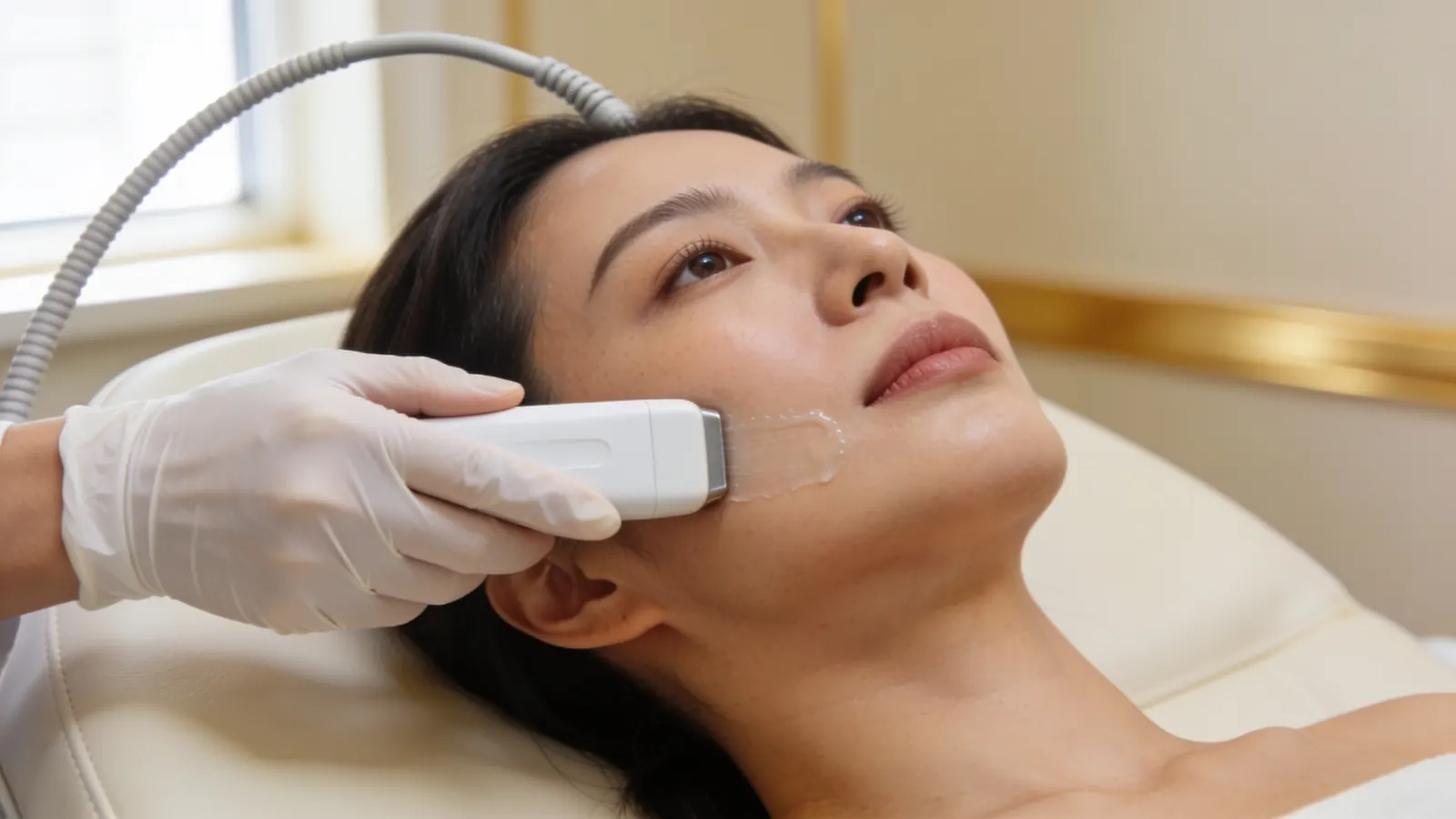
Ultrasound first: how the scan helps show silicone and its spread
High-frequency ultrasound helps show what a lump is likely to be made of, where it sits, how far the material has spread and which vessels run nearby. Silicone has its own appearance on the scan, different from hyaluronic acid, which helps when there are no records. With silicone, the scan helps show whether it sits as a defined deposit or is spread through the fat and muscle, how far it reaches, and whether there is fluid or an abscess.
Illustrative image — not a patient.
In an international study of 240 granulomas after cosmetic fillers, half followed hyaluronic acid, 8.3% PMMA and 3.8% silicone oil. On the scan they showed as dark nodules or as dark tissue around filler deposits, most often in the fat beneath the skin, and the authors conclude that ultrasound gives detailed anatomical information to support diagnosis and management (Wortsman 2025). Imaging also shapes the plan: in a series of granulomas after illegal filler injections, imaging sorted cystic lumps from infiltrating ones, and each type was treated differently (Choi 2022).
The scan shows what a lump is likely made of; it does not prove it. Where it does not look like filler, further tests are arranged, and a tissue sample remains the gold standard for identifying a filler (Requena 2011). Dr Sin Yong performs the scan himself, and the plan follows what it shows. More on scanning is in ultrasound-guided filler correction.
Is it silicone or something else?
Many people with a lump do not know exactly what was injected, especially after treatments done years ago, overseas, or several times in the same area. A lump in a face that once had silicone can be:
Silicone itself, or the granuloma and scar tissue around it.
Hyaluronic acid layered over the silicone, which can be dissolved, leaving the silicone behind.
An infection or abscess in the material, which is usually red, hot, painful or draining and needs a doctor the same day; if no doctor can see you today, A&E.
Something unrelated, such as a cyst, a lymph node or, rarely, a growth, which needs a different plan.
A granuloma is not always silicone: in the international ultrasound study, half of the granulomas followed hyaluronic acid (Wortsman 2025). A lump that keeps growing, sits where nothing was injected, feels fixed to deeper tissue, changes the skin over it or comes with swollen glands elsewhere is assessed for other causes before anything is treated as filler.
Non-absorbable filler removal: what published treatments report
The evidence comes from reviews, case series and case reports, mostly without comparison groups, and the fillers, areas and methods differ from study to study. This is what they report.
Medical treatment
A review of treatment options for foreign-body granulomas after all injectable fillers gives medical treatment injected into the granuloma, repeated in four-week cycles, as the preferred treatment; started early, it can shrink granulomas within weeks, and it can be combined with other medicines and pulsed lasers to limit thinning of the skin (Lemperle and Gauthier-Hazan 2009). In the review of delayed lip nodules, most cases resolved after several treatments, beginning with oral medical treatment and followed by surgical excision (Trinh, Surg J 2022). In 11 patients with PMMA problems in the midface, medical treatment injected into the lumps gave minimal improvement in six (Limongi 2016).
Laser-assisted approaches, including intralesional laser
In intralesional laser treatment, a laser fibre is placed inside the lump and the softened material is then pressed or drawn out. In 20 patients, infected gel lumps were opened with a 532 nm laser and the infected gel and pus let out, and granulomas from gels containing particles were treated with an 808 nm diode laser placed inside the lesion, which melted and liquefied the material so that it could be evacuated. All 20 had a reduction or complete resolution, complete resolution became more frequent with repeated treatments, and the authors report less morbidity and disfigurement than with surgical removal (Cassuto 2009). In 242 patients treated with intralesional laser for filler complications, 92% improved, 9% resolved completely and 3% did not improve; the authors report a good safety profile and suggest considering it before surgery (Schelke, Plast Reconstr Surg 2018).
These studies used different lasers and methods from the Sculpting mode of Time Freeze Laser LCLR®, and their figures do not apply to it.
Minimally invasive extraction
Material that has collected in a pocket can sometimes be drained. In 35 women with granulomas after illegal filler injections, imaging sorted the lumps into cystic ones, which were punctured and drained, and infiltrating ones, which were treated with an intralesional laser followed by suction; surgical removal with a lifting procedure followed where that was not enough. Four had incomplete removal or a contour deformity during follow-up, and two of them had another operation (Choi 2022). Material woven through tissue is harder: in a series of 11 patients, polyacrylamide gel in the lips had spread through all three layers of the lip, with scar tissue in every patient, and could not be aspirated (Kastner 2018).
Surgical excision
Surgery has worked in some reports. A silicone granuloma in the cheek that followed a dental infection healed completely after all the lesions were removed through the mouth (Murakami 2020), and nine of 11 patients with PMMA problems in the midface had surgical debulking, which was effective for the swelling, redness and lumps (Limongi 2016). The treatment review places surgical excision last, because granulomas grow finger-like into the surrounding tissue, and keeps surgery or drainage for lumps and cystic granulomas with little ingrowth (Lemperle and Gauthier-Hazan 2009). What the operation involves, and what has gone wrong after it, is set out below.
Silicone filler removal surgery: what it involves and the problems reported
Surgical removal means an incision through the skin, or inside the mouth for the lips and cheeks, and cutting out the lump together with the tissue the material has spread into. In the lips it can mean reshaping the lip and grafting fat to replace lost volume: removing polyacrylamide gel from the lips meant lip reconstruction, with fat grafting in eight of 11 patients in one series (Kastner 2018).
Product left behind. In that lip series, the authors state that gel remaining in the lining of the lip must be accepted (Kastner 2018). In the series of 35 women treated with drainage, intralesional laser and, where needed, surgery, four had incomplete removal or a contour deformity, and two had another operation (Choi 2022).
Tissue loss. One of the 11 patients in the lip series had severe necrosis, death of tissue, in the upper lip (Kastner 2018).
Scars, dents and nerves. Every incision leaves a scar, removing tissue can leave a dent or an uneven contour, and an injured nerve can leave numbness, or weakness in a smile, a lip or a brow.
No way back. Tissue that has been cut out cannot be put back.
Swipe sideways to see the whole table.
Approach
What it involves
Incision
Reported findings and considerations
Surgical excision
Cutting out the lump and the tissue the material has spread into
Yes, through the skin or inside the mouth
Effective for a cheek silicone granuloma (Murakami 2020) and for midface PMMA problems in one series (Limongi 2016); gel left in the lip lining, and severe tissue loss in one of 11 lip operations (Kastner 2018)
Drainage
Puncturing a collection and letting the material out
A puncture
Used for cystic lumps (Choi 2022); aspiration was not possible in a lip series in which the gel had spread with scar tissue (Kastner 2018)
Intralesional laser
A laser fibre placed inside the lump; the softened material is pressed or drawn out
A puncture or small opening
92% improved and 9% resolved completely in a series of 242 (Schelke, Plast Reconstr Surg 2018)
Medical treatment
Medicines by mouth or injected into the lump, for inflammation or infection
None
The preferred treatment for granulomas in one review (Lemperle and Gauthier-Hazan 2009); minimal improvement for midface PMMA lumps in one series (Limongi 2016)
Sculpting mode of Time Freeze Laser LCLR®
Laser directed at the lump, planned from the ultrasound map
None
Dr Sin Yong's own protocol; it can cause blistering or a change in skin colour, so settings are chosen for your skin
Waiting
Review over time
None
Reactions to non-absorbable fillers show little tendency to settle on their own (Requena 2011); a small deposit that cannot be seen and causes no symptoms is sometimes reasonably left alone
Dr Sin Yong explains the risks and limits of each option at the assessment, including waiting where that is reasonable. Get assessed before you agree to surgery: an operation can still be done later if it is ever needed, but it cannot be undone. More on operations to take filler out is in filler removal surgery.
Silicone in the lips: lumps, spread and lip filler removal
In the systematic review of delayed nodules after lip fillers, silicone was the filler most often reported, ahead of hyaluronic acid, and the nodules appeared on average 2.9 years after treatment (Trinh, Surg J 2022). Polyacrylamide gel in the lips has been found spread into the lining and the skin around the mouth, even years after injection, and removing it has meant lip reconstruction, with some gel left behind (Kastner 2018). Cutting into the lip leaves a scar and can change the shape of the lip.
Dr Sin Yong treats silicone in the lips the same way as elsewhere. He maps it with ultrasound, including how far it has spread into the lip and around the mouth, and treats the lumps with the Sculpting mode of Time Freeze Laser LCLR®, without an incision. Hyaluronic acid lip filler placed over old silicone is dissolved first, after a skin test. For hyaluronic acid lip filler on its own, see lip filler dissolving; for filler that has moved above the lip line, see lip filler migration; and for other problems, lip filler gone wrong.
Red, hot, swollen or draining: infection is treated first
A lump that is red, hot, tender, swollen or draining may be infected or actively inflamed. It needs a doctor the same day, or A&E if no doctor can see you today, and is treated medically first, before any device is considered. With non-absorbable gels this matters, because low-grade bacteria have been found in reacting polyacrylamide gel up to five years after injection (Christensen 2013), and inflammation was the commonest complication reported after polyalkylimide (Schelke 2009). A fever needs a doctor the same day; if no doctor can see you today, A&E. Feeling faint, confused or very unwell: call 995 or go to A&E now.
Urgent: a change in vision or eye pain after filler: call 995 now. Skin that turns pale, dusky or mottled, or pain that is getting worse, needs urgent assessment by the doctor who injected you, or at A&E, now. See the warning signs of a blocked blood vessel after filler.
Tried other treatments and almost given up?
Many patients who come to see Dr Sin Yong about silicone and other non-absorbable filler lumps tell him they have tried almost everything else and had given up hope. Having tried other treatments does not mean nothing more can be done: what is done next depends on what the scan shows.
That history is useful. Knowing what was injected, when, and what has already been tried often explains why a problem has stayed: hyaluronidase acts only on hyaluronic acid and only where it reaches, some fillers are not hyaluronic acid at all, and swelling or fluid can look like filler. Ultrasound helps show which of these applies, and the plan starts from there. For material that cannot be dissolved, Dr Sin Yong uses the Sculpting mode of Time Freeze Laser LCLR® for nodules large and small, without an incision. How each person responds varies.
If you have been told nothing more can be done, it is still worth having the area scanned: ultrasound helps show what is there, and the plan is made from that. Bring any records of past treatments, product names and dates if you have them. More on this is in when filler dissolving has not worked.
How Dr Sin Yong treats silicone lumps without surgery
History. What was injected, where and when, if known; any dental work, infection or new filler before the lump appeared; what has been tried and what you were offered. Having no records is fine.
Ultrasound mapping. Dr Sin Yong scans each lump himself: the likely material, its depth, how far it has spread and the vessels nearby.
Infection first. A red, hot or draining lump needs a doctor the same day, or A&E if no doctor can see you today, and is treated medically before anything else.
Hyaluronic acid over the silicone. Where hyaluronic acid filler sits over or beside the silicone, he dissolves it. Your allergy history is checked. Before planned dissolving, Dr Sin Yong always does a skin test: a small amount of hyaluronidase is injected just under the skin to check for a reaction. A small first dose follows, with a review at about 48 hours.
Silicone and other non-absorbable material. He treats it with the Sculpting mode of Time Freeze Laser LCLR®, his own protocol on a long-pulsed 755 nm and 1064 nm laser platform, directed at the mapped lump, without an incision.
Review. Each lump is reassessed, and any further visit is planned from what is seen.
He does not inject new filler to hide a silicone lump. Where the face has lost shape because of lumps, that is considered only after they have been addressed. Dr Sin Yong developed the Time Freeze Laser LCLR® protocol himself and performs every scan and treatment himself on Orchard Road. He has been invited to share his clinical expertise in Seoul, Dubai, Bangkok and São Paulo, including as a Global Key Opinion Leader. More on the laser is in the Sculpting mode of Time Freeze Laser LCLR®.
Your next step
Not for emergencies. A change in vision or eye pain after filler: call 995 now. Pale, dusky or mottled skin, or pain that is getting worse: go now to the doctor who injected you, or to A&E. Do not message or book for these signs.
1. MessageWhatsApp +65 8023 7170 with what is bothering you. A reply comes from the clinic, not a bot.
2. AssessmentDr Sin Yong examines you himself on Orchard Road, with ultrasound where earlier filler is involved.
3. A plan in writingWhat he would do, what he would not, the fee factors, and the option of no treatment.
Every treatment is performed by Dr Sin Yong personally. Singapore Medical Council registered · invited to share his clinical expertise internationally for CLASSYS, DEKA, Fotona, Hironic and Ilooda.
In Dr Sin Yong's practice, almost every silicone lump is treated without surgery. He maps the silicone with ultrasound and treats the lumps with the Sculpting mode of Time Freeze Laser LCLR®, without an incision. Published work also describes intralesional laser and drainage for lumps from other non-absorbable gels and illegal filler injections, with surgery kept for what remained (Cassuto 2009; Choi 2022). Silicone spread through tissue is hard to take out completely by any method, which is why the scan comes before any decision to cut.
Many of the patients Dr Sin Yong sees have tried other treatments first. A treatment that did not help can still leave options open: hyaluronidase may not have reached the filler, the filler may not be hyaluronic acid, or what looks like filler may be swelling or fluid. Ultrasound helps show which applies, and the plan follows what it finds.
Usually not. Get assessed before you agree to it. Cutting silicone out leaves a scar, can leave a dent or injure a nerve, and because silicone spreads through the tissue, some can be left behind. After removal of another non-absorbable gel from the lips, the authors state that gel left in the lip lining must be accepted (Kastner 2018). In Dr Sin Yong's practice, almost every silicone lump is treated without surgery. If yours is one of the few that needs surgery, you are told plainly, and why.
No. Hyaluronidase, the enzyme used to dissolve filler, acts on hyaluronic acid only. It has no effect on silicone, polyacrylamide gel, polyalkylimide or PMMA, and no injection dissolves them. If hyaluronic acid filler has been placed over or beside old silicone, that part can be dissolved after a skin test. The silicone itself is treated differently: Dr Sin Yong maps it with ultrasound and uses the Sculpting mode of Time Freeze Laser LCLR®, without an incision.
Silicone stays in the tissue, so the body can react to it long after the injection. In a systematic review of delayed lip nodules, in which silicone was the filler most often reported, nodules appeared on average 35.2 months after treatment (Trinh, Surg J 2022). Triggers are common: in 28% of patients with late problems from non-absorbable fillers, symptoms began after dental work, more filler or other facial treatments (Kadouch 2013), and a silicone granuloma has followed a dental infection (Murakami 2020).
You often cannot tell by touch. A lump in a face that once had silicone can be silicone, the granuloma around it, hyaluronic acid layered over it, a collagen stimulator, fat graft, an infection, or something unrelated such as a cyst or a lymph node. Ultrasound shows what the lump is likely made of and how far it spreads. A lump that keeps growing or feels fixed is assessed for other causes, and a tissue sample remains the gold standard for identifying a filler (Requena 2011).
Usually, yes. In a systematic review of delayed nodules after lip fillers, silicone was the filler most often reported (Trinh, Surg J 2022). Dr Sin Yong maps silicone in the lips with ultrasound, including how far it has spread around the mouth, and treats the lumps with the Sculpting mode of Time Freeze Laser LCLR®, without an incision. Removing non-absorbable gel from the lips surgically has meant lip reconstruction, with some gel left behind (Kastner 2018), so get assessed before you agree to an operation.
A granuloma is the body's reaction to a foreign material: inflammatory cells gather around the silicone and wall it off, often with scar tissue, so the area becomes firm, lumpy or swollen. In a systematic review of delayed lip nodules, most of those examined under the microscope were foreign-body granulomas (Trinh, Surg J 2022). Granulomas appear after several months, often at all injected sites at once, and are often triggered by a bacterial infection elsewhere in the body (Lemperle and Gauthier-Hazan 2009).
Yes. Silicone can migrate from where it was injected. In a case series and literature review, silicone from facial filler, and from breast implants, had travelled to the eyelids and formed foreign-body granulomas there, and the authors note that silicone is known to travel throughout the body (Neerukonda 2023). Ultrasound shows where the silicone sits now, which is not always where it was injected, and the plan is made from that map.
Usually, yes. Polyacrylamide gel cannot be dissolved, and reactions to it have been linked to low-grade bacteria: in one study, bacteria were found in 53 of 54 testable patients with reactions and in none of 24 without, up to five years after injection (Christensen 2013). A red, hot or swollen gel lump needs a doctor the same day, or A&E if no doctor can see you today, and is treated medically first. Firm lumps are then mapped with ultrasound and treated with the Sculpting mode of Time Freeze Laser LCLR®, without an incision.
Usually, yes. PMMA is made of tiny acrylic beads that do not dissolve, and lumps can appear months after injection, often with swelling and redness. In 11 patients with PMMA problems around the eyes and midface, symptoms began 2 to 24 months after injection and 64% had nodules (Limongi 2016). Dr Sin Yong maps PMMA lumps with ultrasound and treats them with the Sculpting mode of Time Freeze Laser LCLR®, without an incision. A red, hot, painful, swollen or draining lump, or a fever, needs a doctor the same day, or A&E if no doctor can see you today, and is treated medically first.
Yes. Dental work and dental infections are among the reported triggers for late problems with non-absorbable fillers: in one series, 28% of patients noticed symptoms after dental procedures, more filler or other facial treatments (Kadouch 2013), and a cheek silicone granuloma followed a dental infection (Murakami 2020). The authors of that report advise improving oral hygiene before dental treatment in people with facial silicone. Tell any doctor who plans to inject your face as well.
A red, hot, painful, swollen or draining lump, a lump that is growing quickly, or a fever needs a doctor the same day, not a planned laser visit; if no doctor can see you today, go to A&E. Spreading redness with a fever, feeling faint, confused or very unwell, or swelling around the eye with pain: call 995 or go to A&E now. A change in vision or eye pain after filler is an emergency: call 995 now. Skin that turns pale, dusky or mottled, or pain that is getting worse after filler, needs urgent assessment by the doctor who injected you, or at A&E, now.
Dr Sin Yong performs the ultrasound scan, any dissolving and every Sculpting mode treatment himself, on Orchard Road. It is not delegated to another doctor, a nurse or a therapist, so the same doctor follows each lump from the first scan to the last review. Bring any records of what was injected, where and when, if you have them; having none is fine.
References
Liquid injectable silicone: a review of its history, immunology, technical considerations, complications, and potential. Plastic and Reconstructive Surgery, 2006. source
Silicone Granulomas of the Eyelids-A Case Series Illustrating a Distant Migratory Phenomenon. Ophthalmic Plastic and Reconstructive Surgery, 2023. source
Delayed Granulomas as a Complication Secondary to Lip Augmentation with Dermal Fillers: A Systematic Review. The Surgery Journal, 2022. source
Buccal Silicone Granuloma Caused by the Dental Infection. Case Reports in Dentistry, 2020. source
Delayed-onset complications of facial soft tissue augmentation with permanent fillers in 85 patients. Dermatologic Surgery, 2013. source
Adverse reactions to injectable soft tissue fillers. Journal of the American Academy of Dermatology, 2011. source
Bacterial infection as a likely cause of adverse reactions to polyacrylamide hydrogel fillers in cosmetic surgery. Clinical Infectious Diseases, 2013. source
Complications after treatment with polyalkylimide. Dermatologic Surgery, 2009. source
Complications and Management of Polymethylmethacrylate (PMMA) Injections to the Midface. Aesthetic Surgery Journal, 2016. source
International Multicentric Study on Ultrasound Characteristics, Layer Location, and Corporal Distribution of Granulomas After Cosmetic Fillers Injections. Journal of Ultrasound in Medicine, 2025. source
Foreign body granulomas after all injectable dermal fillers: part 2. Treatment options. Plastic and Reconstructive Surgery, 2009. source
Advanced laser techniques for filler-induced complications. Dermatologic Surgery, 2009. source
Intralesional Laser Treatment for Dermal Filler Complications. Plastic and Reconstructive Surgery, 2018. source
Minimally invasive removal of facial foreign body granulomas. Archives of Aesthetic Plastic Surgery, 2022. source
Removal of Polyacrylamide Gel (Aquamid®) from the Lip as a Solution for Late-Onset Complications: Our 8-Year Experience. Aesthetic Plastic Surgery, 2018. source
About this page: written and medically reviewed by Dr Sin Yong, MBBS (NUS), MRCS (Edinburgh) · Last reviewed 26 October 2026 · Illustrative images only, not patients · Editorial policy
Not for emergencies. A change in vision or eye pain after filler: call 995 now. Pale, dusky or mottled skin, or pain that is getting worse: go now to the doctor who injected you, or to A&E. Do not message or book for these signs.