Medically reviewed by Dr Sin Yong · Last reviewed · 17 min read · Doctor-performed, never delegated · Jump to questions
Dr Sin Yong · MBBS (NUS) · MRCS (Edin) · MSc Aesthetic Medicine with Distinction (Queen Mary, London) · MSc Practical Dermatology (Cardiff) · Global Key Opinion Leader
Ellansé is polycaprolactone microspheres suspended in a gel carrier. The gel gives volume on the day; the collagen the skin builds around the microspheres is what remains — and none of it can be dissolved. Assessed and placed by Dr Sin Yong on Orchard Road, Singapore.
At a glance
Ellansé Singapore refers to polycaprolactone (PCL) microspheres in a carboxymethylcellulose gel carrier, used as a collagen biostimulator. The gel gives volume on the day and the skin then builds collagen around the microspheres. Neither can be dissolved, so assessment, including an ultrasound of earlier injections, comes first.
Key takeaways
Ellansé is polycaprolactone microspheres in a gel carrier: the gel gives early correction, then collagen forms around the microspheres.
It suits structural work in firm tissue such as the chin, jawline, temples and backs of the hands.
It cannot be dissolved by hyaluronidase, so it is placed deep, staged and dosed for the collagen, not the gel.
It does not suit lips or tear troughs, and it does not lift a descended jowl.
Dr Sin Yong, an aesthetic physician, assesses and performs it, and scans any previous filler before adding more.
Polycaprolactone (PCL) microspheres suspended in an aqueous carboxymethylcellulose (CMC) gel carrier, manufactured by Sinclair
Composition
About 30% PCL microspheres, roughly 25–50 µm in diameter, in about 70% CMC gel
Two effects in sequence
The gel gives immediate correction; as it is absorbed over weeks, fibroblasts lay down collagen around the microspheres
Formulations
Supplied in more than one formulation, differing in how slowly the microspheres resorb; the choice is made per patient and per area
Regulatory status
CE-marked medical device. It is not FDA-approved in the United States
Reversibility
None. Hyaluronidase has no action on polycaprolactone or on the CMC carrier
Where it behaves well
Structural areas with firm tissue cover: jawline, chin, temples, mid-face support, backs of the hands
Where it does not belong
Lips, tear troughs and thin-skinned mobile areas, where a firm, non-dissolvable product is most likely to show or lump
Before any top-up
An ultrasound scan of what is already in the tissue. Lumps and heaviness after earlier injections usually call for subtraction, not more
Approach used here
Placed deep, on bone or in the deep fat where the anatomy allows; staged rather than finished in one visit; never layered over unmapped previous filler
What sets the fee, formulation by formulation and area by area, is on Ellansé cost factors.
What recovery looks like, and what is not normal, is described in full under Ellansé downtime.
What to do afterwards, including the no-massage rule, is on the Ellansé aftercare page.
If a nodule forms after treatment, the guide to filler nodules explains how it is assessed.
What Ellansé actually is
Ellansé is a suspension of polycaprolactone microspheres in a carboxymethylcellulose gel. Polycaprolactone is a synthetic polymer with a long history in resorbable sutures and implants; here it is formed into smooth spheres a few tens of microns across, which make up roughly 30% of the syringe. The remaining 70% is the gel that carries them.
The two components do different jobs on different timelines. The gel provides correction on the day, which is why Ellansé is sometimes described as a filler. Over the following weeks the gel is absorbed, and the microspheres that remain act as a scaffold: fibroblasts lay down new collagen around them, and that collagen is what provides the longer-term support. The microspheres themselves break down slowly to carbon dioxide and water.
It is therefore both a filler and a collagen stimulator, in sequence. That is useful, and it is also the source of most of the misunderstanding around it.
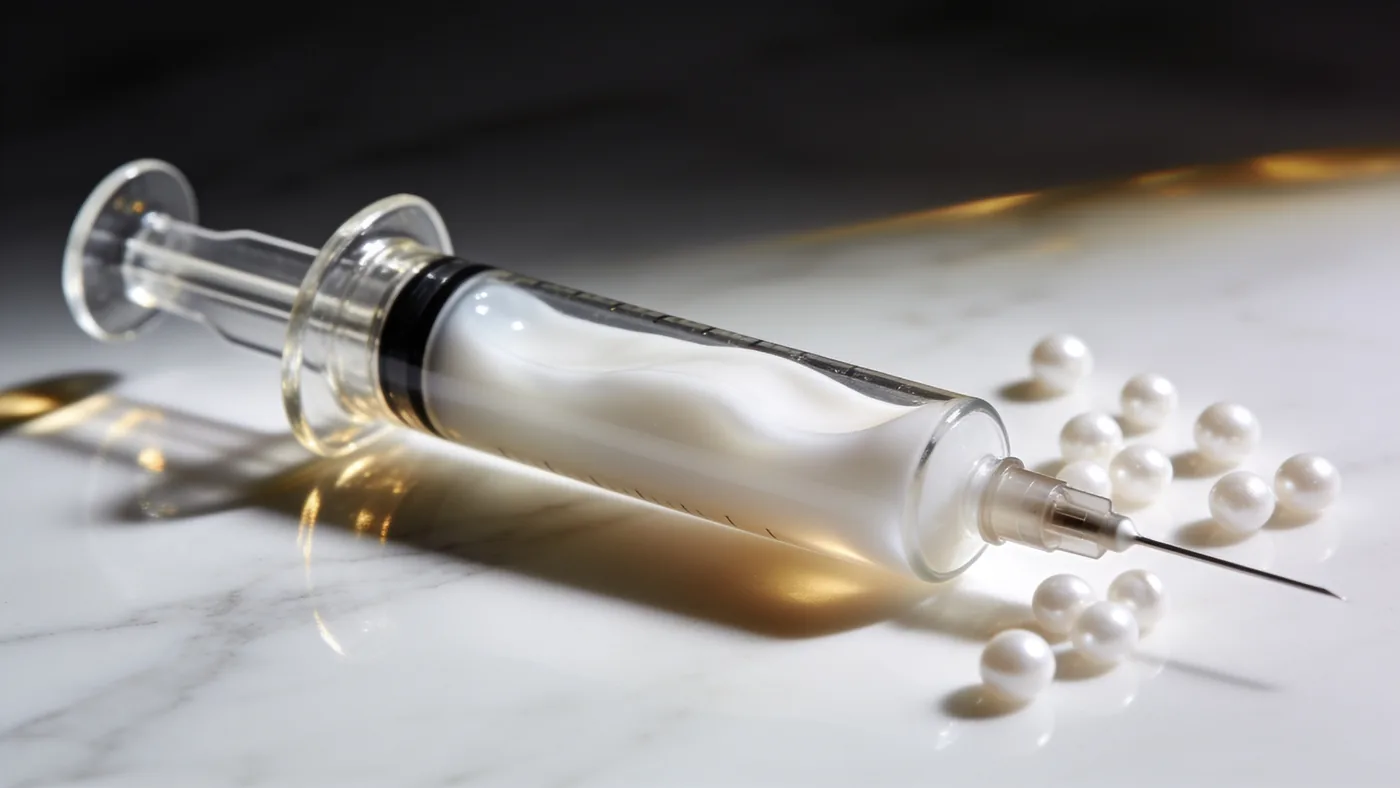
Illustrative. The gel carrier gives the early correction; the microspheres left behind are the scaffold the skin builds collagen around.
“Hyaluronic filler has an undo injection. Sculptra and Ellansé don't.”
Dr Sin YongOn choosing a non-dissolvable product · from his Instagram explainer series
Why the day-one result is misleading
Because the gel gives an immediate correction, Ellansé is the one collagen stimulator that can be judged in the mirror on the day — and that judgement is usually wrong in both directions.
In the first weeks the gel carrier is absorbed and the volume it provided recedes, so a patient who was pleased on the day may believe the result has faded. Over the following months the collagen response builds around the microspheres, so volume returns in a more structural form. The final result is the collagen, not the gel, and it is not the same shape or quantity as what was visible on the day.
That sequence has a practical consequence: the product is dosed for the collagen it will produce, not for the gel it shows. Filling to a pleasing day-one result is how the lower face ends up heavier than intended months later, with no way to take it back.
Ellansé cannot be dissolved
Hyaluronidase reverses hyaluronic acid filler. It has no action on polycaprolactone or on the carboxymethylcellulose gel that carries it. Once placed, Ellansé is managed, not reversed.
Nodules are described with polycaprolactone as with every biostimulator. They are usually related to placement that is too superficial, to volume concentrated in one spot, or to mobile areas where the product is worked by muscle. Management depends on what the lump is, which is why ultrasound comes before any intervention; a lump that turns out to be previous hyaluronic acid filler is treated very differently from one that is polycaprolactone.
This is also why Dr Sin Yong will not place Ellansé over previous filler that has not been mapped. Correction of biostimulator problems from treatment elsewhere is assessed under filler correction.
“The gel you see on day one is not the result. The collagen that replaces it is — and by then it is too late to change your mind.”
Dr Sin YongOn why Ellansé is planned, not previewed
How Dr Sin Yong places it
Ellansé rewards depth and punishes spread. Dr Sin Yong places it deep — on the periosteum or in the deep fat compartments where the anatomy allows — in small, deliberate deposits that give the collagen somewhere structural to form, rather than as a sheet in the superficial fat where a firm product shows through thin skin.
The face is treated as a structure, not a surface. The jawline is read as a line from chin to angle, and the temple and lateral cheek are assessed for how they support the lower face before anything is placed lower down. Where the goal is definition, he uses the firmer formulation sparingly and stages it; where the goal is diffuse support in thinner skin, the softer formulation or a different product altogether may be more defensible.
He under-treats at a first visit and reviews once the gel has gone and the collagen has begun to form, because that is the first point at which the real result can be judged.
Which Ellansé grade is used where: the polycaprolactone formulations compared
Ellansé comes in more than one formulation. The grades share the same polycaprolactone microspheres and gel carrier; they differ in how slowly the microspheres resorb, and so how long the collagen scaffold persists. No grade can be dissolved. The table sets the grades against the areas where a firm, non-reversible product is defensible.
Illustrative image — not a patient.
Formulation
How it differs
Where it tends to be considered
What it cannot do
Page
Ellansé-S
The shorter-resorbing grade: the microspheres clear sooner, so the scaffold is present for a shorter horizon
Where a shorter scaffold horizon is preferred; the grade is chosen at assessment
Cannot be dissolved; does not suit lips, tear troughs or thin mobile skin
Whichever grade is chosen, Dr Sin Yong doses for the collagen it will produce, not the gel seen on the day.
Illustrative image — not a patient.
Who Ellansé suits, and who it does not
It suits structural work in firm tissue: a chin that needs projection, a jawline that needs a cleaner line, temples and lateral cheeks that have hollowed, and the backs of the hands, where the tendons have become visible. It suits a patient who wants some change on the day but is choosing the product for the collagen that follows, and who understands it cannot be reversed.
It does not suit the lips, the tear troughs or the fine lines of thin, mobile skin. It does not lift a descended tissue plane; a jowl is a laxity problem for focused ultrasound or the VF Lift – Vertical Facelift, and adding volume below it makes the jowl heavier. And it is not the right first injectable in a face that has never been assessed; a reversible hyaluronic acid filler is the more forgiving place to start.
Against its neighbours: Sculptra gives almost no volume on the day and works more diffusely; Radiesse is calcium hydroxylapatite, also immediate plus stimulating, and is the one more often diluted for skin quality. Which fits is an anatomical decision.
Illustrative. Structural areas with firm tissue cover suit a firm, non-dissolvable product; thin, mobile skin does not.
Noticed lumps or heaviness? Scan before you add
A face that has been injected more than once often arrives with a complaint that sounds like it needs more product — a heaviness in the lower face, a fullness under the eyes, a lump that has appeared months after the last visit. In Dr Sin Yong's experience the opposite is more often true: the problem is what is already there, and the answer is subtraction, not addition.
So before any further Ellansé is placed, he scans. High-frequency ultrasound shows what material is sitting in the tissue, how deep it is, whether it has migrated, and whether a lump is polycaprolactone, old hyaluronic acid filler, a cyst, or scar. Each of those is managed differently, and two of them are made worse by injecting on top. A scan takes minutes and changes the plan more often than not.
If the scan shows that less is what you need, that is a different procedure with its own planning — see filler correction. If it shows a clean field, Ellansé can be placed with confidence rather than hope. Either way, nothing is added to a face that has not been looked beneath.
Risks and what to expect of the procedure
The common findings are swelling, bruising and tenderness at the injection sites, and a temporary firmness where the gel sits. Nodules and visible or palpable product are the specific risks of a firm, non-dissolvable material and are discussed above. The serious risks are vascular and attend any injectable placed near facial vessels, which is why depth, plane and anatomical knowledge matter more than the brand on the box.
Polycaprolactone is resorbed by the body over time and the collagen it produced ages with the rest of the face. The change is not lifelong, and no duration quoted to you is a prediction for your anatomy.
Who should not have Ellansé?
The section above covers the areas and goals Ellansé does not suit; this one covers medical reasons. Ellansé is not used in anyone with a known allergy to its components or a history of severe allergic reactions, with autoimmune disease or on immune-modifying treatment, or with a bleeding disorder. It is postponed during pregnancy and breastfeeding, and wherever there is infection or inflammation at or near the injection site, such as active acne or a cold sore.
It is not placed over non-absorbable filler such as silicone, or over any previous filler that has not been identified, which is why an ultrasound scan comes first. Blood-thinning medicines, a tendency to keloid or hypertrophic scarring, and recent or planned dental work call for caution or a change of timing. Because neither the polycaprolactone nor its gel carrier can be dissolved with hyaluronidase, anyone who wants a result that can be reversed should choose a hyaluronic acid filler instead. Suitability is decided at consultation, after Dr Sin Yong has taken a medical history and examined the area.
Illustrative image — not a patient.
What recovery looks like after Ellansé
The sequence below describes phases, not a timetable: how quickly each passes depends on the settings used, the area and the person, and is discussed at consultation.
Immediately afterSwelling, tenderness and possibly bruising at the injection sites, with a temporary firmness where the gel sits.
The first eveningAvoid pressure on the area, heat, alcohol and strenuous exercise; a cool compress eases swelling.
The following daysSwelling and bruising settle on their own; the carrier gel gives early volume that softens as it integrates.
As the skin settlesCollagen forms gradually around the polycaprolactone microspheres, so the structural result refines over the following months.
Follow-upPlacement is staged rather than finished in one visit; any nodule or unevenness is assessed by ultrasound, because Ellansé cannot be dissolved.
Who it suits, who should wait, who is referred on
Tends to suit
A chin needing projection or a jawline needing a cleaner line
Hollowed temples and lateral cheeks
Backs of the hands where tendons have become visible
People who accept that it cannot be reversed
Better to wait
Pregnancy or breastfeeding
Active infection or inflammation at the injection sites
A face that has never been assessed, where a reversible filler is the more forgiving start
Referred on
Jowl or loose jawline from laxity → focused ultrasound or VF Lift – Vertical Facelift assessment
Lumps or heaviness from earlier filler → ultrasound scan and filler correction assessment
Who should not have this treatment
Pregnancy or breastfeeding
Active infection, inflammation or skin disease at the injection sites
Known allergy to polycaprolactone, carboxymethylcellulose or any component
History of keloid or hypertrophic scarring, considered individually
Active autoimmune condition, until assessed
Unmapped previous filler in the area to be treated
People who want lips or tear troughs treated, expect a lift of a sagging jowl, or want a fully reversible option tend to respond poorly, because Ellansé is a non-reversible structural tool.
Before you book
Tell us about every previous filler or biostimulator, with dates and areas if you know them
Declare pregnancy, breastfeeding, autoimmune conditions and any history of keloid scarring
Mention blood thinners, aspirin, fish oil or supplements that increase bruising
Avoid fresh sun exposure and pause strong skincare actives as advised
Bring photos of your face over the years and any records of earlier treatments
What determines the fee
The fee depends on the areas treated, the formulation chosen, the amount of product your anatomy calls for, whether treatment is staged with review once the gel has gone, and whether it is combined with another treatment. The plan is set after assessment rather than as a fixed course. A written quote is given at consultation, and the consultation also decides whether Ellansé is advised at all, or whether a reversible filler or a different approach would suit you better.
1. MessageWhatsApp +65 8023 7170 with what is bothering you. A reply comes from the clinic, not a bot.
2. AssessmentDr Sin Yong examines you himself on Orchard Road, with ultrasound where earlier filler is involved.
3. A plan in writingWhat he would do, what he would not, the fee factors, and the option of no treatment.
Every treatment is performed by Dr Sin Yong personally. Singapore Medical Council registered · invited to share his clinical expertise internationally as a Key Opinion Leader for CLASSYS, DEKA, HIRONIC, FOTONA, ALMA, LUTRONIC and ILOODA · HSA-registered devices · ultrasound-guided correction
Both, in sequence. The gel carrier gives volume on the day, like a filler. As the gel is absorbed, the polycaprolactone microspheres act as a scaffold and the skin builds collagen around them. The lasting result is the collagen, not the gel.
Can Ellansé be dissolved?+
No. Hyaluronidase breaks down hyaluronic acid only; it has no effect on polycaprolactone or on the carboxymethylcellulose carrier. Problems are managed with time, targeted treatment and, in some cases, procedural options, never dissolved.
Why did my Ellansé result fade after a few weeks?+
Because the gel carrier that gave the day-one volume is absorbed over weeks. The collagen response that replaces it builds more slowly, so the shape changes before it settles. Dosing is planned for the collagen, not for the gel, for exactly this reason.
What is the difference between Ellansé and Sculptra?+
Both stimulate collagen and neither can be dissolved. Ellansé is polycaprolactone microspheres in a gel, so it gives immediate volume and then collagen. Sculptra is poly-L-lactic acid with almost no immediate volume, used more diffusely. Which suits you is decided by the anatomy and the goal.
What is the difference between Ellansé and Radiesse?+
Both give volume on the day and stimulate collagen afterwards, and neither is reversed by hyaluronidase. Ellansé uses polycaprolactone microspheres; Radiesse uses calcium hydroxylapatite, and Radiesse is the one more often diluted for skin quality across larger areas.
Is Ellansé FDA approved?+
No. It is a CE-marked medical device available in Europe, Asia and elsewhere; it has not been approved by the US FDA. Regulatory status is one input to the decision, not the whole decision.
Can Ellansé be used in the lips or under the eyes?+
These are the areas where a firm, non-dissolvable product is most likely to show or lump, and Dr Sin Yong does not use it there. A reversible hyaluronic acid product is the defensible choice for the lips and tear troughs.
Does Ellansé cause lumps?+
Nodules are described with every collagen stimulator, usually related to superficial placement, product concentrated in one spot, or mobile areas. A lump that is growing, painful or red should be examined, usually with ultrasound, before anything is done to it.
I have lumps or heaviness from previous filler — can Ellansé fix it?+
Not by adding more. Heaviness and lumps after earlier injections are usually a sign of too much, misplaced or migrated product, and the first step is an ultrasound scan to see what is there and where. It may be subtraction you need, which is handled under filler correction, before anything new is considered.
Who is not a good candidate for Ellansé?+
Anyone with autoimmune disease, a history of severe allergic reactions, a bleeding disorder or an infection near the injection site, or who is pregnant or breastfeeding, should not have Ellansé at that time. It also does not suit the lips, tear troughs or thin, mobile skin. Because polycaprolactone cannot be dissolved with hyaluronidase, someone new to injectables is often better starting with a reversible hyaluronic acid filler. Suitability is confirmed at consultation.
How much does Ellansé cost in Singapore?+
The cost depends on the areas treated, the formulation, the amount your anatomy calls for, whether treatment is staged, and whether it is combined with another treatment. Because Ellansé cannot be reversed and is dosed for the collagen it forms, a written quote is given at consultation after assessment, and the consultation decides whether it is advised at all.
Is Ellansé worth it?+
It can be worthwhile for structural work in firm tissue, such as the chin, jawline, temples and backs of the hands, in someone choosing it for the collagen that follows and accepting it cannot be reversed. It is not suited to lips, tear troughs, thin mobile skin or a sagging jowl, nor as a first injectable in an unassessed face.
How long does Ellansé last?+
No duration is promised. The gel is absorbed first and the longer-term support comes from collagen formed around the microspheres, so longevity depends on the formulation, the area, the amount placed, your tissue and weight changes. Review timing, once the gel has gone and collagen is forming, is set at consultation.
What are the disadvantages of Ellansé?+
It cannot be dissolved, so a misplaced or excessive result is managed rather than reversed. The day-one result differs from the final one, and nodules are a recognised complication. It does not suit lips or tear troughs and does not lift sagging tissue. Swelling, bruising and tenderness are expected afterwards.
How are Ellansé lumps or nodules managed?+
Ellansé is polycaprolactone and cannot be dissolved with hyaluronidase. A lump is examined, often with ultrasound, to see whether it is product, inflammation or tissue response. Options range from observation and injections to Time Freeze Laser LCLR® in its Sculpting mode, which Dr Sin Yong uses to take away the excess.
Ellansé cannot be dissolved with hyaluronidase. A nodule is examined and mapped with ultrasound to confirm what it is and how deep it sits. Inflammatory nodules are managed medically; firm over-stimulated areas are treated with Time Freeze Laser LCLR®, which is built to target the excess tissue response and take it away. See the non-HA filler lumps page.
Christen MO, Vercesi F. Polycaprolactone: how a well-known and futuristic polymer has become an innovative collagen-stimulator in esthetics. Clinical, Cosmetic and Investigational Dermatology 2020;13:31–48. source de Melo F, Nicolau P, Piovano L, et al. Recommendations for volume augmentation and rejuvenation of the face and hands with the new generation polycaprolactone-based collagen stimulator (Ellansé®). Clinical, Cosmetic and Investigational Dermatology 2017;10:431–440. source Wortsman X. Identification and complications of cosmetic fillers: sonography first. Journal of Ultrasound in Medicine 2015;34(7):1163–1172. source Health Sciences Authority. Infosearch — register of health products and medical devices approved for supply in Singapore. source Singapore Medical Council. Guidelines on Aesthetic Practices for Doctors, 2016 Edition. source
Medically reviewed by Dr Sin Yong, MBBS (NUS), MRCS (Edinburgh) · Last updated 21 October 2026 · Editorial policy
Where Dr Sin Yong consults: Orchard Road, Singapore (unit on booking) · Orchard MRT · Mon–Fri 10am–8pm, Sat 11am–3pm · WhatsApp +65 8023 7170 · Getting here · How fees are quoted
Planned for the collagen, not the gel
Whether a firm, non-dissolvable biostimulator is the right answer depends on the structure of your face and on what has been injected before. Dr Sin Yong assesses that first.