Published 26 October 2026 · Reviewed by Dr Sin Yong
Ellansé gone wrong usually means lumps, lasting swelling, a granuloma months or years later, or a face too full or uneven. It cannot be dissolved, so people are told it must be cut out. That leaves a scar and can cause a dent or nerve injury. Ellansé can still be treated without an incision: in Dr Sin Yong's practice, almost every hard lump is treated without surgery. Get assessed first.
Short answerGet assessed before surgery. Ellansé gone wrong means a nodule, lasting swelling, a granuloma months or years later, or an overfilled or uneven face. Ellansé, polycaprolactone microspheres in a gel carrier (Christen 2020), cannot be dissolved: unlike hyaluronic acid filler, it cannot be removed by injecting an enzyme (Lin 2020). It can still be treated without an incision: Dr Sin Yong treats nodules and granulomas with the Sculpting mode of Time Freeze Laser LCLR®. A red, hot or tender lump needs a doctor the same day; if no doctor can see you today, A&E.
Get assessed. Ellansé cannot be dissolved, but it can be treated without an incision; cutting it out leaves a scar, can leave a dent or injure a nerve, and cannot be undone.
What it is
Polycaprolactone microspheres in a carboxymethylcellulose gel carrier (Christen 2020); unlike hyaluronic acid filler, it cannot be removed by injecting an enzyme (Lin 2020).
Side effects
In a review of 1,111 treatments given by one doctor, the commonest problems were swelling lasting more than 2 weeks (4.5%) and bruising (2.7%), and no nodules or granulomas occurred (Lin 2020).
Late granulomas
Across four collagen stimulators, not Ellansé alone, granulomas appeared from 1 week to 15 years after injection, on average about 20 months; 4% of reported cases followed polycaprolactone (Wang 2025).
Ultrasound first
Polycaprolactone has its own appearance on the scan (Wortsman 2017), and an expert consensus calls ultrasound mandatory for managing filler complications (Velthuis 2025).
Without an incision
Dr Sin Yong maps Ellansé with ultrasound and treats nodules and granulomas with the Sculpting mode of Time Freeze Laser LCLR®; a red, hot or tender lump needs a doctor the same day (A&E if no doctor can see you today) and is treated medically first.
Most Ellansé problems are lumps, swelling or unevenness that can wait for a planned assessment. A few signs cannot wait. Ellansé is often placed in the temples, cheeks, jawline and chin, where blood vessels run close, and a blocked blood vessel is a risk with any injection there. The warning signs are the same as after any filler:
Urgent: a change in vision or eye pain after filler: call 995 now. Skin that turns pale, dusky or mottled, or pain that is getting worse, needs urgent assessment by the doctor who injected you, or at A&E, now. See the warning signs of a blocked blood vessel after filler.
Stroke signs (new weakness of the face, an arm or a leg, or slurred speech): call 995 now, and do not travel to a clinic first.
Redness that is spreading, with a fever; feeling faint, confused or very unwell; or swelling around the eye with pain: call 995 or go to A&E now.
Difficulty breathing, a tight throat, swelling of the tongue or throat, or swelling that spreads quickly across the face, after any injection, including hyaluronidase, can be a serious allergic reaction: call 995 now. Itch, hives or swelling that spreads beyond the treated area: contact the clinic that injected you the same day.
Skin that is dying after a blocked blood vessel (necrosis) is an emergency. It needs urgent, more intensive care than a lump does, starting now.
Signs of a blocked vessel usually appear during or soon after the injection, sometimes later: act whenever they appear, whoever injected the filler. Hyaluronidase does not break down polycaprolactone, so if Ellansé blocks a vessel, care is urgent and supportive, with referral where needed. Where hyaluronic acid sits in the same area, hyaluronidase can act on the hyaluronic acid part, and it is not delayed for a skin test. A blocked vessel is never treated with the Sculpting mode of Time Freeze Laser LCLR® or any other laser.
Red, hot, swollen or draining: medical treatment first
An Ellansé lump that is red, hot, tender, swollen or draining may be inflamed or infected. It is treated medically first, before any device and before any talk of surgery. A collection of pus can need draining through a small opening alongside medical treatment; that is a smaller procedure than an operation to cut a lump out. More on this is in infection after filler.
A red, hot, painful, swollen or draining lump, a lump that is growing quickly, or a fever: a doctor the same day; if no doctor can see you today, A&E. That can be the doctor who injected you, Dr Sin Yong or your own doctor. It is not a matter for a planned laser visit.
60-second Ellansé check
Not for emergencies. A change in vision or eye pain after filler: call 995 now. Difficulty breathing, a tight throat, swelling of the tongue or throat, or swelling that spreads quickly across the face: call 995 now. Pale, dusky or mottled skin, or pain that is getting worse: go now to the doctor who injected you, or to A&E. A red, hot or draining lump, or a fever: a doctor the same day; if no doctor can see you today, A&E. Do not use this check or WhatsApp for these signs.
Answer three questions and send them straight to the clinic on WhatsApp. Dr Sin Yong will let you know whether an ultrasound assessment is worthwhile. No obligation.
1 · When was it injected?
2 · What bothers you most?
3 · Have you been offered surgery for it?
Your answers open in your own WhatsApp app; nothing is stored on this page.
Ellansé gone wrong, and only offered surgery? Read this before you agree to it
Patients come to Dr Sin Yong after being told that an Ellansé lump has to be cut out, or that nothing can be done because Ellansé cannot be dissolved. It is true that it cannot be dissolved: hyaluronidase, the enzyme that dissolves hyaluronic acid filler, has no effect on polycaprolactone. Material that cannot be dissolved can still be treated without an incision. Before you agree to an operation, know what it means:
A scar. Every cut through the skin of the face heals with a scar.
A dent. Cutting out a lump takes tissue with it, and the area can heal hollow or uneven.
Nerve injury. Nerves that give the face feeling and movement run close to where filler sits. An injured nerve can leave numbness, or weakness in a smile, a lip or a brow.
Product left behind. Filler spread through tissue is hard to remove completely.
No way back. Tissue that has been cut out cannot be put back.
In Dr Sin Yong's practice, almost every hard lump is treated without surgery. If yours is one of the few that needs surgery, you are told plainly, and why. Dr Sin Yong maps Ellansé with ultrasound and treats nodules large and small, and granulomas, with the Sculpting mode of Time Freeze Laser LCLR®, without an incision. A red, hot or tender lump needs a doctor the same day (A&E if no doctor can see you today) and is treated medically first. Lumps from every kind of filler are covered in hard lumps after filler or skin boosters.
The options for Ellansé, one by one, are set out in Ellansé removal, and the treatment itself, how it works and who it suits, in Ellansé in Singapore. This page is about what goes wrong, how often, whether Ellansé is safe, and what surgery involves.
“A biostimulator cannot be dissolved. That single fact should shape every decision about using one.”
Dr Sin YongOn why some fillers do not dissolve
What Ellansé is, and why problems can appear late
Ellansé is made of polycaprolactone. A review describes polycaprolactone as a biocompatible, biodegradable polymer used in medicine for more than 70 years, and the polycaprolactone-based collagen stimulator as microspheres suspended in a carboxymethylcellulose gel carrier that gives immediate and sustained volume (Christen 2020). Consensus recommendations from a multinational expert group describe it as working by stimulating new collagen, and set out injection technique, depth and volume area by area (de Melo 2017).
The body absorbs the gel carrier gradually. The microspheres stay, and the body lays down its own collagen around them, which carries the longer-term volume. The body breaks the microspheres down slowly, and Ellansé comes in more than one version, made to last different lengths of time before that happens. That is the treatment. It is also why Ellansé problems can appear late or change over time: the microspheres, and the body's response to them, are there long after the appointment.
A review of biostimulators, polycaprolactone among them, adds that the body's immune response differs between products according to the size and shape of their particles, that material the body recognises as foreign follows a foreign-body pathway, and that injection technique and contamination also influence the response (Corduff 2025). Where microspheres sit too close together, too close to the surface or under thin skin, the same response can build a lump you can feel or see. Because contamination can play a part, a lump that flares red or tender needs a doctor the same day (A&E if no doctor can see you today) and is treated medically before anything else.
Like poly-L-lactic acid (Sculptra) and calcium hydroxylapatite (Radiesse), Ellansé is a collagen stimulator: its gel gives volume on the day, and the lasting effect is the collagen built around the microspheres. Problems after those two are covered in Sculptra gone wrong and Radiesse gone wrong, and how the three differ in collagen biostimulators in Singapore.
Ellansé side effects: what is expected, and what is not
Some effects are part of any Ellansé treatment and are not a sign that it has gone wrong:
Swelling, tenderness and bruising where the needle went in, easing steadily as the area settles.
Fullness and firmness on the day. The gel carrier gives volume straight away, and the body absorbs it gradually while collagen forms around the microspheres, so the look on the day is not how the area will settle.
Temporary unevenness while the swelling settles.
In a review of 1,111 polycaprolactone treatments in 780 patients, all given by one doctor, the main problems were swelling lasting more than 2 weeks (4.5%), bruising (2.7%), swelling of the upper cheek below the eye (malar oedema, 0.72%), temporary lumps that could be felt (0.45%) and discolouration (0.18%). No nodules or granulomas occurred in that series, and the authors describe both as rare possible complications (Lin 2020).
What is not expected
A lump you can see once the swelling has settled.
A firm lump that appears months or years after the treatment.
Swelling that does not settle, or comes back.
Fullness that keeps increasing, or a face that looks heavy after repeated treatments.
One side clearly fuller than the other once the swelling has gone.
A lump that keeps growing, turns red, hot, tender or swollen, or drains: see a doctor the same day; if no doctor can see you today, A&E. It is treated medically first.
These are the problems this page is about. The signs that cannot wait are set out in when to act at once, above.
Ellansé swelling: what settles, and what does not
Swelling straight after Ellansé is expected, and it eases steadily rather than growing. Normal recovery, phase by phase, is in Ellansé downtime. Swelling that lasts, comes back months later or sits with a firm lump is a different matter and is worth a scan: it can be fluid held in the upper cheek, inflammation, hyaluronic acid or a skin booster placed later, or the product itself. Swelling that is red, hot or painful needs a doctor the same day; if no doctor can see you today, A&E. Swelling around the eye with pain means calling 995 or going to A&E now.
What goes wrong after Ellansé, described in words, not photographs
This page shows no before-and-after photographs, in line with Singapore's rules on medical advertising. Instead, this is what goes wrong after Ellansé, described in words, and what Dr Sin Yong does about each. Many people have more than one of these.
Swipe sideways to see the whole table.
What you notice
What it usually is
What Dr Sin Yong does
A firm nodule you can feel or see, often in the temples, cheeks, jawline or chin
A nodule: microspheres gathered in one place or placed too close to the surface, with collagen formed around them
Maps it with ultrasound; small ones that cause no trouble can be left alone; he treats the rest with the Sculpting mode of Time Freeze Laser LCLR®, for nodules large and small, without an incision
A firm lump that appears months or years later
Usually a late nodule; less often a granuloma, the body's immune reaction walling off the microspheres; sometimes another filler placed since
Treats any inflammation medically first; maps it; treats a polycaprolactone nodule or granuloma with the Sculpting mode, without an incision
A face that looks heavy or too full rather than lumpy
Overcorrection: more product than the area needed, or collagen built up over repeated treatments
Assesses it separately from lumps; maps where the extra volume sits and directs the Sculpting mode at the excess; adds no more product
One side fuller than the other, ridges or an uneven contour
Unevenness: product placed or spread unevenly
Maps where the product sits; treats the areas of excess with the Sculpting mode
Bumps in the temples, forehead or under the eyes
Thin skin over the product, where small amounts show; Dr Sin Yong does not place Ellansé under the eyes
Maps how deep they sit; treats them with the Sculpting mode, with settings chosen for thin skin and eye protection near the eyes
Fullness or a lump away from where Ellansé was placed
Product that has spread from where it was placed, or another filler
Maps where it sits now; treats Ellansé with the Sculpting mode where it lies; dissolves hyaluronic acid after a skin test, if the lump is the hyaluronic acid itself
Swelling that will not settle or comes and goes, including puffiness on the upper cheek below the eye
Malar oedema, fluid held in the upper cheek, seen in 0.72% of 1,111 treatments in one series (Lin 2020); or inflammation, hyaluronic acid placed later, or the product itself
Scans it; treats inflammation medically first; the plan follows what the scan shows
A red, hot, tender, swollen or draining lump, or a fever
Inflammation or infection
Needs a doctor the same day (A&E if no doctor can see you today); treated medically first, before any device and before any talk of surgery
Products often sit together, for example hyaluronic acid or a skin booster placed over older Ellansé, which is one more reason the scan comes first. How an Ellansé nodule differs from product that has moved after Sculptra is set out in Ellansé nodules and Sculptra migration.
Ellansé lumps years later, and problems after two years
A lump can appear a year or more after Ellansé. The microspheres stay in the tissue until the body has broken them down, and the body keeps responding to them, so a nodule or a granuloma can appear, or first be noticed, long after the treatment, including after two years. The published numbers:
Granulomas, months to years later. In a systematic review of 117 patients with granulomas after collagen stimulators, granulomas appeared from 1 week to 15 years after injection, on average about 20 months, usually as nodules and most often around the mouth. That range covers all four products in the review, not Ellansé alone: PMMA (35% of reported cases), poly-L-lactic acid (31%), calcium hydroxylapatite (27%) and polycaprolactone (4%). The authors note longer delays for fillers that do not break down (Wang 2025).
Rare, and hard to manage. In a review of 1,111 polycaprolactone treatments given by one doctor, no nodules or granulomas occurred, and the authors call them rare possible complications (Lin 2020). A case report describes granulomas after polycaprolactone filler as rare but challenging to manage (Cerón Bohórquez 2024).
A late lump can be a granuloma, the body's immune reaction walling off the microspheres, or a nodule of microspheres with collagen around them. It can also be something else: hyaluronic acid or a skin booster placed since, fluid, or something that is not filler at all, such as a cyst or a lymph node. That is why a late lump is scanned before anything is decided.
What happens next depends on what the lump is. A late lump that is red, hot, tender or swollen needs a doctor the same day (A&E if no doctor can see you today) and is treated medically first. One that is not inflamed is mapped, and Dr Sin Yong treats a polycaprolactone nodule or granuloma with the Sculpting mode of Time Freeze Laser LCLR®, without an incision. If the lump is hyaluronic acid placed later, it is dissolved after a skin test.
Is Ellansé safe? How often problems are reported
No injectable is free of risk. Most side effects of Ellansé are mild, such as swelling, bruising and tenderness. Its specific risk is a nodule or a granuloma, and because it cannot be dissolved, a problem cannot be reversed the way hyaluronic acid filler can, although it can still be treated without an incision. The published numbers:
1,111 treatments by one doctor. Swelling lasting more than 2 weeks (4.5%) and bruising (2.7%) were the commonest problems; no nodules or granulomas occurred, and the authors describe both as rare possible complications (Lin 2020).
In collections of complications. In 55 complications after collagen stimulators, collected by ultrasound specialists in Brazil, polycaprolactone accounted for 7.3% (Ianhez 2024). In the systematic review of 117 patients with granulomas after collagen stimulators, 4% of reported cases followed polycaprolactone (Wang 2025).
Rare but challenging. A case report with a review of the literature describes granulomas after polycaprolactone filler as rare but challenging to manage (Cerón Bohórquez 2024).
These figures come from different kinds of study, with different products, areas and follow-up. The percentages in the two collections describe the cases each study gathered, not the risk with any one treatment. They show what can happen; they do not predict what will happen to you.
The serious risks of Ellansé are those of any injection near facial vessels, which is why the depth and the area matter as much as the product; the warning signs are set out in when to act at once, above. Thin, mobile skin, such as under the eyes and in the lips, shows a firm product readily, which is why Dr Sin Yong does not place Ellansé there. Who suits Ellansé, and where it is placed, is covered in Ellansé in Singapore.
Ultrasound first: what the scan shows after Ellansé
Ultrasound shows where the filler sits, how deep it is and how far it has spread, and what it is likely made of. After Ellansé that matters, because a lump can be polycaprolactone, hyaluronic acid or a skin booster placed later, a granuloma, fluid, or something that is not filler at all.
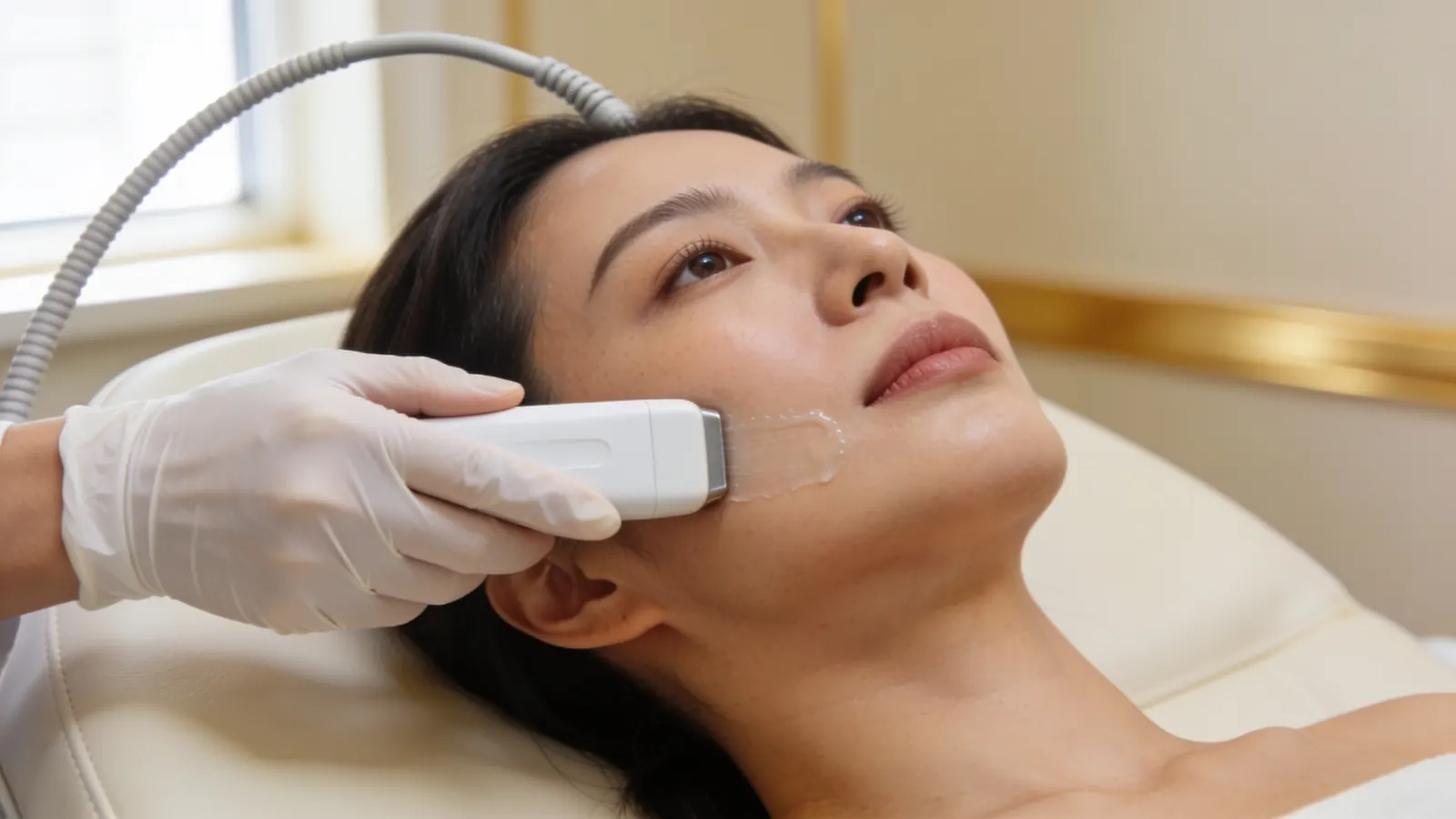
Illustrative image — not a patient.
Polycaprolactone has its own appearance on the scan. In a study of polycaprolactone filler in pig skin and in patients, it showed as darker deposits containing bright spots and small comet-tail artefacts, an appearance that differs from other fillers (Wortsman 2017). A review of filler ultrasound, which covers polycaprolactone among other fillers, describes patterns specific to each material and characteristic features for complications such as a foreign-body granulomatous reaction, an abscess, migration and overfilling; it calls high-frequency ultrasound with colour Doppler the first-line tool for identifying the type of filler, where it is and its complications (Khorasanizadeh 2026).
The scan also guides the plan. In a study of 231 patients with firm lumps after cosmetic filler, not specific to Ellansé, ultrasound agreed with the tissue diagnosis in 85.7% of the 70 who had a biopsy. The commonest findings were a collection of filler that was not hyaluronic acid (37.2%) and a granuloma around such filler (22.5%), and the type of lump on the scan was linked to which approach did better (Wang 2026). That study did not use the Sculpting mode, and its figures do not apply to it. An international consensus of 15 experts from seven specialties calls ultrasound mandatory for managing filler complications (Velthuis 2025).
The scan shows what a lump is likely made of; it does not prove it. Where a lump does not look like filler, further tests are arranged. Dr Sin Yong performs the scan himself, and the plan follows what it shows. More on scanning is in ultrasound-guided filler correction.
Why Ellansé cannot be dissolved, and what is done instead
Hyaluronidase is an enzyme that acts on hyaluronic acid only. It has no effect on polycaprolactone, and unlike hyaluronic acid filler, polycaprolactone cannot be removed by injecting an enzyme (Lin 2020). In 55 complications after collagen stimulators in general, polycaprolactone among them, saline, hyaluronidase, medical treatment injected into the lumps and energy-based devices were all used, only 5 cases resolved completely, and hyaluronidase helped only where calcium hydroxylapatite had been mixed with hyaluronic acid (Ianhez 2024). That study did not use the Sculpting mode, and its figures do not apply to it.
Material that cannot be dissolved can still be treated without an incision. Dr Sin Yong maps each nodule or granuloma with ultrasound, treats any inflammation medically first, and then treats it with the Sculpting mode of Time Freeze Laser LCLR®, his own protocol on a long-pulsed 755 nm and 1064 nm laser platform, directed at the mapped lump, without an incision. He uses it for nodules large and small, and for granulomas, including a granuloma with no filler left. Like any laser, it can cause blistering or a change in skin colour, so settings are chosen for your skin. Near the eyes he keeps the settings conservative and uses eye protection.
When hyaluronic acid sits with Ellansé
Hyaluronic acid filler, or a skin booster made of hyaluronic acid, is often placed over or beside older Ellansé. Only the hyaluronic acid can be dissolved, and a lump is dissolved only if it is the hyaluronic acid itself. Your allergy history is checked. Before planned dissolving, Dr Sin Yong always does a skin test: a small amount of hyaluronidase is injected just under the skin to check for a reaction. A small first dose goes into the mapped hyaluronic acid, with a review at about 48 hours, because dissolving more than the excess can leave a hollow. In an emergency such as a blocked blood vessel, dissolving is not delayed for a skin test. What remains is then treated with the Sculpting mode, in a planned order. Dr Sin Yong does not inject more filler over a lump; any refilling waits at least two weeks after dissolving and is considered only once the lumps have been addressed. More is in how hyaluronidase is used.
What published work describes
Published work also describes medical treatment. In a published case of polycaprolactone granuloma diagnosed on a tissue sample, a combination of medical treatments was injected under ultrasound guidance, with medicines by mouth (Cerón Bohórquez 2024). In the systematic review of granulomas after collagen stimulators, medical treatment injected into the granuloma was the commonest treatment (Wang 2025). These are different approaches from the Sculpting mode, and their figures do not apply to it. Each option, one by one, is in Ellansé removal.
Do I need surgery to remove Ellansé? What an operation involves
Usually not. Get assessed first. Ellansé is not a gel sitting in a pocket. Once the gel carrier has been absorbed, the microspheres sit inside collagen your body has made around them. Surgery therefore means cutting out the nodule or granuloma, through the skin or from inside the mouth, together with your own tissue around the microspheres, which is why a dent is a real risk. A review of granulomas after dermal fillers in general notes that cutting them out is often incomplete, because granulomas have ill-defined borders, and that it may leave scars and deformities (Lee 2015).
In one series of 31 patients operated on for contour problems after facial fillers in general, by excision through facelift incisions, needle aspiration or excision inside the mouth, scar tissue and the reaction around the filler made the dissection difficult. One patient had a facial nerve injury, which improved after four months; two had collections of blood under the skin and one a collection of fluid (Ghareeb 2022).
Where surgery has a place
Surgery has a place, and the published work says so. In the systematic review of 117 patients with granulomas after collagen stimulators, polycaprolactone among them, surgical removal often resolved symptoms (Wang 2025). In the ultrasound study of 231 firm lumps, granulomas with no filler left did better with invasive treatment, and invasive treatment gave greater improvement overall (Wang 2026). That study did not use the Sculpting mode, and its figures do not apply to it. An abscess may need draining, and a lump that does not look like filler on the scan may need a tissue sample.
The point is the order: scan first, decide after. What the lump is on the scan, not simply that it is hard, decides what is treated without an incision and which few need an operation. A scan does not delay that decision: an operation can still be done later if it is ever needed, and it cannot be undone.
Ellansé: the options compared
Swipe sideways to see the whole table.
Option
What it involves
Incision
What to weigh up
Waiting
Review over time
None
Reasonable for small nodules that cause no trouble; nodules and granulomas can persist
Medical treatment
Treatment for inflammation or infection, by mouth or injected into the lump
None
Comes first for a red, hot or tender lump, which needs a doctor the same day (A&E if no doctor can see you today)
Hyaluronidase
Enzyme injected into mapped hyaluronic acid
None; fine needle
Acts on hyaluronic acid only, so only on hyaluronic acid placed with or over the Ellansé; skin test first; too much can leave a hollow
Sculpting mode of Time Freeze Laser LCLR®
Laser directed at the mapped nodule, granuloma or excess
None
Can cause blistering or a change in skin colour; settings chosen for your skin and the area; conservative settings and eye protection near the eyes; never used for a blocked vessel
Surgical removal
Cutting out the nodule or granuloma with the tissue around it, through the skin or inside the mouth
Yes
A scar; a dent where tissue is removed; nerve injury; product left behind; cannot be undone
Many patients who come to see Dr Sin Yong about Ellansé that has gone wrong tell him they have tried almost everything else and had given up hope. Having tried other treatments does not mean nothing more can be done: what is done next depends on what the scan shows.
That history is useful. Knowing what was injected, when, and what has already been tried often explains why a problem has stayed: hyaluronidase acts only on hyaluronic acid and only where it reaches, some fillers are not hyaluronic acid at all, and swelling or fluid can look like filler. Ultrasound shows which of these applies, and the plan starts from there. For material that cannot be dissolved, Dr Sin Yong uses the Sculpting mode of Time Freeze Laser LCLR® for nodules large and small, without an incision. How each person responds varies.
If you have been told nothing more can be done, it is still worth having the area scanned: ultrasound shows what is there, and the plan is made from that. Bring any records of past treatments, product names and dates if you have them. More on this is in when filler dissolving has not worked.
How Dr Sin Yong treats Ellansé gone wrong without surgery
History. What was injected, which version of Ellansé if known, where and when, including any hyaluronic acid, skin booster or other filler placed since; whether the lump has flared; what has been tried and what you were offered. Having no records is fine.
Ultrasound mapping. Dr Sin Yong scans each lump himself: where the product sits, how deep it is, how far it has spread, what it is likely made of and the vessels nearby.
Inflammation or infection first. A red, hot, tender or draining lump needs a doctor the same day (A&E if no doctor can see you today) and is treated medically before anything else.
Hyaluronic acid, if any. If the lump is hyaluronic acid placed with or over the Ellansé, it is dissolved with hyaluronidase after a skin test: a small first dose, with a review at about 48 hours.
Ellansé itself. He treats nodules large and small, granulomas and areas of excess with the Sculpting mode of Time Freeze Laser LCLR®, directed at the mapped lump, without an incision.
Further tests where needed. A lump that does not look like filler on the scan is not treated as filler; further tests are arranged.
Review. Each lump is reassessed, and any further visit is planned from what is seen.
He does not inject more Ellansé or other filler to hide a lump or to even out a heavy face. Where the face has lost shape, that is considered only after the lumps have been addressed. Dr Sin Yong developed the Time Freeze Laser LCLR® protocol himself and performs every scan and treatment himself on Orchard Road. He has been invited to share his clinical expertise in Seoul, Dubai, Bangkok and São Paulo, including as a Global Key Opinion Leader. More on the laser is in the Sculpting mode of Time Freeze Laser LCLR®.
Your next step
Not for emergencies. A change in vision or eye pain after filler: call 995 now. Pale, dusky or mottled skin, or pain that is getting worse: go now to the doctor who injected you, or to A&E. Do not message or book for these signs.
1. MessageWhatsApp +65 8023 7170 with what is bothering you. A reply comes from the clinic, not a bot.
2. AssessmentDr Sin Yong examines you himself on Orchard Road, with ultrasound where earlier filler is involved.
3. A plan in writingWhat he would do, what he would not, the fee factors, and the option of no treatment.
Every treatment is performed by Dr Sin Yong personally. Singapore Medical Council registered · invited to share his clinical expertise internationally for CLASSYS, DEKA, Fotona, Hironic and Ilooda.
Usually not. Get assessed first. Ellansé cannot be dissolved, but it can still be treated without an incision: Dr Sin Yong maps it with ultrasound and treats nodules and granulomas with the Sculpting mode of Time Freeze Laser LCLR®. Surgery leaves a scar and can leave a dent or injure a nerve. In Dr Sin Yong's practice, almost every hard lump is treated without surgery. If yours is one of the few that needs surgery, you are told plainly, and why.
Many of the patients Dr Sin Yong sees have tried other treatments first. A treatment that did not help can still leave options open: hyaluronidase may not have reached the filler, the filler may not be hyaluronic acid, or what looks like filler may be swelling or fluid. Ultrasound shows which applies, and the plan follows what it finds.
Most often, a firm nodule you can feel or see, in the temples, cheeks, jawline or chin, or bumps where the skin is thin. A firm lump can also appear months or years later: usually a late nodule, less often a granuloma. Others notice a face that looks heavy or uneven, or swelling that will not settle. This page describes each problem in words, not photographs. A lump that turns red, hot or tender needs a doctor the same day; if no doctor can see you today, A&E.
Expected effects are swelling, tenderness, bruising and firmness where the gel sits, easing as the area settles. In a review of 1,111 treatments given by one doctor, the main problems were swelling lasting more than 2 weeks (4.5%), bruising (2.7%), swelling of the upper cheek (0.72%), temporary lumps (0.45%) and discolouration (0.18%), with no nodules or granulomas (Lin 2020). Nodules and granulomas are rare but remain its specific risk. A red, hot or tender lump needs a doctor the same day; if no doctor can see you today, A&E.
No injectable is free of risk. Its serious risk, as with any filler, is a blocked blood vessel; a change in vision or eye pain: call 995 now. Its specific risk is a nodule or granuloma: none occurred in 1,111 treatments by one doctor, and the authors call them rare (Lin 2020), but 4% of granulomas reported after collagen stimulators followed polycaprolactone (Wang 2025). It cannot be dissolved but can still be treated without an incision. Dr Sin Yong does not place it under the eyes or in the lips.
No. Hyaluronidase acts on hyaluronic acid only and has no effect on polycaprolactone, and unlike hyaluronic acid filler, polycaprolactone cannot be removed by injecting an enzyme (Lin 2020). Material that cannot be dissolved can still be treated without an incision: Dr Sin Yong maps it with ultrasound and treats nodules and granulomas with the Sculpting mode of Time Freeze Laser LCLR®. Hyaluronic acid placed over Ellansé is dissolved after a skin test, if the lump is the hyaluronic acid itself.
It can, though rarely: the microspheres stay until the body breaks them down. In a systematic review of 117 patients with granulomas after collagen stimulators, they appeared from 1 week to 15 years after injection, on average about 20 months; that range covers all four products studied, and polycaprolactone accounted for 4% of cases (Wang 2025). A new lump long after Ellansé is worth a scan. A red, hot or tender one needs a doctor the same day; if no doctor can see you today, A&E.
It can. The microspheres in Ellansé stay in the tissue until the body has broken them down, so a nodule or granuloma can appear, or first be noticed, after two years. Across four collagen stimulators, not Ellansé alone, granulomas have appeared from 1 week to 15 years after injection (Wang 2025). Not every late lump is Ellansé: it can be hyaluronic acid placed later, fluid, or something that is not filler at all. A scan shows what it is likely to be, and the plan follows what it finds.
Early swelling is expected and eases steadily. In a review of 1,111 treatments given by one doctor, swelling lasted more than 2 weeks in 4.5%, and 0.72% had swelling of the upper cheek (malar oedema) (Lin 2020). Swelling that does not settle, comes back months later or sits with a lump is worth a scan. Swelling that is red, hot or painful needs a doctor the same day; if no doctor can see you today, A&E. Swelling around the eye with pain: call 995 or go to A&E now.
Ellansé works by stimulating new collagen (de Melo 2017), which forms around its microspheres. Anything that concentrates them can turn that response into a lump: too much product in one place, product placed too close to the surface, or thin, mobile skin. A review notes that particle size and shape, injection technique and contamination all influence the body's immune response to biostimulators (Corduff 2025). Repeated treatments can build up volume until the face looks heavy, and other fillers layered in the same area add to it.
Usually, yes. A granuloma is the body's immune reaction walling off the microspheres. Ellansé cannot be dissolved, but that does not mean a granuloma has to be cut out. Dr Sin Yong maps it with ultrasound, treats any inflammation medically first, and then treats it with the Sculpting mode of Time Freeze Laser LCLR®, without an incision, including a granuloma with no filler left. Surgery has a place: in a systematic review of granulomas after collagen stimulators, surgical removal often resolved symptoms (Wang 2025). The scan comes first.
Overall heaviness is usually overcorrection: more product than the area needed, or collagen built up over repeated treatments; layered hyaluronic acid or swelling can add to it, and a scan shows which. Ellansé itself cannot be dissolved, but it can still be treated without an incision: Dr Sin Yong maps where the extra volume sits and directs the Sculpting mode of Time Freeze Laser LCLR® at the excess. He does not add more product to balance it, and anything further is considered only after the excess has been addressed.
That can be inflammation or infection: see a doctor the same day, not at a planned laser visit; if no doctor can see you today, A&E. Spreading redness with a fever, feeling faint, confused or very unwell, or swelling around the eye with pain: call 995 or go to A&E now. A change in vision or eye pain after an injection: call 995 now. Pale, dusky or mottled skin, or pain that is getting worse: urgent assessment by the doctor who injected you, or at A&E, now.
Dr Sin Yong performs the ultrasound scan, any dissolving and every Sculpting mode treatment himself, on Orchard Road. It is not delegated to another doctor, a nurse or a therapist, so the same doctor follows each lump from the first scan to the last review. Bring any records of what was injected, which version of Ellansé if known, where and when, and any scan reports; having none is fine.
References
Polycaprolactone: How a Well-Known and Futuristic Polymer Has Become an Innovative Collagen-Stimulator in Esthetics. Clinical, Cosmetic and Investigational Dermatology, 2020. source
Recommendations for volume augmentation and rejuvenation of the face and hands with the new generation polycaprolactone-based collagen stimulator (Ellansé®). Clinical, Cosmetic and Investigational Dermatology, 2017. source
Polycaprolactone-based dermal filler complications: A retrospective study of 1111 treatments. Journal of Cosmetic Dermatology, 2020. source
The Immunologic Spectrum of Biostimulators and Its Clinical Importance. Plastic and Reconstructive Surgery Global Open, 2025. source
Foreign Body Granulomas Reaction Related to Collagen Stimulatory Cosmetic Fillers: A Systematic Review. Journal of Cosmetic Dermatology, 2025. source
Ultrasound-guided Treatment of Polycaprolactone Granuloma. Plastic and Reconstructive Surgery Global Open, 2024. source
Complications of collagen biostimulators in Brazil: Description of products, treatments, and evolution of 55 cases. Journal of Cosmetic Dermatology, 2024. source
Ultrasound Morphology of Polycaprolactone Filler. Journal of Ultrasound in Medicine, 2017. source
Ultrasonographic evaluation of cosmetic fillers: patterns and frequent complications - A literature review. Clinical Imaging, 2026. source
Retrospective Study on Palpable Indurations After Cosmetic Filler Injection: Ultrasonic Characterization and Image-Guided Therapy. Aesthetic Surgery Journal, 2026. source
The use of ultrasound imaging in aesthetic injectables: A modified Delphi consensus. Journal of Plastic, Reconstructive & Aesthetic Surgery, 2025. source
Foreign body granulomas after the use of dermal fillers: pathophysiology, clinical appearance, histologic features, and treatment. Archives of Plastic Surgery, 2015. source
Complicated Facial Fillers: Management Algorithm. Plastic and Reconstructive Surgery Global Open, 2022. source
About this page: written and medically reviewed by Dr Sin Yong, MBBS (NUS), MRCS (Edinburgh) · Last reviewed 26 October 2026 · Illustrative images only, not patients · Editorial policy
Not for emergencies. A change in vision or eye pain after filler: call 995 now. Pale, dusky or mottled skin, or pain that is getting worse: go now to the doctor who injected you, or to A&E. Do not message or book for these signs.