Main guideDermal fillers — what it treats, who it suits, sessions, downtime and what decides the cost, by Dr Sin Yong.
When filler blocks a blood vessel and the skin is at risk: see filler necrosis.
Published 26 October 2026 · Reviewed by Dr Sin Yong
Hyaluronidase, sometimes searched for as Hyalase, is the enzyme that dissolves hyaluronic acid filler and nothing else; in Singapore it is given by a doctor. Collagen stimulators, silicone and fat do not respond to it, and different fillers respond differently to the same dose. Told your filler cannot be dissolved? Get assessed first. The visit itself is described on the filler dissolving page.
Short answerHyaluronidase is an enzyme that breaks down hyaluronic acid. In Singapore it is given by a doctor as an injection, and it dissolves hyaluronic acid filler and nothing else: poly-lactic acid, calcium hydroxylapatite and non-absorbable fillers do not respond. Dr Sin Yong maps the filler with ultrasound, always does a skin test first, gives a small first dose and reviews it at about 48 hours.
Told your filler cannot be dissolved, and only offered surgery? Get assessed first
Hyaluronidase acts on hyaluronic acid only. When a filler is something else, patients are often told it cannot be dissolved and that surgery is the only way to take it out. The first half is true. Material that cannot be dissolved can still be treated without an incision. Before you agree to an operation, know what it means:
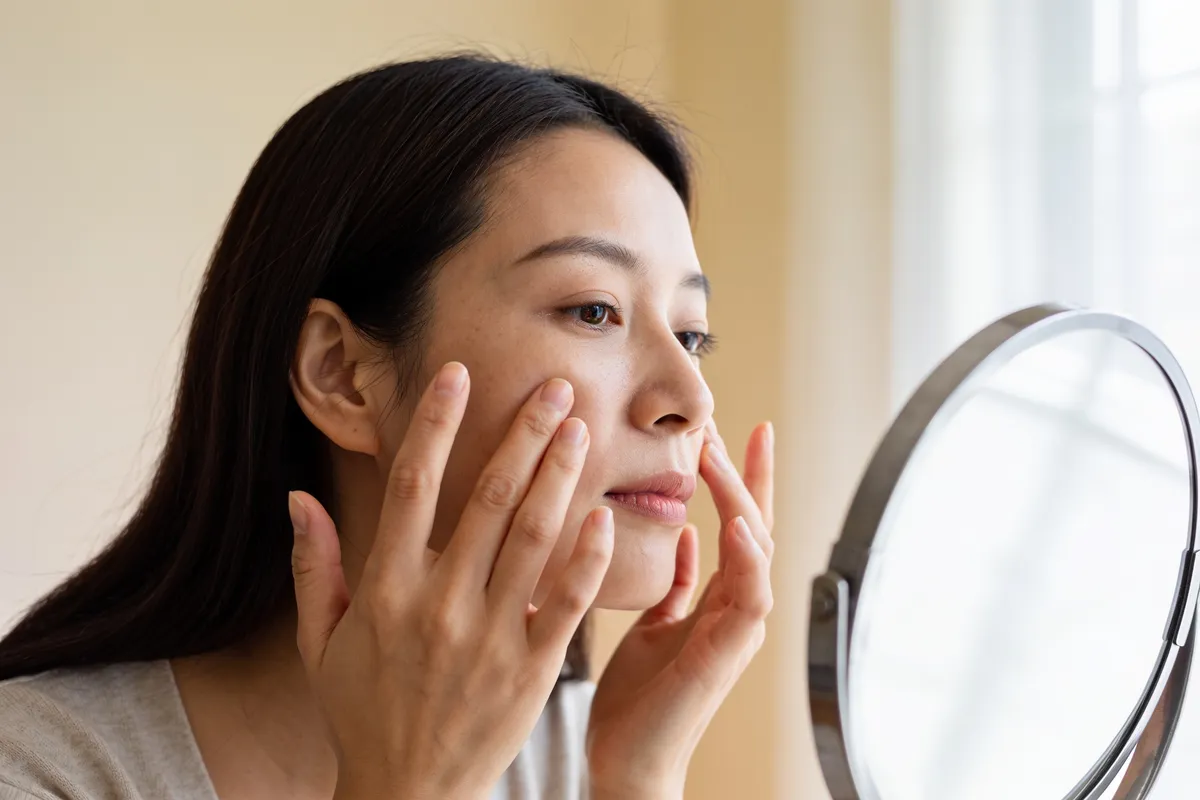
Skin quality is assessed in natural light. Illustrative image, not a patient.
A scar. Every cut through the skin of the face heals with a scar.
A dent. Cutting out a lump takes tissue with it, and the area can heal hollow or uneven.
Nerve injury. Nerves that give the face feeling and movement run close to where filler sits. An injured nerve can leave numbness, or weakness in a smile, a lip or a brow.
Product left behind. Filler spread through tissue is hard to remove completely.
No way back. Tissue that has been cut out cannot be put back.
Dr Sin Yong maps the filler with ultrasound and dissolves hyaluronic acid. Material that cannot be dissolved, including collagen stimulators, silicone and other non-absorbable fillers, is treated with the Sculpting mode of Time Freeze Laser LCLR®, without an incision. In Dr Sin Yong's practice, almost every hard lump is treated without surgery. If yours is one of the few that needs surgery, you are told plainly, and why. More is in the Sculpting mode of Time Freeze Laser LCLR® and hard lumps after filler or skin boosters.
What hyaluronidase is, and what it acts on
Hyaluronidase is an enzyme that breaks the long chains of hyaluronic acid into small fragments that the body clears. It has been in medical use since 1949 and is the agent used to dissolve hyaluronic acid filler (Murray 2021). Filler gel is cross-linked so that the body's own enzymes break it down slowly; injected hyaluronidase breaks it down quickly. A short definition is in the glossary under hyaluronidase.
Records of the product, amount and date make later assessment more accurate. Illustrative image, not a patient.
It acts on hyaluronic acid and nothing else: not polycaprolactone, poly-L-lactic acid, poly-D,L-lactic acid, calcium hydroxylapatite, silicone or fat. Poly-lactic acid and calcium hydroxylapatite are broken down by the body through other, slower processes, and non-absorbable fillers stay. A medical treatment described for calcium hydroxylapatite acts slowly and is not effective in an emergency (Wollina 2024). Polycaprolactone fillers cannot be removed straight away by injecting an enzyme (Lin 2020). In a series of 55 complications after collagen stimulators, hyaluronidase helped only where calcium hydroxylapatite had been combined with hyaluronic acid (Ianhez 2024).
Swipe sideways to see the whole table.
Filler materials and whether hyaluronidase dissolves each
Material
Examples
Does hyaluronidase dissolve it?
What Dr Sin Yong does
Hyaluronic acid filler
Most lip, under-eye, cheek, chin, nose and smile line fillers
Yes
Ultrasound-guided hyaluronidase, after a skin test
Hyaluronic acid skin boosters
Boosters made of hyaluronic acid, such as Profhilo
Yes
Scan first; dissolving where a lump is hyaluronic acid
Hyaluronic acid with calcium hydroxylapatite
HArmonyCa
Only the hyaluronic acid part
Dissolving, then the Sculpting mode for what remains
Poly-D,L-lactic acid
Juvelook
Only its hyaluronic acid carrier
Sculpting mode for clumping nodules
Poly-L-lactic acid
Sculptra
No
Sculpting mode for nodules and migrated product
Polycaprolactone
Ellansé
No
Sculpting mode, nodules large and small
Calcium hydroxylapatite
Radiesse
No
Sculpting mode, nodules large and small
Polynucleotide skin boosters
Rejuran
Not the polynucleotide itself
Scan first; the Sculpting mode for a lump that stays
Silicone and other non-absorbable fillers
Liquid silicone, polyacrylamide gel, PMMA
No
Mapped with ultrasound; the Sculpting mode, without an incision
Fat graft
Fat transfer
No
Assessed by scan; the Sculpting mode for excess graft
“Dissolving filler is not an undo button.”
Dr Sin YongOn what dissolving can and cannot do
How long does hyaluronidase take to work?
It starts acting soon after it is injected. In a randomised study, the largest change came between 30 minutes and 3 hours after the injection, with gradual further breakdown up to week 2 (Zhang-Nunes 2021). In laboratory and animal work, the enzyme's activity in tissue fell off within 30 minutes, and injecting it directly into the filler worked better than applying it over the surface (Hong, J Cosmet Dermatol 2025). Where the enzyme is placed matters, not only how much. Why one filler needs more enzyme than another is set out in the hyaluronidase glossary entry.
The injections themselves cause some swelling, so the change is not judged on the day. Dr Sin Yong reviews the area at about 48 hours and decides any further dose then, based on what remains. He waits at least two weeks after hyaluronidase before any refilling.
Does hyaluronidase work? What a randomised trial and reviews show
Hyaluronidase has been tested in a randomised trial published in JAMA Dermatology. Small deposits of two hyaluronic acid fillers were placed in the arms of nine women, and 72 sites were then injected with different doses of hyaluronidase or with saline. Even the smallest dose reduced the filler compared with saline. Sites given the highest dose were less palpable than sites given the lowest at four weeks and at four months, so the effect depended on the dose and on the filler.
A 2024 scoping review found only five randomised trials, with 53 participants in total, and concluded that the ideal dose and protocol have not been established. An ultrasound-guided study found hyaluronidase effective across fillers of different firmness. The enzyme works, and the right dose depends on the filler and where it sits.
Ultrasound-guided placement: putting the enzyme where the filler is
Because the enzyme acts where it is placed, and not for long, it needs to go into the filler itself. Dr Sin Yong scans the area himself with high-frequency ultrasound before any dissolving. Under ultrasound guidance, hyaluronidase can be injected directly into the filler deposit (Schelke 2018), and an expert review notes that guidance can make these treatments more effective (Kroumpouzos and Treacy 2024).
Planned dissolving: skin test, a small first dose, review at about 48 hours
The plan follows what the skin shows on the day. Illustrative image, not a patient.
History. What was injected, where and when; any earlier hyaluronidase and any reaction to it; and bee or wasp sting allergy, which guidance lists as a reason for extra care (Murray 2021).
Ultrasound. The filler is mapped before anything is injected.
Skin test. Before planned dissolving, Dr Sin Yong always does a skin test: a small amount of hyaluronidase is injected just under the skin to check for a reaction.
A small first dose. Placed into the mapped filler with a fine needle and titrated to effect rather than given as a set number of units (King 2018). For a non-urgent problem, a low dose goes into the excess (Landau 2015).
Review at about 48 hours. Further doses only where filler remains.
Refilling
Not on the same day. Dr Sin Yong waits at least two weeks after hyaluronidase before any refilling, and does not encourage it. Where laxity or a hollow remains once the area has settled, the usual route is the VF Lift – Vertical Facelift, which lifts your own tissue with nothing added.
Emergencies: a blocked blood vessel is treated at once
A blocked blood vessel after hyaluronic acid filler is a different situation from planned dissolving. It is treated straight away with high doses of hyaluronidase under a separate protocol, not with the small, staged doses described above (Murray 2021; Landau 2015; Kroumpouzos and Treacy 2024). Treatment is not delayed for a skin test: guidance advises testing before non-urgent dissolving, but not where a delay could cause harm (King 2018).
Records of the product, amount and date make later assessment more accurate. Illustrative image, not a patient.
Urgent: a change in vision or eye pain after filler: call 995 now. Skin that turns pale, dusky or mottled, or pain that is getting worse, needs urgent assessment by the doctor who injected you, or at A&E, now. See the warning signs of a blocked blood vessel after filler.
Hyaluronidase side effects
Lifting is judged along the jawline and neck. Illustrative image, not a patient.
Swelling, redness, itch or bruising at the injection points. These are common and settle.
A hollow where more than the excess was dissolved, which staged dosing is designed to avoid.
Some of the skin's own hyaluronic acid near the injection points is broken down too; the body replaces it.
Allergic reaction. Uncommon; usually local swelling and itch, rarely more serious.
No effect on other fillers. Material that is not hyaluronic acid does not respond.
Hyaluronidase allergy
In a systematic review of 37 studies describing 106 patients with hyaluronidase allergy, previous hyaluronidase injections and sensitisation from insect or wasp stings were the main risk factors. Many reactions happened at a second injection, and the reactions responded to treatment (Guliyeva 2024). Having had hyaluronidase before without a problem does not rule out a reaction next time. Swelling or itching that spreads beyond the treated area, or hives, needs a call to the clinic straight away. Breathing difficulty, a tight throat, or spreading swelling of the face, lips, tongue or throat means calling 995 now. More is in hyaluronidase allergy and the skin test.
When hyaluronidase is not the first step
A red, hot or tender lump. This may be infection. Consensus recommendations advise hyaluronidase for non-inflammatory reactions without active infection; an infection needs drainage, a sample for testing and medical treatment, not hyaluronidase as the first step (Baranska-Rybak 2024).
Recent filler. Early swelling and unevenness often settle on their own, so a review is usually wiser than dissolving straight away, unless there are signs of a blocked vessel.
Fullness that is not filler. Swelling, fluid, weight change and your own tissue can look like filler, and the enzyme does not act on them.
Filler that is not hyaluronic acid. The enzyme has nothing to act on; the Sculpting mode of Time Freeze Laser LCLR® is used instead.
Dissolving that has already failed. The enzyme may not have reached the filler, the filler may not be hyaluronic acid, or the fullness may be something else. See when filler dissolving has not worked.
How Dr Sin Yong uses hyaluronidase
Dr Sin Yong takes the history, performs the ultrasound scan and the skin test, and places the enzyme himself on Orchard Road. The aim is to dissolve what is in excess, in stages, and to use the Sculpting mode of Time Freeze Laser LCLR® for what the enzyme cannot touch. More filler is not added to disguise a problem. He developed the Time Freeze Laser LCLR® protocol himself and has been invited to share his clinical expertise internationally, including as a Global Key Opinion Leader.
A gentle lift with the fingers shows where laxity sits. Illustrative image, not a patient.
You do not need to have been treated here: filler placed elsewhere in Singapore or overseas is assessed in the same way. The wider guide is filler dissolving in Singapore.
People think that dissolving filler resets you to zero. It doesn't, and you should know that before you start. It has to be done in stages, judged by anatomy, because tissue that has been stretched for years doesn't snap back on its own. Rushed dissolution can leave you looking more deflated than when you walked in. It's a sequence, not a single appointment. Ask whoever you see to walk you through the whole plan first.
Transcript of Dr Sin Yong's video, lightly edited for reading.
When to see a doctor urgently
After a dissolving injection, swelling of the lips, tongue or throat, widespread hives or difficulty breathing are signs of an allergic reaction and need emergency care at once.
After any filler injection, severe or increasing pain, skin that turns white, blotchy or dusky, or any change in vision is an emergency: contact the treating doctor at once or go to an emergency department, the same day.
Frequently Asked Questions
Hyaluronidase in Singapore is given by a doctor as an injection. It dissolves hyaluronic acid filler and nothing else. Dr Sin Yong maps the filler with ultrasound and does a skin test first.
No. Hyaluronic acid is the gel that most fillers are made of, and it also occurs naturally in the skin. Hyaluronidase is the enzyme that breaks hyaluronic acid down. The body makes its own hyaluronidase, which is why hyaluronic acid filler fades slowly; injected hyaluronidase does the same job quickly and in one place. The names are similar because one acts on the other, but they do opposite things.
No. It dissolves hyaluronic acid only. Polycaprolactone (Ellansé), poly-L-lactic acid (Sculptra), calcium hydroxylapatite (Radiesse), poly-D,L-lactic acid (Juvelook, apart from its hyaluronic acid carrier), silicone and other non-absorbable fillers, and fat do not respond. Being told a filler cannot be dissolved does not mean it must be cut out: Dr Sin Yong treats this material with the Sculpting mode of Time Freeze Laser LCLR®, without an incision.
Hyaluronic acid fillers are made in different ways. In a laboratory comparison of 16 fillers, manufacturing technology was the most important factor in how easily the enzyme broke them down (Faivre 2024). In a randomised study, one cheek filler needed more than the highest dose tested while another responded to the lowest (Zhang-Nunes 2021). That is why the dose is titrated to effect, not set in advance.
Usually not. Get assessed first. Surgery means a scar, a possible dent, a risk of nerve injury and product left behind, and it cannot be undone. In Dr Sin Yong's practice, almost every hard lump is treated without surgery: material that cannot be dissolved, silicone included, is treated with the Sculpting mode of Time Freeze Laser LCLR®, without an incision. If yours needs surgery, you are told plainly, and why.
Yes. When people talk about a filler dissolver, they mean hyaluronidase, the enzyme injected to break down hyaluronic acid filler. No enzyme dissolves collagen stimulators or silicone in the same way. Massage, heat, creams and so-called natural dissolvers do not dissolve hyaluronic acid filler, and some can push it elsewhere.
Each injection is a quick sting from a fine needle, and some people notice brief warmth or itch where the enzyme goes in. Tenderness, swelling or a small bruise afterwards is common and settles. Tell the clinic if swelling grows or itching spreads beyond the treated area, because that can be the start of an allergic reaction.
Yes, if it is hyaluronic acid. Hyaluronic acid filler can stay in the tissue for years: in one study, a small untreated test deposit was still present 4 years later (Zhang-Nunes 2021). Old hyaluronic acid filler is dissolved with the same enzyme. Ultrasound shows whether filler from earlier treatments is still there, how much and where, before any dose is given.
A hyaluronidase injection breaks down hyaluronic acid, including the small amount in your own skin, which is why flooding an area can leave it looking deflated for a while. Dr Sin Yong keeps the dose small and places it into the filler seen on ultrasound, so the enzyme works on the excess rather than the surrounding tissue.
Some preparations are. Older hyaluronidase is purified from cattle or sheep tissue; a newer form is a recombinant human enzyme made in cell culture. Animal-derived hyaluronidase is more likely to cause an allergic reaction, though allergy is possible with either. Placement at the right depth matters more than the preparation. Dr Sin Yong asks about earlier hyaluronidase injections and sting allergy, and does a skin test first.
In hospital medicine it helps fluids and medicines given under the skin spread and absorb. It is also used alongside local anaesthetic for eye surgery, and when a drip has leaked into the tissue around a vein. Dissolving hyaluronic acid filler, planned or in an emergency, is a later use of the same enzyme. In aesthetic practice in Singapore, a hyaluronidase injection is given by a doctor after an assessment.
References
Guideline for the Safe Use of Hyaluronidase in Aesthetic Medicine, Including Modified High-dose Protocol. Journal of Clinical and Aesthetic Dermatology, 2021. source
The Use of Hyaluronidase in Aesthetic Practice (v2.4). Journal of Clinical and Aesthetic Dermatology, 2018. source
Hyaluronidase Caveats in Treating Filler Complications. Dermatologic Surgery, 2015. source
Prospective in vivo evaluation of three different hyaluronic acid gels to varying doses of hyaluronidase with long-term follow-up. Journal of Plastic, Reconstructive & Aesthetic Surgery, 2021. source
Comparison of Hyaluronidase-Mediated Degradation Kinetics of Commercially Available Hyaluronic Acid Fillers In Vitro. Aesthetic Surgery Journal, 2024. source
How Should We Use Hyaluronidase for Dissolving Hyaluronic Acid Fillers?. Journal of Cosmetic Dermatology, 2025. source
In Vivo Degradation of Crosslinked Hyaluronic Acid Fillers by Exogenous Hyaluronidases. Dermatologic Surgery, 2018. source
Hyaluronidase for Dermal Filler Complications: Review of Applications and Dosage Recommendations. JMIR Dermatology, 2024. source
A Scoping Review of Hyaluronidase Use in Managing Complications of Aesthetic Interventions. Aesthetic Plastic Surgery, 2024. source
Ultrasound to improve the safety of hyaluronic acid filler treatments. Journal of Cosmetic Dermatology, 2018. source
Allergic Complications of Hyaluronidase Injection: Risk Factors, Treatment Strategies, and Recommendations for Management. Aesthetic Plastic Surgery, 2024. source
Spontaneous and induced degradation of dermal fillers: A review. Journal of Cutaneous and Aesthetic Surgery, 2024. source
Polycaprolactone-based dermal filler complications: A retrospective study of 1111 treatments. Journal of Cosmetic Dermatology, 2020. source
Complications of collagen biostimulators in Brazil: Description of products, treatments, and evolution of 55 cases. Journal of Cosmetic Dermatology, 2024. source
Late-Onset Reactions after Hyaluronic Acid Dermal Fillers: A Consensus Recommendation on Etiology, Prevention and Management. Dermatology and Therapy, 2024. source
Alam M, Hughart R, Geisler A, Paghdal K, Maisel A, Weil A, et al. Effectiveness of Low Doses of Hyaluronidase to Remove Hyaluronic Acid Filler Nodules: A Randomized Clinical Trial. JAMA Dermatology, 2018. doi.org
Borzabadi-Farahani A, Mosahebi A, Zargaran D. A Scoping Review of Hyaluronidase Use in Managing the Complications of Aesthetic Interventions. Aesthetic Plastic Surgery, 2024. doi.org
Bravo BSF, Cavalcante T, Silveira C, Bravo LG, Zafra MC, Elias MC. Resolve and dissolve-An ultrasound-guided investigation on the effects of hyaluronidase on different soft tissue fillers. Journal of Cosmetic Dermatology, 2024. doi.org
About this page: written and medically reviewed by Dr Sin Yong, MBBS (NUS), MRCS (Edinburgh) · Last reviewed 8 November 2026 · Illustrative images only, not patients · Editorial policy
Not for emergencies. A change in vision or eye pain after filler: call 995 now. Pale, dusky or mottled skin, or pain that is getting worse: go now to the doctor who injected you, or to A&E. Do not message or book for these signs.