Published 26 October 2026 · Reviewed by Dr Sin Yong
Skin that turns white, then dusky, purple or mottled after filler, or pain that is getting worse, can mean a blocked blood vessel and skin that is starting to die. It needs urgent assessment by the doctor who injected you, or at A&E, now. A change in vision or eye pain: call 995 now. Once the skin has healed, scars, dents and colour change are assessed and treated.
Short answerFiller necrosis is skin dying because filler has blocked or pressed on a blood vessel. Pale, dusky or mottled skin, or pain that is getting worse: urgent assessment by the doctor who injected you, or at A&E, now. A change in vision or eye pain: call 995 now. For hyaluronic acid, high doses of hyaluronidase are given at once. In a systematic review of 186 published cases, starting the high-dose pulsed protocol within 24 hours of the injection halted the progression of impending necrosis; the evidence is of limited quality (Al-Alam Sansur 2023).
A change in vision or eye pain after filler: call 995 now. Pale, dusky or mottled skin, or pain that is getting worse: urgent assessment by the doctor who injected you, or at A&E, now.
Speed matters
In a systematic review of 186 published cases, starting high-dose pulsed hyaluronidase within 24 hours of the injection halted the progression of impending necrosis after hyaluronic acid filler (Al-Alam Sansur 2023). That is not a window to wait in: go now.
Vision loss
Rare, and an emergency; for any change in vision or eye pain, call 995 now. In 48 published cases, vision recovered fully in 20.8% and partly in 16.7% (Beleznay 2019).
Rare
A systematic review of filler for facial wrinkles recorded 1,076 adverse events; two were severe, one of them a mild skin necrosis (Janovskiene 2024).
Cannot be dissolved
Hyaluronidase acts on hyaluronic acid only. If Radiesse, Ellansé, Sculptra, silicone or PMMA blocks a vessel, it is the same emergency: urgent assessment by the doctor who injected you, or at A&E, now. Care is supportive, and never a laser.
After it heals
Scars, dents and colour change are assessed and treated in stages; the Sculpting mode of Time Freeze Laser LCLR® is used only for leftover filler that cannot be dissolved, without an incision.
Filler necrosis or a blocked vessel: what to do now
Urgent: a change in vision or eye pain after filler: call 995 now. Skin that turns pale, dusky or mottled, or pain that is getting worse, needs urgent assessment by the doctor who injected you, or at A&E, now. See the warning signs of a blocked blood vessel after filler.
Skin that is dying after a blocked blood vessel (necrosis) is an emergency. It needs urgent, more intensive care than a lump does, starting now.
Each sign, and what to do
A change in vision or eye pain after filler, such as blurred or lost vision or double vision: call 995 now. Do not drive yourself.
Stroke signs (new weakness of the face, an arm or a leg, or slurred speech): call 995 now, and do not travel to a clinic first.
Pale, dusky or mottled skin, or pain that is getting worse: urgent assessment by the doctor who injected you, or at A&E, now. The skin often turns white first, then dusky, purple or net-like.
Blisters, crusts, dark scabs or broken skin over an area that turned pale or dusky: the skin is already short of blood. Urgent assessment by the doctor who injected you, or at A&E, now.
Spreading redness with a fever, feeling faint, confused or very unwell, or swelling around the eye with pain: call 995 or go to A&E now.
A red, hot, painful, swollen or draining lump, or a fever: a doctor the same day; if no doctor can see you today, A&E. It is treated medically first, before any device.
Difficulty breathing, a tight throat, swelling of the tongue or throat, or swelling that spreads quickly across the face, after any injection, including hyaluronidase, can be a serious allergic reaction: call 995 now. Itch, hives or swelling that spreads beyond the treated area: contact the clinic that injected you the same day.
These signs usually appear during or soon after the injection, sometimes later: act whenever they appear, whoever injected the filler and whatever it was. Speed matters: the skin is short of blood while you wait. Do not massage the area or put heat on it, and do not wait for a reply to a message, a booked review or the colour to settle.
Tell the doctor what was injected, where and when, if you know: it tells them whether the filler can be dissolved. A photograph is useful for the record, but it should never delay getting to a doctor.
What happens next
Where the filler is hyaluronic acid, a blocked vessel is treated at once with high doses of hyaluronidase, and the skin test is not done first when delay could cause harm (King 2018). Filler that cannot be dissolved needs urgent supportive care, with referral where needed. Whatever the filler, a blocked vessel is never treated with the Sculpting mode of Time Freeze Laser LCLR® or any other laser. Skin that breaks down needs wound care and review until it has healed. The treatment is set out in filler necrosis treatment, below, and what is done once the skin has healed in scar after filler necrosis.
What filler necrosis is: a blocked or compressed vessel starving the skin
Filler necrosis is skin, and sometimes the tissue beneath it, dying because filler has cut off its blood supply. The filler either enters an artery during the injection and blocks it, or presses on a vessel from outside. Either way, the skin that vessel supplies is starved of blood and oxygen. A blocked or compressed vessel is called a vascular occlusion. A case series of blocked vessels after hyaluronic acid filler describes where it leads: filler entering or pressing on a vessel can cause skin necrosis or scarring (Choi 2023).
How rare it is
Severe complications of filler are rare. A systematic review of studies of filler for facial wrinkles, covering 3,967 participants, recorded 8,795 complications. Most were mild or temporary reactions where the needle went in; 1,076 were adverse events, and two of those were severe: one mild skin necrosis and one abscess. No loss of vision and no deaths were reported (Janovskiene 2024). Rare is not never, and the signs above apply after any filler, whoever injected it.
What dissolving can and cannot do
Before the skin dies there is a stage, sometimes called impending necrosis, when it is short of blood but can still recover if the blood supply returns. That is why speed matters. Where the filler is hyaluronic acid, hyaluronidase dissolves it to let blood flow again; it does not bring back skin that has already died. What is left once the skin has healed, a scar, a dent or a change in colour, is treated separately, and it needs more work than a lump does.
“Dissolving filler is not an undo button.”
Dr Sin YongOn what dissolving can and cannot do
What filler necrosis looks like, stage by stage
Necrosis develops in stages, and the stage decides what is done. The signs usually begin during or soon after the injection, sometimes later. Act whenever they appear.
Swipe sideways to see the whole table.
Stage
What you may see or feel
What is done
Pale skin
Skin near the injection turns white or pale, often with pain that is out of proportion or getting worse
Urgent assessment by the doctor who injected you, or at A&E, now; for hyaluronic acid, high doses of hyaluronidase at once
Dusky or mottled skin
The area turns dusky, purple or net-like (mottled), often following the path of a vessel rather than the injection point; pain getting worse
Urgent assessment by the doctor who injected you, or at A&E, now; treatment is repeated and the skin reassessed until its colour and blood flow return
Blisters and broken skin
Blisters, crusts, dark scabs or broken skin over the area: the skin is dying
Urgent assessment by the doctor who injected you, or at A&E, now; then wound care and review until it has healed
Eye or brain signs, at any stage
Blurred or lost vision, double vision or eye pain; new weakness of the face, an arm or a leg, or slurred speech
Call 995 now; do not travel to a clinic first, and do not drive yourself
Healing
The scab separates and new skin forms beneath it; the area can look pink, dark or uneven
Wound care and review by the doctor treating it. A red, hot, painful, swollen or draining area, or a fever: a doctor the same day; if no doctor can see you today, A&E
Healed
A scar, a dent, a patch of darker, lighter or redder skin, or a lump of filler left behind
Assessed once healed: laser resurfacing for scars; treatment of colour change; for a leftover lump, dissolving if it is hyaluronic acid, or the Sculpting mode of Time Freeze Laser LCLR® if it cannot be dissolved
A bruise is different: blue or purple where the needle went in, tender but not out of proportion, and fading rather than spreading. The differences are set out in how to tell a blocked vessel from a bruise. If you are not sure which you have, treat pale, dusky or mottled skin, or pain that is getting worse, as the emergency: urgent assessment by the doctor who injected you, or at A&E, now.
Nose filler necrosis, lip filler necrosis and the other high-risk areas
A blocked vessel can follow filler anywhere in the face, and no area is free of risk. Concern is highest where arteries run close to where filler is placed and connect with each other and, in places, with the artery that supplies the eye.
The nose. The tip, the sides of the nose, the strip between the nostrils and the bridge. Its small arteries form a dense network, and some connect with the circulation of the eye. A review of 80 articles on complications of hyaluronic acid nose filler names a blocked vessel as the severe risk (Caranti 2025). More is in nose filler gone wrong.
Between the brows, on the forehead and at the temples. The arteries between the brows and on the forehead branch from the artery that supplies the eye, and those of the temple connect with it. More is in forehead and temple filler gone wrong.
Under the eyes and on the cheeks. Arteries in the cheek, especially towards the side of the nose and below the eye, connect with the vessels that supply the eye. More is in under-eye filler gone wrong and cheek filler gone wrong.
Beside the nose and mouth. An artery runs up beside the nose, close to where filler for the smile lines (the nasolabial area) is placed. More is in smile line filler gone wrong.
The lips. The arteries of the lips run within them, close to where filler is placed. A review of lip and perioral filler complications finds most of them mild and manageable, but names vascular compromise among the problems that can cause significant harm and may need more invasive treatment (Kroumpouzos 2023). More is in lip filler gone wrong.
For vision loss there are published site figures. In a review of 48 cases of partial or complete vision loss after filler, published between January 2015 and September 2018, the injection sites included the nose in 56.3%, the area between the brows (the glabella) in 27.1%, the forehead in 18.8% and the nasolabial fold in 14.6% (Beleznay 2019). Those figures are for vision loss, not for skin necrosis.
Wherever it happens, the action is the same: pale, dusky or mottled skin, or pain that is getting worse, needs urgent assessment by the doctor who injected you, or at A&E, now; a change in vision or eye pain means calling 995 now.
Can filler cause blindness? Rare, and an emergency
Very rarely, yes. Filler that enters a small artery in the face can travel back into an artery that supplies the eye and block it. The result can be sudden blurring or loss of vision, double vision, or pain in or around the eye. It is an emergency: call 995 now, do not drive yourself, and do not travel to a clinic first.
A review of the world literature found 48 new cases of partial or complete vision loss after filler, published between January 2015 and September 2018, adding to 98 cases in an earlier review (Beleznay 2019). In those 48 cases:
hyaluronic acid was the filler in 81.3%;
symptoms included loss of vision, pain, paralysis of eye movement and a drooping eyelid;
skin changes appeared in 43.8%, and complications of the brain and nervous system in 18.8%;
vision recovered fully in 10 (20.8%) and partly in 8 (16.7%);
management varied, and no single treatment was consistently effective.
The authors call blindness from fillers rare (Beleznay 2019). Loss of vision can come with skin changes and with stroke signs: new weakness of the face, an arm or a leg, or slurred speech. For any of these, call 995 now, and do not travel to a clinic first.
Filler necrosis treatment: high-dose hyaluronidase, and why speed matters
Where the filler is hyaluronic acid, a blocked vessel is treated at once with high doses of hyaluronidase, the enzyme that breaks down hyaluronic acid, rather than the low or moderate doses used for a non-inflamed lump (Kroumpouzos and Treacy 2024). The skin test that comes before planned dissolving is not done first when delay could cause harm (King 2018). The doses are repeated, and the skin is reassessed, until its colour and blood flow return.
Why speed matters
One approach used for skin that is starting to die is the high-dose pulsed hyaluronidase protocol. A systematic review of 186 cases from 72 studies, all of them case reports and case series, found that using it at once for impending skin necrosis after hyaluronic acid filler gave predictable, satisfactory results, and that starting within 24 hours of the injection halted the progression of necrosis and prevented lasting effects; the evidence is of limited quality (Al-Alam Sansur 2023). In a case series of blocked vessels after hyaluronic acid filler, assessed with Doppler ultrasound, thermal imaging and blood tests, how soon treatment started, how soon hyaluronidase was injected and the white blood cell count influenced the outcome; early recognition and prompt hyaluronidase prevented further damage and improved the outlook (Choi 2023).
So do not wait to see whether it settles. If more than 24 hours have passed, still go now to the doctor who injected you, or to A&E: skin that is still changing colour is still at risk.
Ultrasound in an emergency
Treatment is never held back for a scan, but where ultrasound is to hand it can help. On colour Doppler ultrasound, which shows blood flow, a blocked vessel shows as absent or reduced flow (Khorasanizadeh 2026). Ultrasound can also guide the enzyme: in a retrospective study of 39 patients with blocked vessels from hyaluronic acid filler, where flooding the whole region had brought little or no improvement, injections aimed at the filler seen on ultrasound were followed by immediate improvement in all of them, ultrasound showed blood flow restored, and they used a mean of 122.5 units, against 1,519.4 for flooding (Schelke, Aesthet Surg J 2023). None of this is a reason to look for a scanner first: go now to the doctor who injected you, or to A&E.
Why the evidence comes from case reports
The evidence for emergency treatment comes from case reports and case series; trials are lacking. A scoping review of hyaluronidase in aesthetic complications, searching to May 2022, found only five qualifying randomised trials, with 53 people in all, and they tested it on uncomplicated hyaluronic acid lumps in the skin of the forearm, upper arm or back. None addressed reversing facial filler, inflamed lumps, or a blocked blood supply and necrosis (Borzabadi-Farahani 2024).
Hyaluronidase can itself cause an allergic reaction. In an emergency the skin test is not done first, so the doctor asks about allergies and watches for a reaction; more is in hyaluronidase allergy and the skin test.
When the filler cannot be dissolved: urgent supportive care, never a laser
Hyaluronidase acts on hyaluronic acid only. It has no effect on calcium hydroxylapatite (Radiesse), polycaprolactone (Ellansé), poly-L-lactic acid (Sculptra), the poly-D,L-lactic acid in Juvelook, silicone, PMMA or polyacrylamide gel. If one of these blocks a vessel, it is the same emergency: urgent assessment by the doctor who injected you, or at A&E, now. Care is urgent and supportive, with referral where needed, without an enzyme to dissolve the cause. In a hybrid of hyaluronic acid and calcium hydroxylapatite, hyaluronidase acts on the hyaluronic acid part only.
Necrosis is not limited to hyaluronic acid. In a series of 32 people with complications after PMMA, a non-absorbable filler, 5 had tissue necrosis (Salles 2008). In the review of vision loss above, hyaluronic acid was the filler in 81.3% of cases, not in all of them (Beleznay 2019). If you know what was injected, tell the doctor treating you: it helps decide whether dissolving is part of the treatment.
Whatever the filler, a blocked vessel is never treated with the Sculpting mode of Time Freeze Laser LCLR® or any other laser. Later, once the skin has healed, a lump of filler that cannot be dissolved can still be treated without an incision: Dr Sin Yong treats it with the Sculpting mode. That is for the lump left behind, never for the emergency.
Scar after filler necrosis: what is done once the skin has healed
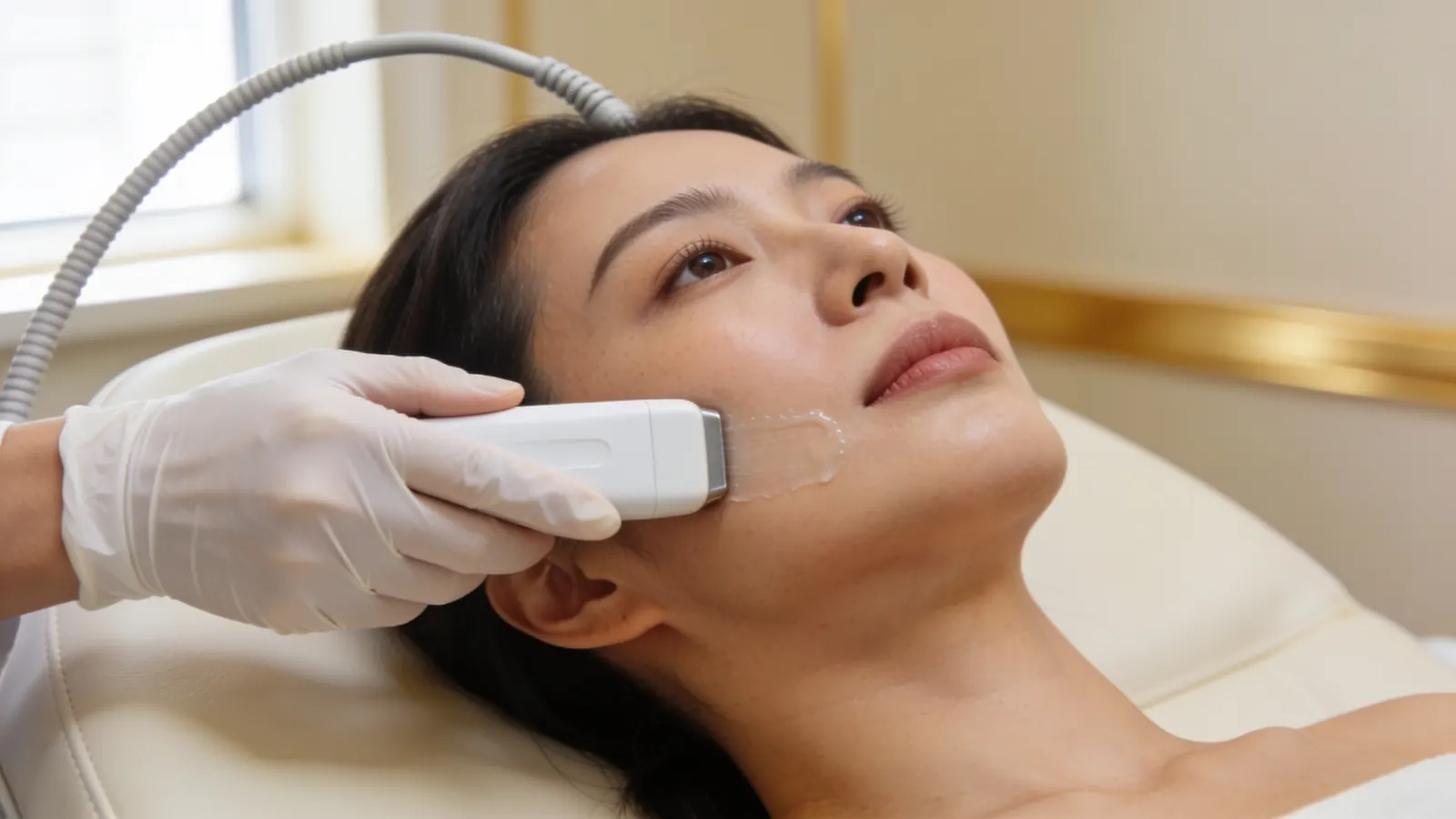
This is where necrosis differs most from other filler problems. A lump is material in the wrong place; necrosis is an injury to the skin itself, and what it leaves behind needs a different degree of work. Once the wound has closed and the skin has settled, Dr Sin Yong assesses what is left, and it is treated more intensively than a lump: often with more than one kind of treatment, planned in stages and reviewed between them.
Illustrative image — not a patient.
What can be left
A scar. Sunken, raised or uneven skin where the surface broke down. A case series of blocked vessels after hyaluronic acid filler names scarring as a possible consequence (Choi 2023).
A dent. Lost tissue under the skin, leaving a hollow or a notch, for example at the edge of a nostril or the lip.
A change in colour. Skin that is darker, lighter or redder than the skin around it.
Filler left behind. A lump of the filler that caused the problem, or of earlier filler in the same area.
How it is assessed
The scar, the dent and the colour are examined, and the area is scanned for filler left behind. Ultrasound shows where the filler sits, how deep it is and how far it has spread, and what it is likely made of. The scan shows what a lump is likely made of; it does not prove it, and where something does not look like filler, further tests are arranged. An international expert consensus calls ultrasound mandatory for managing filler complications, and recommends identifying filler already in place before more is injected (Velthuis 2025). More on scanning is in ultrasound-guided filler correction.
What is done
Scars: laser resurfacing. Sunken or uneven scars are treated with fractional laser resurfacing, matched to the depth of the scar. How the laser is matched to the depth of a scar is explained, for acne scars, in acne scar laser treatment; the laser itself is described in fractional CO2 laser. Raised scars are treated differently; see keloids and hypertrophic scars.
Colour change. Colour is treated as colour, not as a scar: darker patches with treatment aimed at the pigment rather than more resurfacing, which can darken them, and redness with treatment aimed at the redness. More is in post-inflammatory hyperpigmentation.
A leftover lump. Hyaluronic acid is dissolved only if the lump is the hyaluronic acid itself, after a scan and a skin test. Dr Sin Yong treats a leftover lump of filler that cannot be dissolved with the Sculpting mode of Time Freeze Laser LCLR®, without an incision. The Sculpting mode is used only for leftover filler, never for the scar itself, for skin that is still healing, or for a blocked vessel. More on lumps is in hard lumps after filler.
A dent. It is assessed with the scar, and the plan, including what treatment cannot replace, is explained before anything is done.
Scars after necrosis can be stubborn. In a published case of necrosis after injected exosomes, not filler, the crusts came away at two weeks and left significant sunken scarring and darker skin, and three laser sessions gave only modest improvement (AlBargawi 2025). The aim of treatment is a scar that is less noticeable; the skin may not return to exactly how it was.
A scar or lump after filler necrosis, and only offered surgery? Get assessed first
Once the skin has healed, some people are told that the scar has to be cut out, that a leftover lump needs an operation, or that nothing more can be done. Before you agree to an operation, know what it means:
A scar. Every cut through the skin of the face heals with a scar.
A dent. Cutting out a lump takes tissue with it, and the area can heal hollow or uneven.
Nerve injury. Nerves that give the face feeling and movement run close to where filler sits. An injured nerve can leave numbness, or weakness in a smile, a lip or a brow.
Product left behind. Filler spread through tissue is hard to remove completely.
No way back. Tissue that has been cut out cannot be put back.
Cutting out a scar replaces it with a new one. An operation can itself harm the blood supply: in a series of 11 people who had polyacrylamide gel removed from the lips, which meant reconstructing the lip, ten of the eleven outcomes were judged aesthetically satisfying, but one patient had severe tissue loss (necrosis) in the upper lip (Kastner 2018). That series was about gel in the lips, not about scars after necrosis.
For a leftover hard lump, the usual rule applies. In Dr Sin Yong's practice, almost every hard lump is treated without surgery. If yours is one of the few that needs surgery, you are told plainly, and why.
Surgery has a place
Where tissue has been lost, for example part of the rim of a nostril or of the lip, rebuilding it is surgical work, and an abscess may need draining. The point is the order: let the skin heal, have the area assessed and scanned, then decide.
Before you agree
Has the skin fully healed and settled?
Has the area been scanned, and is any filler left? Is any of it hyaluronic acid that could be dissolved first?
Have laser resurfacing for the scar and treatment of the colour change been considered?
Where will the cuts be, and where will the new scar sit?
How much tissue will be removed, and how will the area look afterwards?
A scan does not delay that decision: an operation can still be done later if it is ever needed, and it cannot be undone. If you have already been offered surgery, Dr Sin Yong can assess the area and give you a second opinion before you decide. More is in filler removal surgery.
Tried other treatments and almost given up?
Many patients who come to see Dr Sin Yong about lumps and marks left after a filler complication tell him they have tried almost everything else and had given up hope. Having tried other treatments does not mean nothing more can be done: what is done next depends on what the scan shows.
That history is useful. Knowing what was injected, when, and what has already been tried often explains why a problem has stayed: hyaluronidase acts only on hyaluronic acid and only where it reaches, some fillers are not hyaluronic acid at all, and swelling or fluid can look like filler. Ultrasound shows which of these applies, and the plan starts from there. For material that cannot be dissolved, Dr Sin Yong uses the Sculpting mode of Time Freeze Laser LCLR® for nodules large and small, without an incision. How each person responds varies.
If you have been told nothing more can be done, it is still worth having the area scanned: ultrasound shows what is there, and the plan is made from that. Bring any records of past treatments, product names and dates if you have them. More on this is in when filler dissolving has not worked.
How Dr Sin Yong approaches what filler necrosis leaves behind
Emergency care comes first. A blocked vessel is treated urgently, by the doctor who injected you or at A&E, and wound care continues with the doctor treating the wound until the skin has healed.
Maps. Once the skin has healed, he examines the scar, any dent and any change in colour, and scans the area himself with ultrasound for filler left behind.
Dissolves hyaluronic acid left behind. Only if the lump is the hyaluronic acid itself. He uses hyaluronidase, which acts on hyaluronic acid only. Your allergy history is checked. Before planned dissolving, Dr Sin Yong always does a skin test: a small amount of hyaluronidase is injected just under the skin to check for a reaction. A small first dose goes into the mapped lump, with a review at about 48 hours, because dissolving more than the excess can leave a hollow. Refilling, if wanted at all, waits at least two weeks. In an emergency such as a blocked blood vessel, dissolving is not delayed for a skin test.
Treats leftover filler that cannot be dissolved, without an incision. He treats Radiesse, Ellansé, Sculptra, silicone, PMMA and other material that cannot be dissolved with the Sculpting mode of Time Freeze Laser LCLR®, his own protocol on a long-pulsed 755 nm and 1064 nm laser platform, directed at the mapped material, without an incision, and only once the skin has healed. Like any laser, it can cause blistering or a change in skin colour, so settings are chosen for your skin.
Treats the scar and the colour. Laser resurfacing for sunken or uneven scars, matched to their depth, and treatment aimed at colour change, planned in stages with a review before each step.
Reviews. The area is reassessed, and any further visit is planned from what is seen.
Dr Sin Yong developed the Time Freeze Laser LCLR® protocol himself and performs every scan, every dissolving injection and every laser treatment himself on Orchard Road. He has been invited to share his clinical expertise in Seoul, Dubai, Bangkok and São Paulo, including as a Global Key Opinion Leader. You do not need to have been treated here: what necrosis has left after filler placed elsewhere in Singapore or overseas is assessed the same way, once the skin has healed (see correction of filler done overseas), and having no records of what was injected is fine. More on the laser is in the Sculpting mode of Time Freeze Laser LCLR®.
Your next step
Not for emergencies. A change in vision or eye pain after filler: call 995 now. Pale, dusky or mottled skin, or pain that is getting worse: go now to the doctor who injected you, or to A&E. Do not message or book for these signs.
1. MessageWhatsApp +65 8023 7170 with what is bothering you. A reply comes from the clinic, not a bot.
2. AssessmentDr Sin Yong examines you himself on Orchard Road, with ultrasound where earlier filler is involved.
3. A plan in writingWhat he would do, what he would not, the fee factors, and the option of no treatment.
Every treatment is performed by Dr Sin Yong personally. Singapore Medical Council registered · invited to share his clinical expertise internationally for CLASSYS, DEKA, Fotona, Hironic and Ilooda.
For a scar, dent, colour change or lump once the skin has healed, book an assessment with Dr Sin Yong on Orchard Road. Not for emergencies. Pale, dusky or mottled skin, or pain that is getting worse: go now to the doctor who injected you, or to A&E. A change in vision or eye pain: call 995 now. Do not message or book for these signs. How consultations work.
Filler necrosis is skin dying because filler has blocked a blood vessel or pressed on one, so the skin it supplies is starved of blood. It is rare, and it is an emergency. Pale, dusky or mottled skin, or pain that is getting worse, needs urgent assessment by the doctor who injected you, or at A&E, now. A change in vision or eye pain: call 995 now. Skin that is dying needs urgent, more intensive care than a lump does, starting now.
Many of the patients Dr Sin Yong sees have tried other treatments first. A treatment that did not help can still leave options open: hyaluronidase may not have reached the filler, the filler may not be hyaluronic acid, or what looks like filler may be swelling or fluid. Ultrasound shows which applies, and the plan follows what it finds.
Skin near the injection turns white, then dusky, purple or net-like (mottled), often with pain that is severe or getting worse; later come blisters, crusts, dark scabs or broken skin. It usually appears during or soon after the injection, sometimes later. Whenever it appears, it needs urgent assessment by the doctor who injected you, or at A&E, now. Do not massage it, put heat on it or wait for a reply. A change in vision or eye pain: call 995 now.
Go now to the doctor who injected you, or to A&E: pale, dusky or mottled skin, or pain that is getting worse, needs urgent assessment now. A change in vision or eye pain, or stroke signs (new weakness of the face, an arm or a leg, or slurred speech): call 995 now, and do not travel to a clinic first. Do not massage the area, put heat on it, or wait for a message reply or a booked review. Tell the doctor what was injected, if you know.
For hyaluronic acid, a blocked vessel is treated at once with high-dose hyaluronidase, with no skin test first when delay could cause harm (King 2018). In a systematic review of 186 published cases, starting the high-dose pulsed protocol within 24 hours of the injection halted the progression of impending necrosis (Al-Alam Sansur 2023). Other fillers need urgent supportive care; whatever the filler, never a laser. Skin that has broken down needs urgent assessment by the doctor who injected you, or at A&E, now, then wound care until it heals.
Very rarely, yes. Filler that enters a small artery in the face can travel back into an artery that supplies the eye. In a review of 48 published cases of vision loss after filler, the injection sites included the nose in 56.3% and the area between the brows in 27.1%; vision recovered fully in 20.8% and partly in 16.7%, and no single treatment was consistently effective (Beleznay 2019). Blurred or lost vision, double vision or eye pain after filler: call 995 now, and do not drive yourself.
Part of the lip or the skin around it turns white, then dusky, purple or mottled, often with pain that is getting worse; later come blisters, crusts or broken skin. It needs urgent assessment by the doctor who injected you, or at A&E, now. Blisters can look like a cold sore; if the skin around them is pale, dusky or mottled, or the pain is getting worse, it is the same emergency. A review names vascular compromise among lip filler problems that can cause significant harm (Kroumpouzos 2023).
Its small arteries form a dense network, and some connect with the artery that supplies the eye. A review of 80 articles on hyaluronic acid nose filler names a blocked vessel as the severe risk (Caranti 2025), and the nose was among the injection sites in 56.3% of 48 published cases of vision loss (Beleznay 2019). Pale, dusky or mottled skin on the nose needs urgent assessment by the doctor who injected you, or at A&E, now. A change in vision or eye pain: call 995 now.
Yes. Radiesse, Ellansé, Sculptra, silicone and PMMA can also block a vessel, and hyaluronidase does not act on them. Necrosis has also been reported after PMMA: in one series of 32 people with complications, 5 had tissue necrosis (Salles 2008). Care is urgent and supportive, with referral where needed, and never a laser. Pale, dusky or mottled skin, or pain that is getting worse: urgent assessment by the doctor who injected you, or at A&E, now. Once healed, a leftover lump can still be treated without an incision.
Not the emergency. A blocked vessel is never treated with the Sculpting mode of Time Freeze Laser LCLR® or any other laser: hyaluronic acid is dissolved with high-dose hyaluronidase, and other fillers need urgent supportive care. Lasers come later, once the skin has healed: laser resurfacing for scars, treatment for colour change, and the Sculpting mode only for a leftover lump of filler that cannot be dissolved. Pale, dusky or mottled skin needs urgent assessment by the doctor who injected you, or at A&E, now.
If the skin is still pale, dusky or mottled, or the pain is getting worse, that comes first: urgent assessment by the doctor who injected you, or at A&E, now. Necrosis can leave a scar: a case series of blocked vessels after hyaluronic acid filler names scarring as a possible consequence, and early recognition and prompt hyaluronidase prevented further damage (Choi 2023). Once healed, a scar, a dent or a change in colour can be left; each is assessed and treated, with more work than a lump needs.
Once the skin has fully healed, Dr Sin Yong examines the scar, any dent and any change in colour, and scans for filler left behind. Sunken or uneven scars are treated with laser resurfacing matched to their depth, and colour change is treated as colour. Leftover filler that cannot be dissolved is treated with the Sculpting mode of Time Freeze Laser LCLR®, without an incision. The aim is a less noticeable scar; the skin may not return to exactly how it was.
Usually not. Get assessed first. Where tissue has been lost, rebuilding it can need surgery; otherwise scars are treated with laser resurfacing, and Dr Sin Yong treats leftover filler that cannot be dissolved with the Sculpting mode of Time Freeze Laser LCLR®, without an incision. In Dr Sin Yong's practice, almost every hard lump is treated without surgery. If yours is one of the few that needs surgery, you are told plainly, and why. Cutting out a scar leaves a new scar, can leave a dent, and cannot be undone.
Rare. A systematic review of filler for facial wrinkles, covering 3,967 participants, recorded 1,076 adverse events; two were severe, one of them a mild skin necrosis (Janovskiene 2024). A review of the world literature calls blindness from fillers rare (Beleznay 2019). Rare is not never: after any filler, pale, dusky or mottled skin, or pain that is getting worse, needs urgent assessment by the doctor who injected you, or at A&E, now; a change in vision or eye pain: call 995 now.
References
The Use of Hyaluronidase in Aesthetic Practice (v2.4). Journal of Clinical and Aesthetic Dermatology, 2018. source
Management strategies for vascular complications in hyaluronic acid filler injections: A case series analysis. Journal of Cosmetic Dermatology, 2023. source
Safety and Potential Complications of Facial Wrinkle Correction with Dermal Fillers: A Systematic Literature Review. Medicina (Kaunas), 2024. source
Complications of Nonsurgical Rhinoplasty with Hyaluronic Acid Injections: A Narrative Review. Aesthetic Plastic Surgery, 2025. source
Complications of fillers in the lips and perioral area: Prevention, assessment, and management focusing on ultrasound guidance. Journal of Plastic, Reconstructive & Aesthetic Surgery, 2023. source
Update on Avoiding and Treating Blindness From Fillers: A Recent Review of the World Literature. Aesthetic Surgery Journal, 2019. source
Hyaluronidase for Dermal Filler Complications: Review of Applications and Dosage Recommendations. JMIR Dermatology, 2024. source
Use of the high-dose pulsed hyaluronidase protocol in the management of impending skin necrosis associated with hyaluronic acid fillers: a systematic review. International Journal of Oral and Maxillofacial Surgery, 2023. source
Ultrasonographic evaluation of cosmetic fillers: patterns and frequent complications - A literature review. Clinical Imaging, 2026. source
Ultrasound-Guided Targeted vs Regional Flooding: A Comparative Study for Improving the Clinical Outcome in Soft Tissue Filler Vascular Adverse Event Management. Aesthetic Surgery Journal, 2023. source
A Scoping Review of Hyaluronidase Use in Managing the Complications of Aesthetic Interventions. Aesthetic Plastic Surgery, 2024. source
Complications after polymethylmethacrylate injections: report of 32 cases. Plastic and Reconstructive Surgery, 2008. source
The use of ultrasound imaging in aesthetic injectables: A modified Delphi consensus. Journal of Plastic, Reconstructive & Aesthetic Surgery, 2025. source
Necrosis Following Dermal Injection of Lyophilized Exosomes: A Case Report. Journal of Cosmetic Dermatology, 2025. source
Removal of Polyacrylamide Gel (Aquamid®) from the Lip as a Solution for Late-Onset Complications: Our 8-Year Experience. Aesthetic Plastic Surgery, 2018. source
About this page: written and medically reviewed by Dr Sin Yong, MBBS (NUS), MRCS (Edinburgh) · Last reviewed 26 October 2026 · Illustrative images only, not patients · Editorial policy
Not for emergencies. A change in vision or eye pain after filler: call 995 now. Pale, dusky or mottled skin, or pain that is getting worse: go now to the doctor who injected you, or to A&E. Do not message or book for these signs.