When the overfilled look involves the whole face, see pillow face.
Main guideDermal fillers — what it treats, who it suits, sessions, downtime and what decides the cost, by Dr Sin Yong.
Published 25 October 2026 · Reviewed by Dr Sin Yong
Under-eye filler can usually be dissolved if it is hyaluronic acid, the type most often used under the eyes. Puffiness, a lump, a ridge or a blue tint after tear trough filler are the common reasons to dissolve it. Dr Sin Yong maps the filler with ultrasound first, places hyaluronidase into the excess, and reviews before deciding on anything more. A firm lump that stays, from any product, is covered under lump after filler.
Short answerYes, in most cases. Hyaluronic acid filler under the eyes, including tear trough filler, can be dissolved with hyaluronidase, an enzyme that breaks it down. The scan comes first: ultrasound shows where the filler sits, how deep it is and whether it looks like hyaluronic acid. A small first dose goes into the mapped filler, the area is reviewed at about 48 hours, and any further dose is titrated to what remains (King 2018). Collagen-stimulating fillers do not dissolve, but Dr Sin Yong treats them with the Sculpting mode of Time Freeze Laser LCLR®, without an incision.
Most under-eye filler is hyaluronic acid, which hyaluronidase breaks down.
Ultrasound first
The scan shows where the filler sits, how deep it is and whether it looks like filler at all.
Aimed at the excess
The enzyme goes into the mapped deposit rather than across the whole lower eyelid.
Staged
A small first dose, a review at about 48 hours, and no refilling for at least two weeks.
Not hyaluronic acid
Collagen stimulators, fat and non-absorbable fillers do not dissolve; Dr Sin Yong treats them with the Sculpting mode of Time Freeze Laser LCLR®, without an incision.
Hard lumps after filler or skin boosters, and only offered surgery? Get assessed first: cutting filler out leaves a scar and can cause dents or nerve injury. Find out how Dr Sin Yong treats them without surgery.
Why people have under-eye filler dissolved
The lower eyelid is the least forgiving place in the face for filler. The skin is very thin, there is little fat between it and the muscle, and the area drains fluid slowly. Filler that would be invisible in the cheek can show here, and a gel that draws in water can turn a hollow into a bag. These are the concerns patients bring most often when they ask to have under-eye filler dissolved.
Swipe sideways to see the whole table.
What you notice
What it often is
What usually helps
Puffiness or bags, often worse in the morning
Filler drawing in water, or fluid held above the malar septum (malar oedema)
Ultrasound to tell filler from fluid; dissolving the filler if it is there
A visible bead, lump or ridge
Filler placed too close to the surface, or too much in one place
Targeted hyaluronidase into the mapped deposit
A blue or grey tint under thin skin
Superficial hyaluronic acid showing through the thin skin (the Tyndall effect)
Dissolving the superficial deposit
Filler still there years later
Hyaluronic acid that has lasted far longer than expected
Mapping, then dissolving the excess
A heavy, tired look after several top-ups
Layers of filler added over time
Staged dissolving, then reassessment
A new tender, red or firm lump months later
A delayed inflammatory nodule
Medical assessment first; a red or tender lump needs a doctor the same day (A&E if no doctor can see you today); see lumps months or years after filler
How common is this? In a published series of 1,452 tear trough treatments in 583 patients, swelling occurred in 10%, contour irregularity in 4.6% and a bluish tint in 3.3%, and larger volumes raised the risk of swelling (Wilde 2023). Most problems after hyaluronic acid filler are mild and related to volume and technique (Signorini 2016). Hyaluronic acid placed too close to the surface can show as discoloration, the Tyndall effect, and a low dose of hyaluronidase into the superficial gel is among the published options (Hirsch 2006; Kroumpouzos and Treacy 2024).
Problems can also appear late. A systematic review of delayed complications after tear trough filler found swelling to be the most common, followed by lumps, migration and discoloration, appearing on average about 17 months after the injection (Trinh 2022).
60-second under-eye filler check
Not for emergencies. A change in vision or eye pain after filler: call 995 now. Difficulty breathing, a tight throat, swelling of the tongue or throat, or swelling that spreads quickly across the face: call 995 now. Pale, dusky or mottled skin, or pain that is getting worse: go now to the doctor who injected you, or to A&E. A red, hot or draining lump, or a fever: a doctor the same day; if no doctor can see you today, A&E. Do not use this check or WhatsApp for these signs.
Answer three questions and send them straight to the clinic on WhatsApp. Dr Sin Yong will let you know whether an ultrasound assessment is worthwhile. No obligation.
1 · When was the filler done?
2 · What bothers you most?
3 · Have you had filler dissolved before?
Your answers open in your own WhatsApp app; nothing is stored on this page.
Is it filler, eye bags or fluid?
Not every bulge under the eye after filler is filler. Dissolving only helps if hyaluronic acid is the cause, so the first job is telling these apart.
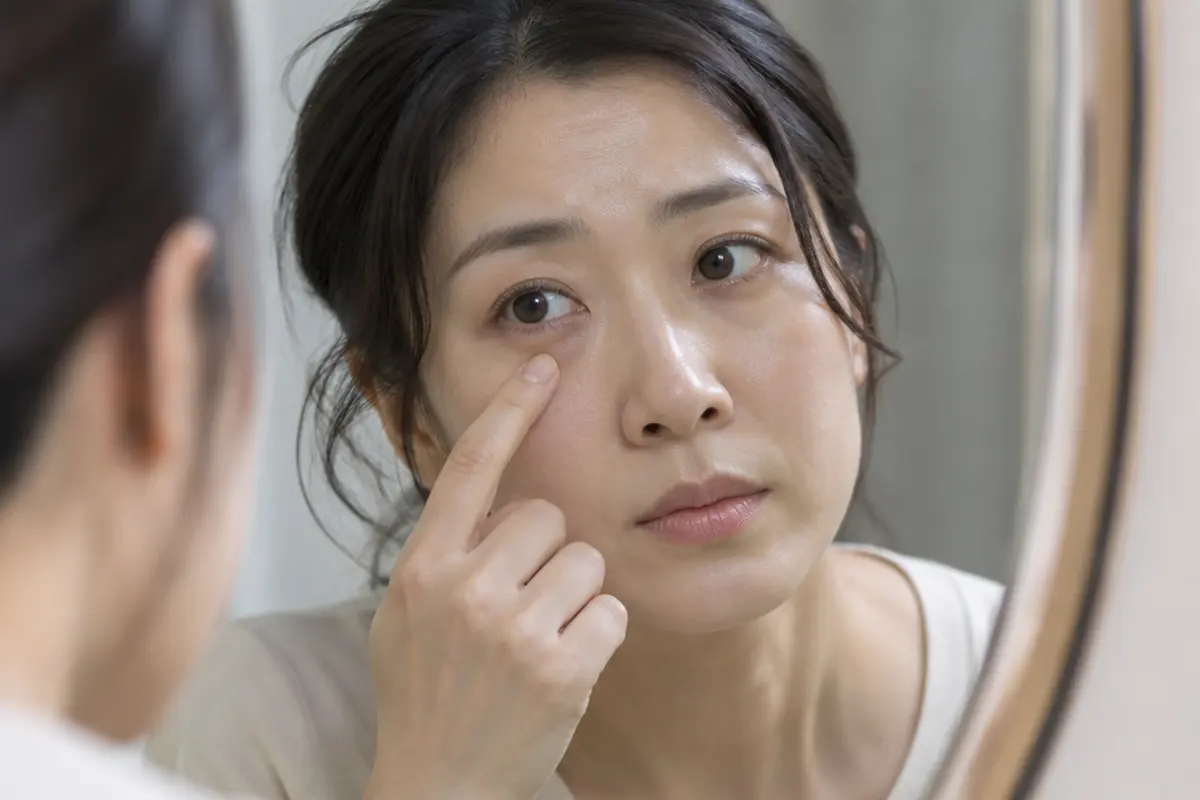
Thin under-eye skin shows vessels and pigment more easily. Illustrative image, not a patient.
Clues that it is filler
It appeared, or got worse, after treatment.
It has an edge you can feel, or sits as a ridge or bead.
It has a bluish tint.
Clues that it is eye bags
The bulge was there before any filler.
It becomes more obvious when you look upwards, which is typical of the fat that sits behind the eyelid.
Clues that it is fluid
Puffiness that is worse in the morning, after salty food or a late night, and better later in the day.
Swelling that sits low, on the upper cheek below the lid–cheek junction.
Often it is a mix: filler holding water, on top of fluid that pools easily in this area (Funt 2011). In a published series of 26 eyes with swelling after filler, ultrasound suggested the filler was pressing on the small veins that drain the area, and removing it under ultrasound guidance restored the flow (Schelke, J Cosmet Dermatol 2023). Ultrasound settles most of these questions in the same visit. True eye bags are covered on eye bag removal without surgery, and the differences are set out in eye bags, dark circles and tear troughs compared.
“Under the eye I treat the finding, not the request. If the problem is a shadow from a hollow, a polynucleotide will not touch it; if the problem is crepey skin, more filler will make it worse. Telling the two apart is the whole consultation.”
Dr Sin YongOn under-eye filler and what lies beneath it
Ultrasound mapping before dissolving under-eye filler
On high-frequency ultrasound, hyaluronic acid filler shows as a dark, well-defined pocket. The scan shows how deep it sits, just under the skin, within the muscle or on the bone, how large it is, whether there is one pocket or several, and which vessels run beside it (Wortsman 2015).
Illustrative image — not a patient.
Why the scan changes the plan
A superficial deposit causing a blue tint needs a different approach from a deep pocket holding water.
Filler from more than one treatment can sit at different depths.
A collagen-stimulating filler looks different from hyaluronic acid, which avoids injecting an enzyme that cannot work.
Published work describes ultrasound being used to find earlier filler before treatment and to place hyaluronidase directly into the deposit (Schelke 2018), and an expert review notes that ultrasound guidance can make dissolving more effective (Kroumpouzos and Treacy 2024). Dr Sin Yong performs the scan and the injection himself in the same visit. How the scan guides the needle is explained step by step on ultrasound-guided filler dissolving.
What happens when under-eye filler is dissolved
History. What was injected, when and where, as far as you know, and any treatment already tried. Having no records is fine.
Allergy check. You are asked about any previous reaction to hyaluronidase and to bee or wasp stings. Before planned dissolving, Dr Sin Yong always does a skin test: a small amount of hyaluronidase is injected just under the skin to check for a reaction.
Ultrasound. Each side is scanned and the filler is mapped.
A small first dose. Hyaluronidase is placed into the mapped filler with a fine needle. For a non-urgent correction, the published guidance is a small first dose rather than a large one (King 2018).
Review. The area is reviewed at about 48 hours, once the enzyme has acted, and any further dose is titrated to what remains.
What it feels like
The injection is a brief sting, sometimes followed by a short warm or itchy feeling where the enzyme was placed. The enzyme starts working soon after it is placed, but the result is judged at the review, once any swelling from the injections has settled.
Before you come
Bring the product names and dates if you have them.
Tell the clinic if you are pregnant or breastfeeding; non-urgent dissolving is usually deferred.
An infection or active skin problem around the eye is settled first.
Why the enzyme is aimed at the excess
Dissolving all of the filler under the eye can leave the area hollower than before, and can remove filler that was doing its job. With the deposit mapped, the enzyme goes where the excess is. If a hollow remains once the face has settled, it is reassessed then, never refilled on the same day.
A study comparing ultrasound-targeted injection with flooding a whole region found that the targeted approach used far less hyaluronidase: a mean of 122.5 units against 1,519.4 (Schelke, Aesthet Surg J 2023). That study was about blocked vessels rather than cosmetic correction, but the principle carries over: when the filler can be seen, less enzyme is needed to reach it.
Does dissolving under eye filler work? What published studies show
Hyaluronidase has been tested in a randomised trial, in the arm and not under the eye. Every dose reduced hyaluronic acid filler compared with saline, and higher doses cleared it faster, with the effect varying between fillers. A 2024 scoping review found only five such trials and concluded that the ideal dose has not been established.
For the under-eye specifically, the published evidence consists of case series. A systematic review of delayed complications found swelling to be the most common problem, at 42.3% of 52 cases, and hyaluronic acid the product in most. Because the dose is not standardised and the under-eye is thin, the amount is kept small and aimed at the excess, with a review before any second treatment.
After dissolving: what to expect, and what comes next
Some swelling, redness or a small bruise at the injection points is common, and settles. Avoid rubbing or massaging the area unless you have been told to. Difficulty breathing, a tight throat, swelling of the tongue or throat, or swelling that spreads quickly across the face, after any injection, including hyaluronidase, can be a serious allergic reaction: call 995 now. Itch, hives or swelling that spreads beyond the treated area: contact the clinic that injected you the same day. An area that becomes hot and painful needs a doctor the same day; if no doctor can see you today, A&E. More detail is in what to expect after filler dissolving.
Once the excess has gone, the problem the filler was meant to hide may show again: a hollow, dark circles or loose skin. Dissolving removes filler; it does not change the skin or the fat pads. These are the options Dr Sin Yong discusses at the review:
No further treatment. A natural contour without filler is a valid result in its own right.
Loose or crepey lower eyelid skin.FSX laser is used for laxity of the lower eyelid skin.
A deep hollow. If filler is wanted again, it is considered only after at least two weeks, once the swelling has settled, in a small amount and placed deep.
When under-eye filler is not hyaluronic acid
Hyaluronidase acts on hyaluronic acid only. Other materials are sometimes placed under the eyes: collagen stimulators such as poly-L-lactic acid (Sculptra), polycaprolactone (Ellansé) or calcium hydroxylapatite (Radiesse), injected collagen, fat and, in older or overseas treatments, non-absorbable fillers. None of these dissolves with the enzyme.
They are mapped with ultrasound in the same way. For excess collagen-stimulator material, including under the eye, Dr Sin Yong uses the Sculpting mode of Time Freeze Laser LCLR®, his own protocol, which is built to target excess material with no incision; whether it suits a particular under-eye is decided at the assessment. Inflamed or infected lumps are treated medically first. A mix of hyaluronic acid and other products is common; see non-hyaluronic acid filler lumps under the eye and hard lumps after filler.
Risks of dissolving under-eye filler
Swelling, redness, itch or bruising at the injection points.
Over-correction: dissolving more than intended can leave a hollow, which is why the dose is staged.
Allergy: uncommon, ranging from local swelling to, rarely, a more serious reaction. This is why a history is taken and a skin test is always done before the treatment dose.
No effect on anything that is not hyaluronic acid.
Like any medical treatment, dissolving has limits, which Dr Sin Yong explains at the assessment alongside the alternatives, including no treatment.
Urgent: a change in vision or eye pain after filler: call 995 now. Skin that turns pale, dusky or mottled, or pain that is getting worse, needs urgent assessment by the doctor who injected you, or at A&E, now. See the warning signs of a blocked blood vessel after filler.
Tried other treatments and almost given up?
Many patients who come to see Dr Sin Yong about under-eye filler problems tell him they have tried almost everything else and had given up hope. Having tried other treatments does not mean nothing more can be done: what is done next depends on what the scan shows.
That history is useful. Knowing what was injected, when, and what has already been tried often explains why a problem has stayed: hyaluronidase acts only on hyaluronic acid and only where it reaches, some fillers are not hyaluronic acid at all, and swelling or fluid can look like filler. Ultrasound helps show which of these applies, and the plan starts from there. For material that cannot be dissolved, Dr Sin Yong uses the Sculpting mode of Time Freeze Laser LCLR® for nodules large and small, without an incision. How each person responds varies.
If you have been told nothing more can be done, it is still worth having the area scanned: ultrasound helps show what is there, and the plan is made from that. Bring any records of past treatments, product names and dates if you have them. More on this is in when filler dissolving has not worked.
How Dr Sin Yong approaches under-eye filler correction
Under-eye filler is one of the concerns patients bring to Dr Sin Yong most often. His approach is the same each time: find out what is there before treating it, aim the enzyme at what is in excess, and leave time between steps. He examines you, performs the scan and places the enzyme himself, and the plan, including what he would not do and what decides the fee, is set out in writing.
Not for emergencies. A change in vision or eye pain after filler: call 995 now. Pale, dusky or mottled skin, or pain that is getting worse: go now to the doctor who injected you, or to A&E. Do not message or book for these signs.
1. MessageWhatsApp +65 8023 7170 with what is bothering you. A reply comes from the clinic, not a bot.
2. AssessmentDr Sin Yong examines you himself on Orchard Road, with ultrasound where earlier filler is involved.
3. A plan in writingWhat he would do, what he would not, the fee factors, and the option of no treatment.
Every treatment is performed by Dr Sin Yong personally. Singapore Medical Council registered · invited to share his clinical expertise internationally for CLASSYS, DEKA, Fotona, Hironic and Ilooda.
Book an under-eye filler assessment with Dr Sin Yong on Orchard Road. How consultations work.
When Time Freeze Laser LCLR® is used instead of, or after, hyaluronidase
Hyaluronidase dissolves hyaluronic acid filler and nothing else, and it works over days. Dr Sin Yong uses the Time Freeze Laser LCLR® in two situations the enzyme cannot cover: when the excess is not hyaluronic acid (Sculptra, Ellansé, Radiesse, Juvelook or a fat graft), and when an overfilled area needs same-day reduction of the excess filler while the skin over it is lifted and tightened. After hyaluronidase has done its work, the laser is also used to treat the laxity that the filler was hiding. Which route applies is decided from the ultrasound scan at the assessment.
Frequently Asked Questions
Yes, if it is hyaluronic acid, which most under-eye fillers are. Hyaluronidase breaks it down. Ultrasound first shows where the filler sits and whether it looks like hyaluronic acid, because collagen-stimulating fillers, fat and non-absorbable fillers do not respond to the enzyme. A small first dose is placed into the mapped filler and reviewed before any more is used.
Hyaluronic acid filler can stay in the tissue far longer than many people expect; a review of MRI studies found it in the mid-face years after injection (Master 2024). The gel attracts water, the lower eyelid drains fluid slowly, and swelling is the most commonly reported delayed problem after tear trough filler (Trinh 2022), so old filler can gradually look like a bag, often worse in the morning. Ultrasound shows whether filler is still there, which decides whether dissolving will help.
The enzyme starts working soon after it is placed. Dr Sin Yong reviews the area at about 48 hours, once it has acted and the swelling from the injection has begun to settle, and decides then whether any more is needed. Judging on the day is unreliable, because the injections themselves cause some swelling.
It can, if more filler is dissolved than was in excess, or if the filler was hiding a hollow that is still there. That is why the dose is small, placed into the mapped excess and reviewed before more is used. If a hollow shows once things settle, the options are discussed then: leaving it, treating the skin, or a small amount of filler placed deep after at least two weeks.
It can break down some of the skin's own hyaluronic acid around the injection site, but the body replaces its own hyaluronic acid continuously, so this is not a lasting loss. The practical risk is dissolving more filler than intended, which is managed by mapping the filler first and using a small, staged dose.
The injection is a brief sting from a fine needle, sometimes followed by a short warm or itchy feeling where the enzyme was placed. Afterwards the area can be tender, swollen or bruised, and this settles. Difficulty breathing, a tight throat, swelling of the tongue or throat, or swelling that spreads quickly across the face, after any injection, including hyaluronidase, can be a serious allergic reaction: call 995 now. Itch, hives or swelling that spreads beyond the treated area: contact the clinic that injected you the same day.
Not on the same day, and Dr Sin Yong does not encourage it. He waits at least two weeks after hyaluronidase, until the swelling has settled, then assesses the area as it is. Where a hollow or loose skin remains under the eye, the usual route is the VF Lift – Vertical Facelift, which lifts your own tissue with nothing added, rather than more filler.
Then hyaluronidase will not dissolve it. Poly-L-lactic acid, polycaprolactone, calcium hydroxylapatite, injected collagen, fat and non-absorbable fillers all need a different plan, and are mapped with ultrasound first. For excess collagen-stimulator material, where it suits, Dr Sin Yong uses the Sculpting mode of Time Freeze Laser LCLR®, which is built to target excess material with no incision. Inflamed or infected lumps are treated medically first.
Yes. Many patients have no records, especially after treatment overseas or several years ago. The history is taken as far as you remember it, and ultrasound helps show whether the material looks like hyaluronic acid or something else, how deep it sits and how much there is. Bring any receipts, product stickers or messages from the clinic if you have them.
Non-urgent dissolving is usually deferred in pregnancy and while breastfeeding, and while there is an infection or active skin problem near the eye. A known allergy to hyaluronidase usually rules out planned dissolving, and strong reactions to bee or wasp stings, or earlier hyaluronidase injections, need careful assessment first, sometimes with an allergy specialist. If the bulge is eye bags rather than filler, dissolving will not help.
Without imaging, hyaluronidase is placed by feel and by the shape of the area, and is often spread over a wider region to be sure of reaching the filler. With ultrasound, the filler is seen first, so the enzyme can be placed into the deposit itself. In a study of blocked-vessel emergencies, the targeted approach used far less enzyme than flooding the region (Schelke, Aesthet Surg J 2023).
No referral is needed. You can contact the clinic directly, whether your filler was done here, elsewhere in Singapore or overseas, and doctors can also refer patients with a suspected filler problem. If you have urgent signs, do not wait for an appointment: for a change in vision or eye pain after filler, call 995 now; for pale, dusky or mottled skin, or pain that is getting worse, get urgent assessment by the doctor who injected you, or at A&E, now.
The enzyme is the same, but the tear trough is less forgiving. The skin is thin, the filler often sits close to the eye and blood vessels, and a small excess or a bluish tint shows readily. So tear trough filler dissolving starts with an ultrasound map, uses a small first dose aimed at the excess, and is reviewed at about 48 hours before anything more is placed.
Often, yes. Treatment is directed at the specific area that the ultrasound shows, rather than the whole face. Hyaluronic acid filler can be dissolved in a targeted way; products that cannot be dissolved are managed area by area. What suits your case is decided at the assessment.
Yes. A small bump may be product, swelling or a nodule, and each is managed differently. Dr Sin Yong examines it himself, with ultrasound, before anything is done.
References
The Use of Hyaluronidase in Aesthetic Practice (v2.4). Journal of Clinical and Aesthetic Dermatology, 2018. source
Guideline for the Safe Use of Hyaluronidase in Aesthetic Medicine, Including Modified High-dose Protocol. Journal of Clinical and Aesthetic Dermatology, 2021. source
Hyaluronidase for Dermal Filler Complications: Review of Applications and Dosage Recommendations. JMIR Dermatology, 2024. source
Ultrasound to improve the safety of hyaluronic acid filler treatments. Journal of Cosmetic Dermatology, 2018. source
Periorbital venous stasis may be involved with filler induced malar edema: a duplex ultrasound-imaging-based case series. Journal of Cosmetic Dermatology, 2023. source
Delayed Complications following Dermal Filler for Tear Trough Augmentation: A Systematic Review. Facial Plastic Surgery, 2022. source
Tear trough filler using the three-point tangent technique: lessons from 1452 tear trough applications. Plastic and Reconstructive Surgery Global Open, 2023. source
Avoiding malar edema during midface/cheek augmentation with dermal fillers. Journal of Clinical and Aesthetic Dermatology, 2011. source
Management of injected hyaluronic acid induced Tyndall effects. Lasers in Surgery and Medicine, 2006. source
Hyaluronic Acid Filler Longevity in the Mid-face: a review of 33 MRI studies. Plastic and Reconstructive Surgery Global Open, 2024. source
Identification and Complications of Cosmetic Fillers: Sonography First. Journal of Ultrasound in Medicine, 2015. source
Ultrasound-Guided Targeted vs Regional Flooding: A Comparative Study for Improving the Clinical Outcome in Soft Tissue Filler Vascular Adverse Event Management. Aesthetic Surgery Journal, 2023. source
Global Aesthetics Consensus: Avoidance and Management of Complications from Hyaluronic Acid Fillers-Evidence- and Opinion-Based Review and Consensus Recommendations. Plastic and Reconstructive Surgery, 2016. source
Alam M, Hughart R, Geisler A, Paghdal K, Maisel A, Weil A, et al. Effectiveness of Low Doses of Hyaluronidase to Remove Hyaluronic Acid Filler Nodules: A Randomized Clinical Trial. JAMA Dermatology, 2018. doi.org
Borzabadi-Farahani A, Mosahebi A, Zargaran D. A Scoping Review of Hyaluronidase Use in Managing the Complications of Aesthetic Interventions. Aesthetic Plastic Surgery, 2024. doi.org
Trinh LN, McGuigan KC, Gupta A. Delayed Complications following Dermal Filler for Tear Trough Augmentation: A Systematic Review. Facial Plastic Surgery, 2022. doi.org
About this page: written and medically reviewed by Dr Sin Yong, MBBS (NUS), MRCS (Edinburgh) · Last reviewed 6 November 2026 · Illustrative images only, not patients · Editorial policy
Not for emergencies. A change in vision or eye pain after filler: call 995 now. Pale, dusky or mottled skin, or pain that is getting worse: go now to the doctor who injected you, or to A&E. Do not message or book for these signs.