How a normal firmness differs from Ellansé nodules is set out in the aftercare guide.
Where skin quality rather than volume is the concern, see skin booster.
Published 25 October 2026 · Reviewed by Dr Sin Yong
Time Freeze Laser LCLR®
I want to see the Time Freeze before and after
Singapore's advertising rules do not allow before-and-after photos on a clinic website, so they are not shown here. Tap the button and a WhatsApp message to the clinic opens with the request already written; send it and the team will reply with the Time Freeze Laser LCLR® before-and-after PDF.
WhatsApp +65 8023 7170 · replies within clinic hours · results vary and are assessed in person
Ellansé cannot be dissolved. It is made of polycaprolactone microspheres in a gel, and hyaluronidase, the enzyme that dissolves hyaluronic acid filler, has no effect on it. Nodules, excess volume or product that has spread are mapped with ultrasound first. Where it suits, Dr Sin Yong targets the excess with the Sculpting mode of Time Freeze Laser LCLR®.
Short answerNo. Ellansé is polycaprolactone (PCL) microspheres in a carboxymethylcellulose gel, and hyaluronidase breaks down neither. The body absorbs the gel, while the microspheres stay and stimulate collagen around them (Christen 2020). Problems are therefore managed rather than dissolved: ultrasound maps the nodules or excess, inflamed lumps are treated medically, and Dr Sin Yong uses the Sculpting mode of Time Freeze Laser LCLR® to target excess material where it suits.
No. This is the single most important fact about correcting Ellansé, and the one most often misunderstood. Hyaluronidase, the enzyme used to dissolve filler, breaks down hyaluronic acid. Ellansé contains no hyaluronic acid. It is made of microspheres of polycaprolactone (PCL), a biodegradable polymer long used in medicine, suspended in a carboxymethylcellulose gel (Christen 2020; de Melo 2017). Neither part responds to the enzyme: in a review of 1,111 treatments, the authors note that polycaprolactone filler cannot be immediately removed by injecting an enzyme (Lin 2020).
Proportions are assessed from the front and in profile. Illustrative image, not a patient.
When hyaluronidase still has a part to play
Where Ellansé has been layered with hyaluronic acid filler or skin boosters in the same area, the hyaluronic acid can be dissolved selectively, which sometimes reduces the fullness around the Ellansé. The scan shows whether that applies. The enzyme will not change the polycaprolactone itself.
60-second Ellansé check
Not for emergencies. A change in vision or eye pain after filler: call 995 now. Difficulty breathing, a tight throat, swelling of the tongue or throat, or swelling that spreads quickly across the face: call 995 now. Pale, dusky or mottled skin, or pain that is getting worse: go now to the doctor who injected you, or to A&E. A red, hot or draining lump, or a fever: a doctor the same day; if no doctor can see you today, A&E. Do not use this check or WhatsApp for these signs.
Answer three questions and send them straight to the clinic on WhatsApp. Dr Sin Yong will let you know whether an ultrasound assessment is worthwhile. No obligation.
1 · When was the filler done?
2 · What bothers you most?
3 · Do you know which product was used?
Your answers open in your own WhatsApp app; nothing is stored on this page.
Ellansé nodules, and only offered surgery? Get assessed first
Patients with Ellansé nodules often tell Dr Sin Yong that surgery was the only option they were offered. Before you agree to it, know what it means: a scar, a possible dent where tissue is removed, a risk to the nerves that give the face feeling and movement, and no way back.
Ellansé is polycaprolactone and hyaluronidase does not dissolve it, but that does not mean it has to be cut out. Dr Sin Yong maps each nodule with ultrasound and treats nodules large and small with the Sculpting mode of Time Freeze Laser LCLR®, without an incision. The laser has its own risks, which are explained at the assessment.
Ellansé is a collagen stimulator. When it is injected, the gel gives volume straight away. The body then absorbs the gel, while the polycaprolactone microspheres stay in the tissue and prompt it to lay down collagen around them, which carries the longer-term volume. Different versions are made to last different lengths of time before the microspheres themselves are broken down (Christen 2020).
This is why Ellansé problems change over time. Early on, the gel and normal swelling can make an area look fuller than it will be. Later, a nodule may be a cluster of microspheres with collagen around it: firm, and not softened by massage. More on the product is on Ellansé in Singapore and in the glossary under polycaprolactone.
“What you see on the day after Ellansé is gel and swelling sitting over the product. I do not call it the result, and I do not add to it, until the gel has gone and the collagen has had its say.”
Dr Sin YongOn judging Ellansé
Common problems after Ellansé
Swipe sideways to see the whole table.
What you notice
What it often is
What is considered
A firm nodule you can feel or see
Microspheres clustered or placed too superficially, with collagen around them
Ultrasound; the Sculpting mode of Time Freeze Laser LCLR®, used for nodules large and small
Too much volume, or a heavy, puffy look
More product than the area needed, or collagen built up over repeated treatments
Mapping; the Sculpting mode of Time Freeze Laser LCLR® for the excess
Product that seems to have moved
Spread from where it was placed, or placement in a layer that allows movement
Mapping to see where it sits now
Bumps in the forehead or temples
Thin skin and fat over the area, where small amounts show easily
Ultrasound; the plan follows the depth
A red, tender or swollen lump, sometimes months later
Inflammation or infection; rarely a foreign-body granuloma
A doctor the same day (A&E if no doctor can see you today); medical treatment first
Fullness soon after treatment
The gel and normal swelling
Review rather than treatment, unless there are urgent signs
In the review of 1,111 polycaprolactone treatments, the most common problems were swelling and bruising, and nodules and granulomas were described as rare (Lin 2020). Lumps from collagen-stimulating fillers can still be persistent: in a series of 55 such complications, nodules were the most common problem, and hyaluronidase helped only where hyaluronic acid had been mixed in (Ianhez 2024). A granuloma is managed with anti-inflammatory treatment, ideally guided by ultrasound (Cerón Bohórquez 2024), which is why a lump that is red, tender or growing is treated medically before anything else. Such a lump needs a doctor the same day; if no doctor can see you today, A&E. The differences between collagen-stimulator nodules and migrated product are set out in collagen-stimulator nodules and migration.
Ultrasound mapping of Ellansé
Ultrasound is the first step for any Ellansé problem. Polycaprolactone has its own appearance on the scan, with bright specks and small comet-tail artefacts inside the deposit, which sets it apart from the dark, uniform pockets of hyaluronic acid (Wortsman 2017; Wortsman 2015).
Illustrative image — not a patient.
The scan shows:
where the microspheres sit, and how deep;
whether a lump is a cluster of product, collagen around it, inflammation, or something unrelated such as a cyst or a lymph node;
whether hyaluronic acid filler or skin boosters have been layered in the same area;
the vessels nearby, which matter for any further treatment.
Some patients come only for mapping, to know what is there before deciding anything; that is a valid reason for an assessment. Dr Sin Yong performs the scan himself.
Time Freeze Laser LCLR® for Ellansé nodules and excess
LCLR® stands for Laser Collagen Lipo Remodelling. It is a proprietary protocol developed by Dr Sin Yong on a long-pulsed 755 nm and 1064 nm laser platform, and he performs every treatment himself. Its Sculpting mode is built to target excess material. For Ellansé, it is the tool he uses on polycaprolactone nodules and excess, including where they sit with hyaluronic acid or skin boosters, and including under the eye after assessment and ultrasound.
Motion graphic, not to scale: how a hard lump forms after filler and skin boosters, how ultrasound maps it, and how the Sculpting mode of Time Freeze Laser LCLR® targets the excess.Video transcript
How a hard lump forms after filler and skin boosters. Diagram, not to scale.
A cross-section of facial tissue builds up layer by layer: skin, fat, muscle and bone.
Different products, same area: hyaluronic acid filler, skin booster and collagen stimulator, placed at different times.
They merge into one firm lump with a thin capsule, pressing on surrounding tissue. Small red vessels can show above it.
An ultrasound probe glides across the skin, mapping the material and its depth; the lump outline is traced in gold.
Time Freeze Laser LCLR®, Sculpting mode: laser energy is directed at the mapped area, built to target the excess material.
Ultrasound first. No incision. Response varies from person to person. Dr Sin Yong, Orchard Road, Singapore.
No incision and no stitches.
No redness, no downtime.
The area is reassessed before you leave, and any further visit is planned from what is seen.
Every face and every nodule is different, so the response varies from person to person. Like any medical treatment, laser has its own risks and limits, which are explained at the assessment alongside the alternatives. More on the protocol is on Time Freeze Laser LCLR®, and on the mode used for nodules in the Sculpting mode of Time Freeze Laser LCLR®.
Other options: medical treatment or waiting
Waiting and review. Early fullness after Ellansé is partly gel and swelling, which settle. An area is judged once that has happened, unless something is clearly wrong.
Medical treatment. A lump that is red, hot, tender or growing can be inflammation or infection: it needs a doctor the same day (A&E if no doctor can see you today) and is treated medically first.
Massage. Massage does not break up an established nodule, and firm pressure can irritate an inflamed one.
Consensus recommendations on filler complications advise identifying the type of lump before choosing a treatment (Urdiales-Gálvez 2018), which is the reason the scan comes first.
What happens at an Ellansé assessment
History. When and where it was injected, which version if known, how much, and any other fillers or skin boosters in the same area.
Examination. At rest and in expression, with photographs for your own comparison.
Ultrasound. Each area of concern is mapped.
A plan in writing. What would be treated and how, what would be left, and what decides the fee.
Treatment. Where it suits, treatment can follow in the same visit. Inflamed lumps are treated medically first.
You do not need to have been treated here. Patients travelling to Singapore can plan their visit through international patients, and doctors can refer through for GPs.
Tried other treatments and almost given up?
Many patients who come to see Dr Sin Yong about Ellansé problems tell him they have tried almost everything else and had given up hope. Having tried other treatments does not mean nothing more can be done: what is done next depends on what the scan shows.
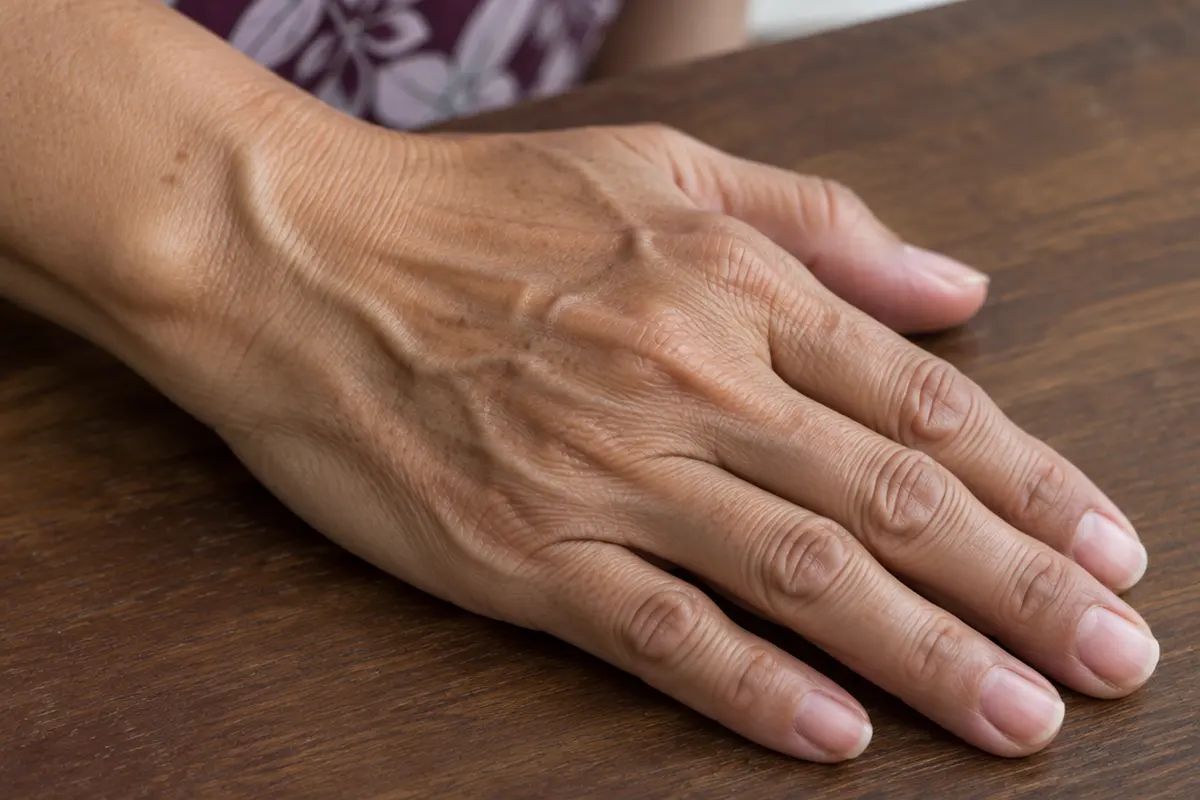
Hands lose volume with age and show tendons and veins. Illustrative image, not a patient.
That history is useful. Knowing what was injected, when, and what has already been tried often explains why a problem has stayed: hyaluronidase acts only on hyaluronic acid and only where it reaches, some fillers are not hyaluronic acid at all, and swelling or fluid can look like filler. Ultrasound helps show which of these applies, and the plan starts from there. For material that cannot be dissolved, Dr Sin Yong uses the Sculpting mode of Time Freeze Laser LCLR® for nodules large and small, without an incision. How each person responds varies.
If you have been told nothing more can be done, it is still worth having the area scanned: ultrasound helps show what is there, and the plan is made from that. Bring any records of past treatments, product names and dates if you have them. More on this is in when filler dissolving has not worked.
How Dr Sin Yong approaches Ellansé correction
The first job is to work out what the lump actually is. Dr Sin Yong maps before he treats, does not inject an enzyme that cannot work, dissolves any hyaluronic acid layered in the same area selectively, and uses the Sculpting mode of Time Freeze Laser LCLR® where excess collagen-stimulator material is the problem. The plan, including what he would not do, is set out in writing.
Not for emergencies. A change in vision or eye pain after filler: call 995 now. Pale, dusky or mottled skin, or pain that is getting worse: go now to the doctor who injected you, or to A&E. Do not message or book for these signs.
1. MessageWhatsApp +65 8023 7170 with what is bothering you. A reply comes from the clinic, not a bot.
2. AssessmentDr Sin Yong examines you himself on Orchard Road, with ultrasound where earlier filler is involved.
3. A plan in writingWhat he would do, what he would not, the fee factors, and the option of no treatment.
Every treatment is performed by Dr Sin Yong personally. Singapore Medical Council registered · invited to share his clinical expertise internationally for CLASSYS, DEKA, Fotona, Hironic and Ilooda.
Book an Ellansé assessment and ultrasound mapping with Dr Sin Yong on Orchard Road. How consultations work.
Non-hyaluronic-acid excess: the Sculpting mode of Time Freeze Laser LCLR®
Because this product does not dissolve, the question is how to take away the excess without an incision. Dr Sin Yong uses the Sculpting mode of the Time Freeze Laser LCLR® for exactly this: the overfilled or nodular area is mapped on ultrasound, the excess is reduced in the same session, and the skin over it is lifted and tightened rather than left slack. Patients travel from Dubai, South Africa, Hong Kong and elsewhere for this correction. Suitability and the number of sessions are decided at the assessment; results vary.
Time Freeze Laser LCLR®, in one line. Dr Sin Yong uses it to lift every zone of the face and neck, to take away excess filler in the same session, and to reduce loose fat in sagging areas while the skin tightens. The three uses, explained · Sculpting mode for excess filler.
A device is only a device. Ultherapy Prime, Thermage or a filler syringe is a tool, like a suture; technique, experience and customisation to the face decide the result. Why technique, not the device, decides the result.
Frequently Asked Questions
Usually, yes. Get assessed before you agree to it: cutting Ellansé out leaves a scar and can cause dents or nerve injury. Ellansé cannot be dissolved, but Dr Sin Yong maps each nodule with ultrasound and treats nodules large and small with the Sculpting mode of Time Freeze Laser LCLR®, without an incision. A nodule that is red, hot or tender needs a doctor the same day (A&E if no doctor can see you today) and is treated medically first.
Yes. Lumps after collagen-stimulating fillers often appear late: in a published series of 55 complications, nodules usually appeared more than a month after treatment (Ianhez 2024). A new lump long after Ellansé is worth an ultrasound scan, which helps show whether it is product, a reaction around it, or something else.
Polycaprolactone is broken down only slowly by the body, so a visible nodule can stay for a long time. Small nodules that cannot be seen are sometimes reasonably left alone and reviewed. For nodules that bother you, Dr Sin Yong uses the Sculpting mode of Time Freeze Laser LCLR® after mapping them with ultrasound, without an incision.
A lump that is growing, or becoming red, warm or tender, may be inflammation or, rarely, a foreign-body granuloma, a reaction around the product (Wang 2025). It needs a doctor the same day (A&E if no doctor can see you today) and is treated medically first. A lump that is firm but unchanged is more often product gathered in one place, which ultrasound helps show.
No. Ellansé is polycaprolactone microspheres in a carboxymethylcellulose gel, and hyaluronidase, the enzyme that dissolves hyaluronic acid filler, does not act on either. Problems are managed instead: ultrasound maps the product, inflamed lumps are treated medically, and excess material can be targeted with the Sculpting mode of Time Freeze Laser LCLR® where it suits.
Not by dissolving. Excess polycaprolactone can be targeted with the Sculpting mode of Time Freeze Laser LCLR®, which is built to target excess material with no incision; Dr Sin Yong uses it for nodules large and small. What suits depends on what the scan shows and where the product sits.
Early fullness and swelling after Ellansé often settle as the gel is absorbed. A firm nodule that persists is usually a cluster of microspheres with collagen around it, which does not settle in the way swelling does. A lump that is red, tender or growing needs a doctor the same day (A&E if no doctor can see you today) rather than waiting.
It can help with the hyaluronic acid part. Where Ellansé has been layered with hyaluronic acid filler or skin boosters, ultrasound shows which is which, the hyaluronic acid can be dissolved selectively, and the Ellansé is reassessed afterwards. The enzyme will not change the polycaprolactone itself.
The skin and fat over the forehead and temples are thin, so small amounts of product, or product placed close to the surface, can show as bumps. Ultrasound shows the depth and size of each deposit, which decides what can be done; the Sculpting mode of Time Freeze Laser LCLR® is considered for excess material.
No. An established nodule is a cluster of microspheres with collagen around it, and massage does not break it up. Firm pressure can irritate an inflamed lump. Gentle massage is sometimes advised soon after treatment for unevenness of the gel, but only on the advice of the doctor who examined you.
Not every lump after Ellansé is Ellansé. It can be hyaluronic acid or a skin booster from another treatment, inflammation, or something unrelated such as a cyst or a lymph node. Ultrasound helps tell these apart, which is why it comes before any treatment.
Dr Sin Yong uses the Sculpting mode of Time Freeze Laser LCLR® under the eye, but only after assessment and ultrasound; whether it suits a particular under-eye depends on the depth and amount of product and the condition of the skin. Eye protection is used during any laser treatment near the eyes.
It helps to know, but the assessment goes ahead without it. Ultrasound shows where the product is and how much there is, which matters more for planning than the version. Bring any records, product cards or messages from the clinic if you have them.
Usually not. Dr Sin Yong treats almost every Ellansé nodule without surgery, and says so plainly when surgery is the right tool. Concerns are mapped first, then managed with medical treatment, the Sculpting mode of Time Freeze Laser LCLR®, which he uses for nodules large and small without an incision, or time, depending on what the scan shows.
Often, yes. Treatment is directed at the specific area that the ultrasound shows, rather than the whole face. Hyaluronic acid filler can be dissolved in a targeted way; products that cannot be dissolved are managed area by area. What suits your case is decided at the assessment.
Yes. A small bump may be product, swelling or a nodule, and each is managed differently. Dr Sin Yong examines it himself, with ultrasound, before anything is done.
References
Polycaprolactone: How a Well-Known and Futuristic Polymer Has Become an Innovative Collagen-Stimulator in Esthetics. Clinical, Cosmetic and Investigational Dermatology, 2020. source
Recommendations for volume augmentation and rejuvenation of the face and hands with the new generation polycaprolactone-based collagen stimulator (Ellansé®). Clinical, Cosmetic and Investigational Dermatology, 2017. source
Polycaprolactone-based dermal filler complications: A retrospective study of 1111 treatments. Journal of Cosmetic Dermatology, 2020. source
Complications of collagen biostimulators in Brazil: Description of products, treatments, and evolution of 55 cases. Journal of Cosmetic Dermatology, 2024. source
Ultrasound-guided Treatment of Polycaprolactone Granuloma. Plastic and Reconstructive Surgery Global Open, 2024. source
Ultrasound Morphology of Polycaprolactone Filler. Journal of Ultrasound in Medicine, 2017. source
Identification and Complications of Cosmetic Fillers: Sonography First. Journal of Ultrasound in Medicine, 2015. source
The Use of Hyaluronidase in Aesthetic Practice (v2.4). Journal of Clinical and Aesthetic Dermatology, 2018. source
About this page: written and medically reviewed by Dr Sin Yong, MBBS (NUS), MRCS (Edinburgh) · Last reviewed 7 November 2026 · Illustrative images only, not patients · Editorial policy
Not for emergencies. A change in vision or eye pain after filler: call 995 now. Pale, dusky or mottled skin, or pain that is getting worse: go now to the doctor who injected you, or to A&E. Do not message or book for these signs.