Rejuran Singapore · Polynucleotide · Healer · S · I · Orchard Road

Rejuran Singapore — Healer, S and I, Explained

Medically reviewed by Dr Sin Yong · Last reviewed · 19 min read · Doctor-performed, never delegated · Jump to questions

Dr Sin Yong · MBBS (NUS) · MRCS (Edin) · MSc Aesthetic Medicine with Distinction (Queen Mary, London) · MSc Practical Dermatology (Cardiff) · International KOL

A polynucleotide preparation purified from salmon DNA, delivered by intradermal micro-injection. It is directed at how the skin repairs itself — not at volume, not at lift, not at pigment.

~20 mg/mL
Polynucleotide concentration
50–1,500 kDa
PN fragment range
Salmon DNA
Purified source
Intradermal
Micro-injection plane
Invited by Device Makers to Share His Expertise
International KOL for 14+ device brandsShared his clinical expertise with 500+ doctors across AsiaMBBS (NUS) · MRCS (Edinburgh) · MSc with Distinction (Queen Mary, London) · MSc (Cardiff)Every treatment personally performed — never delegated

Rejuran Healer is a polynucleotide skin booster purified from salmon DNA and registered with Singapore's Health Sciences Authority as an injectable medical device. It is injected into the dermis to support skin repair, texture and elasticity. It is not a filler: it adds no volume, does not lift and does not remove pigment. Fish allergy is checked first.

Also called: polynucleotide (PN) injections, 婴儿针, リジュラン

Key takeaways
  • Rejuran Healer is a polynucleotide skin booster purified from salmon DNA, registered with Singapore's HSA as an injectable medical device.
  • It is injected into the dermis and is directed at skin texture, fine lines, elasticity and post-acne skin quality.
  • Suitability depends on fish allergy, pregnancy status, skin condition and keloid tendency.
  • It is not a filler: it adds no volume, does not lift, does not remove pigment and does not shrink pores.
  • Dr Sin Yong, an aesthetic physician, assesses and performs the injections personally.

What Rejuran Actually Is

Rejuran is made by PharmaResearch in Korea and is registered with Singapore’s Health Sciences Authority as an injectable medical device. The active material is polynucleotide — chains of nucleotides purified from salmon DNA, filtered and sterilised so that what is injected is the polymer, not genetic information. Rejuran Healer carries polynucleotide at approximately 20 mg/mL, around 2 per cent.

Two terms get used interchangeably and should not be. PN denotes polynucleotide, the longer-chain material in the Rejuran range. PDRN denotes polydeoxyribonucleotide, shorter fragments of the same family used in other preparations. Products built on each are not the same product, and a page that treats the two as synonyms is describing something else.

It is not a filler. Nothing in the syringe is engineered to occupy space or hold a contour. What is being bought is a signal to the tissue, delivered where the tissue can act on it.

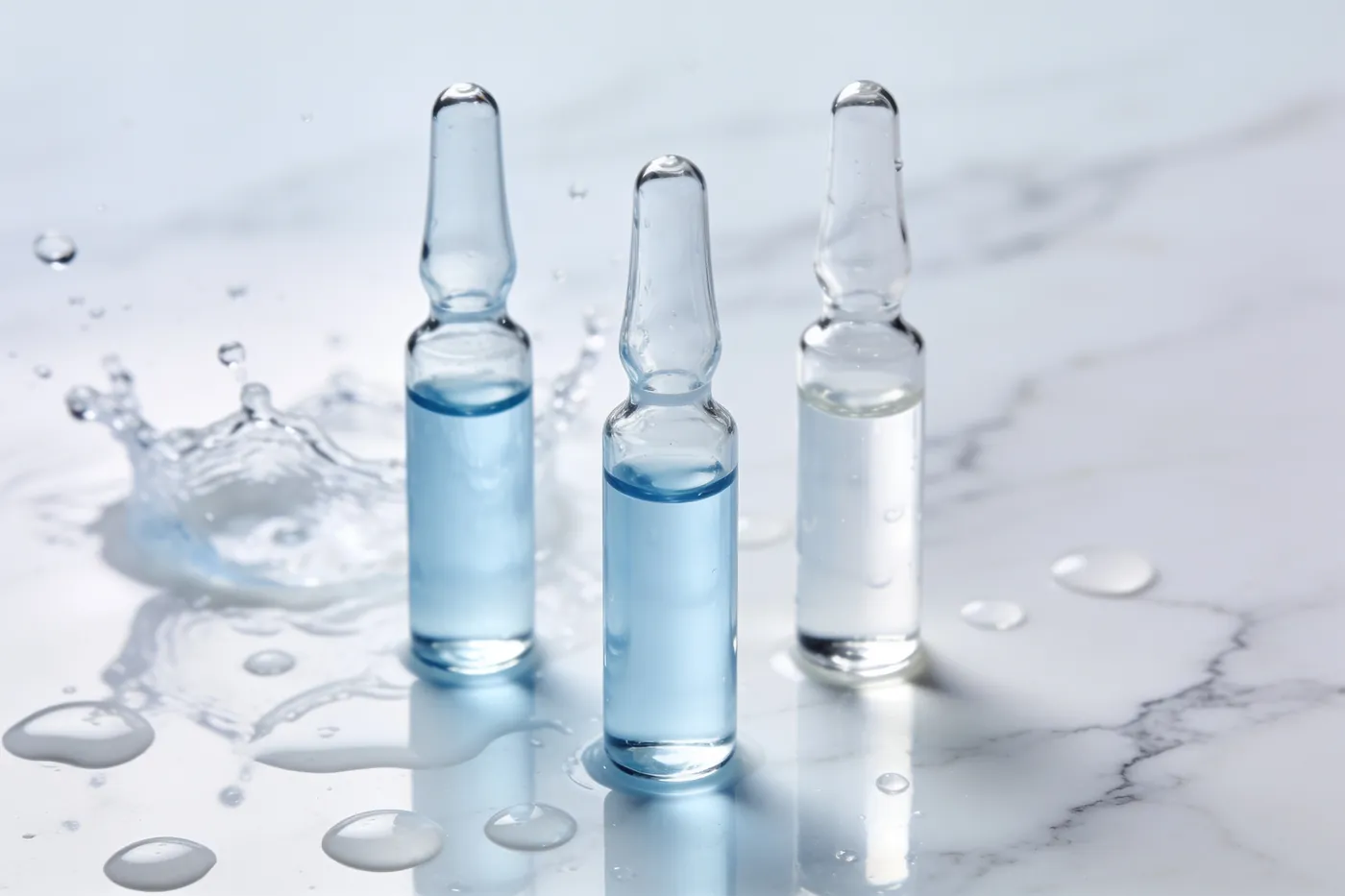
Three small glass ampoules of clear and pale-blue solution standing on white marble
Illustrative. Injectable preparations differ in what they are and what they can do.

Key Facts

At a glance
Product
Rejuran®, PharmaResearch (Korea) — a polynucleotide skin booster
Classification
HSA-registered injectable medical device, administered by a doctor
Active material
Polynucleotide (PN) at approximately 20 mg/mL — around 2 per cent in Rejuran Healer
Fragment size
Polynucleotide chains across a molecular weight range of roughly 50–1,500 kDa
Source
Purified and sterilised from salmon DNA; fish-derived, not bacterial or animal-tissue derived
Delivery
Intradermal micro-injections, by fine needle or by injector device
Range
Healer (facial skin) · S, higher viscosity (scarred skin) · I, lower viscosity (periorbital) · HB, combined with hyaluronic acid
Not directed at
Volume, facial shape, pigment, or pore diameter

“Nobody is injecting fish into your face. Here is what is actually in the syringe. Purified DNA fragments.”

Dr Sin YongOn what polynucleotides are · from his Instagram explainer series

The Mechanism

Polynucleotides act on the repair environment of the dermis rather than on its bulk. Two effects are described in the literature: an influence on fibroblast activity and extracellular matrix turnover, and signalling through adenosine A2A receptor pathways, which is also the route through which the molecule’s anti-inflammatory action is described. The material additionally behaves as a hydrophilic polymer in the tissue it occupies.

The practical consequence is that Rejuran is directed at how skin behaves rather than at how much of it there is. It changes no dimension of the face, and tissue that is signalled to repair still has to do the repairing.

“Rejuran signals the skin to repair. It does not fill, it does not lift, and it does not remove pigment.”

Dr Sin YongOn what polynucleotides do

Healer, S, I and HB — the Range

Rejuran Healer is the standard facial preparation, polynucleotide at approximately 20 mg/mL, injected intradermally across the face.

Rejuran S is formulated at a higher viscosity and is intended for scarred skin, where the material is placed into and around the scar rather than spread across a field — one component of a wider approach to acne scarring.

Rejuran I is lower in viscosity, intended for the thin skin of the periorbital area. Under-eye complaints are frequently not skin complaints at all: hollowing, shadow and herniated fat all present as “dark circles” — distinctions set out in the under-eye filler guide and under tear trough refinement. Which a face has is decided by examination, not by product choice.

Rejuran HB combines polynucleotide with hyaluronic acid, so it carries both a repair signal and a hydrating component in one syringe.

What It Is Directed At — and What It Is Not

Rejuran is directed at skin texture, fine lines, elasticity, the quality of post-acne skin and the appearance of enlarged pores — dermal-quality complaints, the territory where a repair signal is a sensible thing to deliver.

It adds no volume. A hollow or a deficient contour is a structural problem and needs material engineered to stay where it is put. No polynucleotide preparation does that.

It does not remove pigment. Melasma, sun-induced marks and post-inflammatory hyperpigmentation are chromophore problems, addressed by light-based and topical approaches.

It does not shrink pores. Nothing shrinks a pore — a pore is a fixed anatomical opening. What changes is how strongly it contrasts with the skin around it, which is a question of surface texture and dermal support, and that is what a repair signal can address.

Who It Suits, and What Assessment Involves

Because the material is purified from salmon DNA, fish allergy is asked about and assessed before anything is offered. It is not used in pregnancy or while breastfeeding, not injected through active infection or inflamed skin, and a keloid tendency is weighed where the intention is to inject into or around scarred tissue. Anyone expecting volume, a lift or pigment clearance is being offered the wrong treatment.

Examination looks at the skin under good light and under stretch. Post-acne skin has to be sorted: rolling scars tethered to the dermis, boxcar scars with a fixed wall, ice-pick tracts, and residual redness or pigment that is not scarring at all. Those are treated differently, and a polynucleotide addresses the skin-quality component. Nothing here substitutes for that examination.

The Visit, and Recovery

Topical anaesthetic is usual. Delivery is by fine needle in a distributed pattern of micro-injections, or by an injector device placing small volumes at a set depth; which is used depends on the area. Small papules or wheals appear at the injection points as the material sits — the expected appearance, not a complication. The plan and any intervals are set individually at review rather than quoted in advance.

Recovery varies. The papules settle as the material is taken up; bruising is possible, particularly around the eyes where skin is thin and vessels superficial. What warrants prompt review rather than waiting: pain that increases instead of settling, spreading redness and warmth, or swelling that does not subside. Between visits a plain barrier-supporting routine such as weekly maintenance is usually all that is asked for.

Risks, Stated Plainly

The common events are local: bruising, swelling and tenderness at the injection points, and visible papules that settle. Nodules can occur where material is deposited unevenly or too superficially, and infection is uncommon but possible with any needle through skin.

Allergic reaction is rare, but it is the reason fish allergy is asked about directly rather than assumed absent. Where injection is in or around scar tissue, a personal or family history of keloid formation is weighed before proceeding.

How It Differs from the Adjacent Options

Profhilo. Profhilo is hyaluronic acid — 64 mg per 2 mL, thermally bonded hybrid complexes that disperse through tissue. A different molecule, acting on hydration and the skin envelope.

Hyaluronic acid skin boosters place non-cross-linked or lightly bonded HA intradermally to hydrate where it is put. See skin boosters for how the classes separate.

PDLLA biostimulators. Poly-D,L-lactic acid acts as a resorbable scaffold recruiting the patient’s own collagen over a longer arc — a structural intention rather than a skin-quality one. See collagen biostimulators.

Pico laser. Picosecond laser works photoacoustically on pigment particles and on focal dermal injury. It addresses a chromophore; an injectable does not.

Ablative CO2 resurfacing removes columns of tissue so the wall of a structural scar is remodelled. Where a scar is tethered or has a fixed edge, signalling the skin to repair will not lift it — that is resurfacing or subcision territory, under acne scar treatment.

What Determines the Cost

Treatment is planned individually, so cost follows the plan rather than a published list.

Factors discussed at consultation

  • The area treated. Full face differs from the periorbital area alone, or from a defined field of scarred skin.
  • Which preparation the assessment indicates. Healer, S, I and HB are formulated differently and are not interchangeable.
  • Whether one modality or several. A skin-quality complaint may need only an injectable; a structural scar needs structural work alongside.
  • How the plan is staged. Work spread over time is costed differently from work done in one visit.

A figure quoted before examination would not reflect your presentation. Cost is set out at consultation, before anything is agreed.

Is Rejuran safe?

Rejuran is generally well tolerated when it is injected by a doctor after assessment, but like any injectable it carries risks that should be stated before treatment. It is registered with Singapore's Health Sciences Authority as a medical device, and the polynucleotide is purified and sterilised from salmon DNA so that what is injected is the polymer, not genetic material.

The common effects are local and expected: small papules at the injection points, swelling, tenderness and bruising, more so around the eyes. Less common are nodules where material sits unevenly or too superficially, and infection. Allergic reaction is rare, which is why fish allergy is asked about directly rather than assumed absent.

Safety also depends on who is treated. Rejuran is not used in pregnancy or while breastfeeding, or through active infection or inflamed skin, and a keloid tendency is weighed before injecting near scars. It is given with sterile technique by a doctor; a product of uncertain origin, or injection outside a medical setting, removes the safeguards that make the treatment predictable.

What is a Rejuran facial?

A 'Rejuran facial' usually means Rejuran Healer injections, not a facial in the spa sense. The name has stuck because the treatment covers the whole face and is often booked as regular skin maintenance, but the product works only because it is placed into the dermis by micro-injection, which in Singapore is a medical treatment performed by a doctor.

Some salons offer facials with polynucleotide or 'salmon DNA' serums applied to the surface, sometimes after a device that creates fine channels. These are different treatments: a topical serum does not deliver the same material to the same depth, and findings from studies of the injectable cannot be transferred to it.

If you are booking a Rejuran facial, it is worth confirming three things: that it is the injectable product, that a doctor is administering it, and which preparation in the range is being used. The visit itself, the papules that follow and the recovery are described above.

Rejuran Healer, S, I and HB compared
OptionWhat it doesWhat it cannot doTypical recoveryWho it tends to suit
Rejuran HealerStandard facial preparation: polynucleotide at about 20 mg/mL placed intradermally across the faceAdd volume, lift or clear pigmentSmall papules at the injection points that settle; bruising possibleTexture, fine lines, elasticity and overall skin quality on the face
Rejuran SHigher-viscosity preparation placed into and around scarsRelease a tethered scar or resurface a fixed-wall scarPapules and possible bruising over the treated scarsThe skin-quality component of acne scarring, alongside structural scar work
Rejuran ILower-viscosity preparation for the thin periorbital skinCorrect hollowing, shadow or herniated fat under the eyesBruising is more likely around the eyesFine lines and crepey skin around the eyes, once the under-eye cause is diagnosed
Rejuran HBPolynucleotide combined with hyaluronic acid in one syringeReplace a filler or a structural treatmentPapules that settle; bruising possibleSkin that needs both a repair signal and hydration

What recovery looks like after Rejuran Healer

The sequence below describes phases, not a timetable: how quickly each passes depends on the settings used, the area and the person, and is discussed at consultation.

  1. Immediately afterSmall papules or wheals at each injection point, with redness and sometimes bruising, more so around the eyes where skin is thin.
  2. The first eveningAvoid make-up, heat, alcohol and vigorous exercise; a cool compress eases swelling and the papules begin to flatten.
  3. The following daysPapules settle as the polynucleotide is taken up; bruising fades on its own and the skin looks ordinary again.
  4. As the skin settlesChanges in texture and hydration develop gradually rather than on the day; the early papules are not the result.
  5. Follow-upIncreasing pain, spreading redness or swelling that does not subside is reviewed promptly; the plan is set individually at review.

Who it suits, who should wait, who is referred on

Tends to suit

  • Skin texture and fine-line concerns
  • Reduced elasticity or tired-looking skin quality
  • Post-acne skin quality, as one part of a wider plan
  • No fish allergy and no active skin infection

Better to wait

  • Pregnancy or breastfeeding
  • Active infection or inflamed skin in the area
  • Expectation of volume, lift or pigment clearance

Referred on

  • Volume loss or hollowing → a structural treatment plan at consultation, not Rejuran
  • Melasma or pigmentation → a light-based or topical plan; deeper diagnosis uncertain → dermatology review
Who should not have this treatment
  • Fish or salmon allergy
  • Pregnancy or breastfeeding
  • Active infection or inflamed skin at the injection site
  • Keloid tendency (weighed before injecting in or around scars)
  • Blood-thinning medicines or a bleeding tendency (bruising risk)
  • Known allergy to topical anaesthetic or another product used

People expecting volume, a lift, pigment clearance or smaller pores tend to respond poorly, because Rejuran is directed at skin quality only.

Before you book

What determines the fee

The fee depends on the area treated, which Rejuran product suits the skin (Healer, S, I or HB), the amount used, whether needle or injector device delivery is chosen, and whether it is combined with another treatment. A written quote is given at consultation, after Dr Sin Yong has examined the skin. The consultation also decides whether Rejuran is advised at all, or whether the concern, such as volume or pigment, needs a different treatment.

How quotes work at this practice: how we quote.

Myths we hear in clinic

“Rejuran is a filler that restores volume.”

It adds no volume and does not lift; it is a polynucleotide directed at how skin behaves, not how much of it there is.

“Rejuran shrinks pores and removes pigment.”

A pore is a fixed opening and pigment is a chromophore problem; Rejuran addresses texture and dermal support only.

Frequently Asked Questions

What is Rejuran made of? +

Rejuran is a polynucleotide preparation made by PharmaResearch in Korea and registered with Singapore’s Health Sciences Authority as an injectable medical device. The polynucleotide is purified and sterilised from salmon DNA, with chain lengths spanning roughly 50–1,500 kDa. Rejuran Healer carries it at approximately 20 mg/mL, around 2 per cent.

Is Rejuran a filler? +

No. Nothing in the range is engineered to occupy space or hold a contour, and none of it corrects a structural deficit. Rejuran is directed at the repair environment of the dermis — fibroblast activity, matrix turnover and inflammatory signalling. A hollow or a deficient jawline needs material designed to stay where it is placed, which is a different class of product entirely.

What is the difference between PN and PDRN? +

PN means polynucleotide, the longer-chain material used in the Rejuran range. PDRN means polydeoxyribonucleotide, shorter fragments of the same molecular family used in other preparations. The two terms are often treated as interchangeable in marketing copy, but the products built on each are not the same, and the distinction is worth asking about directly.

What is the difference between Rejuran Healer, S and I? +

Healer is the standard facial preparation. S is formulated at a higher viscosity for scarred skin, where material is placed into and around the scar rather than spread across a field. I is lower in viscosity and intended for the thin skin of the periorbital area. HB combines polynucleotide with hyaluronic acid. Which is appropriate is decided at examination.

Will Rejuran get rid of my acne scars? +

Post-acne skin contains several different things: rolling scars tethered to the dermis, boxcar scars with a fixed wall, ice-pick tracts, and residual redness or pigment that is not scarring at all. A polynucleotide addresses the skin-quality component. A tethered or fixed-wall scar is a structural problem and needs structural work — subcision or resurfacing — alongside it.

Does Rejuran make pores smaller? +

Nothing shrinks a pore. A pore is a fixed anatomical opening, and no injectable, laser or topical closes it. What changes is how strongly a pore contrasts with the skin around it, which depends on surface texture and on dermal support beneath. That contrast is what a repair signal delivered into the dermis can act on.

How is a Rejuran plan decided? +

The plan, the preparation used and any interval between visits are set individually at review, after the skin has been examined and its response assessed. No standard course is quoted here, because appropriate staging depends on the area treated, what the skin is doing, and whether structural work is being planned alongside the injectable.

What does recovery look like, and what are the risks? +

Recovery varies. Small papules or wheals appear at the injection points and settle as the material is taken up; bruising is possible, particularly around the eyes where skin is thin. Nodules and infection are uncommon; allergic reaction is rare. Increasing pain, spreading redness and warmth, or swelling that does not subside warrant prompt review rather than waiting.

Who should not have Rejuran? +

Fish allergy is asked about and assessed before anything is offered, because the polynucleotide is purified from salmon DNA. It is not used in pregnancy or while breastfeeding, and not injected through active infection or inflamed skin. A keloid tendency is weighed where the intention is to inject into or around scar tissue. Anyone expecting volume, lift or pigment clearance is being offered the wrong treatment.

Does Rejuran hurt? +

Topical anaesthetic is usually applied first, and most people describe a series of small pricks with some stinging as the material is placed. The skin around the eyes and over scars tends to be more sensitive. Comfort is checked during treatment, and delivery by fine needle or injector device is chosen according to the area.

Can Rejuran be combined with laser or other treatments? +

Yes, and for post-acne skin it often should be, because a polynucleotide addresses skin quality while tethered or fixed-wall scars need subcision or resurfacing. Rejuran can also sit alongside pigment treatment, or a filler for a separate structural problem. The order and spacing are decided at assessment so that each treatment is given at a sensible point in healing.

How much does Rejuran cost in Singapore? +

The fee depends on the area treated, which Rejuran product suits the skin, the amount used, the delivery method and whether it is combined with another treatment. A written quote is given at consultation, after Dr Sin Yong has examined the skin. No price is set beforehand, and the consultation decides whether Rejuran is advised at all.

Is Rejuran worth it? +

It is worth considering for skin texture, fine lines, elasticity or post-acne skin quality, where a repair signal to the dermis is a sensible approach. It is a poorer fit for anyone expecting volume, lift, pigment clearance or smaller pores, because it does none of these, or anyone allergic to fish.

How long does Rejuran last? +

No duration can be promised. How long skin quality stays improved depends on your skin, age, sun exposure, skincare, the product used and the area treated, since tissue that is signalled to repair still has to do the repairing. Intervals and review timing are set individually at consultation.

What are the disadvantages of Rejuran? +

It involves multiple micro-injections, so papules, bruising and swelling are expected, and nodules or infection can occur. It adds no volume, lift or pigment change and is not used in pregnancy or with fish allergy. A plan is built over visits, and change varies between individuals.
Rejuran — Speak with Dr Sin Yong

Available on Orchard Road, Singapore. By appointment with Dr Sin Yong.

WhatsApp to Enquire →About Dr Sin Yong
S
Dr Sin Yong
MBBS (NUS) · MRCS (Edinburgh) · MSc Aesthetic Medicine with Distinction (Queen Mary, London) · MSc Practical Dermatology (Cardiff)
International KOL — CLASSYS · HIRONIC · ILOODA · DEKA · FOTONA

Rejuran is a polynucleotide injectable used in Singapore, directed at skin texture, fine lines, elasticity and the quality of post-acne skin. It is not a filler and adds no volume.

Medically reviewed by Dr Sin Yong, MBBS (NUS), MRCS (Edinburgh) · Last updated 20 September 2026 · Editorial policy

References

  1. Hyaluronic Acid Fillers Versus Polynucleotides for Under-Eye Rejuvenation — PMC / Journal of Clinical Medicine.
  2. Consensus Recommendations for Combined Aesthetic Interventions Using Botulinum Toxin, Fillers, and Energy-Based Devices — PubMed.
  3. Health Sciences Authority, Singapore — Medical devices: regulatory overview and device registration.
Watch

Dr Sin Yong explains

“Glow isn't something we apply. It's something your skin does — when you give it a reason to.”Dr Sin Yong

Dull Skin Is a Collagen Problem

SOCIAL-STRIP-START -->
Follow Dr Sin Yong
InstagramTikTokYouTubeThreadsXLinkedInFacebook
Dr Sin Yong · Ask about skin boosters · Doctor-performed
WhatsApp Enquiry