Published 26 October 2026 · Reviewed by Dr Sin Yong
Cheek filler can be dissolved if it is hyaluronic acid, but cheeks often carry a mix of hyaluronic acid and collagen stimulators such as Sculptra, Radiesse or Ellansé, which do not dissolve. Heavy or puffy cheeks, swelling below the eyes and lumps are the usual reasons. Dr Sin Yong maps the cheeks with ultrasound first and dissolves only the hyaluronic acid excess, in stages.
Short answerHyaluronic acid cheek filler can be dissolved with hyaluronidase; Sculptra, Radiesse and Ellansé cannot. Because cheeks often carry more than one product, ultrasound comes first, to help show what each deposit looks like, how deep it sits and how much there is. A small first dose goes into the hyaluronic acid excess, the cheeks are reviewed at about 48 hours, and further doses are titrated to what remains (King 2018). Dissolving only the excess lowers the risk of a flat cheek, and refilling waits at least two weeks (Murray 2021).
Cheek filler is meant to restore support in the mid-face. The cheek is also where filler is most often layered: several top-ups, sometimes several products, placed over years and at different depths. These are the concerns that bring people to have cheek filler dissolved.
Swipe sideways to see the whole table.
What you notice
What it often is
What is considered
Cheeks that look heavy, round or too high, especially when smiling
Filler added over several top-ups, or used to lift a cheek that had started to sag
Mapping, then staged dissolving of the hyaluronic acid excess
Puffiness on the upper cheek below the eyes, often worse in the morning
Malar oedema: fluid held in an area that drains poorly, sometimes with filler pressing on the small veins
Ultrasound to help tell filler from fluid; dissolving the filler if it is hyaluronic acid
A lump you can feel or see from the start
Product placed in one spot, too close to the surface or in more than one layer
Ultrasound to help show which material it looks like, and its depth; targeted dissolving if it is hyaluronic acid
A new tender, red or swollen lump months later
A delayed inflammatory nodule
Medical assessment first
Fullness that has spread towards the lower eyelid, the side of the nose or the side of the face
Filler migration
Mapping where it sits now; dissolving the migrated part if it is hyaluronic acid
One cheek fuller than the other
Unequal amounts, or filler that has shifted
Mapping both cheeks; treating the fuller side, then a review
Firmness that does not soften after Sculptra, Radiesse or Ellansé
Collagen-stimulator material, or the collagen formed around it
The Sculpting mode of Time Freeze Laser LCLR® for nodules large and small
Hyaluronic acid can stay in the mid-face far longer than many people expect: MRI scans have found it there years after injection (Master 2024), so each top-up placed on filler that has not gone adds to the total. The mid-face, particularly the area just below the eye, has also been described as the part of the face most prone to adverse events after filler (Funt 2011).
60-second cheek filler check
Not for emergencies. A change in vision or eye pain after filler: call 995 now. Difficulty breathing, a tight throat, swelling of the tongue or throat, or swelling that spreads quickly across the face: call 995 now. Pale, dusky or mottled skin, or pain that is getting worse: go now to the doctor who injected you, or to A&E. A red, hot or draining lump, or a fever: a doctor the same day; if no doctor can see you today, A&E. Do not use this check or WhatsApp for these signs.
Answer three questions and send them straight to the clinic on WhatsApp. Dr Sin Yong will let you know whether an ultrasound assessment is worthwhile. No obligation.
1 · When was the filler done?
2 · What bothers you most?
3 · Have you had filler dissolved before?
Your answers open in your own WhatsApp app; nothing is stored on this page.
Too much cheek filler: overfilled cheeks and pillow face
Cheek filler that has built up changes the face in recognisable ways. The cheeks sit too high and too round, they rise as a block when you smile, the lower eyelids are pushed up so the eyes look smaller, and the face looks wider in photographs than it did a few years ago. When the whole face has this rounded, heavy look, it is often called pillow face.
It rarely comes from one treatment. More often, filler was used to lift a cheek that had started to sag, or added again before earlier filler had gone. Filler adds volume; it does not lift loose skin, so adding more to hold a sagging cheek up tends to make it heavier. Where laxity is part of the picture, lifting is considered separately, after any excess filler has been dealt with.
Dissolve all, or only the excess?
Dissolving all of the filler at once can leave the cheek flatter and older-looking than before, and can remove filler that was doing useful work. With each deposit mapped, the enzyme is aimed at the excess, in stages, with a review between doses. It is easier to dissolve a little more than to add filler back.
Cheek filler migration
Filler can end up beyond where it was placed: towards the lower eyelid, into the fold beside the nose, or out towards the side of the face. Factors thought to contribute include repeated top-ups, larger volumes and placement in a layer that moves with expression. Ultrasound helps show where the product sits now, and if it is hyaluronic acid, the migrated part can be dissolved. Signs of migration are covered in filler migration signs.
“A filler cannot lift and a lift cannot replace what has gone. In the forties, getting the order wrong is how a face ends up both heavy and hollow.”
Dr Sin YongOn cheek filler, lifting and the order of treatment
Puffy cheeks after filler: malar swelling
Malar oedema is swelling on the upper cheek, just below the lower eyelid, in a compartment that drains fluid poorly. After filler it can look like a soft mound on the cheekbone, often worse in the morning or after salty food, and it is easily mistaken for an eye bag. It has been described as a significant, long-lasting and frequently reported problem after filler in the mid-face (Funt 2011). The term is explained under malar oedema.
Filler can be part of the cause. In a case series of 17 patients (26 eyes) with malar oedema after hyaluronic acid filler, the swelling began anywhere from immediately to three years after treatment, and venous flow returned once the filler was removed under duplex ultrasound guidance; the authors suggest that filler pressing on the veins and lymphatic vessels that drain the area may be involved (Schelke, J Cosmet Dermatol 2023).
Filler, fluid or something else?
Fluid, fat and loose skin can all look like filler in this area, and dissolving helps only where hyaluronic acid is contributing. Ultrasound helps show whether filler is there and where it sits in relation to the swelling, which decides whether dissolving is worth doing. Swelling here can take longer to settle than other filler problems, so the review is unhurried. Mounds, eye bags and festoons are compared on malar bags and festoons.
Cheek filler lumps months later
Most lumps after cheek filler are there from the start: product placed in one spot, too close to the surface or in more than one layer. A lump that appears weeks or months later is different, and the first question is whether it is inflamed.
Tender, red, warm or swollen. A new lump like this months after hyaluronic acid filler can be a delayed inflammatory nodule, which needs medical assessment rather than more filler (Convery 2021). It is treated medically first.
Firm but not inflamed. Often filler that has clustered or moved. In 27 patients with non-inflamed filler nodules, ultrasound found the filler within the fascial layer in every case, some also in the fat or deeper, and some with signs of migration; the authors found ultrasound-guided injection helpful for dissolving these nodules (Schelke, Dermatol Surg 2023).
Firm, after Sculptra, Radiesse or Ellansé. Usually the collagen-stimulating product itself, or the collagen formed around it, which hyaluronidase does not dissolve; see the next section.
Ultrasound helps tell these apart in the same visit, and occasionally shows that a lump is something unrelated to filler, such as a cyst or a lymph node.
Hyaluronic acid, Sculptra, Radiesse or Ellansé: what is in the cheek?
Collagen stimulators are often used in the cheeks, so many cheeks carry more than one product. Only the hyaluronic acid part dissolves, which is why each deposit is scanned to see what it looks like before anything is injected.
Swipe sideways to see the whole table.
Material
Example
Dissolved by hyaluronidase?
What is considered
Hyaluronic acid
Most cheek fillers
Yes
Staged, ultrasound-guided hyaluronidase into the excess
Poly-L-lactic acid
Sculptra
No
Mapping; the Sculpting mode of Time Freeze Laser LCLR® for nodules large and small; see Sculptra lumps
Calcium hydroxylapatite
Radiesse
No
Mapping; the Sculpting mode of Time Freeze Laser LCLR® for nodules large and small; see Radiesse lumps
Polycaprolactone
Ellansé
No
Mapping; the Sculpting mode of Time Freeze Laser LCLR® for nodules large and small; see Ellansé lumps
Hyaluronic acid dissolved first, then the rest reassessed
Hyaluronidase digests hyaluronic acid; poly-lactic acid and calcium hydroxylapatite are broken down by the body through other, slower processes (Wollina 2024). In a series of 55 complications from collagen stimulators, lumps were the most common problem, usually appearing more than a month after treatment, and hyaluronidase helped only where hyaluronic acid had been combined with the product (Ianhez 2024). On ultrasound, hyaluronic acid usually shows as dark pockets and calcium hydroxylapatite as bright deposits (Wortsman 2015).
For nodules large and small from material that cannot be dissolved, Dr Sin Yong uses the Sculpting mode of Time Freeze Laser LCLR®, without an incision; how each person responds varies. A lump that is red, hot, tender or growing quickly is treated medically first. How the Sculpting mode is used is set out on Time Freeze Laser LCLR® Sculpting mode.
Ultrasound mapping and what happens at the visit
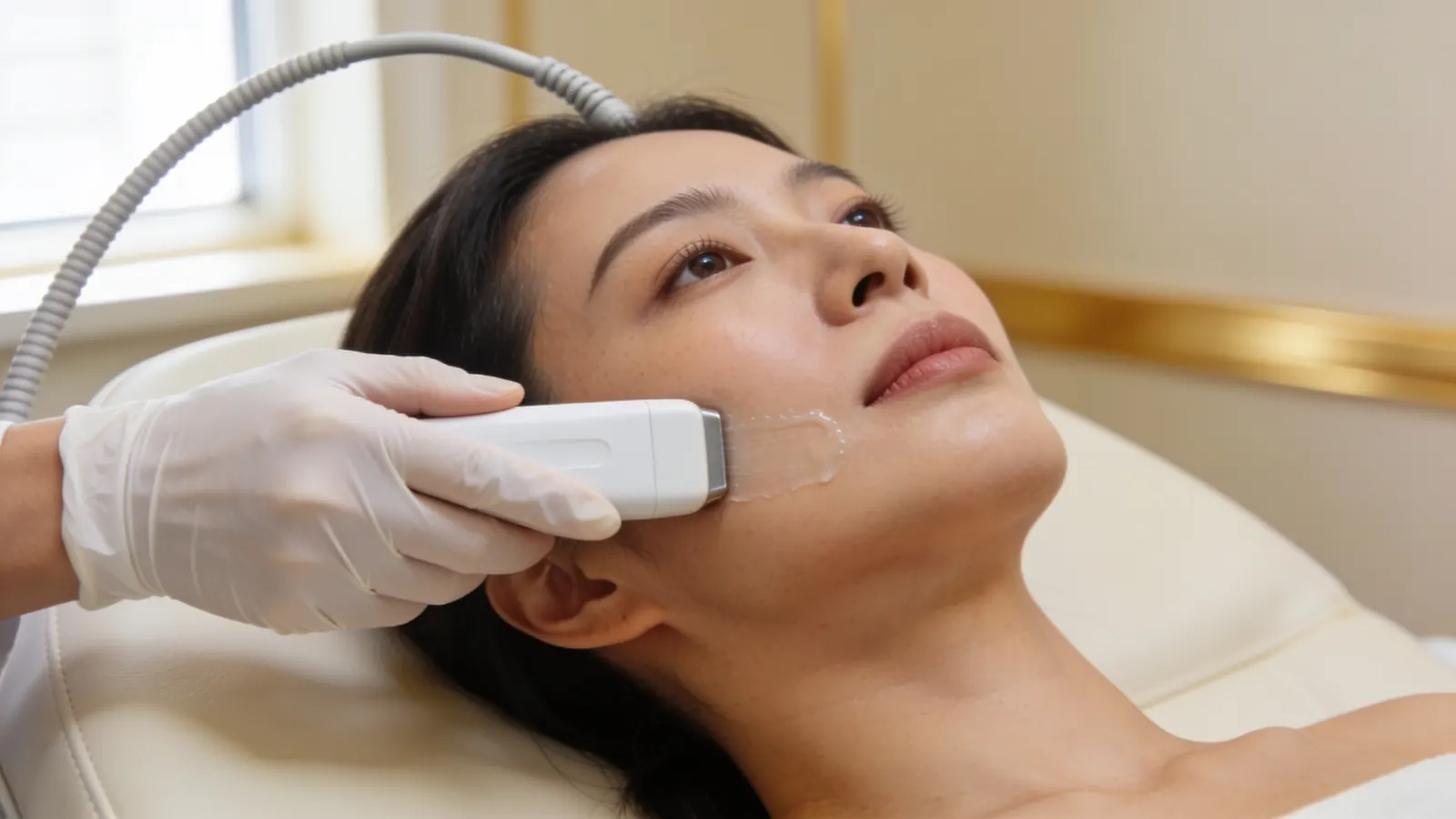
Cheek filler is often placed in more than one layer, from the bone to just under the skin, and the deposit you can feel may not be the one causing the fullness. Each cheek is therefore mapped before any enzyme is used, to see where the filler is, how deep it sits, how much there is and whether it looks like hyaluronic acid (Wortsman 2015).
Illustrative image — not a patient.
History. The products, areas and dates, as far as you know, and any earlier dissolving. Having no records is fine.
Examination. At rest and smiling, from the front and the side, with photographs for your own comparison.
Allergy check. Previous reactions to hyaluronidase and to bee or wasp stings are asked about, and a skin test is always done first: a small amount of hyaluronidase is injected just under the skin to check for a reaction.
Ultrasound. Both cheeks are scanned, layer by layer.
A plan in writing. What would be dissolved, what would be treated another way, what would be left, and what decides the fee.
A small first dose. Hyaluronidase is placed into the mapped excess with a fine needle.
Review. At about 48 hours, with any further dose titrated to what remains (King 2018).
For non-urgent problems, published recommendations favour low to moderate doses and note that ultrasound guidance can make these treatments more effective (Kroumpouzos and Treacy 2024). Allergy to hyaluronidase is uncommon; previous hyaluronidase injections and insect or wasp sting allergy are the main risk factors (Guliyeva 2024), and Dr Sin Yong always does a skin test before planned dissolving. Dr Sin Yong performs the scan and the injection himself in the same visit. Non-urgent dissolving is usually deferred in pregnancy and while breastfeeding, and while there is infection in the area.
After cheek filler is dissolved, and refilling
Swelling, redness or bruising at the injection points is common and settles. Avoid massaging the cheeks unless you have been told to, and contact the clinic promptly if swelling increases, itching spreads or the area becomes hot or painful.
After dissolving, the cheeks are judged at the review, not on the day. If filler was hiding lost support or loosening skin, that may show, and the options are discussed then: no further treatment, lifting where laxity is the problem, or a small amount of filler placed deep. What to expect in the days after is set out in aftercare after filler dissolving.
When can cheek filler be added again?
Not on the same day. Published guidance recommends waiting at least two weeks after hyaluronidase, until the swelling has settled, before any refilling (Murray 2021). Sometimes the answer is less filler placed more precisely, and sometimes none at all.
Risks of dissolving cheek filler
Swelling, redness, itch or bruising, which settle.
Over-correction: a flatter cheek than intended if more is dissolved than was in excess, which staged dosing is designed to avoid.
Allergy: uncommon, from local swelling to, rarely, a more serious reaction.
Breakdown of some of the skin's own hyaluronic acid near the injection site, which the body replaces.
No effect on collagen stimulators, fat or non-absorbable fillers.
Like any medical treatment, dissolving has its own risks and limits, which Dr Sin Yong explains at the assessment alongside the alternatives, including no treatment.
Urgent: a change in vision or eye pain after filler: call 995 now. Skin that turns pale, dusky or mottled, or pain that is getting worse, needs urgent assessment by the doctor who injected you, or at A&E, now. See the warning signs of a blocked blood vessel after filler.
Tried other treatments and almost given up?
Many patients who come to see Dr Sin Yong about cheek filler problems tell him they have tried almost everything else and had given up hope. Having tried other treatments does not, on its own, rule out further options; what can be done depends on what the scan shows.
That history is useful. Knowing what was injected, when, and what has already been tried often explains why a problem has stayed: hyaluronidase acts only on hyaluronic acid and only where it reaches, some fillers are not hyaluronic acid at all, and swelling or fluid can look like filler. Ultrasound helps show which of these applies, and the plan starts from there. For material that cannot be dissolved, Dr Sin Yong uses the Sculpting mode of Time Freeze Laser LCLR® for nodules large and small, without an incision. How each person responds varies.
If you have been told nothing more can be done, it is still worth having the area scanned: ultrasound helps show what is there, and what, if anything, can be done is discussed from that. Bring any records of past treatments, product names and dates if you have them. More on this is in when filler dissolving has not worked.
How Dr Sin Yong approaches cheek filler correction
He maps first, treats the material that is actually there, and dissolves in stages so that the shape of the cheek can be judged as it changes. He examines you, performs the scan and places the enzyme himself, and the plan, including what he would not do and what decides the fee, is set out in writing. You do not need to have been treated here: filler placed elsewhere in Singapore or overseas is assessed in the same way.
Not for emergencies. A change in vision or eye pain after filler: call 995 now. Pale, dusky or mottled skin, or pain that is getting worse: go now to the doctor who injected you, or to A&E. Do not message or book for these signs.
1. MessageWhatsApp +65 8023 7170 with what is bothering you. A reply comes from the clinic, not a bot.
2. AssessmentDr Sin Yong examines you himself on Orchard Road, with ultrasound where earlier filler is involved.
3. A plan in writingWhat he would do, what he would not, the fee factors, and the option of no treatment.
Every treatment is performed by Dr Sin Yong personally. Singapore Medical Council registered · invited to share his clinical expertise internationally for CLASSYS, DEKA, Fotona, Hironic and Ilooda.
Book a cheek filler assessment with Dr Sin Yong on Orchard Road. How consultations work.
If it is hyaluronic acid, yes. Hyaluronidase breaks it down, in small staged doses reviewed at about 48 hours. Many cheeks also carry Sculptra, Radiesse or Ellansé, which the enzyme does not dissolve. Ultrasound helps show which material is in each cheek, how deep it sits and how much there is, before anything is injected.
Many of the patients Dr Sin Yong sees have tried other treatments first. A treatment that did not help can still leave options open: hyaluronidase may not have reached the filler, the filler may not be hyaluronic acid, or what looks like filler may be swelling or fluid. Ultrasound helps show which applies, and the plan follows what it finds. What can be done varies from person to person.
It can, if more is dissolved than was in excess, or if the filler was hiding lost support or loose skin. That is why the enzyme is aimed at the mapped excess in stages, with a review between doses, rather than dissolving everything at once. If the cheek looks flat once things have settled, the options are discussed then, never on the same day.
Early swelling after cheek filler is common and settles. Puffiness that persists on the upper cheek below the eyes, often worse in the morning, can be malar oedema: fluid held in an area that drains poorly, sometimes with filler pressing on the small veins (Schelke, J Cosmet Dermatol 2023). Ultrasound helps show whether filler is there and where it sits in relation to the swelling, which guides whether dissolving is worth considering.
A lump that appears months after hyaluronic acid filler, especially if it is tender, red or swollen, can be a delayed inflammatory nodule, which needs medical assessment rather than more filler (Convery 2021). A firm lump after Sculptra, Radiesse or Ellansé is more often the product itself or the collagen around it. Ultrasound helps tell these apart.
Yes. Filler can end up beyond where it was placed, for example towards the lower eyelid, into the fold beside the nose or out towards the side of the face. Factors thought to contribute include repeated top-ups and larger volumes. Ultrasound helps show where it sits now, and if it is hyaluronic acid, the migrated part can be dissolved in stages.
No. Poly-L-lactic acid (Sculptra), calcium hydroxylapatite (Radiesse) and polycaprolactone (Ellansé) do not respond to hyaluronidase. For nodules large and small from these materials, Dr Sin Yong uses the Sculpting mode of Time Freeze Laser LCLR®, without an incision; how each person responds varies. Where hyaluronic acid was layered in the same cheek, that part can be dissolved first and the rest reassessed.
Not on the same day. Published guidance recommends waiting at least two weeks after hyaluronidase, until the swelling has settled, before refilling (Murray 2021). Any new filler is planned at that point, usually a smaller amount placed deep, and only if the cheek still needs support after dissolving.
Often a mix. Filler that has built up, the cheek's own fat, fluid and skin that has loosened with age can all make the cheeks look heavy, and dissolving changes only the filler. The examination and the scan separate these first. Where the cheek has sagged, lifting is considered separately, after any excess filler has been dealt with.
That is common, especially after treatment overseas or at more than one clinic. The history is taken as far as you remember it, and ultrasound helps show whether each deposit looks like hyaluronic acid or a collagen stimulator, how deep it sits and how much there is. Bring any records, product stickers or messages from the clinic if you have them.
Each injection is a brief sting from a fine needle, sometimes followed by a short warm or itchy feeling where the enzyme goes in. The cheeks can be tender, swollen or bruised afterwards, and this settles. Tell the clinic if swelling increases, itching spreads or the area becomes hot or painful, because these can be signs of a reaction.
References
The Use of Hyaluronidase in Aesthetic Practice (v2.4). Journal of Clinical and Aesthetic Dermatology, 2018. source
Guideline for the Safe Use of Hyaluronidase in Aesthetic Medicine, Including Modified High-dose Protocol. Journal of Clinical and Aesthetic Dermatology, 2021. source
Avoiding malar edema during midface/cheek augmentation with dermal fillers. Journal of Clinical and Aesthetic Dermatology, 2011. source
Periorbital venous stasis may be involved with filler induced malar edema: a duplex ultrasound-imaging-based case series. Journal of Cosmetic Dermatology, 2023. source
Delayed-onset Nodules (DONs) and Considering their Treatment following use of Hyaluronic Acid (HA) Fillers. Journal of Clinical and Aesthetic Dermatology, 2021. source
Investigating the anatomic location of soft tissue fillers in noninflammatory nodule formation: an ultrasound-imaging-based analysis. Dermatologic Surgery, 2023. source
Hyaluronic Acid Filler Longevity in the Mid-face: a review of 33 MRI studies. Plastic and Reconstructive Surgery Global Open, 2024. source
Complications of collagen biostimulators in Brazil: Description of products, treatments, and evolution of 55 cases. Journal of Cosmetic Dermatology, 2024. source
Spontaneous and induced degradation of dermal fillers: A review. Journal of Cutaneous and Aesthetic Surgery, 2024. source
Identification and Complications of Cosmetic Fillers: Sonography First. Journal of Ultrasound in Medicine, 2015. source
Hyaluronidase for Dermal Filler Complications: Review of Applications and Dosage Recommendations. JMIR Dermatology, 2024. source
Allergic Complications of Hyaluronidase Injection: Risk Factors, Treatment Strategies, and Recommendations for Management. Aesthetic Plastic Surgery, 2024. source
About this page: written and medically reviewed by Dr Sin Yong, MBBS (NUS), MRCS (Edinburgh) · Last reviewed 26 October 2026 · Illustrative images only, not patients · Editorial policy
Not for emergencies. A change in vision or eye pain after filler: call 995 now. Pale, dusky or mottled skin, or pain that is getting worse: go now to the doctor who injected you, or to A&E. Do not message or book for these signs.