Published 26 October 2026 · Reviewed by Dr Sin Yong
Lumps after lip filler can be early swelling, a bead of filler placed in one spot, a delayed reaction, a granuloma years later, infection, or old silicone or gel. Many are then told the lump has to be cut out, which leaves a scar and can change the lip. In Dr Sin Yong's practice, almost every hard lump is treated without surgery. Get assessed first.
Short answerGet assessed before you agree to surgery. A lump years later is often a granuloma, most often reported with silicone (Trinh, Surg J 2022). Ultrasound shows what a lump is likely made of. A red, hot or painful lump needs a doctor the same day; if no doctor can see you today, A&E. A lump that is the hyaluronic acid itself is dissolved after a skin test; Dr Sin Yong treats material that cannot be dissolved with the Sculpting mode of Time Freeze Laser LCLR®, without an incision.
Pale, dusky or mottled skin on or around the lip, or pain that is getting worse, needs urgent assessment by the doctor who injected you, or at A&E, now; a change in vision or eye pain: call 995 now; a red, hot, painful or draining lump, or a fever: a doctor the same day, or A&E if no doctor can see you today.
Before surgery
Get assessed. Cutting into the lip leaves a scar, can change the lip's shape, can leave filler behind and cannot be undone.
Commonest reported problem
Lumps and nodules, in a review of 82 published complications after temporary lip fillers (Diwan 2023).
Years later
Delayed lip nodules appeared on average 2.9 years after treatment, and silicone was the filler most often reported (Trinh, Surg J 2022).
Ultrasound first
The scan shows what a lump is likely made of, where it sits and how far it has spread; an expert consensus calls ultrasound mandatory for managing filler complications (Velthuis 2025).
Without an incision
A lump that is the hyaluronic acid itself is dissolved after a skin test; silicone and other material that cannot be dissolved is treated with the Sculpting mode of Time Freeze Laser LCLR®.
Urgent: a change in vision or eye pain after filler: call 995 now. Skin that turns pale, dusky or mottled, or pain that is getting worse, needs urgent assessment by the doctor who injected you, or at A&E, now. See the warning signs of a blocked blood vessel after filler.
Skin that is dying after a blocked blood vessel (necrosis) is an emergency. It needs urgent, more intensive care than a lump does, starting now.
The lips are one of the areas where a blocked blood vessel is a real risk. The arteries that supply them run inside the lip, close to where filler is placed, and filler that enters or presses on one of them can cut off the blood supply to part of the lip or the skin around it. Act on these signs whenever they appear, before anything else:
Pale, white, dusky, purple or mottled skin on or around the lip, blisters or dark scabs on that skin, or pain that is getting worse: urgent assessment by the doctor who injected you, or at A&E, now. Do not wait for a message reply, a booked review or a scan appointment, and do not massage the lip or put heat on it.
A change in vision or eye pain: call 995 now, and do not drive yourself.
Stroke signs, such as new weakness of the face, an arm or a leg, or slurred speech: call 995 now, and do not travel to a clinic first.
Redness that is spreading, with a fever; feeling faint, confused or very unwell; or swelling around the eye with pain: call 995 or go to A&E now.
Difficulty breathing, a tight throat, swelling of the tongue or throat, or swelling that spreads quickly across the face, after any injection, including hyaluronidase, can be a serious allergic reaction: call 995 now. Itch, hives or swelling that spreads beyond the treated area: contact the clinic that injected you the same day.
These signs usually appear during or soon after the injection, sometimes later: act whenever they appear, whoever injected the filler and whatever it was. Where the filler is hyaluronic acid, a blocked vessel is treated at once with high doses of hyaluronidase, and dissolving is not delayed for a skin test. A blocked vessel is never treated with the Sculpting mode of Time Freeze Laser LCLR® or any other laser.
Red, hot, painful, swollen or draining: a doctor the same day (A&E if no doctor can see you today)
A lip lump that is red, hot, painful, swollen or draining, or that comes with a fever, can be infection or active inflammation. It needs a doctor the same day; if no doctor can see you today, A&E. That can be the doctor who injected you, Dr Sin Yong or your own doctor. It is treated medically first, before any dissolving, any device and any talk of surgery. An expert consensus advises drainage, a culture and antibiotics for an infection rather than hyaluronidase first (Baranska-Rybak 2024). Hyaluronic acid that remains is dissolved only once the infection is under control, because dissolving never replaces treating it.
The lips swell readily after filler, so swelling alone does not mean infection. Small clustered blisters can be a cold sore, which can flare after lip injections and needs different medical treatment. Blisters on skin that is pale, dusky or mottled can mean a blocked blood vessel: urgent assessment by the doctor who injected you, or at A&E, now. More is in infection after filler and the warning signs of a blocked vessel.
60-second lip filler lump check
Not for emergencies. A change in vision or eye pain after filler: call 995 now. Difficulty breathing, a tight throat, swelling of the tongue or throat, or swelling that spreads quickly across the face: call 995 now. Pale, dusky or mottled skin, or pain that is getting worse: go now to the doctor who injected you, or to A&E. A red, hot or draining lump, or a fever: a doctor the same day; if no doctor can see you today, A&E. Do not use this check or WhatsApp for these signs.
Answer three questions and send them straight to the clinic on WhatsApp. Dr Sin Yong will let you know whether an ultrasound assessment is worthwhile. No obligation.
1 · When was it injected?
2 · What bothers you most?
3 · Have you been offered surgery for it?
Your answers open in your own WhatsApp app; nothing is stored on this page.
Lip filler lumps, and only offered surgery? Read this first
Patients come to Dr Sin Yong after being told that a lump in the lip has to be cut out, that old silicone can only be removed by an operation, or that nothing more can be done. For a lump that is not an emergency, know what an operation means before you agree to it:
A scar. Every cut through the skin of the face heals with a scar.
A dent. Cutting out a lump takes tissue with it, and the area can heal hollow or uneven.
Nerve injury. Nerves that give the face feeling and movement run close to where filler sits. An injured nerve can leave numbness, or weakness in a smile, a lip or a brow.
Product left behind. Filler spread through tissue is hard to remove completely.
No way back. Tissue that has been cut out cannot be put back.
The lip has its own risks. It is mostly muscle, its edge and fullness show every change, and filler that has spread through it with scar tissue cannot simply be lifted out, so removal can mean reshaping the lip. What an operation involves is set out in do I need surgery to remove a lip filler lump, below.
In Dr Sin Yong's practice, almost every hard lump is treated without surgery. If yours is one of the few that needs surgery, you are told plainly, and why. He maps every lump with ultrasound, treats an inflamed or infected lump medically first, dissolves a lump that is the hyaluronic acid itself after a skin test, and treats silicone and other material that cannot be dissolved with the Sculpting mode of Time Freeze Laser LCLR®, without an incision.
“For hard lumps from mixed products, I use one tool, Time Freeze Laser LCLR®, to target the material without surgery.”
Dr Sin YongOn hard lumps from mixed fillers and skin boosters
Lumps and nodules after lip filler: the kinds, and how to tell them apart
A lump in the lip after filler is not one thing. When it appeared, how it feels and whether it is inflamed are the first clues; the scan shows the rest. Lumps are the commonest reported problem after lip filler: in a review of 82 published complications after lip augmentation with temporary fillers, nodules were the commonest across every filler type (Diwan 2023).
Swipe sideways to see the whole table.
What you notice
When it shows
What it usually is
What Dr Sin Yong does
Soft bumps, unevenness, swelling or bruising
While the lips are still swollen
Expected swelling, or filler that has not yet settled
Reviews it; no pressing or massaging unless the doctor who injected you advises it
A firm bead, or a string of beads along an injection line
Still there once the swelling has gone
Filler placed in one spot, too much in one place, or too close to the surface
Maps it; if it is hyaluronic acid, dissolves it in small doses after a skin test
A new firm, tender or swollen lump
Weeks to months later, sometimes after an illness or dental treatment
A delayed inflammatory reaction to the filler
If it is red, hot, tender or swollen: a doctor the same day (A&E if no doctor can see you today), and medical treatment first. If it is not inflamed: mapped, and dissolved after a skin test if the lump is the hyaluronic acid itself
A hard lump, sometimes several, sometimes in both lips
Months to years later
A granuloma, the body's reaction walling off the filler; silicone is the filler most often reported
Maps it; treats inflammation medically first; dissolves hyaluronic acid after a skin test; treats the rest with the Sculpting mode of Time Freeze Laser LCLR®
A red, hot, painful or draining lump, or a fever
Soon after the injection, or months to years later
Infection or active inflammation
A doctor the same day (A&E if no doctor can see you today); medical treatment before anything else
Firm, uneven lumps from filler injected long ago, often abroad
Years later
Silicone, polyacrylamide gel, PMMA or another non-absorbable filler
Maps it; treats it with the Sculpting mode of Time Freeze Laser LCLR®, without an incision
A lump where more than one product was injected
Any time
Mixed products, such as hyaluronic acid over old silicone or gel, or calcium hydroxylapatite or a skin booster in the lip
Dissolves the hyaluronic acid part after a skin test; treats the rest with the Sculpting mode, in a planned order
Pale, dusky or mottled skin, or pain getting worse
Usually during or soon after the injection, sometimes later: act whenever it appears
A blocked blood vessel
Emergency: urgent assessment by the doctor who injected you, or at A&E, now (see act now, above)
More than one kind can sit in the same lip, which is one more reason the scan comes before any treatment.
Lip filler bumps soon after treatment: do they go away?
Lips swell after any injection, and while they are swollen they often feel uneven or bumpy. Even a lip treatment that is not filler does this: in a study of 30 people given polynucleotide injections into the lips, every one had swelling 30 minutes afterwards, with pain in 90% and redness in 77%, mostly mild and short-lived (Rho 2025). Normal early lumpiness eases steadily as the lips settle. It does not grow, turn red or hot, or get more painful: a lump that is red, hot or painful needs a doctor the same day, or A&E if no doctor can see you today, and skin that turns pale, dusky or mottled, or pain that is getting worse, needs urgent assessment by the doctor who injected you, or at A&E, now.
A bump that is still there once the swelling has gone is usually the filler itself: placed in one spot as a small pool, too much in one place, or too close to the surface, where it can be felt as a firm bead, or a string of beads along the line it was injected. It does not always fade on its own. In a small study of three hyaluronic acid gels injected in small test amounts, one deposit left without enzyme was still present after 4 years (Zhang-Nunes 2021). A bead that is the hyaluronic acid itself is mapped and dissolved after a skin test; see hyaluronic acid lip lumps, below.
Massage
Massage only if the doctor who injected you advises it, for a soft, early irregularity. Never massage a lump that is red, hot or painful: it needs a doctor the same day, or A&E if no doctor can see you today. Never massage or heat skin that is pale, dusky or mottled: that, or pain that is getting worse, needs urgent assessment by the doctor who injected you, or at A&E, now. Massage does not dissolve filler, and it does nothing for silicone, gel or a granuloma. Do not try to break up a lump yourself with firm pressure, heat or home devices.
Lip filler lumps months later: a delayed reaction
A firm lump that appears weeks or months after lip filler, where there was none before, is usually a delayed reaction to the filler rather than filler simply sitting in one place. Across prospective studies of hyaluronic acid filler, delayed inflammatory reactions ran at about 1.1% a year (Chung 2020). In 400 patients treated with one hyaluronic acid filler only in the lips or under the eyes, 4.25% had late inflammatory reactions, starting a mean of 8.4 weeks after injection and lasting up to 11 months, with a mean of 3.17 episodes each; antibiotics with repeated high-dose hyaluronidase injected into the nodules were effective, and the authors note that rates differ between products (Artzi 2016).
Some follow an illness. One series that was not of lip treatments followed 4,702 treatments with a 20 mg/mL hyaluronic acid filler: 23 patients (0.5%) developed delayed-onset nodules a median of 4 months after injection, and 9 of them had an identifiable immune trigger such as a flu-like illness (Beleznay 2015). An expert consensus says late-onset reactions typically appear three to four months after injection, occasionally much sooner, and proposes the filler's structure, infection introduced at injection or a dormant biofilm, and the body's immune response to conditions such as a viral infection as causes; recent dental treatment is among the risk factors (Baranska-Rybak 2024).
What comes first depends on the lump. A lump that is red, hot, tender or swollen needs a doctor the same day (A&E if no doctor can see you today) and is treated medically first. A lump that is not inflamed is scanned, and if it is the hyaluronic acid itself it is dissolved after a skin test: the consensus recommends hyaluronidase for reactions without inflammation or active infection (Baranska-Rybak 2024). Swelling that comes and goes is covered in swelling months after filler.
A hard lump in the lip years after filler: often a granuloma
A hard lump that appears months or years after lip filler, sometimes in both lips or wherever filler was placed, is often a granuloma: the body's immune reaction walling off the filler, often with scar tissue. In a systematic review of 66 published cases of delayed lip nodules, they appeared on average 35.2 months (2.9 years) after treatment, silicone was the filler most often reported, followed by hyaluronic acid, and most of the 37 examined under the microscope were foreign-body granulomas (Trinh, Surg J 2022). A treatment review notes that granulomas, unlike early lumps of filler, appear after several months, often at all injected sites at once; most patients have a single episode, and a flare can be set off by a bacterial infection elsewhere in the body (Lemperle and Gauthier-Hazan 2009).
A granuloma can grow, come and go, or flare. Inflammation is treated medically first. Hyaluronic acid with a granuloma is dissolved after a skin test. Dr Sin Yong treats granulomas around silicone and other material that cannot be dissolved, and granulomas with no filler left, with the Sculpting mode of Time Freeze Laser LCLR®, without an incision. The granuloma itself, in the lips and elsewhere, is covered in filler granuloma.
Old silicone, gel or mixed products in the lips
Liquid silicone, polyacrylamide gel and PMMA have all been injected into lips, some of it years ago or abroad, and many people do not know exactly what they received. None of them is dissolved by hyaluronidase, which acts on hyaluronic acid only, and a lump of them can persist. Silicone is the filler most often reported in delayed lip granulomas (Trinh, Surg J 2022). Polyacrylamide gel does not stay as one neat pocket: in 11 patients with gel in the lips, it had spread through all three layers of the lip, with scar tissue in every patient, and into the lining of the lip and the skin around the mouth, even years after injection (Kastner 2018).
More than one product can sit in the same lip. Hyaluronic acid is sometimes placed over old silicone or gel. For calcium hydroxylapatite (Radiesse), a review notes that injection into the lips is an unapproved use, and describes the lumps that appear there soon after injection as clumps of the particles rather than a granulomatous reaction (Pavicic 2013). A granulomatous reaction in the lip has still been reported: one case report describes an inflamed lump inside the lip after Radiesse, with new lumps several weeks later, which the authors describe as the first granulomatous response reported after calcium hydroxylapatite; they note that infection or a tumour must be ruled out (Sankar 2007). Polynucleotide skin boosters are also injected into the lips, and they are not dissolved by hyaluronidase either.
Material that cannot be dissolved can still be treated without an incision. Dr Sin Yong maps it with ultrasound, treats any inflammation or infection medically first and dissolves any hyaluronic acid layered with it after a skin test. He then treats silicone, gel, PMMA, calcium hydroxylapatite and other material that cannot be dissolved with the Sculpting mode of Time Freeze Laser LCLR®, his own protocol on a long-pulsed 755 nm and 1064 nm laser platform, directed at the mapped lump, without an incision. Like any laser, it can cause blistering or a change in skin colour, so settings are chosen for your skin. More is in silicone filler lumps, polyacrylamide filler lumps and Radiesse lumps.
Ultrasound first: what the scan shows in a lip lump
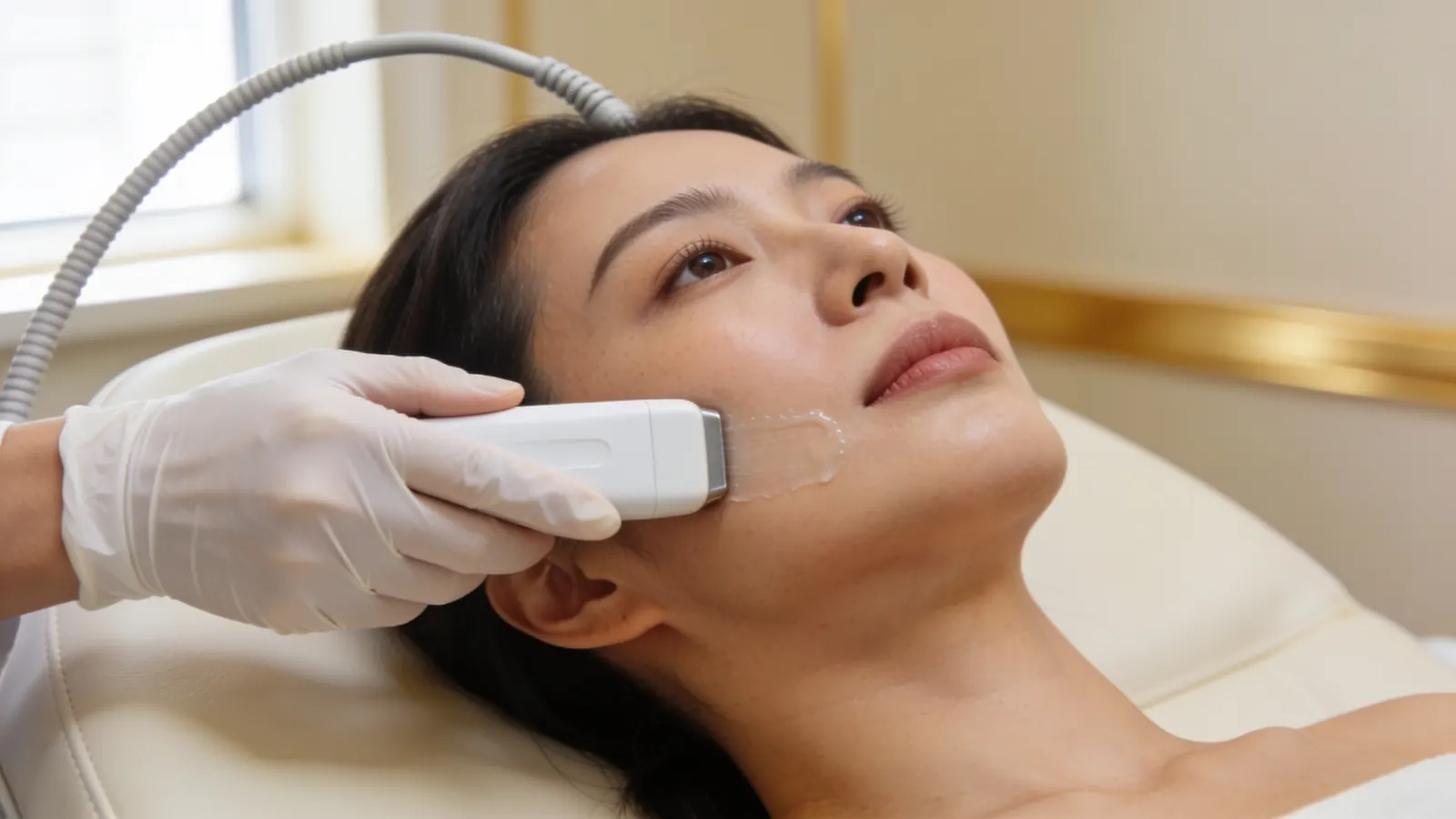
Ultrasound shows where the filler sits, how deep it is and how far it has spread, and what it is likely made of. In a lip, it also shows whether a lump is a deposit of filler, a reaction around it, scar tissue or something else. In a small high-frequency ultrasound series of five women, the scan told granulomas apart from lasting deposits of filler and showed heavy scarring (fibrosis), and lumps the women felt from inside the lip turned out, under the microscope, to be the lip's own small glands, pushed forward by filler deposits, granulomas or scar tissue; the authors call the scan essential for choosing the right treatment (Skrzypek 2021).
Illustrative image — not a patient.
An international expert consensus calls ultrasound mandatory for managing filler complications, recommends identifying fillers already in place before more is injected, and says ultrasound guidance is needed to place injections precisely into a lump (Velthuis 2025). The scan shows what a lump is likely made of; it does not prove it. Where a lump does not look like filler, further tests are arranged, and a lump that keeps growing, sits where nothing was injected, feels fixed to deeper tissue or changes the skin or lining over it is assessed for other causes before anything is treated as filler. Dr Sin Yong performs the scan himself, and the plan follows what it shows. More on scanning is in ultrasound-guided filler correction.
Hyaluronic acid lip lumps: dissolved after a skin test
Most lip filler is hyaluronic acid, and hyaluronidase, an enzyme that acts on hyaluronic acid only, dissolves it. A lasting lump is dissolved only if the lump is the hyaluronic acid itself, after a scan and a skin test. A lump that is inflamed is treated medically first, and infected filler is dissolved only once the infection is under control. Dr Sin Yong dissolves a lip lump in steps:
Allergy history. Any reaction to bee or wasp stings and any earlier hyaluronidase is asked about.
Skin test. Before planned dissolving, Dr Sin Yong always does a skin test: a small amount of hyaluronidase is injected just under the skin to check for a reaction.
A small first dose goes into the mapped lump, not across the whole lip.
Review at about 48 hours, with any further dose titrated to what remains.
Refilling, if wanted at all, waits at least two weeks.
Hyaluronic acid products differ in how easily the enzyme breaks them down. In a small randomised study of three hyaluronic acid gels, the largest change came 30 minutes to 3 hours after the enzyme, and one gel responded even to the lowest dose tested while another needed more than the highest (Zhang-Nunes 2021). Small, staged doses matter in the lip, because dissolving more than the lump can leave the lip thinner or uneven. In an emergency such as a blocked blood vessel, dissolving is not delayed for a skin test. The steps are set out in lip filler dissolving and how hyaluronidase is used, and the test in the skin test and hyaluronidase allergy. Filler that has moved above the lip line is covered in lip filler migration.
Do I need surgery to remove a lip filler lump? What an operation involves
Usually not. Get assessed first. A lump that is the hyaluronic acid itself is dissolved after a skin test, and Dr Sin Yong treats silicone and other material that cannot be dissolved with the Sculpting mode of Time Freeze Laser LCLR®, without an incision.
Removing a lump from the lip means cutting into it, from the inside of the lip or along its edge, and taking the lump out with the tissue it has grown into. The lip is mostly muscle, and its edge and fullness show every change, so the scar, the shape and the movement of the lip all have to heal well.
Swipe sideways to see the whole table.
Approach
What it involves
Incision
What to weigh up
Surgical removal
Cutting out the lump or the filler, sometimes reshaping the lip
Yes
A scar; a dent or changed lip shape; numbness; filler left behind; cannot be undone
Hyaluronidase
Enzyme injected into a mapped hyaluronic acid lump
None; fine needle
Acts on hyaluronic acid only; skin test first; too much can thin the lip
Sculpting mode of Time Freeze Laser LCLR®
Laser directed at mapped material that cannot be dissolved
None
Can cause blistering or a change in skin colour; never used for a blocked vessel
Medical treatment
Treatment for inflammation or infection
None
Comes first for an inflamed or infected lump
Waiting
Review over time
None
Reasonable for early bumps that are easing as the lips settle
What the published reports show
Granulomas grow into the tissue. They grow finger-like into the surrounding tissue, which is why a treatment review places surgical excision last, keeping surgery or drainage for lumps and cystic granulomas with little ingrowth (Lemperle and Gauthier-Hazan 2009).
Gel in the lip meant rebuilding it. In the 11 patients with polyacrylamide gel in the lips, the gel could not be drawn out with a needle, so removal meant reconstructing the lip, with fat grafting in eight. Ten of the eleven outcomes were judged aesthetically satisfying, but one patient had severe tissue loss in the upper lip, and the authors state that gel left in the lining of the lip must be accepted (Kastner 2018).
Several treatments, then surgery. In the systematic review of delayed lip nodules, most cases resolved after several treatments, starting with antibiotics or other medical treatment by mouth and followed by surgical excision (Trinh, Surg J 2022).
A different technique. Published work also describes a laser fibre placed inside the lump, or small stab incisions with drainage, for complications of non-absorbable lip fillers. In one series of 181 patients, the authors report improvement in 95% and complete resolution in 38.7%; 9 stopped treatment because they were not satisfied, none was worse, and 33 had further cosmetic procedures (Zaccaria 2022). That study did not use the Sculpting mode, and its figures do not apply to it.
Surgery has a place: an abscess may need draining, a lump that does not look like filler may need a tissue sample, and a few lumps do need an operation. The point is the order: scan first, decide after. An operation can still be done later if it is ever needed, and it cannot be undone. If you have already been offered surgery, Dr Sin Yong can scan the lip and give you a second opinion before you decide. More is in filler removal surgery.
Tried other treatments and almost given up?
Many patients who come to see Dr Sin Yong about lip filler lumps tell him they have tried almost everything else and had given up hope. Having tried other treatments does not mean nothing more can be done: what is done next depends on what the scan shows.
That history is useful. Knowing what was injected, when, and what has already been tried often explains why a problem has stayed: hyaluronidase acts only on hyaluronic acid and only where it reaches, some fillers are not hyaluronic acid at all, and swelling or fluid can look like filler. Ultrasound shows which of these applies, and the plan starts from there. For material that cannot be dissolved, Dr Sin Yong uses the Sculpting mode of Time Freeze Laser LCLR® for nodules large and small, without an incision. How each person responds varies.
If you have been told nothing more can be done, it is still worth having the area scanned: ultrasound shows what is there, and the plan is made from that. Bring any records of past treatments, product names and dates if you have them. More on this is in when filler dissolving has not worked.
How Dr Sin Yong treats lip filler lumps without surgery
History. What was injected, where and when, if known; any illness, dental treatment or new filler before the lump appeared; what has been tried and what you were offered. Having no records is fine.
Maps. He scans the lip himself: what the lump is likely made of, how deep it sits, how far it has spread and the vessels nearby.
Treats inflammation or infection first. A red, hot, swollen or draining lump is seen the same day and treated medically before anything else.
Dissolves hyaluronic acid. If the lump is the hyaluronic acid itself, he dissolves it with hyaluronidase after checking your allergy history and doing a skin test: a small first dose, with a review at about 48 hours.
Treats what cannot be dissolved, without an incision. He treats silicone, polyacrylamide gel, PMMA, calcium hydroxylapatite, granulomas and mixed products with the Sculpting mode of Time Freeze Laser LCLR®, directed at the mapped lump.
Further tests where needed. A lump that does not look like filler on the scan is not treated as filler.
Reviews. Each lump is reassessed, and any further visit is planned from what is seen.
He does not add filler to hide a lump. Dr Sin Yong developed the Time Freeze Laser LCLR® protocol himself and performs every scan, every dissolving injection and every Sculpting mode treatment himself on Orchard Road. He has been invited to share his clinical expertise in Seoul, Dubai, Bangkok and São Paulo, including as a Global Key Opinion Leader. You do not need to have been treated here: filler placed elsewhere in Singapore or overseas is assessed the same way (see correction of filler done overseas), and having no records of what was injected is fine. Overfilled or uneven lips are covered in lip filler gone wrong, lumps elsewhere in the face in hard lumps after filler, and the laser in the Sculpting mode of Time Freeze Laser LCLR®.
Your next step
Not for emergencies. A change in vision or eye pain after filler: call 995 now. Pale, dusky or mottled skin, or pain that is getting worse: go now to the doctor who injected you, or to A&E. Do not message or book for these signs.
1. MessageWhatsApp +65 8023 7170 with what is bothering you. A reply comes from the clinic, not a bot.
2. AssessmentDr Sin Yong examines you himself on Orchard Road, with ultrasound where earlier filler is involved.
3. A plan in writingWhat he would do, what he would not, the fee factors, and the option of no treatment.
Every treatment is performed by Dr Sin Yong personally. Singapore Medical Council registered · invited to share his clinical expertise internationally for CLASSYS, DEKA, Fotona, Hironic and Ilooda.
Usually not. Get assessed first. A lump that is the hyaluronic acid itself is dissolved after a skin test, and Dr Sin Yong treats silicone, gel and other material that cannot be dissolved with the Sculpting mode of Time Freeze Laser LCLR®, without an incision. In Dr Sin Yong's practice, almost every hard lump is treated without surgery. If yours is one of the few that needs surgery, you are told plainly, and why. Cutting into the lip leaves a scar, can change its shape and cannot be undone.
Many of the patients Dr Sin Yong sees have tried other treatments first. A treatment that did not help can still leave options open: hyaluronidase may not have reached the filler, the filler may not be hyaluronic acid, or what looks like filler may be swelling or fluid. Ultrasound shows which applies, and the plan follows what it finds.
Some do. Early lumpiness while the lips are swollen eases steadily as they settle. A firm bead still there once the swelling has gone is usually filler, and hyaluronic acid can last: in a small study, one deposit left without enzyme was still present after 4 years (Zhang-Nunes 2021). A lump that is the hyaluronic acid itself is dissolved after a skin test. Silicone, gel and other non-absorbable fillers can persist; Dr Sin Yong treats them with the Sculpting mode of Time Freeze Laser LCLR®, without an incision.
Nodules are firm lumps in the lip that you can feel and sometimes see, and they are the commonest reported complication of temporary lip fillers (Diwan 2023). Some are filler gathered in one place; others are a delayed inflammatory reaction, a granuloma, infection or an older non-absorbable filler. In a systematic review of 66 published cases of delayed lip nodules, they appeared on average 2.9 years after treatment (Trinh, Surg J 2022). Ultrasound shows which kind you have, and that decides the plan.
Some unevenness is, while the lips are swollen, and it eases steadily as they settle. A lump that is still there once the swelling has gone, or appears later, is worth a scan. A red, hot, painful or swollen lump, or a fever, needs a doctor the same day; if no doctor can see you today, A&E. Pale, dusky or mottled skin, or pain that is getting worse, needs urgent assessment by the doctor who injected you, or at A&E, now.
Only if the doctor who injected you advises it, for a soft, early irregularity. Never massage a lump that is red, hot or painful: it needs a doctor the same day; if no doctor can see you today, A&E. Never massage or heat skin that is pale, dusky or mottled: that, or pain that is getting worse, needs urgent assessment by the doctor who injected you, or at A&E, now. Massage does not dissolve filler and does nothing for silicone, gel or a granuloma.
Usually a delayed reaction. In 400 patients given one hyaluronic acid filler in the lips or under the eyes, 4.25% had late inflammatory reactions, a mean of 8.4 weeks after injection (Artzi 2016). Infection and the immune response are proposed causes; recent dental treatment is a risk factor (Baranska-Rybak 2024). A red, hot, tender or swollen lump needs a doctor the same day, or A&E if no doctor can see you today; one that is not inflamed is scanned and dissolved after a skin test if it is hyaluronic acid.
It depends when it appeared. Soon after the injection, it is usually filler placed in one spot or too close to the surface; calcium hydroxylapatite in the lip can also form early lumps of its particles (Pavicic 2013). Weeks or months later, it is more often a delayed reaction; years later, a granuloma or old silicone or gel. Ultrasound shows what it is likely made of, and that decides whether it is dissolved after a skin test or treated with the Sculpting mode, without an incision.
Yes. In a systematic review of 66 published cases of delayed lip nodules, they appeared on average 35.2 months after treatment, silicone was the filler most often reported, followed by hyaluronic acid, and most of those examined under the microscope were foreign-body granulomas (Trinh, Surg J 2022). Polyacrylamide gel in the lips has been found spread through the lip years after injection (Kastner 2018). Dr Sin Yong maps the lump with ultrasound, and what it is made of decides the plan.
Pale, dusky or mottled skin on or around the lip, or pain that is getting worse, needs urgent assessment by the doctor who injected you, or at A&E, now. A change in vision or eye pain: call 995 now. Spreading redness with a fever, or feeling faint, confused or very unwell: call 995 or go to A&E now. A red, hot, painful, swollen or draining lump, or a fever: a doctor the same day; if no doctor can see you today, A&E.
Yes, if the lump is the hyaluronic acid itself, which most lip filler is. It is scanned first. Dr Sin Yong checks your allergy history, always does a skin test, and places a small dose into the mapped lump, with a review at about 48 hours before any more. Infected filler is dissolved only once the infection is under control. Silicone, gel, calcium hydroxylapatite and polynucleotides are not dissolved by hyaluronidase; he treats material that cannot be dissolved with the Sculpting mode, without an incision.
Usually, yes. Silicone cannot be dissolved, and it is the filler most often reported in delayed lip granulomas (Trinh, Surg J 2022). That does not mean it has to be cut out. Dr Sin Yong maps silicone in the lip with ultrasound, treats any inflammation medically first, and treats the silicone with the Sculpting mode of Time Freeze Laser LCLR®, without an incision. Polyacrylamide gel and other non-absorbable fillers are treated the same way.
You often cannot tell by touch. In a small ultrasound series, lumps that women felt from inside the lip were the lip's own small glands, pushed forward by filler deposits, granulomas or scar tissue (Skrzypek 2021). Ultrasound shows where filler sits and what a lump is likely made of; it does not prove it. A lump that keeps growing, sits where nothing was injected or changes the skin or lining over it is assessed for other causes, and further tests are arranged where it does not look like filler.
Dr Sin Yong performs the ultrasound scan, any dissolving and every Sculpting mode treatment himself, on Orchard Road. It is not delegated to another doctor, a nurse or a therapist, so the same doctor follows each lump from the first scan to the last review. Bring any records of what was injected, where and when, if you have them; having none is fine.
References
Evaluation of Current Literature on Complications Secondary to Lip Augmentation Following Dermal Filler Injection. Journal of Clinical and Aesthetic Dermatology, 2023. source
Delayed Granulomas as a Complication Secondary to Lip Augmentation with Dermal Fillers: A Systematic Review. The Surgery Journal, 2022. source
Resistant and Recurrent Late Reaction to Hyaluronic Acid-Based Gel. Dermatologic Surgery, 2016. source
A Systematic Review of the Literature of Delayed Inflammatory Reactions After Hyaluronic Acid Filler Injection to Estimate the Incidence of Delayed Type Hypersensitivity Reaction. Aesthetic Surgery Journal, 2020. source
Delayed-onset nodules secondary to a smooth cohesive 20 mg/mL hyaluronic acid filler: cause and management. Dermatologic Surgery, 2015. source
Late-Onset Reactions after Hyaluronic Acid Dermal Fillers: A Consensus Recommendation on Etiology, Prevention and Management. Dermatology and Therapy, 2024. source
Foreign body granulomas after all injectable dermal fillers: part 2. Treatment options. Plastic and Reconstructive Surgery, 2009. source
Clinical Efficacy and Safety of a Highly Purified Polynucleotide for Dry and Chapped Lips: A Prospective, Multicenter Study. Journal of Cosmetic Dermatology, 2025. source
Prospective in vivo evaluation of three different hyaluronic acid gels to varying doses of hyaluronidase with long-term follow-up. Journal of Plastic, Reconstructive & Aesthetic Surgery, 2021. source
Removal of Polyacrylamide Gel (Aquamid®) from the Lip as a Solution for Late-Onset Complications: Our 8-Year Experience. Aesthetic Plastic Surgery, 2018. source
Calcium hydroxylapatite filler: an overview of safety and tolerability. Journal of Drugs in Dermatology, 2013. source
Foreign body reaction to calcium hydroxylapatite after lip augmentation. Journal of the American Dental Association, 2007. source
High frequency ultrasound assessment of labial glands simulating small nodules or granulomas after lip augmentation. Journal of Ultrasonography, 2021. source
The use of ultrasound imaging in aesthetic injectables: A modified Delphi consensus. Journal of Plastic, Reconstructive & Aesthetic Surgery, 2025. source
Filler-induced complications of the lips: 10 years experience with intralesional laser treatment and refinements. Journal of Plastic, Reconstructive & Aesthetic Surgery, 2022. source
About this page: written and medically reviewed by Dr Sin Yong, MBBS (NUS), MRCS (Edinburgh) · Last reviewed 26 October 2026 · Illustrative images only, not patients · Editorial policy
Not for emergencies. A change in vision or eye pain after filler: call 995 now. Pale, dusky or mottled skin, or pain that is getting worse: go now to the doctor who injected you, or to A&E. Do not message or book for these signs.