Published 26 October 2026 · Reviewed by Dr Sin Yong
A delayed filler reaction is the immune system reacting to filler weeks, months or years after it was injected. It can follow flu, COVID-19, a vaccine or dental work, and shows as swelling or firm lumps, sometimes in several treated areas at once. In Dr Sin Yong's practice, almost every hard lump is treated without surgery. Delayed filler reaction, and only offered surgery? Get assessed first.
Short answerA delayed filler reaction is the immune system reacting to filler already in place; international consensus counts it as delayed-onset when it starts more than four weeks after treatment (Philipp-Dormston 2020). A red, hot, painful, swollen or draining lump, or a fever, needs a doctor the same day (A&E if no doctor can see you today) and medical treatment first. Otherwise, it is scanned: a lump that is the hyaluronic acid itself is dissolved after a skin test; other material is treated with the Sculpting mode of Time Freeze Laser LCLR®, without an incision.
An immune reaction to filler already in place; international consensus counts it as delayed-onset when it starts more than four weeks after treatment (Philipp-Dormston 2020).
How common
About 1.1% a year in prospective studies of hyaluronic acid filler (Chung 2020), and 44 delayed events in 4,500 patients, 0.98% per patient, in one series (Humphrey 2020).
When
A median of four months after treatment in two series of the same hyaluronic acid filler (Beleznay 2015; Humphrey 2020).
Triggers
About a third of delayed events followed an immune stimulus (Humphrey 2020); vaccines, flu and other viral illness, and dental work have all been linked.
Act today
A red, hot, painful, swollen or draining lump, or a fever, needs a doctor the same day; if no doctor can see you today, go to A&E.
Before surgery
Get assessed. Inflamed reactions are treated medically first; a lump that is the hyaluronic acid itself is dissolved after a skin test; other material is treated with the Sculpting mode of Time Freeze Laser LCLR®, without an incision.
When a delayed filler reaction is urgent: what to do today
Most delayed reactions to filler are not emergencies. Some signs are, and each has its own action. A delayed reaction and an infection can look alike, so act on the sign, whatever you think the cause is.
A red, hot, painful, swollen or draining lump, or a fever: see a doctor the same day (A&E if no doctor can see you today), whoever can see you soonest, whether the doctor who injected you, Dr Sin Yong or your own doctor.
Redness that is spreading, with a fever; feeling faint, confused or very unwell; or swelling around the eye with pain: call 995 or go to A&E now.
Difficulty breathing, a tight throat, swelling of the tongue or throat, or swelling that spreads quickly across the face, after any injection, including hyaluronidase, can be a serious allergic reaction: call 995 now. Itch, hives or swelling that spreads beyond the treated area: contact the clinic that injected you the same day.
Until you are seen, do not massage, squeeze or try to drain the area, and do not have more filler, or any laser or device treatment, on it. A blocked blood vessel is never treated with the Sculpting mode of Time Freeze Laser LCLR® or any other laser.
Urgent: a change in vision or eye pain after filler: call 995 now. Skin that turns pale, dusky or mottled, or pain that is getting worse, needs urgent assessment by the doctor who injected you, or at A&E, now. See the warning signs of a blocked blood vessel after filler.
Skin that is dying after a blocked blood vessel (necrosis) is an emergency. It needs urgent, more intensive care than a lump does, starting now.
Swelling or a firm lump that is not red, hot or painful, with no fever and none of the other signs above, is not an emergency, but have it examined and scanned before anything is done to it.
60-second delayed filler reaction check
Not for emergencies. A change in vision or eye pain after filler: call 995 now. Difficulty breathing, a tight throat, swelling of the tongue or throat, or swelling that spreads quickly across the face: call 995 now. Pale, dusky or mottled skin, or pain that is getting worse: go now to the doctor who injected you, or to A&E. A red, hot or draining lump, or a fever: a doctor the same day; if no doctor can see you today, A&E. Do not use this check or WhatsApp for these signs.
Answer three questions and send them straight to the clinic on WhatsApp. Dr Sin Yong will let you know whether an ultrasound assessment is worthwhile. No obligation.
1 · When was it injected?
2 · What bothers you most?
3 · Have you been offered surgery for it?
Your answers open in your own WhatsApp app; nothing is stored on this page.
What a delayed filler reaction is
A delayed filler reaction is the immune system reacting to filler that is already in place, after the injection has healed and the area has settled. International consensus on hyaluronic acid fillers counts a reaction as delayed-onset when it starts more than four weeks after treatment, with swelling, firmness and nodules the commonest signs (Philipp-Dormston 2020). Definitions vary: an expert consensus describes late-onset reactions as typically appearing three to four months after injection, and occasionally from 24 hours (Baranska-Rybak 2024). A review of filler problems other than blocked blood vessels sorts them into early and delayed, and stresses recognising them by their timing and managing them early (Hong, Diagnostics 2024).
When the reaction forms firm lumps, they are called delayed-onset nodules; late lumps under the eyes are covered in lumps months or years after filler. Swelling months after filler that has other causes, such as fluid held under the eyes or filler that has built up, is covered in filler swelling months or years later.
Why it happens
An expert consensus proposes three causes: the structure of the filler, including low-molecular-weight hyaluronic acid; infection, carried in at the injection or lying dormant as a biofilm, bacteria living quietly on the filler; and an immune system thrown off balance, for example by an autoimmune disease or a viral infection (Baranska-Rybak 2024). Because the cause differs from person to person, it is looked for before anything is injected, and an inflamed reaction is treated differently from one that is not.
“Dissolving filler is not an undo button.”
Dr Sin YongOn what dissolving can and cannot do
How common delayed reactions are, and how late they appear
How common
They are uncommon. A systematic review found an incidence of 1.1% a year for delayed inflammatory reactions after hyaluronic acid filler in prospective studies; most retrospective studies put it under 1% over 1 to 5.5 years. Possible delayed-type hypersensitivity, the allergic kind of delayed reaction, came to 0.06% a year, and only about 5% of reported cases were confirmed as genuine (Chung 2020).
In 4,500 patients given 9,324 treatments with one hyaluronic acid filler at two clinics, there were 44 delayed adverse events: 0.98% per patient and 0.47% per treatment. Delayed swelling and nodules were the commonest, and all were transient and resolved (Humphrey 2020). After 4,702 treatments with the same filler, 23 patients developed delayed-onset nodules (Beleznay 2015).
How late
In both series, delayed problems appeared a median of four months after treatment (Beleznay 2015; Humphrey 2020). Because the reaction is to filler that is still there, it can appear in an area that had been settled for months.
Does the type of filler matter?
It can. In 1,029 patients given 1,250 treatments with three hyaluronic acid fillers made with the same crosslinking technology, all 5 delayed nodules followed one of the three, 1.0% of the patients treated with it, and none followed the other two (Sadeghpour 2019). Reactions after a flu-like illness have been reported with several brands of hyaluronic acid filler (Turkmani 2019). Late lumps after collagen stimulators, silicone and other non-absorbable fillers are covered in hard lumps after filler.
Filler reaction after a COVID-19 vaccine, flu, a cold or dental work
A delayed reaction often starts after the immune system has been activated by something else, such as an infection, a vaccine or dental treatment. About a third of the delayed events in the series of 4,500 patients followed an immune stimulus (Humphrey 2020), and 9 of the 23 patients with delayed-onset nodules in the other series had an identifiable trigger such as a flu-like illness (Beleznay 2015). These are the triggers reported:
Swipe sideways to see the whole table.
Trigger
What has been reported
What to do
A COVID-19 vaccine
In a case series of four patients, delayed reactions to hyaluronic acid filler followed a dose in an mRNA vaccine trial and first or second doses of mRNA vaccines; these cases returned to baseline within three days with medical treatment (Munavalli 2022)
Have the swelling assessed, and say when you had the vaccine
COVID-19 infection
In the same series, the reaction that followed COVID-19 infection needed more intensive medical treatment and high-dose hyaluronidase injected into the swelling, with weeks of swelling around the eyes that moved from place to place (Munavalli 2022)
Have it assessed; swelling around the eye with pain: call 995 or go to A&E now
Flu or a flu-like illness
In 14 patients, delayed reactions to several brands of hyaluronic acid filler followed an influenza-like illness (Turkmani 2019)
Tell the doctor about the illness; a red, hot, painful, swollen or draining lump, or a fever: a doctor the same day, or A&E if no doctor can see you today
A cold or another infection
Bacterial and viral illness have both been linked with delayed reactions (Munavalli 2022); a systematic review found swelling and redness appearing hours to weeks after a viral infection or a vaccination (Bhatia 2025)
Have it assessed; a red, hot, painful, swollen or draining lump, or a fever: a doctor the same day, or A&E if no doctor can see you today
Dental cleaning or other dental treatment
Dental cleaning has been linked with delayed reactions (Munavalli 2022), and an expert consensus lists recent dental treatment among the risk factors for late-onset reactions (Baranska-Rybak 2024)
Mention it at the assessment; a red, hot, painful, swollen or draining lump, or a fever, after dental work: a doctor the same day, or A&E if no doctor can see you today, because infection has to be ruled out first
No trigger found
In the series of delayed-onset nodules, 14 of the 23 patients had no identifiable trigger (Beleznay 2015)
Have it assessed all the same; the examination and the scan decide what is done
A systematic review of six publications, covering 25 women aged 22 to 65 with reactions after a viral infection or a vaccination, found swelling, redness, deeper swelling of the skin (angioedema) or, in severe cases, marked swelling of the face, appearing hours to weeks afterwards. Medical treatment and hyaluronidase were the commonest treatments, milder cases sometimes settled without treatment, and the quality of the evidence varied (Bhatia 2025).
Difficulty breathing, a tight throat, swelling of the tongue or throat, or swelling that spreads quickly across the face, after any injection, including hyaluronidase, can be a serious allergic reaction: call 995 now. Itch, hives or swelling that spreads beyond the treated area: contact the clinic that injected you the same day.
Delayed reactions are uncommon overall (Chung 2020), and in the case series the three reactions after vaccination settled within three days with medical treatment (Munavalli 2022). Having filler, or having had a reaction after a vaccine, is not on its own a reason to go without a vaccine you need. If you have a reaction, have the area assessed, tell whoever gives your next dose that you have filler, and decide about future doses with your doctor. Before dental treatment, tell your dentist which fillers you have.
What a delayed reaction looks like: swelling and firm or tender nodules
The commonest signs are swelling, firmness and nodules (Philipp-Dormston 2020). What people notice:
Swelling of an area treated weeks, months or years before, sometimes in several treated areas at once.
Firm lumps (nodules) where filler was placed. In one series, delayed-onset nodules appeared a median of four months after injection (Beleznay 2015).
Swelling that comes and goes, sometimes flaring with an illness and settling again.
Redness, heat or tenderness over the area. A red, hot, painful, swollen or draining lump, or a fever, needs a doctor the same day; if no doctor can see you today, go to A&E.
A delayed reaction starts after the area has settled, which sets it apart from the swelling of the first days after filler; early swelling is covered in filler swelling stages. Late lumps in the lips are covered in lip filler lumps. Swelling around the eye with pain, or redness that is spreading with a fever, means calling 995 or going to A&E now.
Delayed reaction or infection? How they differ
From the outside, a delayed reaction and an infection can look the same: a red, swollen, tender area weeks or months after filler. An expert consensus lists infection, introduced at the injection or as a dormant biofilm on the filler, among the proposed causes of late reactions (Baranska-Rybak 2024), so infection is considered first, because it is treated differently.
More in keeping with a delayed reaction: swelling or firm nodules that appear after an illness, a vaccine or dental work, sometimes in several treated areas at once, and that can come and go.
More in keeping with infection: heat, pain that builds rather than eases, a lump that keeps growing or turns soft and tense, pus or fluid draining from the skin, and fever or feeling unwell.
These are pointers, not a diagnosis. Whichever it looks like, a red, hot, painful, swollen or draining lump, or a fever, needs a doctor the same day; if no doctor can see you today, go to A&E. Redness that is spreading, with a fever, or feeling faint, confused or very unwell: call 995 or go to A&E now.
The treatment order differs. An infection needs drainage of any pus, a culture and antibiotics, not hyaluronidase as the first step (Baranska-Rybak 2024). Infected hyaluronic acid is dissolved only once the infection is under control, because dissolving never replaces treating the infection. Examination, ultrasound and, where there is pus, a culture help tell the two apart. More is in filler infection, and firm lumps that form around filler as a reaction to it are covered in filler granuloma.
Ultrasound: what is there, and what it is likely made of
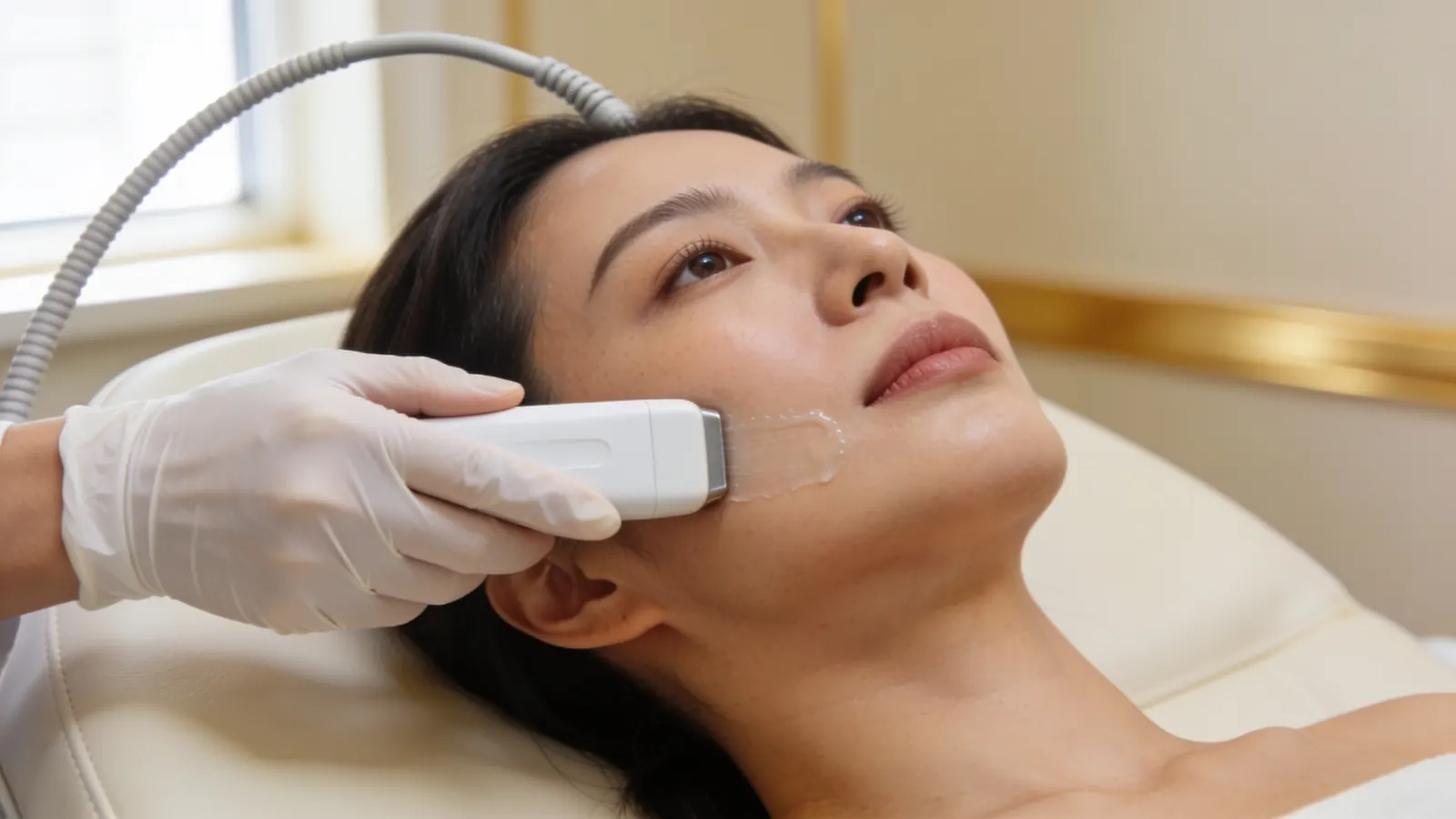
Ultrasound shows where the filler sits, how deep it is and how far it has spread, and what it is likely made of. It also shows whether there is fluid, or a collection such as pus, and whether there is filler in the swollen area at all. An international consensus of 15 experts from seven specialties calls ultrasound mandatory for managing filler complications, recommends identifying fillers already in place before injecting, and states that ultrasound guidance is needed for precise injections into a lesion (Velthuis 2025).
Illustrative image — not a patient.
The scan shows what a lump is likely made of; it does not prove it, and where it does not look like filler, further tests are arranged. If there is no filler in the swollen area, dissolving will not help, and the plan changes. Dr Sin Yong performs the scan himself, and what it shows decides what is done. More on scanning is in ultrasound-guided filler correction.
What is done: medical treatment first, then dissolving or the Sculpting mode
What is done depends on whether the reaction is inflamed and on what the scan shows.
Swipe sideways to see the whole table.
What the examination and scan show
What is done
A red, hot, painful, swollen or draining lump, or a fever
A doctor the same day, or A&E if no doctor can see you today; treated medically first; nothing is dissolved, lasered or cut out until it is under control
Swelling or a nodule that is not inflamed, where the lump is the hyaluronic acid itself
Allergy history and a skin test; then a small first dose of hyaluronidase into the mapped filler, with a review at about 48 hours
A collagen stimulator, silicone, polyacrylamide gel, PMMA or other material that cannot be dissolved
Any inflammation treated medically first; then Dr Sin Yong treats it with the Sculpting mode of Time Freeze Laser LCLR®, without an incision
Hyaluronic acid together with other material
Dissolving and the Sculpting mode, planned in order
No filler where the swelling is
Nothing is dissolved; the plan changes, and further tests are arranged where it does not look like filler
Red, hot, painful or swollen: medical treatment first
An inflamed reaction is treated medically first, before anything is dissolved, before any device and before any talk of surgery. Expert groups differ on what comes first: one consensus favours watchful waiting or medical treatment to calm the inflammation (Baranska-Rybak 2024), while in a survey of 18 physicians from 10 countries, 16 chose antibiotics first, and 13 recommended hyaluronidase injected into the lump, some only after a period of watchful waiting or once antibiotics had not worked (Artzi 2020). In one series of delayed-onset nodules, medical treatment, including treatment injected into the nodules, and hyaluronidase were effective (Beleznay 2015); in another, medical treatment injected into the nodules, combined with hyaluronidase, treated all five (Sadeghpour 2019).
Not inflamed, and hyaluronic acid: dissolved after a skin test
A swelling or nodule that is not red, hot or tender is scanned first. If the lump is the hyaluronic acid itself, it is dissolved: an expert consensus recommends hyaluronidase for non-inflammatory reactions without active infection (Baranska-Rybak 2024), and an international panel lists it for late nodules that are not inflamed (Philipp-Dormston 2020). Hyaluronidase acts on hyaluronic acid only. Your allergy history is checked, including bee or wasp stings and any earlier hyaluronidase. Before planned dissolving, Dr Sin Yong always does a skin test: a small amount of hyaluronidase is injected just under the skin to check for a reaction. A small first dose goes into the filler mapped on the scan, with a review at about 48 hours, because dissolving more than the excess can leave a hollow. In an emergency such as a blocked blood vessel, dissolving is not delayed for a skin test. Dr Sin Yong waits at least two weeks after hyaluronidase before any refilling. More is in hyaluronidase and hyaluronidase allergy and the skin test.
Material that cannot be dissolved: treated without an incision
Collagen stimulators such as Sculptra, Ellansé and Radiesse, the poly-D,L-lactic acid in Juvelook, and non-absorbable fillers such as silicone, polyacrylamide gel and PMMA cannot be dissolved, but they can still be treated without an incision. Dr Sin Yong maps the lump and treats it with the Sculpting mode of Time Freeze Laser LCLR®, his own protocol on a long-pulsed 755 nm and 1064 nm laser platform, directed at the mapped lump. Like any laser, it can cause blistering or a change in skin colour, so settings are chosen for your skin. Where hyaluronic acid sits with other material, dissolving and the Sculpting mode are planned in order. No laser, the Sculpting mode included, is used on a lump that is actively infected or on a blocked blood vessel. More is in the Sculpting mode of Time Freeze Laser LCLR®.
Will a delayed filler reaction come back?
It can. The reaction is to filler that is still in place, so while that filler remains, another illness, vaccine or dental treatment can set it off again. In one series, delayed-onset nodules resolved in a median of six weeks (Beleznay 2015), and in a systematic review, milder reactions after a viral illness or vaccine sometimes settled without treatment (Bhatia 2025).
The plan looks at what the body is reacting to, not only at each flare. Where the reaction is to hyaluronic acid and it is not inflamed, dissolving it after a scan and a skin test is aimed at the material itself. A reaction that keeps coming back is a reason to have the area scanned for what remains, rather than to keep treating each flare as it comes.
Dr Sin Yong does not add filler to an area while it is reacting, and he waits at least two weeks after hyaluronidase before any refilling. If you have had a delayed reaction, tell any doctor who treats you in future, and name the products used if you know them.
Firm lumps after a delayed reaction, and only offered surgery? Get assessed first
Some patients whose delayed reaction has left firm lumps, or keeps flaring, are told that an operation is the answer. Before you agree to one, know what it means:
A scar. Every cut through the skin of the face heals with a scar.
A dent. Cutting out a lump takes tissue with it, and the area can heal hollow or uneven.
Nerve injury. Nerves that give the face feeling and movement run close to where filler sits. An injured nerve can leave numbness, or weakness in a smile, a lip or a brow.
Product left behind. Filler spread through tissue is hard to remove completely.
No way back. Tissue that has been cut out cannot be put back.
In Dr Sin Yong's practice, almost every hard lump is treated without surgery. If yours is one of the few that needs surgery, you are told plainly, and why. For late nodules after hyaluronic acid filler, an international panel listed antibiotics, other medical treatment, hyaluronidase for nodules that are not inflamed, and surgical excision as a last resort (Philipp-Dormston 2020).
Surgery has a place, for the few lumps that need it. The point is the order: an inflamed reaction is treated medically first, the area is scanned, hyaluronic acid is dissolved and other material is treated with the Sculpting mode, without an incision, and any decision to operate comes after that. Draining pus through a small opening, when an infected lump needs it, is a much smaller procedure than cutting filler out. A scan does not delay the decision: an operation can still be done later if it is ever needed, but it cannot be undone. If you have already been offered an operation, Dr Sin Yong can scan the area and give you a second opinion before you decide. What removal surgery involves is set out in filler removal surgery.
Tried other treatments and almost given up?
Many patients who come to see Dr Sin Yong about a delayed reaction to filler tell him they have tried almost everything else and had given up hope. Having tried other treatments does not mean nothing more can be done: what is done next depends on what the scan shows.
That history is useful. Knowing what was injected, when, and what has already been tried often explains why a problem has stayed: hyaluronidase acts only on hyaluronic acid and only where it reaches, some fillers are not hyaluronic acid at all, and swelling or fluid can look like filler. Ultrasound shows which of these applies, and the plan starts from there. For material that cannot be dissolved, Dr Sin Yong uses the Sculpting mode of Time Freeze Laser LCLR® for nodules large and small, without an incision. How each person responds varies.
If you have been told nothing more can be done, it is still worth having the area scanned: ultrasound shows what is there, and the plan is made from that. Bring any records of past treatments, product names and dates if you have them. More on this is in when filler dissolving has not worked.
How Dr Sin Yong approaches a delayed filler reaction
Dr Sin Yong takes the history himself, including recent illnesses, vaccines and dental work, examines the area, performs the ultrasound scan and carries out every treatment on Orchard Road. He sees a red, hot, swollen or painful lump the same day and treats it medically first; nothing is dissolved, lasered or cut out until it is under control. Where a reaction or a lump remains, he maps it, dissolves it if the lump is the hyaluronic acid itself, after a skin test, and treats material that cannot be dissolved with the Sculpting mode of Time Freeze Laser LCLR®, without an incision.
He developed the Time Freeze Laser LCLR® protocol himself and has been invited to share his clinical expertise in Seoul, Dubai, Bangkok and São Paulo, including as a Global Key Opinion Leader. He does not add filler to an area while it is reacting. You do not need to have been treated here. Bring any records of what was injected, where and when; having none is fine. Swelling months after filler from other causes is covered in filler swelling months or years later, and lumps from every kind of filler in hard lumps after filler.
Your next step
Not for emergencies. A change in vision or eye pain after filler: call 995 now. Pale, dusky or mottled skin, or pain that is getting worse: go now to the doctor who injected you, or to A&E. Do not message or book for these signs.
1. MessageWhatsApp +65 8023 7170 with what is bothering you. A reply comes from the clinic, not a bot.
2. AssessmentDr Sin Yong examines you himself on Orchard Road, with ultrasound where earlier filler is involved.
3. A plan in writingWhat he would do, what he would not, the fee factors, and the option of no treatment.
Every treatment is performed by Dr Sin Yong personally. Singapore Medical Council registered · invited to share his clinical expertise internationally for CLASSYS, DEKA, Fotona, Hironic and Ilooda.
It is the immune system reacting to filler that is already in place, after the area has settled. International consensus counts a reaction as delayed-onset when it starts more than four weeks after treatment, with swelling, firmness and nodules the commonest signs (Philipp-Dormston 2020). It can follow an illness, a vaccine or dental work. A red, hot, painful, swollen or draining lump, or a fever, needs a doctor the same day; if no doctor can see you today, go to A&E. Otherwise, have it scanned before anything is done.
Many of the patients Dr Sin Yong sees have tried other treatments first. A treatment that did not help can still leave options open: hyaluronidase may not have reached the filler, the filler may not be hyaluronic acid, or what looks like filler may be swelling or fluid. Ultrasound shows which applies, and the plan follows what it finds.
Spreading redness with a fever, feeling faint, confused or very unwell, or swelling around the eye with pain: call 995 or go to A&E now. Difficulty breathing, a tight throat, swelling of the tongue or throat, or swelling that spreads quickly across the face, after any injection, including hyaluronidase, can be a serious allergic reaction: call 995 now. A change in vision or eye pain after filler: call 995 now. Pale, dusky or mottled skin, or worsening pain: urgent assessment by the doctor who injected you, or at A&E, now.
It has been reported, but delayed reactions are uncommon (Chung 2020). In one case series, reactions after mRNA COVID-19 vaccines settled within three days with medical treatment (Munavalli 2022). A reaction is not, on its own, a reason to go without a vaccine you need. Have the swelling assessed, say when you had the vaccine, and decide about future doses with your doctor. A red, hot, painful, swollen or draining lump, or a fever, needs a doctor the same day; if no doctor can see you today, go to A&E.
A delayed reaction can follow an illness. In 14 patients, delayed reactions to several brands of hyaluronic acid filler followed an influenza-like illness (Turkmani 2019), and bacterial and viral illness in general have been linked with delayed reactions (Munavalli 2022). One or several treated areas can swell, and the reaction can return with a later illness. Tell the doctor about the illness. A red, hot, painful or swollen lump, or a fever, needs a doctor the same day; if no doctor can see you today, go to A&E.
Dental treatment has been linked with delayed reactions, and infection has to be ruled out. An expert consensus lists recent dental treatment among the risk factors for late-onset reactions to hyaluronic acid filler (Baranska-Rybak 2024), and dental cleaning is among the reported triggers (Munavalli 2022). Mention recent dental work at the assessment, and tell your dentist which fillers you have. Pain, heat or a red, swollen lump after dental treatment, or a fever, needs a doctor the same day; if no doctor can see you today, go to A&E.
Firm lumps that appear where filler was placed, after the area has settled. In one series, they appeared a median of four months after injection (Beleznay 2015). A nodule that is red, hot, painful, swollen or draining, or comes with a fever, needs a doctor the same day; if no doctor can see you today, go to A&E. One that is not inflamed is scanned and, if it is the hyaluronic acid itself, dissolved after a skin test. For lumps under the eyes, see lumps months or years after filler.
Uncommon. A systematic review estimated delayed inflammatory reactions after hyaluronic acid filler at 1.1% a year in prospective studies, and at under 1% over 1 to 5.5 years in most retrospective studies (Chung 2020). In one series, there were 44 delayed events in 4,500 patients treated with one hyaluronic acid filler, 0.98% per patient (Humphrey 2020). Rates can differ between products: in 1,029 patients, all five delayed nodules followed one of three related fillers (Sadeghpour 2019).
Usually not a proven allergy. One series calls them delayed hypersensitivity, the allergic kind (Turkmani 2019), but a systematic review put possible cases at 0.06% a year, against 1.1% for delayed inflammatory reactions after hyaluronic acid filler, and about 5% of reported cases were confirmed (Chung 2020). A skin test checks for hyaluronidase allergy, a separate question. Difficulty breathing, a tight throat, swelling of the tongue or throat, or swelling that spreads quickly across the face, after any injection, including hyaluronidase, can be a serious allergic reaction: call 995 now.
From the outside they can look alike: a red, swollen, tender area weeks or months after filler. Heat, pain that builds, a lump that keeps growing or turns soft, pus or a fever point more towards infection. Either way, a red, hot, painful, swollen or draining lump, or a fever, needs a doctor the same day; if no doctor can see you today, go to A&E. An infection needs drainage of any pus, a culture and antibiotics rather than hyaluronidase first (Baranska-Rybak 2024).
It depends on whether it is inflamed. A red, hot, painful, swollen or draining lump, or a fever, needs a doctor the same day, or A&E if no doctor can see you today, and is treated medically first, before anything is dissolved and before any talk of surgery. Otherwise, a lump that is the hyaluronic acid itself is dissolved after a scan and a skin test, and Dr Sin Yong treats material that cannot be dissolved with the Sculpting mode of Time Freeze Laser LCLR®, without an incision.
If the lump is the hyaluronic acid itself, yes, though not while it is inflamed or infected. A nodule that is not inflamed is dissolved after a scan and a skin test: an expert consensus recommends hyaluronidase for non-inflammatory reactions without active infection (Baranska-Rybak 2024). An inflamed or infected reaction is treated medically first, and hyaluronic acid that is still causing a problem is dissolved once the inflammation or infection is under control. Dr Sin Yong treats material that cannot be dissolved with the Sculpting mode, without an incision.
It can. The reaction is to filler that is still in place, so another illness, vaccine or dental treatment can set it off again while that filler remains. In one series, delayed-onset nodules resolved in a median of six weeks (Beleznay 2015), and milder reactions after a viral illness or vaccine sometimes settled without treatment (Bhatia 2025). A reaction that keeps coming back is a reason to have the area scanned for what remains, so the plan deals with the material rather than each flare.
Usually not. Get assessed first. Inflammation is treated medically, hyaluronic acid is dissolved and other material is treated with the Sculpting mode, without an incision. An international panel lists surgical excision as a last resort for late nodules (Philipp-Dormston 2020). Cutting filler out leaves a scar, can cause a dent or nerve injury, can leave product behind, and cannot be undone. In Dr Sin Yong's practice, almost every hard lump is treated without surgery. If yours is one of the few that needs surgery, you are told plainly, and why.
References
Global Approaches to the Prevention and Management of Delayed-onset Adverse Reactions with Hyaluronic Acid-based Fillers. Plastic and Reconstructive Surgery Global Open, 2020. source
Late-Onset Reactions after Hyaluronic Acid Dermal Fillers: A Consensus Recommendation on Etiology, Prevention and Management. Dermatology and Therapy, 2024. source
Review of the Adverse Effects Associated with Dermal Filler Treatments: Part I Nodules, Granuloma, and Migration. Diagnostics, 2024. source
A Systematic Review of the Literature of Delayed Inflammatory Reactions After Hyaluronic Acid Filler Injection to Estimate the Incidence of Delayed Type Hypersensitivity Reaction. Aesthetic Surgery Journal, 2020. source
Retrospective review of delayed adverse events secondary to treatment with a smooth, cohesive 20-mg/mL hyaluronic acid filler in 4500 patients. Journal of the American Academy of Dermatology, 2020. source
Delayed-onset nodules secondary to a smooth cohesive 20 mg/mL hyaluronic acid filler: cause and management. Dermatologic Surgery, 2015. source
Delayed-Onset Nodules to Differentially Crosslinked Hyaluronic Acids: Comparative Incidence and Risk Assessment. Dermatologic Surgery, 2019. source
Delayed hypersensitivity reaction to hyaluronic acid dermal filler following influenza-like illness. Clinical, Cosmetic and Investigational Dermatology, 2019. source
COVID-19/SARS-CoV-2 virus spike protein-related delayed inflammatory reaction to hyaluronic acid dermal fillers: a challenging clinical conundrum in diagnosis and treatment. Archives of Dermatological Research, 2022. source
Systematic Review of Post-Viral Delayed Inflammation Associated with Hyaluronic Acid Dermal Fillers. Medicina (Kaunas), 2025. source
The use of ultrasound imaging in aesthetic injectables: A modified Delphi consensus. Journal of Plastic, Reconstructive & Aesthetic Surgery, 2025. source
Delayed Inflammatory Reactions to Hyaluronic Acid Fillers: A Literature Review and Proposed Treatment Algorithm. Clinical, Cosmetic and Investigational Dermatology, 2020. source
About this page: written and medically reviewed by Dr Sin Yong, MBBS (NUS), MRCS (Edinburgh) · Last reviewed 26 October 2026 · Illustrative images only, not patients · Editorial policy
Not for emergencies. A change in vision or eye pain after filler: call 995 now. Pale, dusky or mottled skin, or pain that is getting worse: go now to the doctor who injected you, or to A&E. Do not message or book for these signs.