Published 26 October 2026 · Reviewed by Dr Sin Yong
Swelling after filler is expected. It is most noticeable early, can be uneven and firm, often comes with bruising, and settles as the tissue calms. Swelling that keeps growing, pain that is getting worse, or skin that turns pale or dusky is not normal: it is urgent. Swelling that will not settle, and only offered surgery? Get assessed first. Dr Sin Yong maps it with ultrasound.
Short answerNormal swelling after filler is most noticeable early, can look lopsided or feel firm, often comes with bruising, and then eases until the area softens and settles. How quickly depends on the area, the product and how much was placed. Most side effects after hyaluronic acid filler are immediate (de Castro Costa 2025); a reaction that starts more than four weeks after treatment is classed as delayed-onset (Philipp-Dormston 2020). Swelling that grows instead of easing, pain that gets worse, or pale or dusky skin is urgent.
Filler causes some swelling. The needle passes through tissue, the gel takes up space, and the body responds to both. Early on, the area can look bigger than intended, feel firm or slightly lumpy, and look different from one side to the other. Bruises are common. None of this is the final shape.
Normal swelling follows a pattern: it is most noticeable early, then eases steadily as the area softens. How long that takes depends on the area, the product, how much was placed and how your tissue reacts, so no fixed number of days applies to everyone. What matters more than the calendar is the direction: normal swelling gets smaller, not bigger.
Swelling and bruising are the side effects reported most often. In a meta-analysis of tear trough filler covering 2,556 people, pooled rates were 19.2% for swelling and 18.4% for bruising (Liu 2023). In a systematic review of 917 people who had hyaluronic acid chin filler, the commonest side effects were injection-site reactions such as swelling, bruising, pain, redness and itching (Ou 2023). Across studies of facial hyaluronic acid filler, 72.6% of reported side effects were immediate and 4.8% were long term (de Castro Costa 2025).
Some hyaluronic acid fillers take up water after they are placed. In an MRI study of 14 people with known injection histories, the filler measured on the scan was about 2.8 times the volume injected, and the authors suggest that some fillers expand after injection, which may explain swelling afterwards (Issa 2026).
60-second filler swelling check
Not for emergencies. A change in vision or eye pain after filler: call 995 now. Difficulty breathing, a tight throat, swelling of the tongue or throat, or swelling that spreads quickly across the face: call 995 now. Pale, dusky or mottled skin, or pain that is getting worse: go now to the doctor who injected you, or to A&E. A red, hot or draining lump, or a fever: a doctor the same day; if no doctor can see you today, A&E. Do not use this check or WhatsApp for these signs.
Answer three questions and send them straight to the clinic on WhatsApp. Dr Sin Yong will let you know whether an ultrasound assessment is worthwhile. No obligation.
1 · When was it injected?
2 · What bothers you most?
3 · Have you been offered surgery for it?
Your answers open in your own WhatsApp app; nothing is stored on this page.
Filler swelling stages: lips, cheeks, under-eyes and chin
The stages are the same in every area: swelling that is most noticeable early, a settling phase as it eases, then the settled shape. What differs is how much each area swells and how long it holds fluid.
Swipe sideways to see the whole table.
Area
Early on
As it settles
Have it checked if
Lips, 0.5 ml or 1 ml
Lips swell readily and can look larger, tight, uneven or slightly lumpy; small bruises at the injection points are common
The lips soften, the outline looks less stretched and bruises fade; more product usually means more visible swelling, but the pattern is the same
Swelling is growing, a lump is getting harder or more painful, the skin turns pale or dusky, or a puffy shelf stays above the lip line once the swelling has gone
Cheeks
Fullness and tenderness over the cheekbones, sometimes with bruising
The puffiness eases and the contour becomes clearer
Puffiness below the eye or on the upper cheek stays, or the face looks rounder at rest than before
Under-eyes (tear trough)
Swelling and bruising are common here: pooled rates of 19.2% and 18.4% (Liu 2023)
Often slower than elsewhere, because the area drains fluid slowly; malar oedema after midface filler has been described as long-lasting (Funt 2011)
Puffiness persists, is worse in the morning, or comes and goes for weeks
Chin and jaw
Swelling, tenderness and a firm feel, sometimes with bruising
The firmness softens and the profile settles
A lump stays, swelling grows, or the area turns red, hot or tender
Persistent puffiness under the eyes is covered in under-eye filler swelling and puffiness. If an area still looks full at rest once the swelling has gone, it is no longer swelling: see the section on migration, lumps and overfilling below.
“Dissolving filler is not an undo button.”
Dr Sin YongOn what dissolving can and cannot do
Bruising and uneven swelling after filler
Bruising. A bruise forms where the needle nicks a small blood vessel. It shows as a blue, purple or red patch that turns yellow-green as it fades. Bruising on its own does not mean the filler has gone wrong. Skin that turns pale, white, dusky, blue-grey or mottled in a lacy pattern is different from a bruise, especially when pain is getting worse: it can mean a blocked blood vessel and needs urgent assessment.
Uneven swelling. One side often swells more than the other, because each side has its own injection points and its own bruises. Lips are especially prone to this. Unevenness is judged once the swelling has gone; if one side is still fuller then, it is a question of shape or of where the filler sits, and ultrasound helps show which.
Small firm areas. A firm area soon after treatment is often swelling or gel that has not yet settled. Do not press hard, massage firmly or use heat or devices to break it up unless the doctor who examined you has advised it. A lump that stays, grows or becomes tender is assessed; see hard lumps after filler.
What is not normal: urgent signs after filler
Normal swelling eases. These signs do not fit that pattern and need attention now, not a wait to see whether they settle:
Swelling that keeps growing instead of easing, especially with tightness, heat or throbbing.
Pain that is getting worse rather than better.
Pale, white, dusky, blue-grey or mottled skin, a patch that feels cold, or skin that is slow to turn pink again after being pressed.
Any change in vision, or eye pain, after filler anywhere on the face.
Spreading redness, heat, pus or fever, which can mean infection and needs same-day medical review.
Spreading itch or hives, which can mean an allergic reaction: contact the clinic or a doctor the same day.
Difficulty breathing, a tight throat, or swelling of the tongue or throat: call 995 now.
Urgent: a change in vision or eye pain after filler: call 995 now. Skin that turns pale, dusky or mottled, or pain that is getting worse, needs urgent assessment by the doctor who injected you, or at A&E, now. See the warning signs of a blocked blood vessel after filler.
When 'swelling' is really migration, a lump or overfilling
Swelling changes from day to day and goes down. A fullness that stays the same once the early swelling has gone is usually something else, and the plan depends on which.
Migration
Filler that has moved beyond where it was placed, such as a puffy shelf above the upper lip or fullness spreading below the eye. In an ultrasound study of 126 people, the layer under the lip skin averaged less than a millimetre, lip filler mostly ended up within the lip muscle, and some injection techniques were linked with signs of migration (Harris 2026). See lip filler migration and filler migration.
A lump
Product that has gathered in one place or sits too close to the surface, or a nodule from a reaction to it. A lump has an edge and stays when the swelling around it has gone. See hard lumps after filler.
Overfilling
A face that looks puffy or rounded at rest after repeated treatment. Facial overfilled syndrome is described as the result of excessive filler and poor technique, and it is reported mainly in people of East Asian descent (Lim 2024). Hyaluronic acid can stay in the tissue far longer than expected: ultrasound studies have found it 12 to 36 months after injection (de Castro Costa 2025), so earlier filler is often still there when more is added. See pillow face.
Fluid under the eyes
Puffiness on the upper cheek below the lower eyelid, often worse in the morning, can be malar oedema: fluid held in an area that drains poorly, described as a frequently reported, long-lasting problem after midface filler (Funt 2011). See swelling months after filler.
Swelling that comes back weeks or months later
Swelling that settles and then returns, or appears for the first time weeks or months later, is a different problem from early swelling. A reaction that starts more than four weeks after treatment is classed as delayed-onset, and swelling, firmness and nodules are its commonest signs (Philipp-Dormston 2020).
These reactions are uncommon but real. In a review of 4,702 treatments with one hyaluronic acid filler, 23 patients (0.5%) developed delayed nodules, a median of four months after injection, and 39% of them had an identifiable trigger such as a flu-like illness (Beleznay 2015). Delayed reactions have followed COVID-19 infection and vaccination, and have also been linked with dental cleaning and with bacterial or viral illness (Munavalli 2022).
What these reactions are, how often they happen and how they are treated is set out in filler swelling months or years later. Swelling that returns is assessed, not covered with more filler.
Ultrasound: is it swelling, fluid or filler?
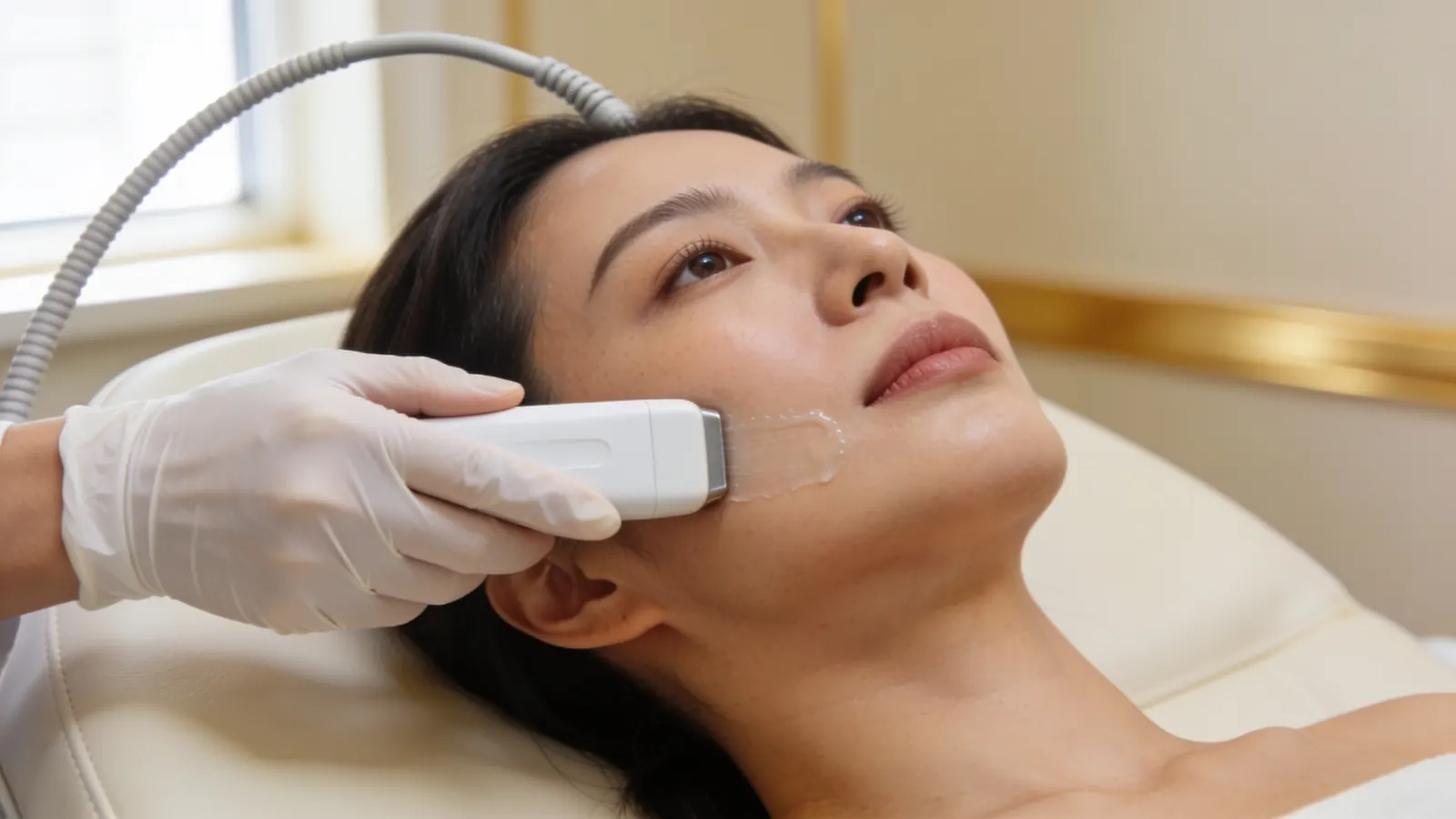
From the outside, swelling, fluid, migrated filler and a lump can look alike. High-frequency ultrasound helps tell them apart: it shows whether filler is present, how deep it sits, how far it spreads and whether there is fluid around it. In a series of palpable nodules after hyaluronic acid filler, high-frequency ultrasound told filler deposits apart from granulomas, fibrosis and inflammation, each with a typical appearance (Mlosek 2021).
Illustrative image — not a patient.
Under the eyes, the scan can also help show why fluid is held. In a duplex ultrasound series of 26 eyes with malar oedema after hyaluronic acid filler, venous flow was restored and the swelling improved within minutes once the filler was removed under ultrasound guidance; the authors conclude that filler pressing on the veins and lymph vessels may cause the swelling (Schelke, J Cosmet Dermatol 2023).
Dr Sin Yong performs the scan himself, and the plan follows what it shows: dissolving where the problem is hyaluronic acid, medical treatment where it is inflammation, and the Sculpting mode of Time Freeze Laser LCLR® where the material cannot be dissolved.
Swelling that will not settle, and only offered surgery? Get assessed first
Some patients are told that a swelling or lump after filler has to be cut out. Before you agree to an operation, know what it means:
A scar. Every cut through the skin of the face heals with a scar.
A dent. Cutting out a lump takes tissue with it, and the area can heal hollow or uneven.
Nerve injury. Nerves that give the face feeling and movement run close to where filler sits. An injured nerve can leave numbness, or weakness in a smile, a lip or a brow.
Product left behind. Filler spread through tissue is hard to remove completely.
No way back. Tissue that has been cut out cannot be put back.
In Dr Sin Yong's practice, almost every hard lump is treated without surgery. If yours is one of the few that needs surgery, you are told plainly, and why. Hyaluronic acid is dissolved, without cutting. Material that cannot be dissolved, including collagen stimulators, mixed products, silicone and other non-absorbable fillers, Dr Sin Yong treats with the Sculpting mode of Time Freeze Laser LCLR®, without an incision. International consensus on delayed reactions to hyaluronic acid filler lists surgical excision as a last resort (Philipp-Dormston 2020). An operation can still be done later if it is ever needed, but it cannot be undone.
What Dr Sin Yong does for swelling that will not settle
He maps the area with ultrasound, then treats what the scan shows.
Swipe sideways to see the whole table.
What the scan shows
What Dr Sin Yong does
Points to know
Hyaluronic acid in excess, misplaced or holding fluid
Dissolves it with hyaluronidase placed into the mapped filler
Skin test first; a small first dose; a review at about 48 hours
Inflammation or infection around filler
Treats it medically first
Dissolving or a device comes later, if at all
Collagen stimulator, mixed products, silicone or other non-absorbable filler
Treats it with the Sculpting mode of Time Freeze Laser LCLR®, without an incision
Hyaluronidase does not act on these; the laser can cause blistering or a change in skin colour, so settings are chosen for your skin
Fluid without filler
Looks for the cause and discusses the options
With no filler present, there is nothing for the enzyme to act on
Normal settling
Reviews it and leaves it to settle
No treatment is a valid plan
Dissolving hyaluronic acid. Hyaluronidase acts on hyaluronic acid only. You are asked about allergies, including bee or wasp stings and any earlier hyaluronidase. Before planned dissolving, Dr Sin Yong always does a skin test: a small amount of hyaluronidase is injected just under the skin to check for a reaction. In an emergency such as a blocked blood vessel, treatment is not delayed for a test. A small first dose is placed into the mapped filler, the area is reviewed at about 48 hours, and any further dose is titrated to effect. In a within-subject study, the largest change came between 30 minutes and 3 hours after hyaluronidase, with gradual further breakdown up to two weeks (Zhang-Nunes 2021). Dissolving more than the excess can leave a hollow, which is why the dose is staged, and Dr Sin Yong waits at least two weeks after hyaluronidase before any refilling. More is in hyaluronidase and hyaluronidase allergy and the skin test.
Tried other treatments and almost given up?
Many patients who come to see Dr Sin Yong about swelling after filler tell him they have tried almost everything else and had given up hope. Having tried other treatments does not mean nothing more can be done: what is done next depends on what the scan shows.
That history is useful. Knowing what was injected, when, and what has already been tried often explains why a problem has stayed: hyaluronidase acts only on hyaluronic acid and only where it reaches, some fillers are not hyaluronic acid at all, and swelling or fluid can look like filler. Ultrasound helps show which of these applies, and the plan starts from there. For material that cannot be dissolved, Dr Sin Yong uses the Sculpting mode of Time Freeze Laser LCLR® for nodules large and small, without an incision. How each person responds varies.
If you have been told nothing more can be done, it is still worth having the area scanned: ultrasound helps show what is there, and the plan is made from that. Bring any records of past treatments, product names and dates if you have them. More on this is in when filler dissolving has not worked.
How Dr Sin Yong approaches swelling after filler
Dr Sin Yong examines you, performs the ultrasound scan and carries out every treatment himself on Orchard Road. He developed the Time Freeze Laser LCLR® protocol himself and has been invited to share his clinical expertise in Seoul, Dubai, Bangkok and São Paulo, including as a Global Key Opinion Leader.
He does not add more filler to hide swelling, a lump or migrated product. You do not need to have been treated here, and having no records is fine. Bring what you have: product names, dates and photos of how the area looked earlier. More on the laser is in the Sculpting mode of Time Freeze Laser LCLR®.
Your next step
Not for emergencies. A change in vision or eye pain after filler: call 995 now. Pale, dusky or mottled skin, or pain that is getting worse: go now to the doctor who injected you, or to A&E. Do not message or book for these signs.
1. MessageWhatsApp +65 8023 7170 with what is bothering you. A reply comes from the clinic, not a bot.
2. AssessmentDr Sin Yong examines you himself on Orchard Road, with ultrasound where earlier filler is involved.
3. A plan in writingWhat he would do, what he would not, the fee factors, and the option of no treatment.
Every treatment is performed by Dr Sin Yong personally. Singapore Medical Council registered · invited to share his clinical expertise internationally for CLASSYS, DEKA, Fotona, Hironic and Ilooda.
Lip filler swelling follows a pattern rather than a fixed timetable. Early on, the lips are at their most swollen and can look larger, tight, uneven or slightly lumpy, often with small bruises. Then the swelling eases steadily, the lips soften and the outline looks less stretched. Finally the settled shape shows, and that is the point at which it is judged. Swelling that grows instead of easing, or pain that gets worse, is not one of the stages: it needs urgent attention.
Many of the patients Dr Sin Yong sees have tried other treatments first. A treatment that did not help can still leave options open: hyaluronidase may not have reached the filler, the filler may not be hyaluronic acid, or what looks like filler may be swelling or fluid. Ultrasound helps show which applies, and the plan follows what it finds.
It depends on how much was injected, the product and how your lips react, so no fixed number of days applies to everyone. Most side effects after hyaluronic acid filler are immediate rather than late (de Castro Costa 2025), and normal swelling gets steadily smaller. Swelling that is still increasing, or new swelling that starts more than four weeks after treatment, is not normal settling; a reaction that starts that late is classed as delayed-onset (Philipp-Dormston 2020).
Gradually rather than overnight. The lips soften, the outline looks less tight and bruises fade through yellow and green. Lips can look uneven while this happens, because each side swells and bruises differently. Judge the shape once the swelling has gone, not in the mirror on the first evening. If the swelling is getting bigger instead of smaller, or a lump becomes harder, hotter or more painful, have it checked the same day.
The stages are the same; the amount changes how much swelling you see. More product in the small space of the lips usually means more visible swelling and more stretch while it settles, and more filler to account for if a lump or unevenness stays. If 1 ml is added on top of earlier filler, the lips may hold more than the latest syringe: ultrasound studies have found hyaluronic acid 12 to 36 months after injection (de Castro Costa 2025).
Yes, early on. Each side has its own injection points and can bruise differently, so lopsided swelling is common in the lips and cheeks. Unevenness is judged once the swelling has gone. If one side is still fuller then, it is a question of shape or of where the filler sits, and ultrasound helps show which. Unevenness with pale or dusky skin, or pain that is getting worse, is urgent.
Swelling makes the lips look fuller and tighter, sometimes with small firm areas. Bruises appear as blue, purple or red patches at the injection points and turn yellow-green as they fade. Neither means the filler has gone wrong. Skin that is pale, white, dusky, blue-grey or mottled in a lacy pattern is different: it can mean a blocked blood vessel and needs urgent assessment by the doctor who injected you, or at A&E.
Cheek filler follows the same pattern: fullness and tenderness over the cheekbones early on, sometimes with bruising, then easing until the contour shows. Puffiness that sits below the eye or on the upper cheek and stays, or a face that looks rounder at rest than before, is no longer early swelling. It can be fluid, migrated filler or overfilling, and ultrasound helps show which; that decides what is done.
Swelling and bruising are common after under-eye filler: a meta-analysis found pooled rates of 19.2% for swelling and 18.4% for bruising after tear trough treatment (Liu 2023). The area drains fluid slowly, so swelling can take longer to settle here than elsewhere, and malar oedema after midface filler has been described as long-lasting (Funt 2011). Puffiness that persists, is worse in the morning or comes and goes needs a scan to tell fluid from filler.
Yes. In a systematic review of 917 people who had hyaluronic acid chin filler, the commonest side effects were injection-site reactions such as swelling, bruising, pain, redness and itching, and major complications were rare (Ou 2023). The chin can feel firm while it settles. A lump that stays, swelling that grows, or skin that becomes red, hot or tender needs assessment. Chin filler is not always hyaluronic acid, which changes what can be done.
When it does not follow the normal pattern. Swelling that keeps growing, pain that gets worse, or skin that turns pale, dusky or mottled needs urgent assessment by the doctor who injected you, or at A&E. A change in vision or eye pain after filler means calling 995 or going to the nearest emergency department now. Difficulty breathing, or swelling of the tongue or throat, also means calling 995.
Yes. Swelling can return, or appear for the first time, weeks or months later, sometimes after a flu-like illness, COVID-19 infection or vaccination, or dental cleaning (Beleznay 2015; Munavalli 2022). It is uncommon, and it is assessed rather than covered with more filler. Causes, triggers and treatment are set out on filler swelling months or years later.
Usually not. Get assessed before you agree to it. Swelling that will not settle is usually hyaluronic acid holding fluid, migrated filler, a nodule or inflammation, and ultrasound helps show which. Hyaluronic acid is dissolved; material that cannot be dissolved, including silicone, Dr Sin Yong treats with the Sculpting mode of Time Freeze Laser LCLR®, without an incision. Cutting filler out leaves a scar, can cause a dent or nerve injury, and cannot be undone.
Only if the doctor who examined you advises it. Massage does not dissolve filler, and firm pressure on fresh filler can push it where it should not go. Do not try to break up a firm area yourself with pressure, heat or devices. Gentle care and time are usually all that early swelling needs. A lump or swelling that stays once the early swelling has gone is worth an ultrasound assessment.
References
The Efficacy and Safety of Hyaluronic Acid Injection in Tear Trough Deformity: A Systematic Review and Meta-analysis. Aesthetic Plastic Surgery, 2023. source
Nonsurgical Chin Augmentation Using Hyaluronic Acid: A Systematic Review of Technique, Satisfaction, and Complications. Aesthetic Plastic Surgery, 2023. source
Clinical Durability of Hyaluronic Acid-Based Dermal Fillers for Facial Application: A Systematic Review. Aesthetic Plastic Surgery, 2025. source
Longevity and Volume Expansion of Hyaluronic Acid Dermal Fillers: A Cross-sectional 3-dimensional Magnetic Resonance Imaging Study. Plastic and Reconstructive Surgery Global Open, 2026. source
Global Approaches to the Prevention and Management of Delayed-onset Adverse Reactions with Hyaluronic Acid-based Fillers. Plastic and Reconstructive Surgery Global Open, 2020. source
Avoiding malar edema during midface/cheek augmentation with dermal fillers. Journal of Clinical and Aesthetic Dermatology, 2011. source
Ultrasound Evaluation of Lip Anatomy and Filler Placement: A Cross-Sectional Study of Injection Accuracy, Migration, and Demographic Variation. Plastic and Reconstructive Surgery, 2026. source
Exploring facial overfilled syndrome from the perspective of anatomy and the mismatched delivery of fillers. Journal of Cosmetic Dermatology, 2024. source
Delayed-onset nodules secondary to a smooth cohesive 20 mg/mL hyaluronic acid filler: cause and management. Dermatologic Surgery, 2015. source
COVID-19/SARS-CoV-2 virus spike protein-related delayed inflammatory reaction to hyaluronic acid dermal fillers: a challenging clinical conundrum in diagnosis and treatment. Archives of Dermatological Research, 2022. source
The use of high-frequency ultrasonography for the diagnosis of palpable nodules after the administration of dermal fillers. Journal of Ultrasonography, 2021. source
Periorbital venous stasis may be involved with filler induced malar edema: a duplex ultrasound-imaging-based case series. Journal of Cosmetic Dermatology, 2023. source
Prospective in vivo evaluation of three different hyaluronic acid gels to varying doses of hyaluronidase with long-term follow-up. Journal of Plastic, Reconstructive & Aesthetic Surgery, 2021. source
About this page: written and medically reviewed by Dr Sin Yong, MBBS (NUS), MRCS (Edinburgh) · Last reviewed 26 October 2026 · Illustrative images only, not patients · Editorial policy
Not for emergencies. A change in vision or eye pain after filler: call 995 now. Pale, dusky or mottled skin, or pain that is getting worse: go now to the doctor who injected you, or to A&E. Do not message or book for these signs.