Main guideDermal fillers — what it treats, who it suits, sessions, downtime and what decides the cost, by Dr Sin Yong.
Published 26 October 2026 · Reviewed by Dr Sin Yong
Hyaluronic acid filler does break down in the body, but slowly and unevenly, and MRI scans have found it in the face years after it was injected. There is no proven safe way to dissolve filler at home: massage, heat, facials, at-home devices, supplements and creams do not. This page sets out what is known, what to avoid, and the choices if filler is bothering you.
Short answerThere is no proven safe way to dissolve filler naturally or at home. Hyaluronic acid filler is broken down by the body's own enzymes, but slowly and unevenly, and on MRI it has been found in the face years after injection (Master 2024). Massage, heat, facials, at-home devices, supplements and creams do not dissolve it. Collagen stimulators are broken down by other, slow processes, and non-absorbable fillers stay (Wollina 2024). The choices are to wait and review, or, for hyaluronic acid, ultrasound-guided hyaluronidase given by a doctor.
Does filler go away on its own? How the body breaks it down
Hyaluronic acid filler does go away on its own, eventually. The body breaks it down with its own hyaluronidase enzymes and with reactive oxygen species, by-products of normal metabolism (Wollina 2024). Filler is made to resist this: the hyaluronic acid in it is cross-linked so that it lasts far longer than the hyaluronic acid the body makes for itself, and more heavily cross-linked products tend to last longer (Wollina 2024).
The breakdown is slow and uneven. A thin layer may soften while a thicker deposit nearby stays, and filler placed over several visits can build up in layers. The gel also holds water, so a filled area can look fuller at some times than others, such as on waking. That is why filler that seems to have gone can still be present, and why a lump or ridge from old filler often stays where it is.
Other fillers behave differently. Collagen stimulators are broken down by other, slow processes, and non-absorbable fillers stay; see collagen stimulators and non-absorbable fillers below.
60-second filler check
Not for emergencies. A change in vision or eye pain after filler: call 995 now. Difficulty breathing, a tight throat, swelling of the tongue or throat, or swelling that spreads quickly across the face: call 995 now. Pale, dusky or mottled skin, or pain that is getting worse: go now to the doctor who injected you, or to A&E. A red, hot or draining lump, or a fever: a doctor the same day; if no doctor can see you today, A&E. Do not use this check or WhatsApp for these signs.
Answer three questions and send them straight to the clinic on WhatsApp. Dr Sin Yong will let you know whether an ultrasound assessment is worthwhile. No obligation.
1 · When was the filler done?
2 · What bothers you most?
3 · Have you already tried other treatments for this?
Your answers open in your own WhatsApp app; nothing is stored on this page.
How long does filler last, and why it builds up
Hyaluronic acid filler is often described as lasting months, but imaging tells a different story. In an MRI study of 33 patients with hyaluronic acid filler in the mid-face, filler was found in every one of them, at least two years after their last injection, and in one patient after 15 years (Master 2024). The authors suggested that this may warrant rethinking how often filler is topped up.
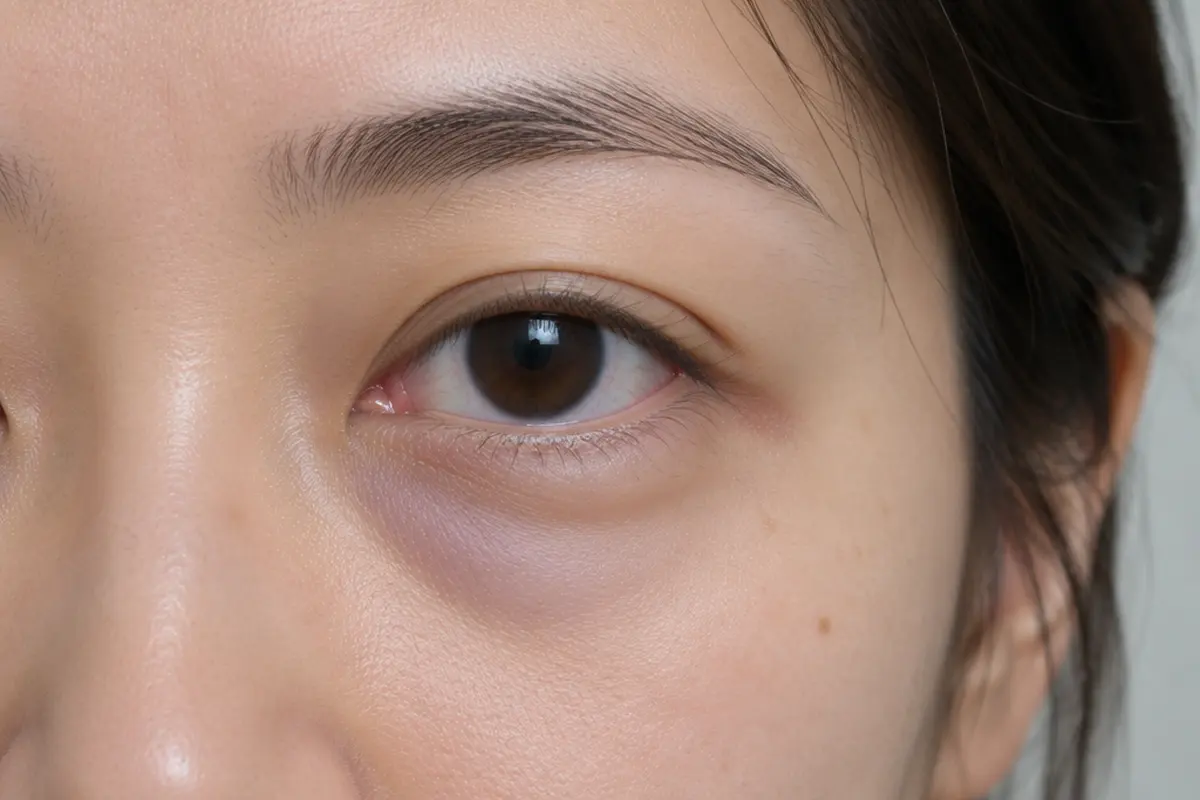
Under-eye puffiness after filler can persist and is checked before more is added. Illustrative image, not a patient.
How long filler stays depends on the product, how much was placed, where it sits and how often it was topped up, and the effect you can see does not always match what is still in the tissue. When the effect seems to fade and more is added, the new filler joins what is already there. Over several years this can build into puffiness or a heavy look; see pillow face.
“Nobody wakes up overfilled. It arrives one reasonable appointment at a time.”
Dr Sin YongOn how filler builds up over time
Does filler dissolve on its own? What imaging and follow-up studies show
The visible effect of filler fades, and the filler itself can remain. In a meta-analysis of lip filler, 91% of people still had fuller lips at two months and 46% at twelve months. In a magnetic resonance imaging study of mid-face filler, hyaluronic acid was still detectable in all 33 people at least two years after injection, and in some for much longer.
The studies cited here did not test massage, heat or facials. The method that has been tested in a randomised trial is hyaluronidase, which reduced hyaluronic acid filler at every dose tested compared with saline. Waiting is reasonable when the filler is not causing a problem, and the studies show that waiting can take years.
Is it still filler? Signs people notice
Common reasons for wanting filler gone include:
Puffiness in an area that was filled, often worse in the morning.
A ridge, bead or lump that can be seen or felt.
Filler that seems to have spread, for example above the lip line; see filler migration signs.
A bluish tint under thin skin, where hyaluronic acid sits close to the surface; see the Tyndall effect.
A heavier or wider look when smiling.
Not every fullness is filler. Swelling, fluid, fat and changes with age can look similar, and dissolving cannot change any of them. On ultrasound, hyaluronic acid filler usually shows as a dark, well-defined pocket (Wortsman 2015), so a scan helps show whether filler remains, where it sits and how much there is, before anyone decides whether to wait or to treat.
Massage, heat, facials, devices and creams: what is known
There is no proven safe way to dissolve filler at home. The methods people try most often are set out below, with what is known about each.
Swipe sideways to see the whole table.
Method people try
Does it dissolve filler?
What is known
Massage
No
It does not break down the gel. A doctor may advise gentle massage for a soft, early irregularity soon after treatment; firm or repeated pressure can bruise the area or move filler elsewhere
Heat: hot compresses, saunas, steam
No
Heat does not dissolve hyaluronic acid filler, and on recently treated skin it adds to swelling and bruising
Facials, gua sha and face rollers
No
Pressure on the surface does not break down filler beneath it; they are avoided on recently treated areas
They are not designed to dissolve filler, and their effect on filler is not established
Creams, serums and patches
No
No product applied to the skin has been shown to dissolve filler beneath it
Supplements, diets and fasting
No
No supplement or diet has been shown to dissolve filler
Products bought online to inject
Do not use them
Contents and sterility cannot be known, and injecting your own face risks infection, allergy and harm to blood vessels
Hyaluronidase given by a doctor
Yes, hyaluronic acid only
The enzyme breaks down hyaluronic acid filler; ultrasound first helps aim it at the excess
Waiting
Slowly, for hyaluronic acid
The body breaks it down over time, but it can take years and may not be even (Master 2024)
Can massage remove filler?
Massage does not break down filler. In the first days after treatment it can change how a soft, newly placed filler settles, which is why a doctor sometimes advises it for a small irregularity, and that advice applies to that situation only. It will not move product back into place once filler has settled or migrated, and repeated firm pressure on older filler can bruise or irritate the area.
Does heat dissolve filler?
No. Hot compresses, saunas, steam rooms and hot showers do not dissolve hyaluronic acid filler. Heat is avoided in the first days after filler or dissolving because it adds to swelling and bruising, not because it melts filler. Laser and other energy-based treatments in a clinic are planned by a doctor for a specific purpose, once the scan has shown what the material looks like, and are not the same as applying heat at home.
Never inject or buy products online to dissolve filler
Enzymes and other products sold as filler dissolvers can be bought online, sometimes with instructions for injecting them at home. Do not use them. What is in the vial, how strong it is and whether it is sterile cannot be known, and injecting your own face, without seeing where the filler or the blood vessels are, risks infection and harm to blood vessels.
Even a genuine product needs care. Allergic reactions to hyaluronidase are uncommon but real: a systematic review of 106 patients with hyaluronidase allergy found that previous hyaluronidase injections and sensitisation from insect or wasp stings were the main risk factors (Guliyeva 2024), and guidance lists a history of sting allergy as a reason for extra care (Murray 2021). Too much enzyme, or enzyme in the wrong place, can also leave an area hollow, because it breaks down any hyaluronic acid filler it reaches.
If you have already injected something, tell a doctor what it was, when and where, and keep any packaging. Difficulty breathing, a tight throat, swelling of the tongue or throat, or swelling that spreads quickly across the face, after any injection, including hyaluronidase, can be a serious allergic reaction: call 995 now. Itch, hives or swelling that spreads beyond the treated area: contact the clinic that injected you the same day.
Collagen stimulators break down only slowly; non-absorbable fillers stay
Everything above is about hyaluronic acid. Many faces also contain collagen stimulators, such as poly-L-lactic acid (Sculptra), poly-D,L-lactic acid (Juvelook), polycaprolactone (Ellansé) and calcium hydroxylapatite (Radiesse), or, from older or overseas treatments, non-absorbable fillers such as silicone.
Poly-lactic acid and calcium hydroxylapatite are broken down by the body through other processes, usually for up to two years, and in individual cases more than five, and non-absorbable fillers stay (Wollina 2024). Polycaprolactone is also broken down slowly. Hyaluronidase does not act on any of them, and none dissolves naturally on any useful timescale for someone bothered by a lump now. In a series of 55 complications from collagen-stimulating fillers, lumps were the most common problem, they were often persistent, and hyaluronidase helped only where hyaluronic acid had been mixed in (Ianhez 2024). That study did not use the Sculpting mode, and its figures do not apply to it.
For nodules large and small made of collagen stimulators, or of several products layered together, Dr Sin Yong uses the Sculpting mode of Time Freeze Laser LCLR®, without an incision; how each person responds varies. Dr Sin Yong maps non-absorbable fillers with ultrasound and treats them with the Sculpting mode as well, without an incision. A lump that is red, hot, tender or growing quickly needs a doctor the same day, or A&E if no doctor can see you today, and is treated medically first. More detail is in Sculptra lumps, Ellansé lumps and Radiesse lumps.
Your choices: wait and review, or ultrasound-guided hyaluronidase
If hyaluronic acid filler is bothering you, there are two real choices, and an assessment helps decide between them.
Illustrative image — not a patient.
Wait and review
Waiting is reasonable when filler is recent, because early swelling and unevenness often settle on their own, and when an irregularity is small enough to live with. While you wait, avoid adding more filler to the area, and take photographs in the same light to compare. A review, with ultrasound where it helps, shows whether filler remains and how much.
Ultrasound-guided hyaluronidase
Where hyaluronic acid filler has built up, migrated or formed a lump, waiting for it to go can take years. Hyaluronidase breaks it down. Ultrasound first shows where the filler sits and whether it looks like hyaluronic acid, so the enzyme can be injected directly into the deposit (Schelke 2018). A small first dose is reviewed at about 48 hours; further doses are titrated to what remains (King 2018), and any refilling waits at least two weeks. The details are in filler dissolving in Singapore, and what to expect afterwards in aftercare after filler dissolving.
How to make filler go away faster
For hyaluronic acid filler, the established way to speed up its breakdown is hyaluronidase given by a doctor. Nothing done at home has been shown to do this. For collagen stimulators, which the enzyme does not affect, Dr Sin Yong treats lumps with the Sculpting mode of Time Freeze Laser LCLR®, without an incision, once the scan has shown what is there.
When not to wait
Some signs mean acting now, not waiting:
Skin over or near filler that turns pale, dusky or mottled, or pain that is getting worse.
Any change in vision, or eye pain, after filler.
A lump that becomes red, hot or tender, or grows quickly. This can be inflammation or infection, or a delayed inflammatory nodule, sometimes months after treatment (Convery 2021), and it is treated medically first. It needs a doctor the same day; if no doctor can see you today, A&E.
Difficulty breathing, a tight throat, swelling of the tongue or throat, or swelling that spreads quickly across the face, after any injection, including hyaluronidase, can be a serious allergic reaction: call 995 now. Itch, hives or swelling that spreads beyond the treated area: contact the clinic that injected you the same day.
Urgent: a change in vision or eye pain after filler means calling 995 now. Skin that turns pale, dusky or mottled, or pain that is getting worse, needs urgent assessment by the doctor who injected you, or at A&E, now. See the warning signs of a blocked blood vessel after filler.
How Dr Sin Yong approaches filler that has not gone away
Dr Sin Yong starts with what is actually there. He examines you, performs the ultrasound scan himself, and explains whether the fullness is filler, which material it looks like, and whether waiting, dissolving or another approach makes sense, including the option of no treatment. The plan, and what decides the fee, is set out in writing. You do not need to have been treated here, and filler placed overseas or years ago is assessed in the same way.
If you have already tried other treatments, including dissolving, and the problem has stayed, that history helps explain why: the filler may not be hyaluronic acid, the enzyme may not have reached it, or what looks like filler may be swelling. More on this is in when filler dissolving has not worked.
Your next step
Not for emergencies. A change in vision or eye pain after filler: call 995 now. Pale, dusky or mottled skin, or pain that is getting worse: go now to the doctor who injected you, or to A&E. Do not message or book for these signs.
1. MessageWhatsApp +65 8023 7170 with what is bothering you. A reply comes from the clinic, not a bot.
2. AssessmentDr Sin Yong examines you himself on Orchard Road, with ultrasound where earlier filler is involved.
3. A plan in writingWhat he would do, what he would not, the fee factors, and the option of no treatment.
Every treatment is performed by Dr Sin Yong personally. Singapore Medical Council registered · invited to share his clinical expertise internationally for CLASSYS, DEKA, Fotona, Hironic and Ilooda.
Hyaluronic acid filler cannot be dissolved at home. The medical route, an ultrasound scan, a skin test and a small first dose of enzyme, is set out in the guide to filler dissolving in Singapore.
Often longer than expected; some fillers never break down. The body’s own enzymes break hyaluronic acid down, but filler gel is cross-linked so that they act slowly. In a systematic review of 24 studies (1,410 patients), the studies using 3D imaging found 60–86.4% of the filler still present at 12 months and 50–86% at 24 months (de Castro Costa 2025). Collagen stimulators break down slowly; silicone and other non-absorbable fillers stay. Injected hyaluronidase breaks hyaluronic acid down quickly, and what it cannot dissolve can still be treated without an incision.
There is no proven safe way to dissolve filler naturally or at home. Hyaluronic acid filler is broken down by the body's own enzymes, but slowly and unevenly, and MRI has found it in the face years after injection (Master 2024). Massage, heat, facials, at-home devices, supplements and creams do not dissolve it. If filler is bothering you, the choices are to wait and review, or to have hyaluronic acid dissolved by a doctor with hyaluronidase.
Hyaluronic acid filler does, eventually: the body breaks it down with its own enzymes and other processes (Wollina 2024). But it often stays far longer than the time usually quoted, and some can remain after the effect seems to have faded, which is why topping up can build volume over the years. Collagen stimulators are broken down by other, slow processes, and non-absorbable fillers such as silicone stay.
It depends on the product, the amount, the area and how often it was topped up. Hyaluronic acid filler is often described as lasting months, but in an MRI study of 33 patients it was found in the mid-face of every one, at least two years after their last injection and in one case after 15 years (Master 2024). Poly-lactic acid and calcium hydroxylapatite usually persist for up to two years, and in individual cases more than five (Wollina 2024).
For hyaluronic acid filler, the established way is hyaluronidase injected by a doctor, ideally after ultrasound has shown where the filler sits. Nothing done at home has been shown to speed up the breakdown, and avoiding further top-ups stops more being added. Collagen stimulators do not respond to hyaluronidase; Dr Sin Yong treats lumps of them with the Sculpting mode of Time Freeze Laser LCLR®, without an incision, once the scan has shown what is there.
Massage does not dissolve filler. In the first days after treatment, the doctor who examined you may advise gentle massage for a soft, early irregularity, and that advice applies to that situation only. Massage will not move filler back once it has settled or migrated, and repeated firm pressure on older filler can bruise or irritate the area. If a lump or ridge has been there for months, have it assessed instead.
No. Hot compresses, saunas, steam rooms and hot showers do not dissolve hyaluronic acid filler. Heat is avoided in the first days after filler or dissolving because it adds to swelling and bruising, not because it melts filler. At-home devices that warm the skin, such as radiofrequency or ultrasonic tools, are not designed to dissolve filler, and their effect on it is not established.
No. No cream, serum, patch, supplement or diet has been shown to dissolve filler, and facials, gua sha and face rollers press on the surface without breaking down what lies beneath it. Some products are marketed as filler dissolvers; claims like these deserve caution. If filler is bothering you, an assessment with ultrasound helps show whether it is still there and what it looks like, which guides the options.
No. A product bought online may not contain what the label says and may not be sterile, and injecting your own face without seeing where the filler and blood vessels are risks infection and harm to blood vessels. Hyaluronidase can also cause allergic reactions, particularly after earlier injections or sensitisation from insect or wasp stings (Guliyeva 2024), and too much can leave a hollow. It should be given by a doctor after assessment.
Only slowly. Poly-lactic acid and calcium hydroxylapatite are broken down through other processes, usually for up to two years, and in individual cases more than five (Wollina 2024), and polycaprolactone is also broken down slowly. Lumps made of these materials are often persistent (Ianhez 2024), and hyaluronidase does not act on them. That study did not use the Sculpting mode, and its figures do not apply to it. For nodules large and small, Dr Sin Yong uses the Sculpting mode of Time Freeze Laser LCLR®, without an incision.
It depends on how recent the filler is, what it is made of and what bothers you. Early swelling and unevenness after recent filler often settle, so a review is usually wiser than dissolving at once. Older hyaluronic acid filler that has built up, migrated or formed a lump can persist, and staged dissolving of the excess is considered. Pale, dusky or mottled skin, or worsening pain, needs urgent assessment by the doctor who injected you, or at A&E, now; a change in vision or eye pain: call 995 now.
Signs include puffiness in an area that was filled, often worse in the morning, a ridge or lump you can feel, a bluish tint under thin skin, or a heavier look when you smile. Not every fullness is filler: swelling, fat and changes with age can look similar. On ultrasound, hyaluronic acid filler usually shows as a dark, well-defined pocket (Wortsman 2015), so a scan helps show whether filler remains and where.
References
Hyaluronic Acid Filler Longevity in the Mid-face: a review of 33 MRI studies. Plastic and Reconstructive Surgery Global Open, 2024. source
Spontaneous and induced degradation of dermal fillers: A review. Journal of Cutaneous and Aesthetic Surgery, 2024. source
Complications of collagen biostimulators in Brazil: Description of products, treatments, and evolution of 55 cases. Journal of Cosmetic Dermatology, 2024. source
Allergic Complications of Hyaluronidase Injection: Risk Factors, Treatment Strategies, and Recommendations for Management. Aesthetic Plastic Surgery, 2024. source
Guideline for the Safe Use of Hyaluronidase in Aesthetic Medicine, Including Modified High-dose Protocol. Journal of Clinical and Aesthetic Dermatology, 2021. source
The Use of Hyaluronidase in Aesthetic Practice (v2.4). Journal of Clinical and Aesthetic Dermatology, 2018. source
Ultrasound to improve the safety of hyaluronic acid filler treatments. Journal of Cosmetic Dermatology, 2018. source
Identification and Complications of Cosmetic Fillers: Sonography First. Journal of Ultrasound in Medicine, 2015. source
Delayed-onset Nodules (DONs) and Considering their Treatment following use of Hyaluronic Acid (HA) Fillers. Journal of Clinical and Aesthetic Dermatology, 2021. source
Clinical Durability of Hyaluronic Acid-Based Dermal Fillers for Facial Application: A Systematic Review. Aesthetic Plastic Surgery, 2025. pubmed.ncbi.nlm.nih.gov
Czumbel LM, Farkasdi S, Gede N, Mikó A, Csupor D, Lukács A, et al. Hyaluronic Acid Is an Effective Dermal Filler for Lip Augmentation: A Meta-Analysis. Frontiers in Surgery, 2021. doi.org
Alam M, Hughart R, Geisler A, Paghdal K, Maisel A, Weil A, et al. Effectiveness of Low Doses of Hyaluronidase to Remove Hyaluronic Acid Filler Nodules: A Randomized Clinical Trial. JAMA Dermatology, 2018. doi.org
About this page: written and medically reviewed by Dr Sin Yong, MBBS (NUS), MRCS (Edinburgh) · Last reviewed 6 November 2026 · Illustrative images only, not patients · Editorial policy
Not for emergencies. A change in vision or eye pain after filler: call 995 now. Pale, dusky or mottled skin, or pain that is getting worse: go now to the doctor who injected you, or to A&E. Do not message or book for these signs.