Key facts
- HIFU
- Focused ultrasound on the Ultraformer MPT: focal coagulation points at 1.5, 2.0, 3.0 or 4.5 mm; 4.5 mm reaches the SMAS
- VF Lift – Vertical Facelift
- Volnewmer 6.78 MHz monopolar radiofrequency: volumetric heating of dermis and subcutaneous layer, planned zone by zone; no focused ultrasound
- Why combine
- Each acts on a layer the other does not; a face with SMAS laxity and dermal or fat-layer change may need both
- Order
- Decided by the dominant finding at assessment, not by a fixed rule
- Spacing
- Set at review once the first response has been read; no fixed interval
- Not combined
- Pacemaker or implanted electronic device, pregnancy, active infection, recent filler or threads in the plane, a very thin face
Why would HIFU and the VF Lift be combined at all?
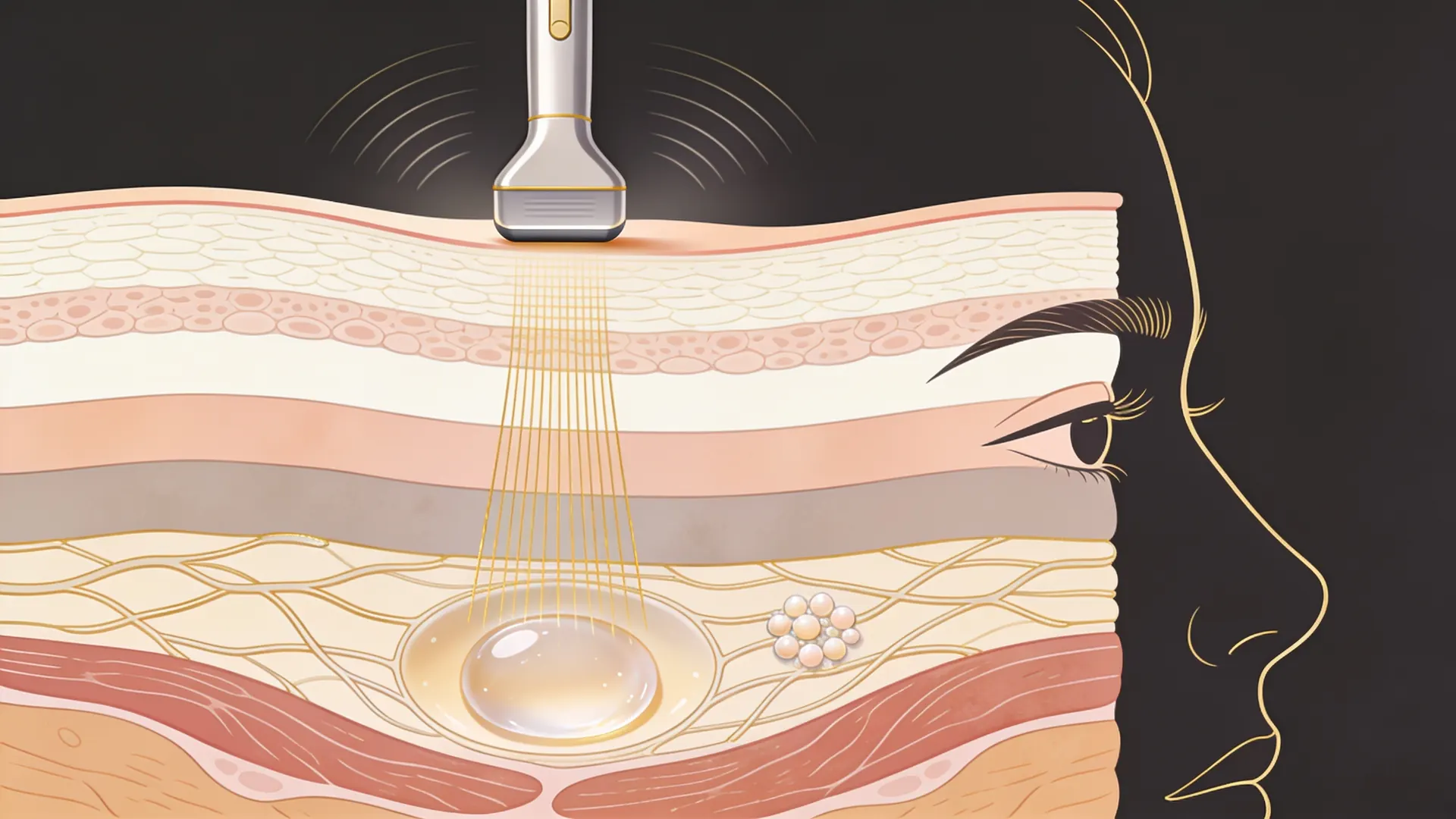
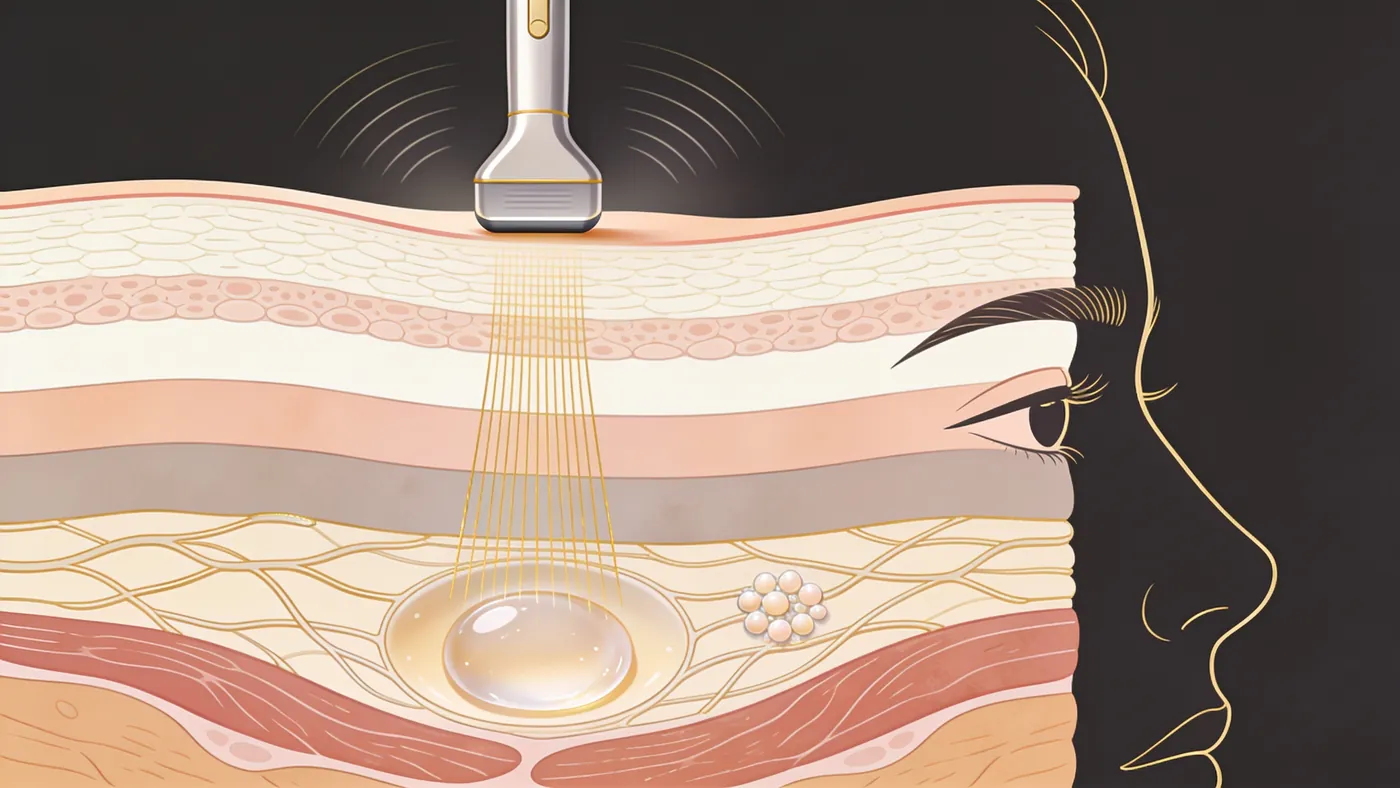
HIFU and the VF Lift – Vertical Facelift are combined because they act on different layers by different mechanisms, and some faces have changed in both. HIFU converges ultrasound at a set depth so that a small point of tissue reaches roughly 60 to 70 °C while the surface is spared; at 4.5 mm that point sits in the SMAS, and at 3.0 and 1.5 mm in the dermis. The VF Lift runs on Volnewmer monopolar radiofrequency at 6.78 MHz, which heats the dermis and the subcutaneous layer as a volume rather than at points, with the surface cooled throughout. It does not use focused ultrasound.
A face whose jawline has descended because the SMAS has loosened, and whose skin has also lost firmness across the cheek, has two problems in two layers. Focal heat at the SMAS does not change dermal quality across a zone; volumetric heating of the dermis does not place coagulation points in the fascia. The combination is not a stronger version of either; it is two different actions directed at two different findings.
Whether both are needed is an assessment question. Dr Sin Yong examines the face at rest and in animation, palpates skin and fat thickness over each zone and maps where the SMAS is lax against where the dermis has thinned or where puffiness or hollowing sits. Many faces need one energy only.
Which goes first, and why?
Which energy goes first is decided by the dominant finding, not by a fixed rule. Where SMAS laxity along the jawline and under the chin is the main change and the skin itself is reasonable, HIFU is usually placed first, because the deeper, focal treatment answers the main question and its response can be read before heat is added to the layers above it. Where dermal laxity, puffiness or hollowing across the mid and lower face is the main change, the VF Lift leads, because volumetric heating of the dermis and fat layer is the action that finding needs, and the SMAS question can be revisited once that response is seen.
The principle behind either order is the same: treat the layer that explains most of what you see, read the response, then decide whether the second layer still needs addressing. Some zones that might have been candidates for focal heat turn out not to need it once the dermis and subcutaneous layer have responded; equally, a jawline treated at the SMAS can reveal that the remaining change is dermal.
Both treatments avoid the same anatomical hazards, the thyroid, the orbital rim and the course of the marginal mandibular nerve, and both are planned from palpated tissue thickness rather than a preset. That shared map is what makes a sequence coherent.
“"HIFU or radiofrequency, which is better?" Wrong question. They don't do the same job.”
Dr Sin YongOn choosing an energy device
How is the spacing between the two decided?
Spacing is set at review, once the response to the first energy has been read, and no fixed interval is quoted in advance. Both HIFU and monopolar radiofrequency work through a collagen response that develops gradually, so a review booked too early sees swelling and early firmness rather than the remodelling itself. The second energy is timed to settled tissue, and the interval differs from face to face because depth, energy, zones and the person's response all differ.
Stacking the second treatment before the first response has been read adds thermal load to tissue that is still responding and removes the information the review was meant to give: if a zone looks hollower or more swollen than expected, no one can say which energy caused it. Reading one response before adding another is slower, and it is the safer and more informative order.
At review Dr Sin Yong re-examines the zones, compares the face with the photographs in your medical record, and decides whether the second energy is still indicated, in which zones and at what depth. The plan can end with the decision that the second treatment is not needed.
HIFU and VF Lift – Vertical Facelift compared by what each does| Question | HIFU (Ultraformer MPT) | VF Lift – Vertical Facelift (Volnewmer) |
|---|
| Energy | High-intensity focused ultrasound | Monopolar radiofrequency at 6.78 MHz |
| How heat is placed | Focal coagulation points at a set depth | Volumetric heating of a whole zone, surface cooled |
| Layer reached | SMAS at 4.5 mm; dermis at 3.0 and 1.5 mm | Dermis and subcutaneous layer |
| Planned for | Laxity of the SMAS and dermis along jawline, chin and neck | Laxity, puffiness and hollowing, zone by zone |
| Does not do | Change dermal quality across a zone; replace volume; remove skin | Place focal heat in the SMAS; use focused ultrasound; remove skin |
| Not planned for | Thin tissue over bone; thyroid, orbital rim, nerve course | Pacemaker or implanted electronic device; metal in the field |
Who should not combine HIFU with the VF Lift?
Anyone with a pacemaker, defibrillator or other implanted electronic device is not treated with monopolar radiofrequency, so the VF Lift is not planned and the question of combining does not arise. Metal implants in or near the field change the radiofrequency plan and are assessed individually for HIFU. Pregnancy, active infection, open wounds, inflamed acne or a cold sore in the area mean waiting for both.
Recent filler or threads in the plane are timed around rather than heated over, and any earlier injectable or energy treatment is declared before either energy is planned. A very thin face with little fat beneath the skin is treated with restraint, because both energies can reduce the fat beneath thin tissue and leave a hollow; in such a face the case for stacking two heating treatments is weak. A tendency to keloid scarring, reduced sensation in the area and autoimmune or connective-tissue disease each call for caution.
Some faces are wrong for both. Marked volume loss is a question for restoration rather than heat, a full submental fat pad calls for a fat-directed mechanism, and heavy redundant skin is beyond what any energy device reaches and is referred to a plastic surgery specialist.
What are the risks of stacking two energies?
The risks of stacking are the risks of each energy plus the effect of adding heat to tissue already heated. Each on its own commonly causes redness, warmth, tenderness and some swelling that settle. Less commonly HIFU can irritate a nerve branch along the jaw or above the brow, causing temporary numbness or weakness, or reduce the fat beneath thin skin and leave hollowing; monopolar radiofrequency can cause a blister, crust or small burn where too much heat lands in one spot, a patch of altered sensation, or a slight dent over thin tissue. In darker skin any surface injury can be followed by temporary pigment change.
Placing the second energy over tissue that is still swollen, tender or remodelling raises the chance of each of these, particularly fat loss in a lean face and prolonged swelling, and makes any problem harder to attribute. These risks are reduced, not removed, by palpating tissue thickness zone by zone, keeping the deeper HIFU cartridge to areas with enough depth above bone, cooling the surface during radiofrequency, adjusting energy to your feedback, and spacing the two at review. The complication care page sets out which signs need prompt attention.
Combination is not a reason to expect a surgical result. Neither energy repositions tissue mechanically or removes skin; a thread lift does the first and surgery does both. The combined plan describes a sequence and its decision points, not an outcome.
What determines the fee for a combined plan?
The fee for a combined plan depends on which zones each energy covers, the cartridge depths and number of lines planned for HIFU, how many zones the VF Lift is customised across, and whether both are still indicated after the first review. Singapore's rules for medical advertising prevent prices from being published, and a figure given before examination would describe a plan that does not yet exist.
A written, itemised quote is given after the consultation, naming each treatment, the zones and the review that follows it; the second energy is quoted as a decision to be confirmed at review rather than as a package. The how we quote page explains what the quote contains, and the consultation process page sets out the steps from enquiry to follow-up.