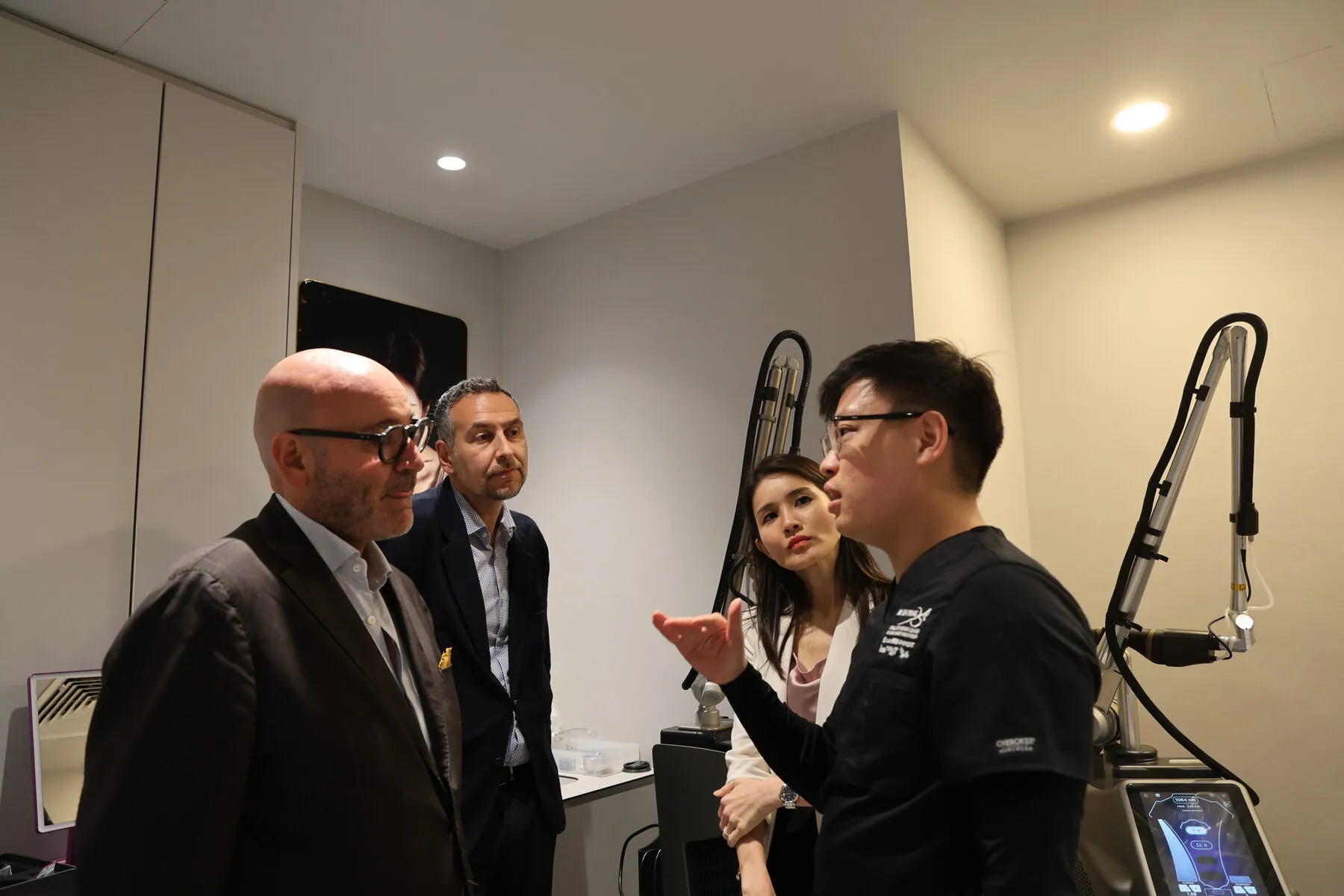
A fractional 675 nm laser whose wavelength is absorbed by collagen rather than water. It works deeper than Dr Sin Yong's other laser protocols — at the reticular dermis, where the skin's structural scaffold sits.
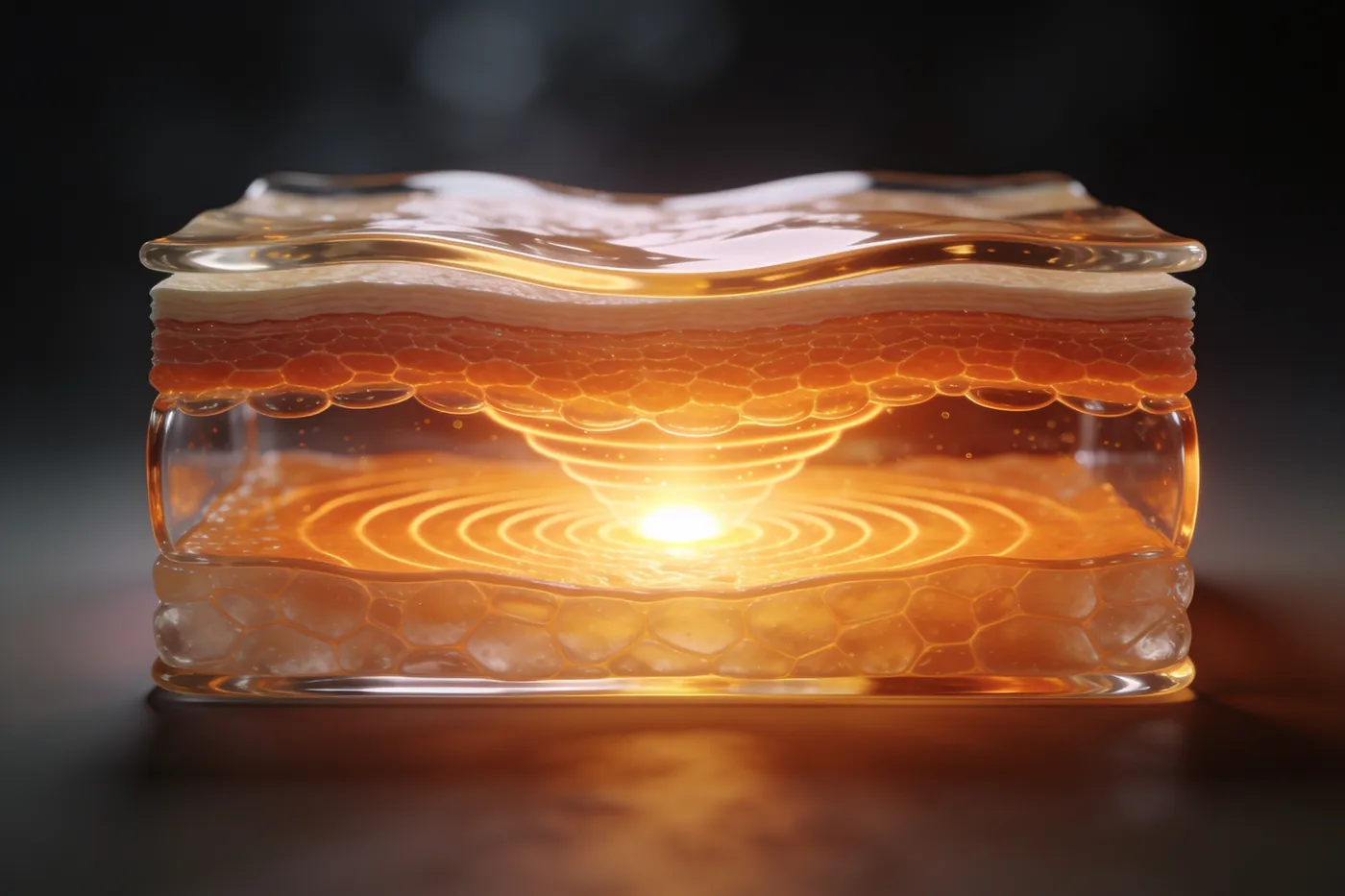
Almost every resurfacing laser in common use shares a hidden assumption: that the way to affect the dermis is to heat the water in it. Water is the chromophore, the tissue warms, and collagen remodels as a downstream consequence of that warming.
675 nm behaves differently. At this wavelength the energy is absorbed preferentially by collagen itself. The structural protein is the target rather than the medium around it, which means the effect can be produced with less energy spread into surrounding tissue.
The DEKA RedTouch Pro delivers it fractionally — through a scanner that lays down microscopic zones of thermal effect under a contact cooling handpiece that holds the epidermis cold throughout. The surface is not ablated. The work happens underneath it.
Dr Sin Yong runs three distinct laser protocols. Patients frequently ask which one is the right choice. The question has no single answer, because they are not competing — they operate at different depths on different targets, and the presentation decides which layer needs attention.
Pigment, inflammation, structure. A plan may draw on more than one of them, and often does. What it should never do is pick a device first and find a reason afterwards.
“At this wavelength the energy is absorbed preferentially by collagen itself.”
Dr Sin YongOn the 675 nm mechanism
Although collagen is the primary absorber at 675 nm, the wavelength also interacts with the vascular component within the dermis. That is the basis for its use in facial redness and as a rosacea laser treatment directed at the vascular presentation.
Some honesty is warranted here. Rosacea is a chronic, relapsing condition. It is managed rather than cured, triggers matter as much as treatment, and a protocol that promises to be rid of it should be treated with suspicion. What a laser directed at the vascular component can do is address one contributor. It does not remove the underlying tendency, and any rosacea treatment in Singapore that suggests otherwise is overpromising.
The clinic also sees a good deal of redness that is not rosacea at all — post-inflammatory erythema after acne, barrier disruption from over-treatment, and reactive skin from aggressive products. Those are different problems with different answers, and sorting out which one you have is the first task.
As a laser acne treatment, the protocol is directed at the inflammatory activity around the follicular unit rather than at the lesion itself. It sits alongside medical management rather than replacing it — a laser does not address the hormonal and follicular drivers that produce acne in the first place, and any plan that ignores those is treating the smoke rather than the fire.
Enlarged pores treatment is worth explaining, because pores are widely misunderstood. A pore does not open and close. What changes its appearance is the collagen and elastic support in the surrounding dermis: when that support weakens, the follicular opening loses its definition and reads as larger. A protocol directed at dermal collagen therefore acts on the support structure rather than on the pore itself. This is why any serious large pores treatment is really a collagen treatment, and why pore appearance and skin laxity tend to move together rather than separately.
The same reasoning covers surface texture. Fractional delivery creates a healing response across a treated field; the tissue reorganises as it repairs.
Because the wavelength acts on collagen directly, and because the epidermis is protected throughout, 少女光 suits a pattern of use that most resurfacing lasers do not. As a skin tightening treatment it is built for periodic maintenance rather than intensive correction — and as a skin rejuvenation treatment it asks less of the skin on each occasion than an ablative approach would.
That is a meaningful distinction in how ageing is approached. Waiting until laxity is established and then treating it aggressively is one strategy. Treating the collagen scaffold periodically, before the loss becomes structural, is another. The second asks less of the skin on each occasion.
It also sits comfortably alongside Dr Sin Yong's structural work — the VF Lift for volumetric lifting, and HIFU or Ultherapy where the objective is lift at SMAS depth. Different layers again.
Vitale M, et al. High-powered 675 nm laser: safety and efficacy in clinical evaluation and in vitro evidence for different skin disorders. Skin Research and Technology, 2024. PMC11359081
DEKA M.E.L.A. RedTouch PRO product specifications, dekalaser.com.
Response to any laser protocol varies with skin type, condition, age and medical history. Suitability is assessed in person, and no device is appropriate for every patient or every presentation.
少女光 is Dr Sin Yong's protocol on the DEKA RedTouch Pro, a 675 nm fractional laser. What distinguishes 675 nm is what absorbs it: most resurfacing lasers are absorbed by water in the tissue, whereas 675 nm is absorbed preferentially by collagen. The energy therefore acts on the dermal collagen structure directly rather than by heating the water around it.
Four things, which is why the protocol suits maintenance rather than a single complaint. Facial redness and the vascular component of rosacea. Inflammatory activity in acne. Enlarged pores and surface texture. And laxity, through the collagen response that follows fractional treatment.
Depth, and target. T2 Frax Radiance works photoacoustically on pigment. R2 Glow works on inflammatory activity at a more superficial level. 少女光 works deeper — the 675 nm wavelength reaches the reticular dermis, roughly 2 to 3 mm, where the collagen scaffold sits. They are not alternatives to one another; they address different layers, and a plan may draw on more than one.
The system delivers energy in a fractional pattern, creating microscopic zones of thermal effect under an integrated contact cooling handpiece that holds the epidermis at low temperature. The epidermal layer is not ablated. Recovery still varies between individuals and is discussed at consultation.
The platform includes a scanning modality developed to extend its use to darker phototypes and tanned skin. Suitability is nonetheless assessed in person, as it is for any laser, and no device is appropriate for every patient or every presentation.
The 675 nm wavelength interacts with the vascular component in the dermis as well as with collagen, which is the basis for its use in facial redness and the vascular presentation of rosacea. Rosacea is a chronic relapsing condition rather than something removed in a course of treatment, and it is managed rather than cured. Assessment comes first.
Pore appearance is largely a function of the collagen and elastic support around the follicular opening. A protocol directed at dermal collagen acts on that support rather than on the pore itself. What changes, and by how much, varies with skin type and the underlying cause of the enlargement.
少女光 is used as an enlarged pores treatment, but the mechanism is worth being clear about. A large pores treatment that targets the pore itself is treating the wrong structure. What determines how a follicular opening reads is the collagen and elastic support in the dermis around it. A 675 nm protocol directed at that support acts on the cause rather than the appearance. How much changes varies with skin type and with why the pores enlarged in the first place, which is established at assessment.
Yes, and that is one of its more common uses here. The 675 nm wavelength acts on dermal collagen directly, so a skin tightening treatment on this platform works on the scaffold rather than by heating the water around it. It reaches the reticular dermis at roughly 2 to 3 mm. Where the objective is lift at a deeper structural plane, focused ultrasound is the more appropriate instrument, and the two are sometimes planned together.
Maintenance is the most common use of 少女光 at the clinic. Because it works on the collagen scaffold without ablating the epidermis, it suits a periodic, preventive pattern rather than an intensive corrective course. Frequency is planned individually rather than sold as a fixed package.
The integrated cooling handpiece is a substantial part of the experience — it holds the skin surface cold while the energy is delivered beneath. Most patients describe warmth. Tolerance varies between individuals and between areas, and comfort is managed during the session.
You do not need to. That is the point of an assessment. The question is which layer the presentation actually sits in — pigment, superficial inflammation, or the dermal collagen scaffold — and that is determined by examination rather than by choosing a device from a menu.
Pico laser for pigment — tighten and tone.
Brightening by calming inflammation, not fragmenting pigment.
The certification and the DEKA platform range.
Assessment across ice-pick, boxcar and rolling scars.
Focused ultrasound lifting at SMAS depth.
Programmes built around consistency rather than correction.
Consultations by appointment at Orchard Road, Singapore.
WhatsApp +65 8023 7170 →