Key facts
- Suits
- Early to moderate laxity of the jawline, under the chin and the neck, with fat neither markedly excessive nor depleted
- Suits poorly
- A hollow midface or temple, a full submental fat pad, or a heavy lower face with redundant skin
- Deciding factor
- Tissue depth above bone over each zone, judged by palpation, not age or skin type
- What differs between types
- Transducer depths and frequency, delivery pattern, imaging, evidence and regulatory clearance
- What does not differ
- A 4D or 7D label and a shot count, neither of which is standardised between makers
- Performed here
- Ultraformer MPT and Ultherapy Prime, both by Dr Sin Yong, chosen after assessment
Who is suitable for HIFU, and what does the assessment look for?
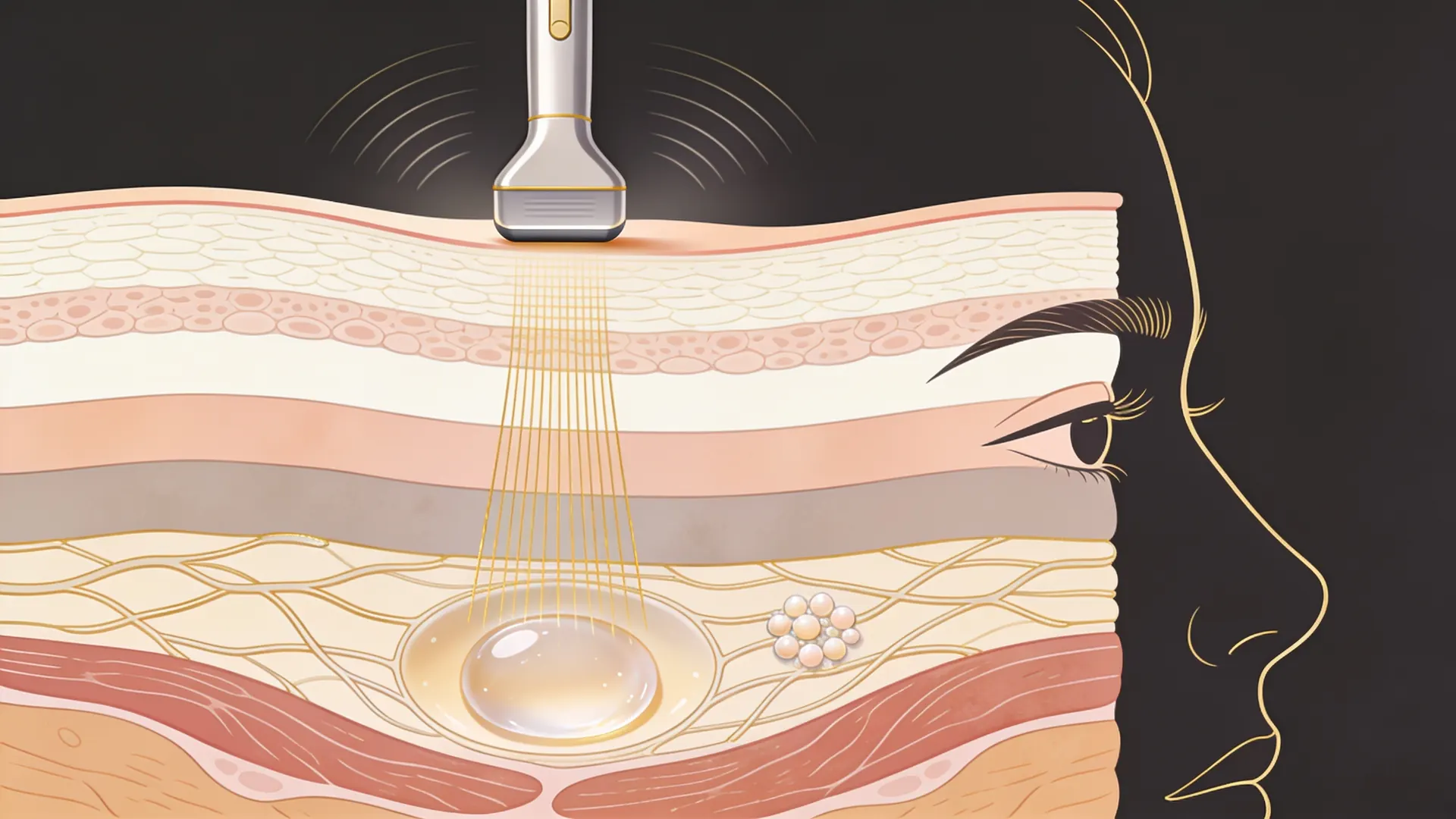
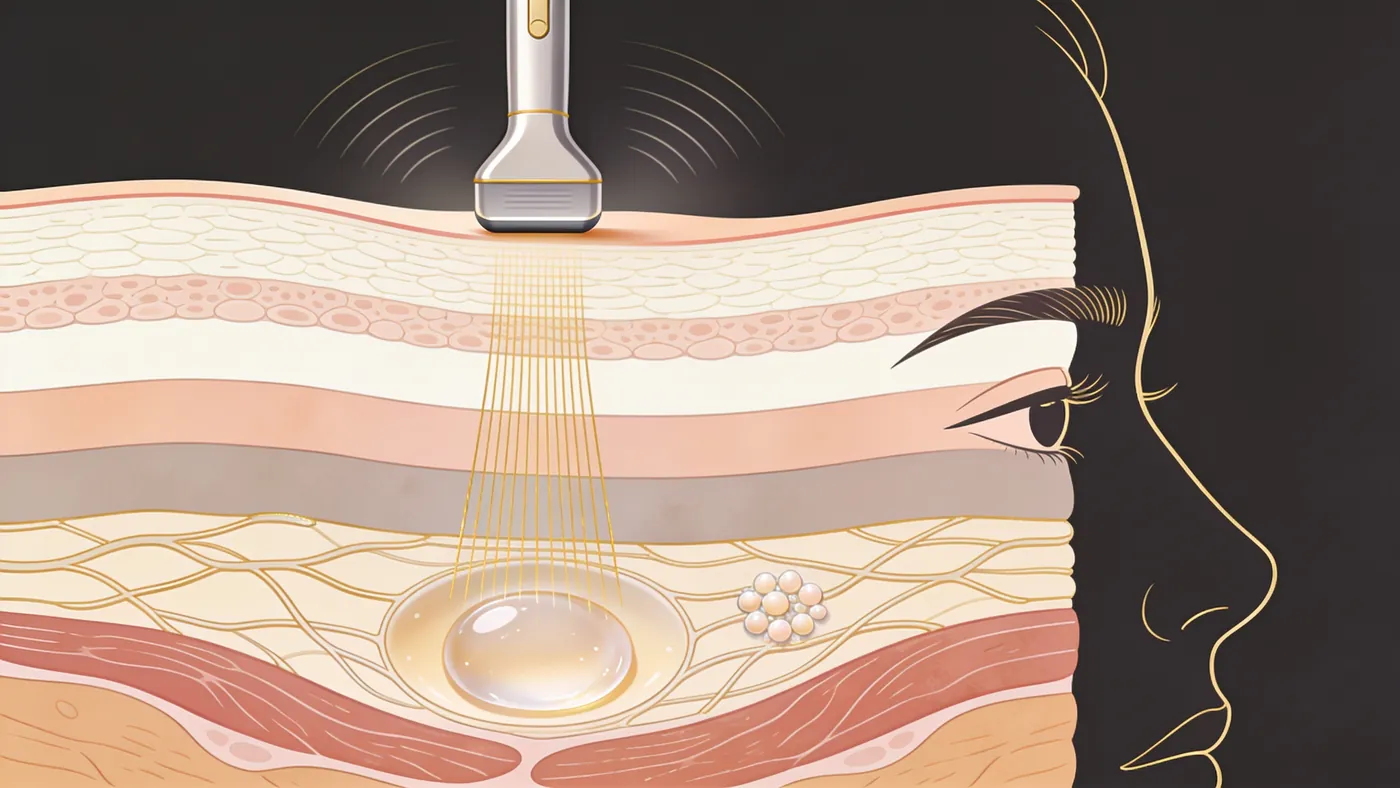
A person is suitable for HIFU when the problem is laxity: skin and the SMAS layer that have loosened in a face whose underlying fat is neither markedly excessive nor depleted, and where there is enough tissue above bone to place the heat safely. That usually means early to moderate softening along the jawline, under the chin and across the neck. The HIFU page explains the mechanism; this page answers the two questions people ask next, whether their own face qualifies and which type of device they should be looking at.
The assessment separates three things that look alike in the mirror. Laxity is tissue that has loosened and folds over the jawline when the chin is tucked. Volume loss is a hollow at the temple or midface that makes the face appear to sag because support has gone. Fat is softness under the chin that stays full however the head is held. Focused ultrasound addresses only the first, so the examination palpates each zone, checks skin recoil and maps where the SMAS is lax against where volume is missing.
Skin type is not the limiting factor. Focused ultrasound is absorbed at depth rather than by melanin in the epidermis, so Fitzpatrick III to V skin, the range most common in Singapore, is assessed on the same grounds as lighter skin: laxity, tissue thickness, implants, previous treatment and medical history.
Who should wait, and who is directed to a different mechanism?
People who should wait include anyone who is pregnant, anyone with active infection or inflamed skin in the treatment area, and anyone whose filler or threads were placed recently in the same plane, until the position of that material has been assessed. Implants or metal near the field and a history of keloid scarring are assessed individually rather than ruled in or out by a form.
Some faces are directed elsewhere from the start. A very lean face with little tissue above bone is treated conservatively or not at all, because heat placed into thin tissue can reach the fat beneath the skin and leave hollowing. Marked volume loss is a question for a biostimulator or filler, not for heat. A heavy lower face with a great deal of redundant skin is beyond what any energy device reaches, and the honest answer may be a thread lift or a referral to a plastic surgery specialist. Where laxity sits alongside fullness, the VF Lift – Vertical Facelift, which runs on Volnewmer monopolar radiofrequency and does not use focused ultrasound, is one of the options discussed.
“HIFU is an umbrella term. The devices differ in transducer design, imaging and clearance; they are not interchangeable.”
Dr Sin YongOn the HIFU Singapore page
Which type of HIFU: what actually differs between the devices?
The devices differ in transducer design, depth control and imaging, and those three things decide how a treatment behaves far more than the name on the handpiece. Every HIFU device converges ultrasound to a focal point so that a small volume of tissue is heated while the surface is spared; what varies is which depths its transducers focus at, at what frequency, how the energy is laid along each line and whether the operator can see the tissue before treating it.
Ultraformer MPT, made by CLASSYS, sets depth by cartridge, with face cartridges at 1.5, 2.0, 3.0 and 4.5 mm, and delivers each line as a train of rapid micro-pulses rather than single shots. There is no imaging: the doctor judges where the focus will land from anatomy and palpation. Ultherapy Prime, made by Merz Aesthetics, is micro-focused ultrasound with visualisation, so the handpiece displays the layers beneath it before each line is delivered, with transducers at 1.5, 3.0 and 4.5 mm. Other Korean platforms such as Shurink and Doublo work on the same principle with their own transducer sets. The Ultraformer MPT page and the Ultherapy page set each one out in detail.
Regulatory clearance and evidence are part of the type question too. The published evidence for focused ultrasound tightening is strongest for the micro-focused systems studied in the literature, and a systematic review of microfocused ultrasound noted that settings and protocols varied widely between studies. Ask whether the device is registered with the Health Sciences Authority as a medical device, which depths will be used where, and who sets the energy.
What separates the HIFU types people compare in Singapore| Type | Depth control | Imaging | Delivery | What the label does not tell you |
|---|
| Ultraformer MPT (CLASSYS) | Cartridges at 1.5, 2.0, 3.0 and 4.5 mm for the face | None; depth judged from anatomy and palpation | Micro-pulsed train along each line | Whether your tissue has the depth for the chosen cartridge |
| Ultherapy Prime (Merz) | Transducers at 1.5, 3.0 and 4.5 mm | Shows the layers before each line is delivered | Lines planned to the image, zone by zone | Whether your face has laxity rather than volume loss |
| Other Korean platforms (Shurink, Doublo) | Set by cartridge, varying by maker | Usually none | Shot or line based, varying by maker | Depth, energy or evidence; each device stands on its own data |
| "4D" or "7D" HIFU | A marketing count, not a depth specification | Not implied by the label | Not implied by the label | Anything standardised; the number differs between makers |
Do 4D and 7D labels or shot counts tell you which type to choose?
No. 4D and 7D are marketing labels used by some device makers, not medical classifications or recognised generations of the technology. The number usually refers to a count of cartridges, delivery modes or handpiece options, and it is not standardised: one maker's 7D is not comparable with another's 4D, and a higher number does not mean deeper or more precise treatment.
Shot counts fail for the same reason. A shot is a unit of the device, not a unit of treatment; on a micro-pulsed platform energy is laid down differently from a shot-based one, so a figure of 300 or 800 does not carry across machines. More lines placed over thin tissue add heat without adding benefit, and the article on HIFU shots explains why the number alone tells you little. The useful comparison is depth, energy per line, imaging and who is holding the handpiece.
How is the type chosen here, and what decides the fee?
Dr Sin Yong performs both Ultraformer MPT and Ultherapy Prime himself, and the assessment decides which suits a given face rather than the patient choosing from a menu. Imaging earns its place where the SMAS sits at an unexpected depth, such as over a thin temple; where anatomy is straightforward, careful mapping and palpation set the depth without it. Energy is adjusted during treatment in response to what you feel, not run from a preset, and the thyroid, the orbital rim and the course of the marginal mandibular nerve are avoided on either device.
Singapore's rules prevent clinics from advertising prices, so no figure appears here and none can be given before examination. What moves the fee is the area treated, the depths used, the number of lines the plan requires and whether HIFU is combined with radiofrequency or laser. A written, itemised quote follows the consultation, and the how we quote page explains what it contains. The consultation can also end with no treatment advised, which is a normal outcome.