Key facts
- A shot
- One focal point of heat at a set depth; a treatment line is a row of them
- Micro-pulsed delivery
- Ultraformer MPT lays energy as rapid pulses along each line, not as single shots
- Depth
- Set by the cartridge: 1.5, 2.0, 3.0 or 4.5 mm on the face; 6, 9 or 13 mm on the body
- Energy
- Varies with transducer frequency, the setting chosen and the device's delivery pattern
- Area
- Jawline, under-chin, neck and brow need different distributions of lines
- Comparison
- A count from one device or clinic does not translate to another
- What matters
- Depth in each zone, energy matched to the tissue and who sets the plan
What is a HIFU shot, and what is a line?
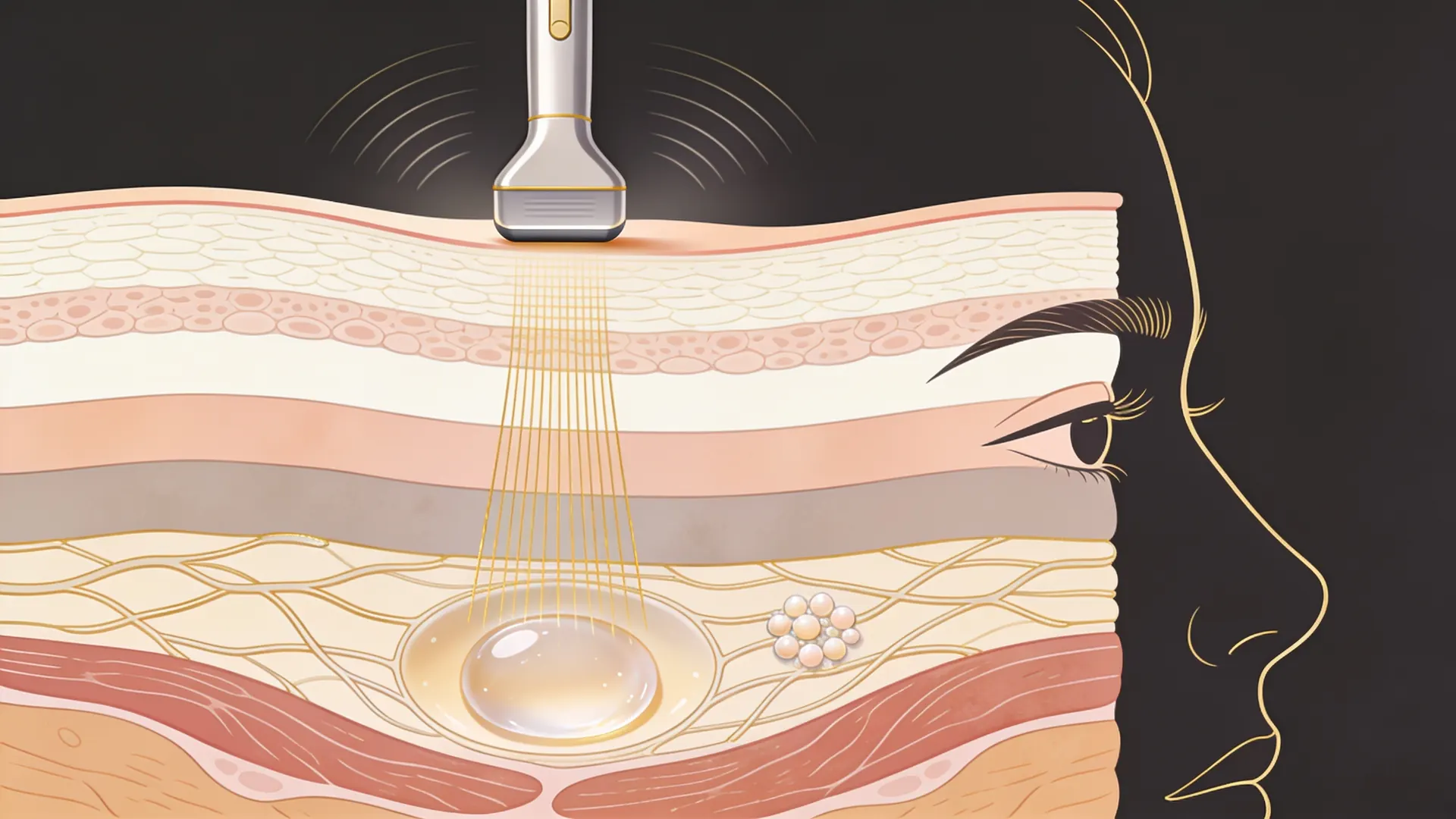
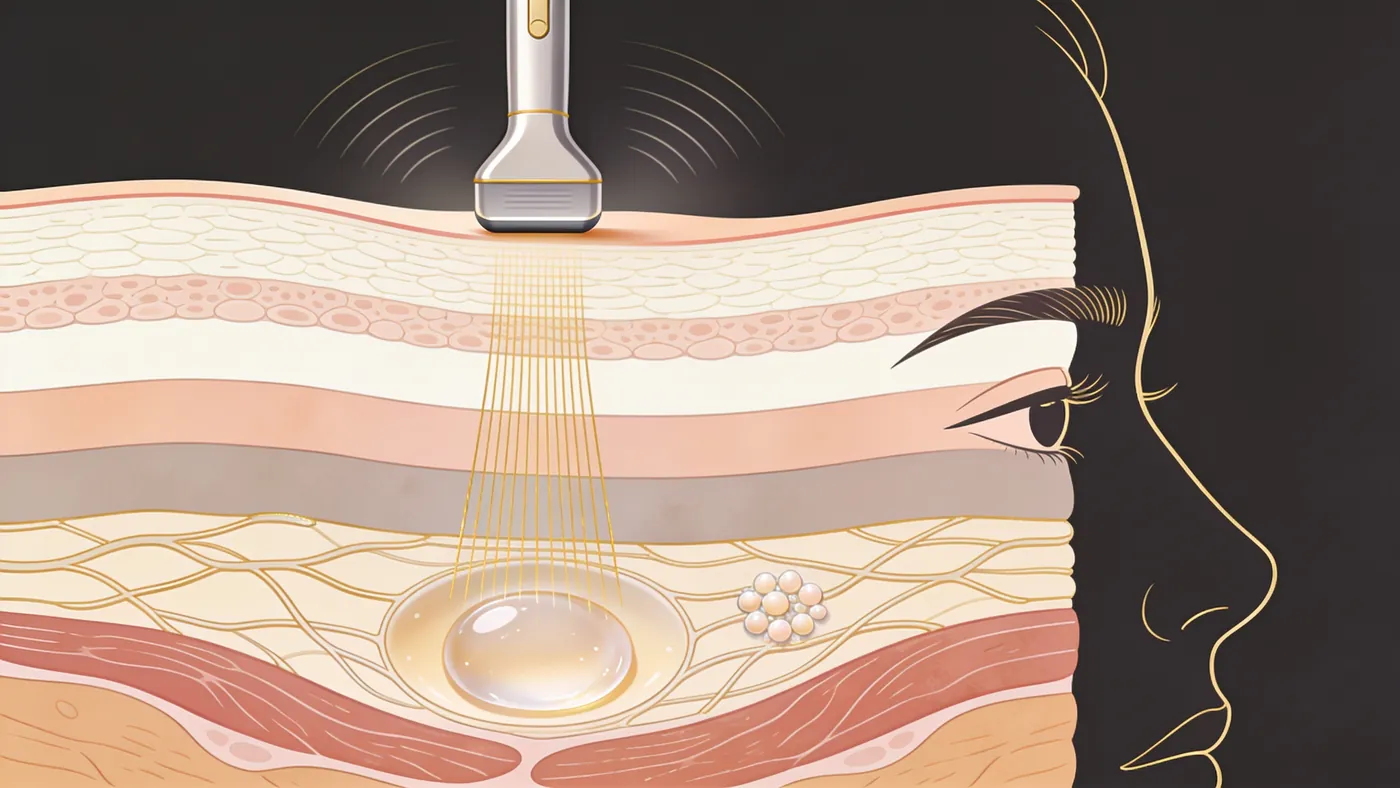
HIFU, or high-intensity focused ultrasound, converges ultrasound at a set depth so that a small point of tissue reaches roughly 60 to 70 °C while the surface is spared. That single point is what older, shot-based devices call a shot. Placed one after another along the path of the handpiece, shots form a treatment line, and the lines make up a treatment map across the face and neck.
Not every platform works this way. On the Ultraformer MPT, MPT stands for micro-pulsed technology: the transducer glides while emitting rapid micro-pulses, laying energy along each line instead of firing one discrete shot at a time. Ultherapy plans its lines against a live image of the tissue. The words shot, line and pulse describe different things on different machines, which is the first reason a bare count cannot travel from one clinic to another. The Ultherapy versus other HIFU platforms comparison sets out the imaging difference.
When a number is quoted, it is worth asking what it counts: points, lines, pulses or total energy, and at which depth. A fair answer names the unit and the depth it applies to.
Does a higher shot count mean a stronger treatment?
No. Total energy depends on the number of points multiplied by the energy at each point, and the energy at each point depends on the transducer, its frequency and the setting chosen. A larger count at low energy and a smaller count at higher energy are different treatments, and a count tells you nothing about either. Strength is also not the aim. HIFU is directed at mild to moderate laxity in specific layers, and beyond the indication, more energy is not more lift.
More lines placed where they are not indicated add heat without adding benefit. In a lean face, extra energy placed into the fat beneath the skin can leave hollowing, and a heavy lower face with a great deal of redundant skin is beyond what any number of shots reaches. These risks are why density and energy are set zone by zone by a doctor, and why a plan quoted as a figure rather than shown as a map deserves a question.
Comfort follows the same logic. Sensation varies with depth and area, and the 4.5 mm cartridge is usually felt more than the shallow ones, most often as a deep warmth or a brief ache over bony areas such as the jawline. Energy is adjusted during treatment in response to your feedback rather than run from a preset, so a count fixed in advance would work against that adjustment.
“The device is the instrument, not the treatment — two clinics with identical Ultraformers can deliver entirely different results, because the lift is in the mapping.”
Dr Sin YongOn why the operator matters more than the badge on the machine
How do cartridge and depth change what a number means?
The cartridge sets the depth, and the depth sets the tissue. On the Ultraformer MPT the face cartridges work at 1.5, 2.0, 3.0 and 4.5 mm and the body cartridges at 6, 9 and 13 mm. The 4.5 mm cartridge, at a lower frequency, reaches the SMAS; the shallower face cartridges, at a higher frequency, work in the dermis. A hundred points in the dermis and a hundred in the SMAS involve different tissue, different sensations and different risks.
Depth is also limited by anatomy. The 4.5 mm cartridge belongs where there is enough tissue above bone, and none of the cartridges is used over the thyroid, the orbital rim or the course of the marginal mandibular nerve. A plan therefore distributes lines unevenly by design: some zones receive several depths, others none. The devices page lists the cartridge ranges and the layer each reaches, and the table shows what else changes the meaning of a count.
Frequency matters as well. On the Ultraformer MPT the shallow face cartridges run at 7 MHz and the 4.5 mm cartridge at 4 MHz, while the body cartridges run at 2 MHz, and a lower frequency reaches deeper. Two devices with the same count can therefore differ both in the depth reached and in how tightly each point is focused.
Why a shot count alone cannot be compared: what else changes the treatment| Variable | What it changes | Why a count misses it |
|---|
| Cartridge depth | The layer heated: superficial dermis, dermis or SMAS | A shot at 1.5 mm and one at 4.5 mm are different tissue |
| Transducer frequency | How deep and how tightly the energy focuses | Shallow and deep cartridges run at different frequencies |
| Energy per shot or line | How much heat each point receives | The same count at different energies is a different dose |
| Delivery pattern | Single shots, or micro-pulses along each line | Platforms do not count their delivery in the same unit |
| Area and tissue thickness | Where lines go and which cartridge is suitable there | Thin and broad faces need different distributions |
Why does the area treated matter more than the total?
A count is an average over very different zones. The jawline, under-chin, neck, cheek and brow differ in tissue thickness, in the nerves nearby and in the depth of the SMAS. A narrow lower face with thin tissue over bone needs a different distribution from a broader face with more depth to work in, and the brow and forehead are treated with the shallower cartridges while the orbital rim is avoided.
That is why the number of lines is an output of the plan rather than a target. It follows the area, the thickness of tissue in each zone, the cartridge depths that are appropriate and the laxity the assessment finds. Where the assessment finds volume loss or a full fat pad rather than laxity, no number of lines is the answer, and a different approach is discussed. The HIFU treatment page sets out how lines are planned.
Earlier treatment changes the map too. Filler or threads recently placed in the same plane, implants or metal near the field and previous energy-device treatments all alter where energy can safely go, so they are declared before the plan is drawn. A count set before these are known is a guess.
Why can 300, 600 or 800 shots not be compared between clinics?
Numbers such as 300, 600 or 800 shots are widely quoted online, usually without the device, the depths, the energy or the area. Two clinics quoting the same number may be using different devices with different delivery patterns, different cartridge ranges and different energy per line. Even on one device, the same count spread across the jawline alone or across the full face and neck is a different treatment. A count can also be quoted per visit or for a whole course, and for one area or several, which changes what it means again.
A lower or higher number may therefore describe a different device, fewer zones, shallower depths or a plan set from a preset rather than by a doctor. Compare what is included: the device and generation, the depths and zones, who performs the treatment and what the review covers. Two quotes for HIFU describe two different treatments unless these match.
Published studies are a reminder that the count is a weak guide. A small study of twenty patients treated in seven facial areas reported physician and patient evaluations that were similar regardless of the number of shots delivered, although it was a single-treatment study and does not settle the question. A systematic review of microfocused ultrasound for facial skin tightening found that device settings, protocols and energies varied between studies and that results declined as laxity increased, so the starting tissue matters as much as any count.
What should you ask instead of how many shots?
Ask which device and generation will be used, and whether it is a medical device registered with the Health Sciences Authority. Ask which cartridge depths will go where, and why. Ask whether tissue thickness is palpated zone by zone, whether the thyroid, orbital rim and nerve courses are avoided, and who sets the energy and holds the handpiece. These are questions of method, and a clinician who can answer them is describing a plan rather than a number.
Ask also what the written quote itemises, and what happens if the face does not need what was proposed. Dr Sin Yong examines first, sets the plan for each face and performs the treatment himself. The Ultraformer MPT page describes the device he uses, and the how we quote page explains why fees follow the plan rather than a count.
Finally, expect gradual change. HIFU works through collagen remodelling over weeks and months, and some early firmness is not the remodelling itself. How much change follows varies with age, skin quality, the degree of laxity, sun exposure and weight change, so no result is promised in advance, whatever the count.