Home›Conditions›Cellulite — Why It Isn't Fat & What the Evidence Supports
Cellulite: Architecture, Not Fat
Medically reviewed by Dr Sin Yong · Last reviewed · 8 min read · Assessed personally by Dr Sin Yong · Jump to questions
Cellulite is not excess fat — lean women have it and most men never will. It is architecture: vertical fibrous bands tethering skin down while fat lobules push up between them. That is why weight loss so often disappoints, and why treatment targets the bands, not the calories.
Global KOL for 14+ device brandsShared his clinical expertise with 500+ doctors across AsiaMBBS (NUS) · MRCS (Edinburgh) · MSc with Distinction (Queen Mary, London) · MSc (Cardiff)Every assessment personally by Dr Sin Yong
Cellulite is a structural pattern, not excess fat: vertical fibrous bands tether the skin down while fat lobules push up between them, which is why lean women have it and weight loss alone often disappoints. Assessment is done standing, grading the dimple pattern and tissue quality, and treatment is directed at the bands, dermis and lobules.
Also called: orange-peel skin, 橘皮组织
In brief
Cellulite is a structural pattern, not excess fat: vertical fibrous bands tether the skin while fat lobules push up between them.
It occurs in lean, fit women because the bands exist regardless of body fat, which is why weight loss often disappoints.
Creams, massage, dry brushing and detox products do not address the fibrous structure.
Key takeaways
Cellulite is a structural pattern, not excess fat: vertical fibrous bands tether the skin while fat lobules push up between them.
It is common in post-pubertal women and occurs in lean, fit people, because the bands exist regardless of body fat.
It is graded on standing assessment of the dimple pattern and tissue quality, which decides which treatment axis leads.
Evidence supports three axes: releasing the bands, firming the dermis with energy, and reducing herniating fat lobules.
Creams, massage, dry brushing and detox products do not address the fibrous structure.
Toxins — 'detox' has no role in a structural condition
Who assesses this
An aesthetic physician — structure-directed assessment, not cream recommendations
Typical first step
Standing assessment of dimple pattern and tissue quality
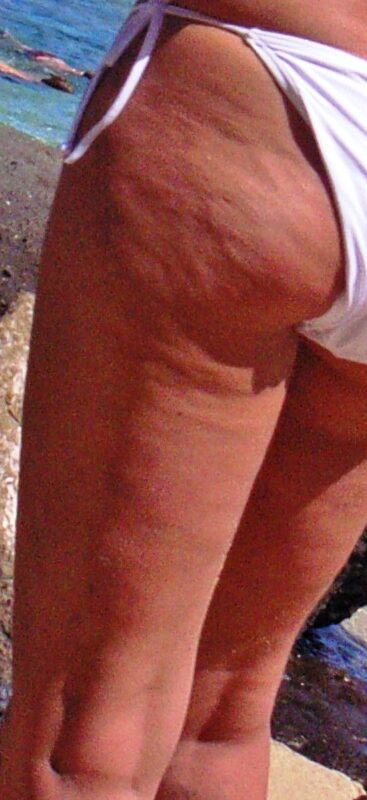
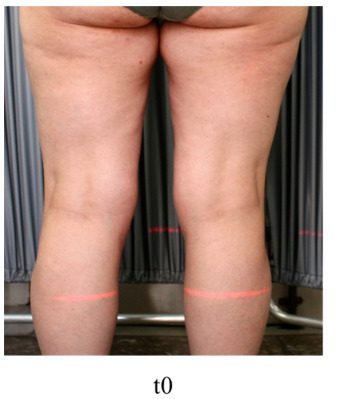
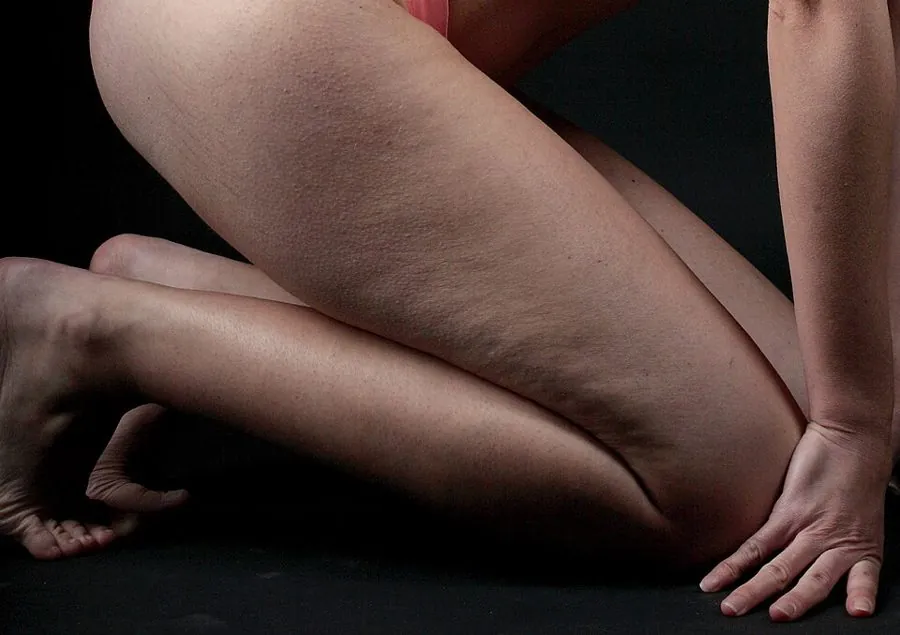
What does cellulite look like?
The dimpled surface pattern of cellulite over the posterior thigh. Image: tata_aka_T from Tokyo, JAPAN, via Wikimedia Commons (CC BY 2.0).Cellulite dimpling of the posterior thighs. Image: Di Guardo A et al., Medicina (Kaunas, Lithuania) (2024), via PubMed Central (CC BY).Dimpling over the thighs. Image: Lanzi, via Wikimedia Commons (CC BY 3.0).
Why is cellulite a structure problem, not a fat problem?
Beneath female skin, fibrous septae run vertically from dermis to fascia, like quilting stitches. Fat lobules bulge upward between the stitches; the stitches hold their points down — the surface reads as dimples. Male septae criss-cross, which is why cellulite is overwhelmingly a female presentation regardless of fitness. Contemporary clinical guides describe exactly this architecture, plus dermal thinning and vascular changes, as the treatment targets [1]. Being lean does not remove the stitches.
What the evidence actually supports
Rational treatment attacks the architecture on three axes: releasing or remodelling the septae, thickening and firming the overlying dermis with energy (radiofrequency, acoustic waves), and reducing the herniating fat lobules where they dominate. A recent systematic review comparing modalities finds meaningful but modality-dependent improvement — and honestly notes no single technology erases cellulite [2]. Dr Sin Yong's cellulite programme and Svelte Touch combine axes per grade; smoothing, not perfection, is the evidence-based endpoint.
What doesn't work for cellulite?
Caffeine creams transiently dehydrate the surface. Massage and dry brushing move fluid — the dimple's anchor is untouched. “Detox” is marketing; there is no toxin in a fibrous band. And weight loss can go either way: smaller lobules bulge less, but looser skin can dimple more. Anyone promising cellulite removal is contradicting the published evidence.
“Cellulite is quilting, not fat. You cannot diet away a stitch.”
— Dr Sin Yong
Dr Sin Yong’s Viewpoint
Cellulite is the most mis-sold condition in aesthetics because it is anatomy — fibrous bands and fat lobules — being marketed as a skincare problem. I treat the structure or I do not treat it at all. Anyone promising smooth thighs from a cream is selling you the tube, not the outcome.
Prefer a preliminary view first? You can also WhatsApp a photo of the area for Dr Sin Yong to review before you decide on a visit.
Which type do you have?
Cellulite grades and look-alikes
Type / look-alike
How to recognise it
What it needs
What does not work
Grade 1 cellulite (mild)
Dimpling visible on pinch or muscle contraction
Grading, then structure-directed assessment
Caffeine or anti-cellulite creams
Grade 2 cellulite (moderate)
Dimpling visible on standing, not at rest
Treatment aimed at bands, dermis or lobules by dominance
Massage and dry brushing
Grade 3 cellulite (marked)
Visible irregularity at rest, with more marked dimples
Combined structure-directed approach, staged and reviewed
Detox products and cleanses
Loose skin after weight loss
Dimpling that appears or worsens as skin loosens
Assessment of skin laxity alongside the dimple pattern
Weight loss alone as the answer
Localised fat excess (bulk, not dimples)
Bulk or bulge without surface dimpling
A different assessment; fat reduction is a separate question
Treating it as cellulite
What does not work, and why
Caffeine creams: they transiently dehydrate the surface and leave the fibrous bands untouched.
Massage and dry brushing: they move fluid, but the dimple's anchor is unchanged.
Detox products: there is no toxin in a fibrous band, so the idea is marketing.
Weight loss alone: smaller lobules bulge less, but looser skin can dimple more, so it can go either way.
When to see a doctor
Dimpling that is new, one-sided or accompanied by pain, redness or swelling
Dimpling that has changed after weight loss or injury
You want a structure-directed assessment before choosing a treatment
You have been offered a cream or device with strong promises and want an independent view
Your next step
1. MessageWhatsApp +65 8023 7170 with what is bothering you. A reply comes from the clinic, not a bot.
2. AssessmentDr Sin Yong examines you himself on Orchard Road, with ultrasound where earlier filler is involved.
3. A plan in writingWhat he would do, what he would not, the fee factors, and the option of no treatment.
Every treatment is performed by Dr Sin Yong personally. Singapore Medical Council registered · invited to share his clinical expertise internationally as a Key Opinion Leader for CLASSYS, DEKA, HIRONIC, FOTONA, ALMA, LUTRONIC and ILOODA · HSA-registered devices · ultrasound-guided correction
“Cellulite means you are overweight or have toxins and poor circulation.”
It is a structural pattern of fibrous bands and fat lobules, present in lean, fit people and unrelated to toxins.
“A cream, massage or dry brushing can smooth cellulite.”
They shift fluid at the surface but leave the fibrous bands that anchor the dimple untouched.
Questions Patients Actually Ask
Why do I have cellulite when I'm slim and fit?+
Because it is architectural, not caloric. The fibrous bands and their pull exist independently of body fat percentage — fitness changes the lobules, not the stitches.
Why don't men get cellulite?+
Their septae run in a criss-cross lattice that resists dimpling, and hormonal fat distribution differs. It is anatomy, not effort.
Does cellulite mean poor circulation or toxins?+
No toxin is involved — that framing sells detox products. Vascular changes accompany cellulite but are part of the architecture story, not a poisoning one.
Which grade am I?+
Grade 1 shows only on pinch or muscle contraction, grade 2 on standing, grade 3 at rest with visible irregularity. Grading at assessment shapes which axis leads.
Can cellulite be permanently removed?+
No technology in the published literature erases it permanently. Meaningful, maintained smoothing is achievable; removal claims are not evidence-based.
Does weight loss improve cellulite?+
Sometimes — smaller lobules protrude less. But looser skin can dimple more, which is why some women see cellulite worsen after major loss.
What causes cellulite?+
Beneath female skin, fibrous septae run vertically from dermis to fascia like quilting stitches, while fat lobules bulge upward between them, producing dimples. Male septae criss-cross and resist dimpling, which is why it is mainly a female presentation. Dermal thinning and vascular changes also contribute. It is anatomy, not toxins, poor circulation or lack of fitness.
Can cellulite be fully removed?+
No technology in the published literature erases cellulite, and any promise of removal contradicts the evidence. Treatment can improve the appearance of the dimple pattern to a degree that varies by modality and person. Smoothing, rather than perfection, is the evidence-based aim, and ongoing maintenance may be discussed at assessment.
Which treatment suits cellulite?+
It depends on grade and what dominates the structure. Decision factors include the dimple pattern, tissue quality, skin laxity, the area, and whether bands, thin dermis or fat lobules lead. The evidence-supported axes are releasing the bands, firming the dermis with energy such as radiofrequency or acoustic waves, and reducing herniating lobules, combined per grade.
How much does cellulite treatment cost in Singapore?+
Cost follows the plan. It depends on the grade and pattern found at standing assessment, the area and number of zones treated, the device and consumables used, how many treatment axes are combined, and how the plan is staged. A written quote is given at consultation, after assessment, and the consultation decides whether treatment is advised at all.