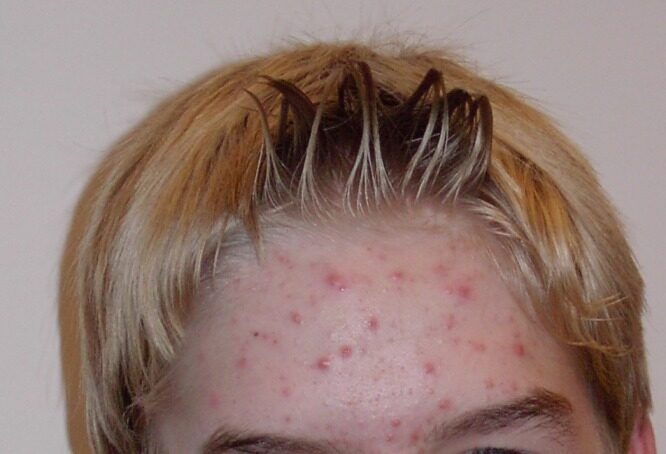
What does post-inflammatory erythema look like?
Why do red marks stay after a pimple heals?
Inflammation is a construction site: to fight a blocked follicle, the skin dilates local capillaries and builds new ones. When the pimple resolves, the vessels do not always demobilise — they linger, dilated and near the surface, reading as a flat pink-to-red mark exactly where the lesion was [1]. The 'Easy as PIE' paper that named the entity distinguished it from both true scarring (structural) and PIH (pigment) precisely because patients and clinics kept treating all three identically — and failing at two of them [1].
PIE, PIH, or a scar? The pressing-glass test
Three leftovers, one minute to sort. Press the mark with a clear glass: PIE blanches — the redness empties out under pressure and refills when you release, because it is blood in vessels. Brown PIH stays exactly as brown — melanin does not move. A mark you can feel as a dip or bump is structural — the territory of true acne scars. Most acne-prone faces carry a mixture, and the treatment plan maps each type to its own tool, because no single device treats all three.
What actually works for PIE?
Vessels answer to vascular treatment. The trial literature supports intense pulsed light and pulsed-dye-class laser for acne-induced erythema — light absorbed by haemoglobin, closing the lingering capillaries [2,3] — the same physics as facial thread vein work, delivered gently across a field of marks. Two sequencing rules protect the result: active acne gets controlled first (or new marks replace treated ones), and settings stay conservative in Singapore skin, where aggressive light work can convert a red mark into a brown one. Time is also honest treatment — PIE fades over months, and for shallow marks patience plus strict non-picking outperforms impatience plus intervention.
What doesn't work for PIE?
Vitamin C, niacinamide and every 'dark mark' serum — pigment agents aimed at a mark that contains no pigment. Aggressive exfoliation — irritation feeds the vascular response you are trying to retire. Picking at the redness — each squeeze re-injures the vessels and resets the months-long clock. And sun on healing marks — UV keeps the inflammatory environment warm; photoprotection is part of the treatment even though PIE is not a pigment problem.
“Press a glass against the mark: if the red empties out, it's blood in vessels, not pigment in skin — and no brightening serum on earth treats a blood vessel.”
— Dr Sin Yong
Dr Sin Yong’s Viewpoint
PIE is the most mis-shopped mark in skincare: red marks treated with brightening serums built for brown ones. The pressing-glass test costs nothing and settles it — if the red blanches, it is vessels, and vessels answer to vascular light, patience and unpicked skin. Knowing which leftover you have is worth more than any product aimed at the wrong one.
Prefer Not to Use WhatsApp?
Use the short enquiry form instead →
Leave your name, mobile number and email and the clinic will contact you directly. No obligation.
Prefer a preliminary view first? You can also WhatsApp a photo of the area for Dr Sin Yong to review before you decide on a visit.