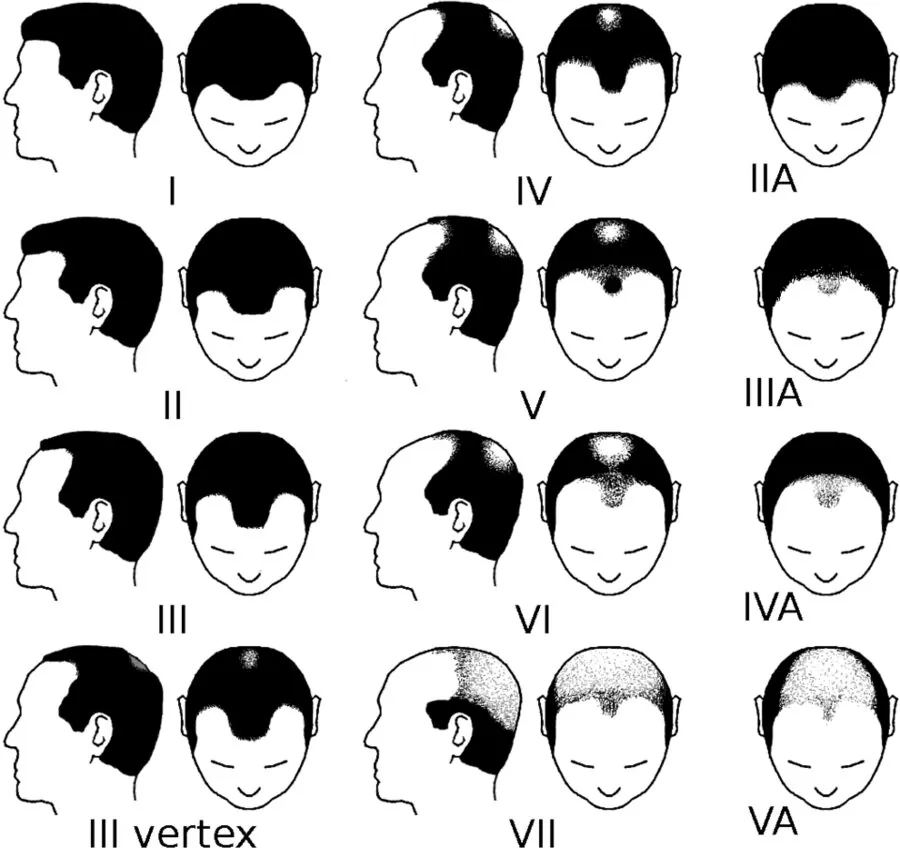
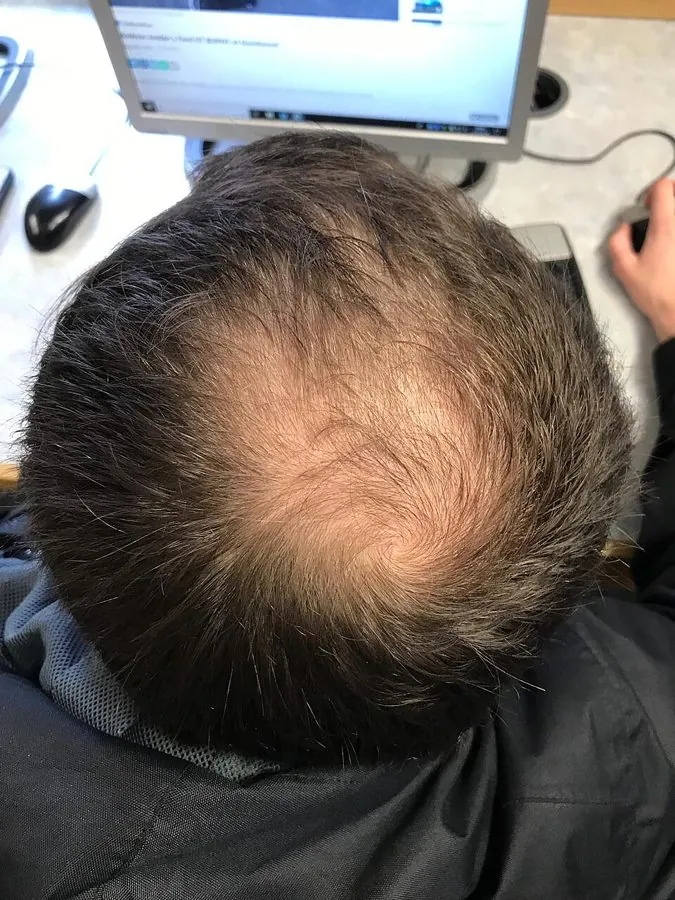
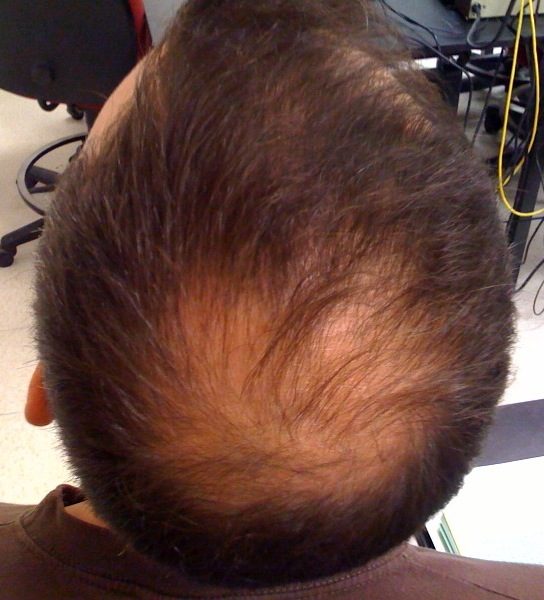
What does androgenetic alopecia look like?
How does pattern hair loss actually happen?
Follicles in the pattern zones — temples and crown in men, the central scalp in women — carry inherited sensitivity to dihydrotestosterone. Under DHT's influence each hair cycle shortens and each regrown hair miniaturises: finer calibre, shorter length, less pigment, until terminal hairs have become barely-visible vellus fuzz and, eventually, the follicle falls dormant [1]. Two clarifications the internet muddles: hormone levels are usually normal — sensitivity is the inheritance, which is why blood tests are often unremarkable — and the pattern's shape is the diagnosis's signature, distinct in men (receding temples and crown) and women (a widening parting behind an intact hairline).
Pattern loss or something else?
The pattern and the timeline separate AGA from its neighbours. Gradual thinning in the classic zones over years is AGA. Diffuse shedding in handfuls after illness, childbirth or crash dieting is telogen effluvium — a different, usually self-limiting process. Coin-shaped bare patches with sharp edges are alopecia areata, an autoimmune event. A receding edge tracking years of tight hairstyles is traction. And a flaky, inflamed scalp thins hair by its own route — see seborrhoeic dermatitis. The conditions coexist happily, and a shedding episode often unmasks underlying AGA — which is why diagnosis precedes every plan here.
What actually works for pattern hair loss?
AGA holds the strongest treatment evidence in hair medicine, codified in the European S3 guideline [1]: topical minoxidil for men and women, oral finasteride for men — both slowing loss and partially reversing miniaturisation in trial after trial — with the guideline framing treatment as long-term, since benefit persists only while treatment continues. Around that pharmacological spine, Dr Sin Yong's programmes layer the clinic arm: medication management, H2LT laser hyperstimulation, Regenera Activa micrograft therapy, and the assessment-led pathways of the male and female hair loss programmes — with restoration planning for advanced zones. The single most consequential variable is the calendar: treatment defends follicles that still exist. Miniaturised is recoverable; bare and shiny mostly is not.
What doesn't work for pattern hair loss?
Waiting a few more years 'to see how bad it gets' — the answer arrives with fewer follicles to save. Caffeine shampoos and biotin as a strategy — supermarket adjuncts against a hormonal mechanism. Scalp massage rituals — circulation was never the problem. Stopping effective treatment once things improve — AGA resumes its timetable within months of the last dose. And for women, assuming nothing can be done because finasteride headlines are male — the female pathway has its own evidence-backed ladder, which is what the assessment maps.
“Pattern hair loss treatment defends the hairs you still have — which is why the best year to start is always the year you first wondered.”
— Dr Sin Yong
Dr Sin Yong’s Viewpoint
Pattern loss is a well-evidenced treatable condition in hair medicine, and the variable that matters most is the calendar. Treatment defends follicles that still exist — the best year to start is the year you first wondered. I would rather have the early consult that seems premature than the late one that is.
Prefer Not to Use WhatsApp?
Use the short enquiry form instead →
Leave your name, mobile number and email and the clinic will contact you directly. No obligation.
Prefer a preliminary view first? You can also WhatsApp a photo of the area for Dr Sin Yong to review before you decide on a visit.