Conditions · Face · Bumps & Growths

Xanthelasma: Yellow Plaques on the Eyelids

Xanthelasma palpebrarum is a soft, flat, yellowish plaque on the eyelid — lipid-laden immune cells accumulated in the skin, most often near the inner corner. It is benign and painless, but it is also the one cosmetic eyelid lesion that doubles as a lipid question: a meaningful share of patients have abnormal cholesterol worth testing for.

WhatsApp Dr Sin Yong →
The Doctor Other Doctors Train With
International KOL & trainer for 14+ device brandsTrained 500+ doctors across AsiaMBBS (NUS) · MRCS (Edinburgh) · Dual UK Masters with DistinctionEvery assessment personally by Dr Sin Yong

Key Facts

What's in it
Foam cells — macrophages loaded with lipid — in the superficial dermis
The signature look
Soft, flat-to-slightly-raised yellow plaque, inner upper eyelid most typical, often symmetric
The lipid link
About half of patients have dyslipidaemia — a lipid panel is standard advice
Natural course
Slowly enlarges over years; essentially never regresses on its own
Removal modalities
Ablative laser (CO2/erbium), surgical excision, chemical agents — matched to size and depth
Recurrence honesty
Recurrence after any modality is well documented — sources report substantial rates over years
Who assesses this
A physician — with a fasting lipid panel as standard advice
Typical first step
Cholesterol check first, removal planning second

What does xanthelasma look like?
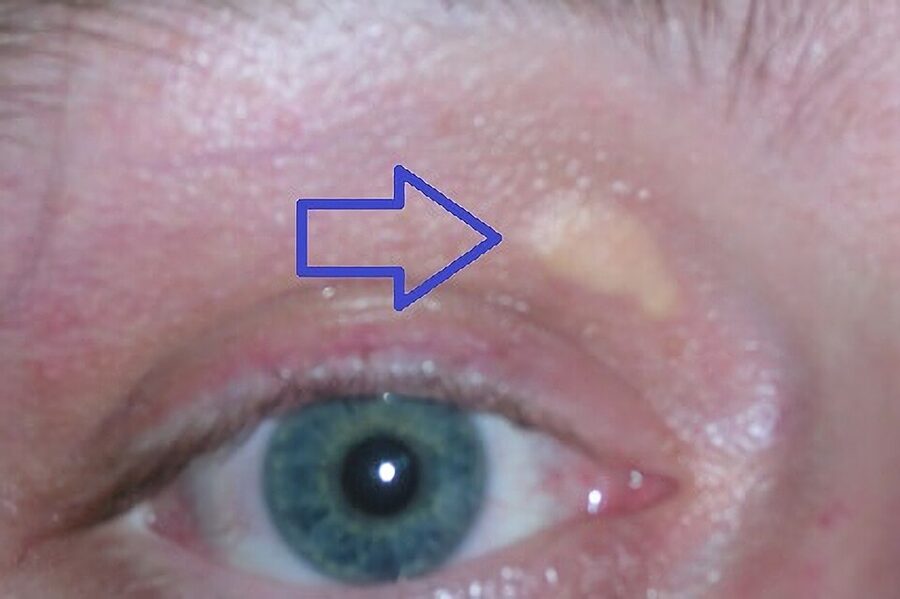
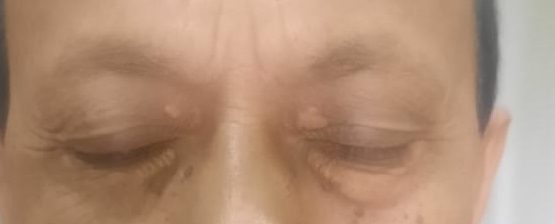
Xanthelasma: a soft yellow cholesterol plaque at the inner upper eyelid (arrow)
Xanthelasma: a soft yellow cholesterol plaque at the inner upper eyelid (arrow). Image: Bobtheowl2 at English Wikipedia, via Wikimedia Commons (CC BY-SA 3.0).

What xanthelasma is

Xanthelasma is the most common cutaneous xanthoma: lipid-filled foam cells settling in the thin skin of the eyelids, forming plaques that creep outward over years [1]. It favours middle age and is more visible in some families than others. It does not threaten vision or health directly — the plaque itself is inert. Its significance is twofold: cosmetic, on the most looked-at anatomy of the face; and metabolic, as a possible flag for lipid abnormalities [1,3].

Does xanthelasma mean high cholesterol?

Roughly half of xanthelasma patients have measurable dyslipidaemia, and the association strengthens when plaques appear young [1,3]. The practical takeaway is simple and cheap: anyone presenting with xanthelasma should have a fasting lipid panel, and where it is abnormal, cardiovascular risk gets assessed properly by their physician. Removing the plaque without asking the lipid question treats the paint and ignores the engine light. Dr Sin Yong raises it in every xanthelasma consult — it is one blood test, and occasionally it is the most valuable thing the appointment produces.

What actually works — and the recurrence truth

Established plaques do not dissolve; removal is physical. The contemporary literature supports ablative CO2 and erbium laser as leading options for most plaques — precise depth control on eyelid skin is the whole game — alongside surgical excision for larger or deeper lesions and other agents in selected cases [2]. On the DEKA CO2 platform (Centre of Excellence), ablation is fractional-precise and staged where plaques are extensive. The honesty clause: recurrence is a documented feature of xanthelasma across every modality — reported in a sizeable fraction of patients over the following years, particularly with untreated lipid abnormalities [1,2]. Managing cholesterol and expectations is part of the treatment plan, not an afterthought. Adjacent eyelid concerns — lid heaviness and dark circles — are assessed in the same sitting when relevant.

What doesn't work for xanthelasma?

Creams, oils and “xanthelasma removal” serums — lipid-laden cells in the dermis are beyond every topical. Home acid kits on eyelid skin — millimetres from the eye, this is scar-and-ectropion territory, and case reports exist to prove it. Squeezing — there is nothing to express. And treating the plaque while ignoring an abnormal lipid panel — the recurrence statistics are written largely by untreated cholesterol.

“Xanthelasma is the rare cosmetic complaint that comes with a blood test attached — remove the plaque by all means, but ask the cholesterol question first.”

— Dr Sin Yong

Dr Sin Yong’s Viewpoint

Xanthelasma is the rare cosmetic complaint where I insist on a blood test before the treatment plan. Half of these patients have lipid abnormalities, and removing the plaque while ignoring the cholesterol is treating the paint and ignoring the engine light. Ask the lipid question first — occasionally it is the most valuable thing the consult produces.

Prefer Not to Use WhatsApp?

Leave your name and mobile number and the clinic will contact you directly. No obligation.

Your details are delivered directly to Dr Sin Yong's clinic team.

Thank you — your enquiry has been received. The clinic will contact you during opening hours (Mon–Sat, 10.30am–8pm).

Prefer a preliminary view first? You can also WhatsApp a photo of the area for Dr Sin Yong to review before you decide on a visit.

Questions Patients Actually Ask

Does xanthelasma mean I have high cholesterol?+

Not necessarily — but about half of patients do, so a fasting lipid panel is standard advice for anyone with these plaques, especially under 40.

Will xanthelasma go away if I lower my cholesterol?+

Established plaques essentially never regress on their own, even with excellent lipid control. Control reduces recurrence risk after removal; it does not erase what is already there.

Is laser removal safe so close to the eye?+

With proper technique, eye protection and depth control, ablative laser removal of eyelid plaques is an established procedure. This is precision work — the reason it belongs in a clinic, not a beauty salon.

Will it come back after removal?+

It can — recurrence over the following years is well documented across all removal methods. Untreated lipid abnormalities and a strong family tendency raise the odds.

Does removal leave a mark?+

Eyelid skin heals remarkably well; with staged, conservative ablation the end result is typically far less noticeable than the yellow plaque. Depth control is what protects against scarring or pigment change.

Are these the same as milia?+

No — milia are firm white keratin pearls; xanthelasma is soft, yellow and flat. Different contents, different removal, same clinic visit to tell them apart.

References

  1. Xanthelasma Palpebrarum — StatPearls (PubMed).
  2. Examining Treatment Strategies for Xanthelasma Palpebrarum: A Comprehensive Literature Review of Contemporary Modalities — Archives of Dermatological Research.
  3. Xanthelasma: An Update on Treatment Modalities — Journal of Cutaneous and Aesthetic Surgery (PMC).
Follow Dr Sin Yong
InstagramTikTokYouTubeThreadsXLinkedInFacebook
Dr Sin Yong · Every assessment personally performed
WhatsApp Enquiry