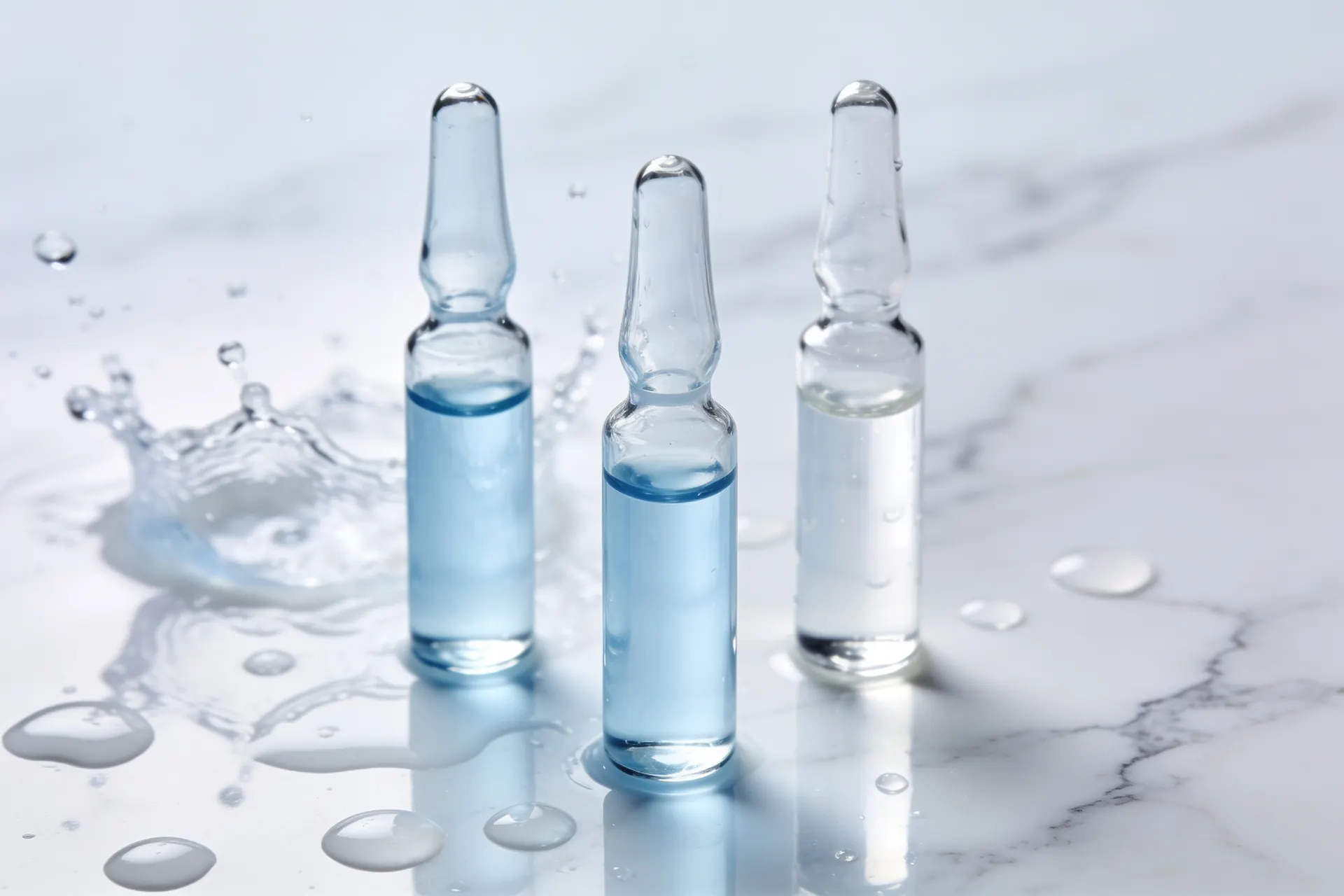
What is a skin booster?
An injectable placed into the dermis to act on hydration, elasticity and texture, the quality of the skin rather than its shape. Unlike a dermal filler it adds no volume and does not change facial contour.
Read the full page →How is a skin booster different from a filler?
A filler occupies space in specific locations to restore or create volume. A booster spreads through tissue and acts on the skin itself. Someone wanting better skin quality is not helped by added volume.
Read the full page →What is the difference between a skin booster and a moisturiser?
Depth. A moisturiser reduces water loss at the surface, through a barrier roughly 10 to 20 µm thick. A booster is injected through that barrier into the dermis. Neither substitutes for the other.
Read the full page →What are the main types of skin booster?
Hyaluronic acid boosters, which hydrate; polynucleotides, directed at repair; and Profhilo, a thermally stabilised hybrid hyaluronic acid that spreads and remodels. Collagen biostimulators are a separate class. None adds volume or lifts.
Read the full page →Is Profhilo a skin booster or a filler?
Not a filler. It is uncross-linked hybrid hyaluronic acid that spreads through tissue rather than holding shape, so it is grouped with skin boosters, though it behaves differently from conventional ones.
Read the full page →Which is better, Profhilo or Rejuran?
Neither, universally. Profhilo suits dehydrated, dull, mildly lax skin; Rejuran (polynucleotides) suits damaged, textured, sensitive or post-acne skin. The choice follows what your skin lacks, which assessment establishes.
Read the full page →What is the difference between PN and PDRN?
PN (polynucleotide) is longer DNA chains that form a viscous gel; PDRN is shorter fragments of the same family. Products built on each are not the same, so ask which you are being offered.
Read the full page →Can I have a polynucleotide booster if I have a fish allergy?
Generally not. People with a fish or salmon allergy are advised to avoid polynucleotide products, because the material is fish-derived. Raise any allergy with the doctor, who can discuss other classes of treatment.
Read the full page →Will I have bumps after a skin booster injection?
Small raised points at the injection sites are expected and settle on their own, more noticeably with polynucleotides than with hyaluronic acid. Redness and occasional bruising are also possible.
Read the full page →Is a water light injection the same as a skin booster?
水光针 is a popular term for hydrating micro-injections, usually of hyaluronic acid. It is one type of skin booster, but the term is used loosely, so ask which product and category is being used.
Read the full page →What are the Bio Aesthetic Points used for Profhilo?
A defined set of injection points per side where Profhilo is deposited rather than spread across the face. They were chosen for vascular safety, sitting away from major facial vessels, and for spread, because the uncrosslinked product diffuses through the subcutaneous layer from each point.
Read the full page →Does Profhilo work on the neck and hands?
Yes, these are among the areas where bio-remodelling is most logically indicated, because there is little volume to restore and a great deal of surface change. It does not lift: a loose neck with platysmal banding or submental fullness is a laxity and fat problem, not a skin-quality one.
Read the full page →What is the difference between Profhilo and Profhilo Structura?
Separate products from the same manufacturer, IBSA. Standard Profhilo is placed in the skin and directed at skin quality. Structura carries more hyaluronic acid and is placed by cannula into the superficial fat compartments of the lateral face, directed at fat-compartment change. Neither is a conventional crosslinked filler.
Read the full page →Will Profhilo fix a flat midface or receded chin?
No. Those are structural volume problems and need something that holds structure, such as a crosslinked filler, or a different approach. Profhilo adds no projection, so placed into that situation it will not produce the change you came for. It suits skin that has lost quality rather than volume.
Read the full page →What is the difference between Rejuran Healer, S and I?
Healer is the facial skin formulation. S is higher in viscosity and placed into and around scarred skin. I is lower in viscosity for the thin periorbital skin. HB combines polynucleotide with hyaluronic acid. All are directed at how skin behaves, not at how much of it there is.
Read the full page →Does Rejuran add volume or lift the face?
No. Rejuran signals the skin to repair; it does not fill, lift or remove pigment. It is directed at texture, fine lines, elasticity and post-acne skin quality. A hollow or deficient contour is a structural problem needing material engineered to stay where it is placed, which no polynucleotide does.
Read the full page →Is Plinest the same as Rejuran?
No. Both are polynucleotide boosters, but they are separate products from different manufacturers: Rejuran from PharmaResearch in Korea and Plinest from Mastelli in Italy. Comparisons rest on each product's own information and evidence, not on the shared label. Rejuran is the polynucleotide used at this practice.
Read the full page →Is a microdroplet hyaluronic acid booster like Skinvive a filler?
No. Products of that kind are hyaluronic acid skin boosters: softer, lightly stabilised hyaluronic acid delivered as many small intradermal micro-injections to hydrate and support the dermis. The class does not restore lost volume, correct a hollow, lift a jowl or treat pigment.
Read the full page →Is Sculptra a skin booster or a filler?
Not strictly. Sculptra is poly-L-lactic acid, a collagen biostimulator: a scaffold placed in the deeper dermis or subdermal plane that prompts your own collagen gradually. It suits diffuse structural loss, not surface dullness, and does not suit lips, tear troughs or fine lines.
Read the full page →Can Sculptra be dissolved if I do not like it?
No. Hyaluronidase breaks down hyaluronic acid only and has no action on poly-L-lactic acid. Misplaced or excessive product is managed with time, targeted treatment of nodules and sometimes procedural options, which is why dilution, plane and dose are planned conservatively and reviewed.
Read the full page →Can skin boosters be used under the eyes?
Polynucleotides and other boosters can act on thin, crepey under-eye skin. They do not correct a tear trough hollow, which is a volume deficit, and they do not reduce herniated fat. Which of these is present is established at assessment before any product is chosen.
Read the full page →Do skin boosters help acne scars or enlarged pores?
Only with one part of the problem. Better hydration and dermal support can make the surface look smoother, but a pore is a structure that no injection shrinks, and tethered scars need subcision and resurfacing matched to the scar type. Boosters sit beside those treatments rather than replacing them.
Read the full page →Who should not have a skin booster?
Anyone with active infection, a cold sore, an acne flare or eczema at the sites, and anyone pregnant or breastfeeding. Component allergy rules out that class: hyaluronic acid for HA boosters, fish for polynucleotides. Autoimmune disease, keloid tendency and blood thinners call for caution rather than refusal.
Read the full page →Why do skin boosters cause bruising and can it be reduced?
Fine needles pass through small dermal vessels, so occasional bruising is expected and settles. Blood thinners, aspirin, fish oil and some supplements make it more likely and should be declared beforehand. Avoiding heat, alcohol and strenuous exercise on the day, and a cool compress, limit swelling.
Read the full page →How often should skin boosters be repeated?
There is no single schedule. Most plans have an initial phase spaced to suit the product, since hyaluronic acid, Profhilo, polynucleotides and PDLLA each work differently, then a maintenance phase timed by how your skin holds the change. The plan is reviewed after each phase rather than fixed in advance.
Read the full page →Can I have a skin booster and laser on the same day?
They are often planned together, but in sequence rather than stacked. A booster addresses the dermal environment, laser addresses pigment and surface texture, and a recent laser or peel changes the timing of a booster. The order and spacing are set at assessment so each does its own job.
Read the full page →Can Profhilo and Rejuran be combined?
They can, sequenced rather than given in one sitting, because hydration and laxity and repair and texture are different axes. Combination should be a ranked decision from assessment, not a default: often one axis clearly dominates and deserves to be addressed first.
Read the full page →What is a needle-free skin booster?
The Deep Synergy Booster replaces the coupling gel in a focused ultrasound session with an ampoule, and the handpiece carries its contents inward, so nothing is injected and there is no needle track to bruise. It cannot place product at a chosen depth, so it is not a substitute for an injectable.
Read the full page →What should I avoid after a skin booster injection?
For the first day or so, leave the area alone: no massage, facials, heavy exercise, saunas or alcohol, and make-up only when told it is reasonable. Gentle cleansing, a plain moisturiser and sun protection are fine. Instructions differ slightly between products and are given on the day.
Read the full page →Is NCTF 135HA, the Chanel injection, a skin booster?
Yes. NCTF 135HA is hyaluronic acid combined with vitamins, amino acids, minerals, coenzymes and nucleic acids, and sits with the hydrating hyaluronic acid boosters. The nickname has no connection with the fashion house. It does not fill hollows, lift or treat pigment, and is not interchangeable with polynucleotides or PDLLA.
Read the full page →