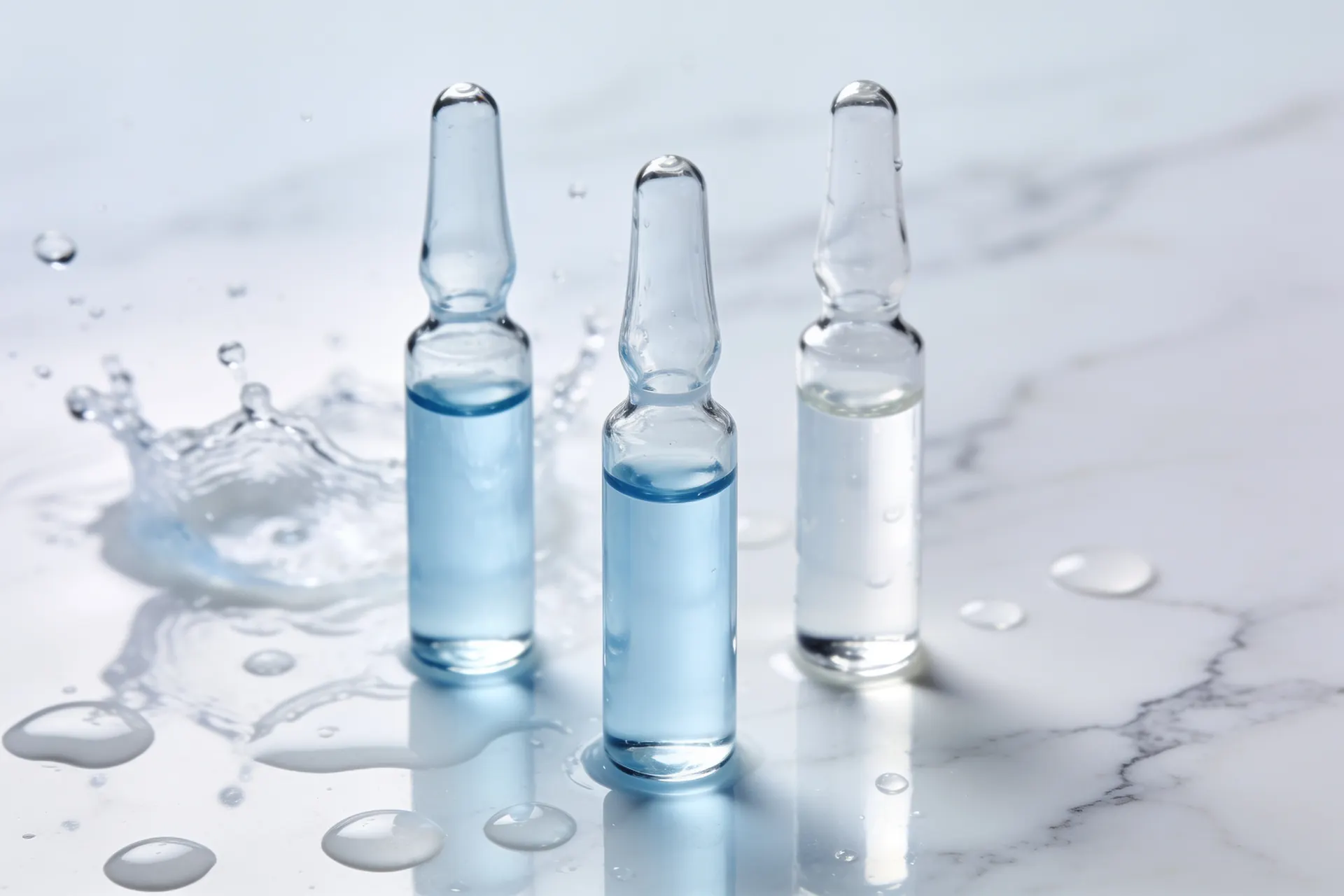
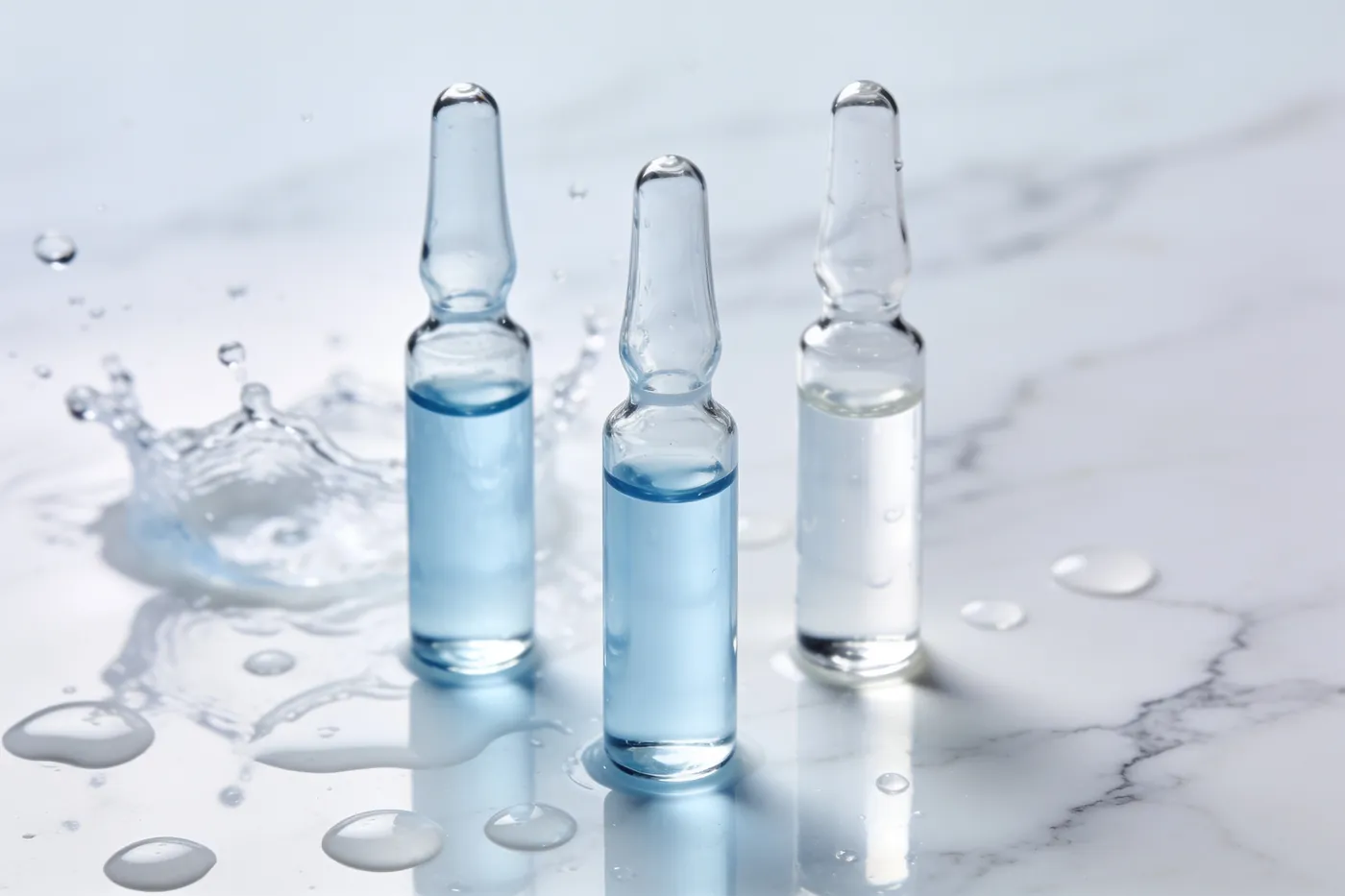
Skin boosters fall into three molecular families. Hyaluronic acid (HA) boosters hold water in the dermis, polynucleotides (PN) are directed at the skin's repair environment, and poly-L-lactic acid (PLLA) is a collagen biostimulator that works on structure through your own collagen. None of them is a filler, and none lifts descended tissue or treats pigment. Which family suits you depends on what the skin is short of, which is decided at examination, not by brand name.
Illustrative. A booster is classed by its molecule and what that molecule does in the skin.
Key facts
Hyaluronic acid (HA)
A water-binding molecule placed in the dermis to hydrate and support the skin
Polynucleotides (PN)
Purified DNA fragments, usually from salmon, directed at the repair environment of the dermis
PLLA
Poly-L-lactic acid scaffold that prompts your own collagen; a biostimulator, not a hydrator
What none of them is
A filler: none lifts descended tissue, clears pigment or shrinks a pore
Reversal
Hyaluronidase acts on hyaluronic acid only; it has no effect on PLLA
Choosing between them
By what the skin is short of, decided at examination, not by brand name
Worth asking
The product name, its category, whether it is HSA-registered and who is injecting
There are three main families, and they are named by their molecule rather than their brand. Hyaluronic acid boosters hydrate the dermis. Polynucleotide boosters, such as Rejuran, are directed at how the skin repairs itself. Poly-L-lactic acid is a collagen biostimulator, sometimes marketed beside boosters although it works on structure rather than surface quality.
The label skin booster is a category, not a product. It covers injectables placed into the skin to change its quality, such as hydration, texture and elasticity, rather than its shape. Under that label sit materials that behave very differently, and nicknames such as the Chanel injection or salmon DNA injection describe a source or a rumour rather than a mechanism.
The useful habit is to translate every name back to its molecule: what is in the syringe, where it is placed and what it is meant to do. The site's guide to skin booster brands explained covers the names; this page covers the molecules behind them.
Because the three families answer different questions, choosing between them is not a ranking. Dull, dehydrated skin is a hydration question; thin, fragile or textured skin is a repair question; a deflated mid-face is a structure question. A family that is right for one of those questions is simply the wrong tool for another, and the skin booster treatment page sets out how the classes are chosen.
The Classes, and How They Differ
A hyaluronic acid skin booster hydrates and supports the dermis. Profhilo® is the bio-remodelling variant — hybrid complexes of high and low molecular weight HA, bonded thermally rather than with a chemical cross-linker, which spread through tissue planes and stimulate rather than fill.
Illustrative. Hyaluronic acid boosters, polynucleotides and needle-free ampoules are different classes doing different jobs.
Polynucleotides work differently again. Rejuran® delivers polynucleotide fragments purified from salmon DNA, directed at fibroblast activity and the extracellular matrix.
PDLLA acts as a scaffold, recruiting the patient's own collagen over the weeks that follow rather than adding material that stays.
Which of these suits you depends on what your skin is actually short of. That is a question for examination.
What does hyaluronic acid do in the skin?
Hyaluronic acid binds water, and when it is placed in the dermis it holds that water in the tissue itself. A plain HA booster is soft and non-cross-linked or lightly stabilised, so it spreads through the skin instead of holding a shape. It is directed at dull, dehydrated skin and fine surface lines, which is a skin quality complaint rather than a structural one.
Fine lines on the neck and chest reflect skin quality. Illustrative image, not a patient.
Profhilo sits inside this family but behaves differently from a conventional booster. It is hybrid HA, bonded thermally rather than with a chemical cross-linker, designed to spread through tissue planes and stimulate as well as hydrate. It remains a skin quality treatment: it does not give projection or structure, and it is separate from Profhilo Structura, which is a different product.
HA is broken down by the body over time, so the skin resumes its own course once the material has gone. That is also why reversal is possible for HA in principle, because hyaluronidase acts on hyaluronic acid and nothing else.
A needle-free route belongs in this conversation only in a limited sense. The Deep Synergy Booster delivers its actives from the surface using focused ultrasound, so it cannot place product at a chosen depth the way an injectable can. Serums sold as boosters for home use are cosmetics, and large molecules cross intact skin poorly, so they are not the same intervention as an injected material.
“A skin booster treats the quality of the skin. A filler occupies space. Confusing the two is the most common error patients arrive with.”
Dr Sin YongOn the difference between a booster and a filler
NCTF 135HA, the 'Chanel injection': what is it?
NCTF 135HA is a hyaluronic acid skin booster combined with a mixture of vitamins, amino acids, minerals, coenzymes and nucleic acids. 'Chanel injection' is a nickname used in parts of Asia; the product has no connection with the fashion house of that name, and the nickname says nothing about what it does.
It is made by Fillmed, a French laboratory once known under the Filorga name. Its hyaluronic acid is non-cross-linked. This means the chains are not bound together, so it hydrates rather than adds volume. It is placed in the upper layer of the skin, the superficial dermis. This is done with many fine micro-injections or a needling technique, in the manner of mesotherapy.
In the classes described above, it sits with the hydrating hyaluronic acid boosters. It is directed at dull, dehydrated skin and fine surface lines. It does not fill hollows, lift descended tissue or treat pigment, and it is not interchangeable with polynucleotides or PDLLA, which act through different mechanisms.
Small raised points, redness and occasional bruising are expected afterwards and settle on their own. Whether a multi-ingredient booster of this kind suits your skin, or whether another class would serve it better, is decided at assessment rather than by the name.
How are polynucleotides different from HA?
Polynucleotides are directed at repair rather than hydration. They are purified DNA fragments, usually from salmon, placed into the dermis by micro-injection. Purification means what is injected is the polymer, not genetic information. The literature describes an influence on fibroblast activity and the extracellular matrix, which is why they are considered for texture, fine lines and thin, crepey skin.
The terms PN and PDRN are not synonyms. PN refers to longer chains and PDRN to shorter fragments of the same family, and products built on each differ in concentration, viscosity and intended use. Rejuran is the polynucleotide product used at this practice, and it is registered with Singapore's Health Sciences Authority as an injectable medical device.
Practical differences show on the day. Small raised points at the injection sites occur with every booster, but they tend to be more noticeable at first with polynucleotides. Because the material is fish-derived, a fish or salmon allergy is raised before any polynucleotide is considered.
How each family is judged also differs. An HA booster may give a hydrated look soon after treatment, whereas collagen-directed families such as polynucleotides and PLLA work gradually, so their effect is judged later rather than in the first days. Laboratory findings explain the idea behind a product, but they are not a prediction of what an individual's skin will do.
Skin booster families compared by molecule
Family
What it does
What it cannot do
Who it tends to suit
Hyaluronic acid booster
Hydrates and supports the dermis
Add volume, lift tissue or treat pigment
Dull, dehydrated skin with fine surface lines
Profhilo (hybrid HA)
Spreads through tissue planes; hydrates and stimulates
Give projection or structure like a filler
Early crepey skin quality, face, neck and hands
Polynucleotides (PN)
Directed at dermal repair and the extracellular matrix
Add volume, lift or remove pigment
Thin or textured skin where repair is wanted
PLLA biostimulator
Prompts your own collagen around a scaffold
Hydrate the surface; it cannot be dissolved
Diffuse structural loss, with patience for gradual change
Dermal filler (for contrast)
Occupies space to restore volume or contour
Improve the quality of the skin itself
Hollows and contour loss
Where does PLLA fit, and why is it different?
PLLA is a scaffold, not a hydrator. Poly-L-lactic acid microparticles sit in the deeper dermis or subdermal plane, and fibroblasts respond by laying down new collagen over time. The change is gradual and structural, which is why PLLA, along with PCL and calcium hydroxylapatite products, is grouped as a collagen biostimulator and not as a skin booster.
The planning consequence is the important one. PLLA cannot be dissolved with hyaluronidase, so dosing is conservative and staged, and a misplaced or overdone product can only be managed while it biodegrades. It is aimed at diffuse volume loss and firmness in the mid-face, temples and jawline, not at surface dullness, and it does not suit lips, tear troughs or fine lines.
The full discussion, including the products used and how correction is approached, sits on the collagen biostimulators page. For a face with both crepey skin and a deflated mid-face, the booster and the biostimulator do different jobs and are sometimes sequenced, with the order decided at assessment.
Skin booster classes compared: molecule, placement, purpose and who should avoid
Skin booster is a family name, not a single product, and the classes differ in what they are made of, how they are placed and what they are for. The table lays them side by side, including two items that are often grouped with boosters but are not the same thing: a collagen-stimulating biostimulator and a topical exosome product. This page counts PDLLA among the booster classes because it is placed into the skin to act on skin quality, but it behaves as a biostimulator, which is why it is listed with PLLA here. Which class suits you is decided at examination, by what your skin is short of, not by brand name.
Skin booster classes compared by molecule, placement, purpose and who should avoid
Class
Molecule class
How placed
What it is for
Who should avoid
Hyaluronic acid (Profhilo-type)
Hyaluronic acid; Profhilo uses thermally bonded high and low molecular weight chains
Fine injections that spread through tissue planes
Hydration, dermal support and early loss of firmness
Allergy to hyaluronic acid or lidocaine; infection or acne flare at the sites
PN or PDRN (Rejuran-type)
DNA-derived polymers, purified from salmon in Rejuran; PDRN fragments are shorter
Many small injections into the dermis, with bumps at first
Thin, fragile skin and texture where repair, not volume, is wanted
Fish allergy; infection at the sites; pregnancy or breastfeeding
PLLA or PDLLA biostimulator (not a booster)
Poly-lactic acid polymers acting as a scaffold for the body's own collagen
Injected by a doctor at a depth chosen for the product
Gradual change in firmness and texture, judged later
Allergy to a component; infection; pregnancy; bleeding tendency needs caution
Exosome (topical)
Extracellular vesicles of roughly 30 to 150 nm, from cell culture or plants
Applied to the skin surface, usually after laser or microneedling; not injected
An adjunct after a procedure; the human evidence is early
Open or infected skin; allergy to an ingredient; expecting a stated result
Which type suits which skin, and who should wait?
The family follows the finding. Dull, dehydrated skin with fine surface lines points to hyaluronic acid. Thin, fragile or textured skin where repair rather than volume is wanted points to polynucleotides. Diffuse structural loss points away from boosters altogether, towards a biostimulator or a filler, and that is a different conversation.
A booster is deferred when there is active infection, a cold sore, an acne flare or eczema at the injection sites, and in pregnancy and while breastfeeding. It is not used in anyone allergic to a component: hyaluronic acid, or fish for polynucleotides. Caution rather than refusal applies to autoimmune disease, a keloid tendency, a bleeding tendency or blood-thinning medicines, and a recent laser or peel changes the timing.
No booster is the right category when the main concern is a hollow, descended tissue, a tethered scar or pigment. Boosters address none of those, whatever their name, and a doctor who explains that is protecting you from the wrong treatment.
Boosters are often planned alongside other work rather than instead of it. Where pigment is the presentation, a laser approach applies; where the problem is descent, energy-based lifting is the relevant tool; where scars are tethered, subcision and resurfacing are matched to the scar type. A booster may sit beside any of these to support skin quality, but it does not substitute for them.
Do skin boosters actually work? What the studies measured
Studies of skin boosters measure specific features of skin quality, not how a face looks to you in the mirror, and the distinction is worth keeping in mind. A 2023 systematic review of injectable hyaluronic acid for facial skin quality included 13 clinical studies and described what they measured: hydration, firmness, brightness, texture, radiance and elasticity. The authors described the evidence as promising, noted that treatment with hyaluronic acid alone was reported to do better than combination cocktails, and called for larger randomised trials. That is a statement about measured skin-quality features in the studies reviewed, not a prediction for an individual face.
The evidence for polynucleotides is thinner. A 2024 systematic review of polynucleotides in aesthetic medicine found nine studies that varied in design, sample size and outcome measures, and none achieved full marks on critical appraisal. Its authors judged the potential promising but noted limited agreement on optimal use and asked for rigorous, high-quality trials. A third review compares polynucleotides with PDRN, explaining that they differ in fragment length and in how they act. Taken together, boosters have been studied for skin-quality measures and the quality of that evidence varies. The reviews are about skin quality, not about volume, lift or pigment, which is why no claim is made about those here.
What are the risks, and when should you call?
Every booster is an injection and carries injection risks. Small raised points, redness, swelling, tenderness and bruising are expected and settle on their own. Less commonly there are lumps where product sits unevenly, a bluish tint where HA lies too close to the surface, a flare of cold sores, or infection.
Delayed inflammatory reactions, appearing as tender swelling after a period, are rare, as are allergic reactions. Any injectable carries a small risk of product entering a blood vessel; with fine superficial placement it is uncommon, but pain, blanching or dusky skin after treatment needs prompt attention. Increasing swelling, heat or pain, rather than settling, is a reason to call the clinic the same day.
Risk is reduced by choosing the family for the skin, sterile technique, correct depth for each product, and treatment by a doctor who can manage a complication. The page on complication care sets out what to do if something feels wrong.
What determines the fee for a skin booster?
Singapore rules prevent clinics advertising prices, so this page gives factors rather than figures. The fee follows the plan: the family of booster indicated, the area treated, whether one family or several are combined, and how the plan is staged over time.
The same complaint can have different causes, so a figure quoted before assessment would not reflect your skin. A written quote is given at consultation after examination, before anything is agreed, and the consultation also decides whether a booster is advised at all. How quotes work is explained on the how we quote page.
Hyaluronic acid boosters, which hydrate; polynucleotides, directed at dermal repair; and PLLA, a collagen biostimulator that works on structure. Profhilo is a hybrid hyaluronic acid. None is a filler, and none lifts descended tissue.
The fee depends on the family of booster indicated, the area treated, whether families are combined and how the plan is staged. Singapore rules prevent clinics advertising prices, so no figures are given here. Dr Sin Yong gives a written quote at consultation, after examination.
It is worth considering when the complaint is skin quality, such as dullness, dehydration, fine lines or thin texture, and you accept gradual, quality-focused change. It is a poor fit if the concern is a hollow, descent or pigment, which boosters do not address.
No duration can be promised. HA is broken down by the body over time, while polynucleotides and PLLA rely on your own tissue response, which varies between people. Plans are reviewed after each phase, and the interval is set by how your skin holds the change.
They add no volume and do not lift, so they cannot replace a filler or an energy-based lift. Small raised points, redness and bruising are expected; lumps, a bluish tint, cold sore flares and infection are less common. Several visits may be planned.
Neither, strictly. PLLA is a collagen biostimulator: a scaffold that prompts your own collagen gradually. It cannot be dissolved with hyaluronidase, so it is planned conservatively and suits diffuse structural loss rather than surface dullness.
Sometimes. Combining two boosters of the same family rarely adds much, but families that do different jobs can be planned together or in stages when the examination shows both jobs need doing. The order and spacing are decided at assessment.
References
Polycomponent mesotherapy formulations for the treatment of skin aging and improvement of skin quality. Clinical, Cosmetic and Investigational Dermatology, 2015. source
Consensus report on the use of PN-HPT (polynucleotides highly purified technology) in aesthetic medicine. Journal of Cosmetic Dermatology, 2021. source
Infosearch: register of health products and medical devices. Health Sciences Authority, Singapore, 2026. source
Skin Booster Types and Brands Explained — NCTF 135HA, Restylane Skinboosters, Profhilo, Rejuran and Plinest sorted by category: what each type of skin booster is …
Polynucleotide Skin Booster: PN vs PDRN — Polynucleotide (PN) and PDRN boosters are purified salmon DNA fragments. How they differ from HA boosters and biostimula…
Skin Whitening Supplements: The Evidence — Glutathione pills, tomato carotenoids and tranexamic acid tablets: what the evidence shows, how HSA regulates supplement…