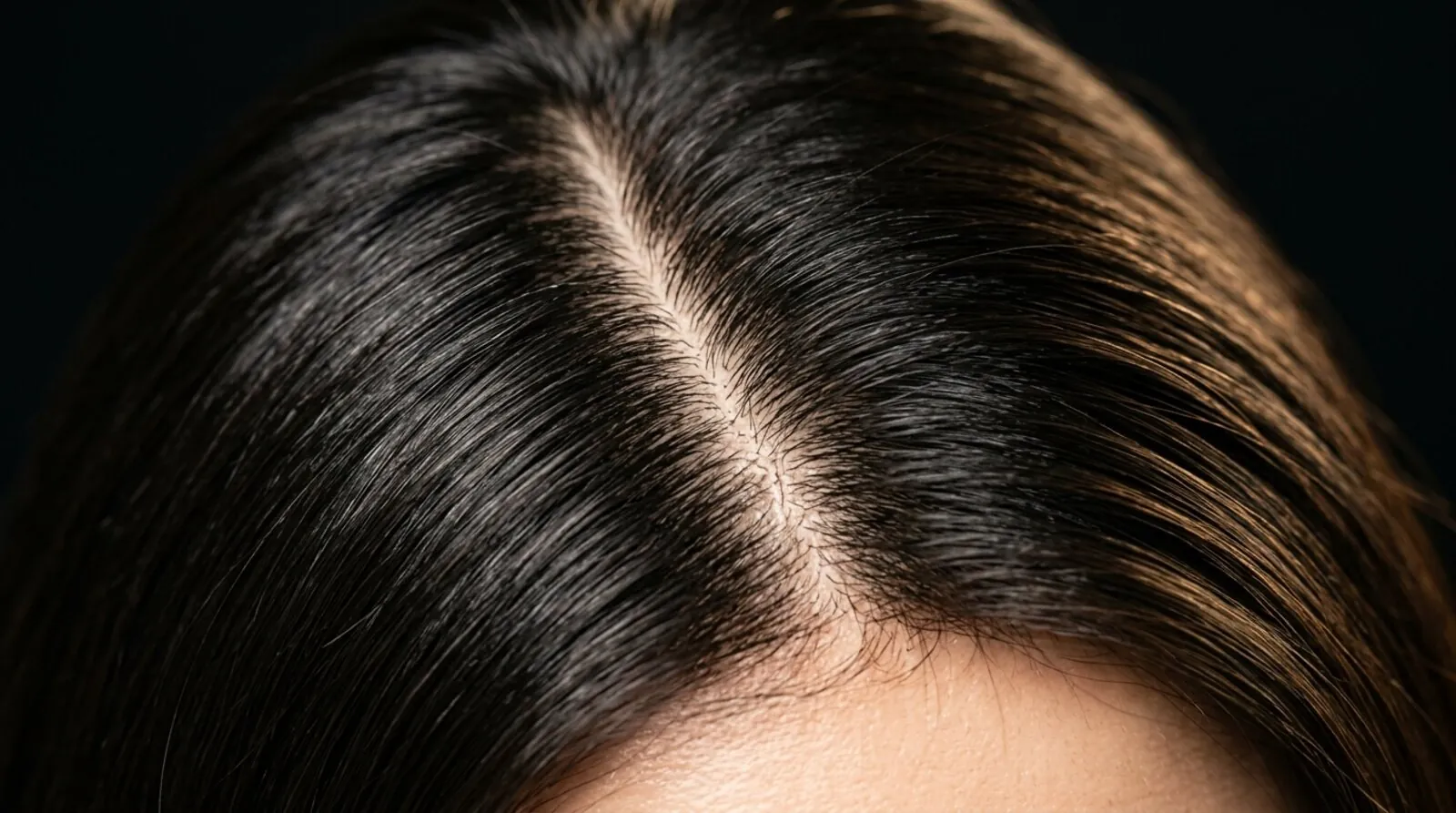
An autologous micrografting hair loss treatment in Singapore, used for both male and female pattern loss. Tissue is taken from the patient's own DHT-protected scalp, processed into a micrograft suspension, and returned to the thinning area — all within a single session.
Before any discussion of treatment, the pattern and stage of hair loss need establishing. This is not administrative. Androgenetic alopecia is progressive, and follicles pass through miniaturisation before they are lost altogether. A follicle that is miniaturising can still respond. One that has gone cannot.
Staging tells you which of those you are dealing with, and therefore what any hair loss treatment can realistically be expected to do. This applies equally to male hair loss treatment and to female hair loss treatment in Singapore. Two standard classifications are used, one for each pattern.
“Staging is not paperwork. It tells you how many follicles are still there to work with, and that decides what is realistic.”
Dr Sin YongOn assessing hair loss
The Norwood scale is the standard classification for male hair loss, and the reference point for any male hair loss treatment in Singapore. It runs from Type I to Type VII and describes a characteristic progression: recession at the temples, then loss at the vertex, then the merging of the two.
| Stage | What it describes |
|---|---|
| Type I | No recession, or minimal recession at the hairline that falls within normal adult variation. |
| Type II | Slight symmetrical recession at the temples. The frontal hairline begins to take on a triangular shape. |
| Type III | The first stage regarded as clinically significant balding. Deep temporal recession, symmetrical, forming an M, U or V shape. |
| Type III vertex | Temporal recession as in Type III, with loss additionally at the vertex — the crown. |
| Type IV | More pronounced frontal and temporal recession, with a larger area of vertex loss. A bridge of hair separates the two regions. |
| Type V | The bridge between the frontal and vertex areas narrows and begins to break down. |
| Type VI | The bridge is lost. The frontal and vertex areas of loss have merged into a single region. |
| Type VII | Only a band of hair remains around the sides and back of the scalp. |

Type III is generally regarded as the first stage of clinically significant balding. The earlier the stage, the more miniaturising follicles remain, and the more scope any treatment has to work with.
Female hair loss treatment in Singapore begins from a different pattern, which is why applying the Norwood scale to women misses what is actually happening. Where male loss recedes, female loss diffuses — and the frontal hairline is typically preserved throughout.
| Grade | What it describes |
|---|---|
| Grade I | Perceptible thinning over the crown, with the frontal hairline preserved. Often first noticed as a widening central parting rather than as recession. |
| Grade II | Pronounced widening of the central parting, with a visible decrease in density across the crown. |
| Grade III | Diffuse thinning across the crown, with the scalp readily visible through the remaining hair. The frontal hairline typically remains. |

The usual first sign is a widening central parting rather than a receding hairline. Women also present more often with non-androgenetic causes — thyroid dysfunction, iron deficiency, telogen effluvium after childbirth or illness — which behave differently and are excluded before pattern loss is assumed.
The procedure rests on a straightforward observation: not all scalp follicles are equally affected by DHT. Those at the back and sides — the occipital and retro-auricular scalp — are comparatively protected, and that region is well vascularised. It is the same anatomical fact that makes hair transplantation possible.
Three 2.5 mm punch biopsies are taken from that protected area under local anaesthetic. The tissue is then mechanically disaggregated and filtered using Rigenera® technology, producing micrografts of approximately 80 microns.
What results is a suspension containing progenitor cells, signalling factors and extracellular matrix — all derived from the patient's own tissue. This is injected into the thinning regions of the scalp as a scalp treatment for hair loss directed at the follicular environment, with the aim of supporting hair regrowth from follicles still present.
Donor and recipient are the same person, within one session. Nothing foreign is introduced.
This is not a hair transplant. A transplant relocates intact follicular units, and the moved hairs are the result. Regenera Activa moves no follicles. It introduces a cellular suspension intended to act on follicles already present in the thinning area. Different procedures, different situations — and sometimes used together.
Nor is it accurately a stem cell treatment, though it is often described that way. The suspension contains progenitor cells, which are more restricted in what they can become than stem cells. The distinction matters because the looser description promises more than the procedure delivers.
Any hair loss treatment Singapore patients consider has to start from one fact: androgenetic alopecia is progressive, and no single approach halts it outright. A considered plan usually draws on more than one route.
Minoxidil and finasteride act on follicular perfusion and on the conversion of testosterone to DHT respectively — the circulation and the hormonal driver. Laser therapy is directed at scalp perfusion and the follicular environment. Micrografting acts through a third route again.
Which combination of hair regrowth treatment applies to you follows from the assessment, the stage identified, and your own circumstances and preferences.
Response to any hair loss treatment varies with the stage of loss, the cause identified, age, medical history and adherence to the plan. Suitability is assessed in person, and no treatment is appropriate for every patient.
Treatment is planned individually, so cost follows the plan rather than a fixed list. Four things shape it:
A figure quoted before assessment would not reflect your presentation. Cost is set out clearly at consultation, before anything is agreed.
Role of Autologous Micrografting Technology through the Rigenera® System in the Treatment of Androgenetic Alopecia. Skin Appendage Disorders, Karger. karger.com
Regenera Activa is an autologous micrografting treatment for hair loss. Three small 2.5 mm punch biopsies are taken from the occipital scalp, mechanically disaggregated and filtered to produce a suspension of progenitor cells, signalling factors and extracellular matrix, which is then injected into the thinning areas. Because the tissue comes from the patient, donor and recipient are the same person within one session.
No. A hair transplant moves intact follicular units from a donor area to a recipient area, and the transplanted hairs are the result. Regenera Activa does not move follicles. It introduces a cellular suspension intended to act on follicles already present in the thinning area. The two are different procedures answering different situations, and in some cases they are used alongside one another.
Female pattern hair loss is one of the presentations Regenera Activa is used for. Female pattern loss usually presents as diffuse thinning over the crown with the frontal hairline preserved, staged on the Ludwig scale, and behaves differently from male pattern loss. Suitability is decided by assessment rather than by pattern alone.
The Norwood scale is the standard classification for male pattern hair loss, running from Type I to Type VII. It describes the progression from minimal temporal recession through to loss of the bridge between the frontal and vertex regions. Staging matters because earlier stages retain more miniaturising follicles capable of responding to treatment.
The Ludwig scale classifies female pattern hair loss in three grades. Grade I is perceptible thinning over the crown with the hairline preserved; Grade II shows pronounced widening of the central parting; Grade III shows diffuse thinning with the scalp readily visible. Unlike male pattern loss, the frontal hairline is typically maintained throughout.
They are related but not identical, and the distinction is worth making because the treatment is often described loosely as a stem cell procedure. Progenitor cells are more restricted in what they can become than stem cells are. The suspension produced by micrografting contains progenitor cells alongside signalling factors and extracellular matrix. Describing it as a stem cell transplant overstates what the procedure does.
Not necessarily. Minoxidil acts on follicular perfusion and finasteride blocks the conversion of testosterone to DHT, addressing the hormonal driver. Micrografting acts through a third route. Because androgenetic alopecia is progressive, plans commonly combine approaches rather than relying on one, and what is appropriate is decided at consultation.
Local anaesthetic is used at both the donor and recipient sites. Most patients describe pressure rather than pain. Tolerance varies between individuals, and comfort is discussed and managed during the session.
Cost depends on the extent of the area treated, the stage of hair loss identified at assessment, and whether the plan combines micrografting with medical or laser management. Because these differ between patients, a figure quoted before assessment would not be meaningful. Pricing is set out clearly at consultation.
Suitability is assessed in person. Scarring alopecia, active scalp infection or inflammation, certain autoimmune and medical conditions, bleeding disorders, and pregnancy are among the things considered. Very pronounced hair loss with few remaining follicles is also unlikely to benefit, and saying so is part of an honest assessment.
Consultations by appointment at Orchard Road, Singapore.
WhatsApp +65 8023 7170 →