Hair Loss Treatment Singapore · Low Level Laser Treatment for Hair Loss · Thinning Hair · Dr Sin Yong

Laser Hair Growth Treatment Singapore — H2LT

Medically reviewed by Dr Sin Yong · Last reviewed · Doctor-performed, never delegated · Jump to questions

Dr Sin Yong · MBBS (NUS) · MRCS (Edin) · MSc Aesthetic Medicine with Distinction (Queen Mary, London) · MSc Practical Dermatology (Cardiff) · Global Key Opinion Leader

Dr Sin Yong's proprietary Hair Hyperstimulation Laser Therapy — calibrated low-level laser energy directed at the dermal papilla, aiming to move follicles from the resting phase back into active growth.

Proprietary
Protocol
Doctor-led
Assessment
Non-Drug
Treatment
Tailored
Session Plan
Proprietary
Protocol
Doctor-led
Assessment
Non-Drug
Treatment
Tailored
Session Plan
Invited by Device Makers to Share His Expertise
Global Key Opinion Leader for 14+ device brandsShared his clinical expertise with 500+ doctors across AsiaMBBS (NUS) · MRCS (Edinburgh) · MSc with Distinction (Queen Mary, London) · MSc (Cardiff)Every treatment personally performed — never delegated
About This Treatment

Laser hair growth treatment at Dr Sin Yong's practice in Singapore is H2LT (Hair Hyperstimulation Laser Therapy), his low-level laser protocol that directs calibrated laser energy at the scalp to act on the follicle and its growth cycle. It is non-drug and non-invasive, used alongside medical management, and starts with scalp mapping and checks for correctable deficiencies.

Key takeaways
  • H2LT (Hair Hyperstimulation Laser Therapy) is Dr Sin Yong's low-level laser protocol for thinning hair, directed at the scalp.
  • It is non-drug and non-invasive, with no incision, graft or anaesthetic, and is used alongside medical management.
  • Suitability depends on the cause of hair loss, which scalp mapping and checks for correctable deficiencies help establish.
  • It cannot regrow follicles already lost or treat scarring alopecia, and response varies between individuals.
  • Dr Sin Yong, an aesthetic physician, performs the treatment personally.

H2LT — Laser Hair Loss Treatment Singapore

H2LT (Hair Hyperstimulation Laser Therapy) is Dr Sin Yong's proprietary low-level laser treatment for hair loss — a calibrated protocol specifically designed for hair follicle stimulation in Singapore's multi-ethnic patient population. The protocol uses calibrated laser energy at specific wavelengths and pulse parameters to stimulate the dermal papilla — the stem-cell rich structure at the base of each follicle that drives hair growth cycles.

The energy stimulation aims to move follicles from the telogen (resting) phase back into the anagen (growth) phase, and how each person responds varies. Non-invasive and non-drug, with the session plan and recovery discussed at consultation.

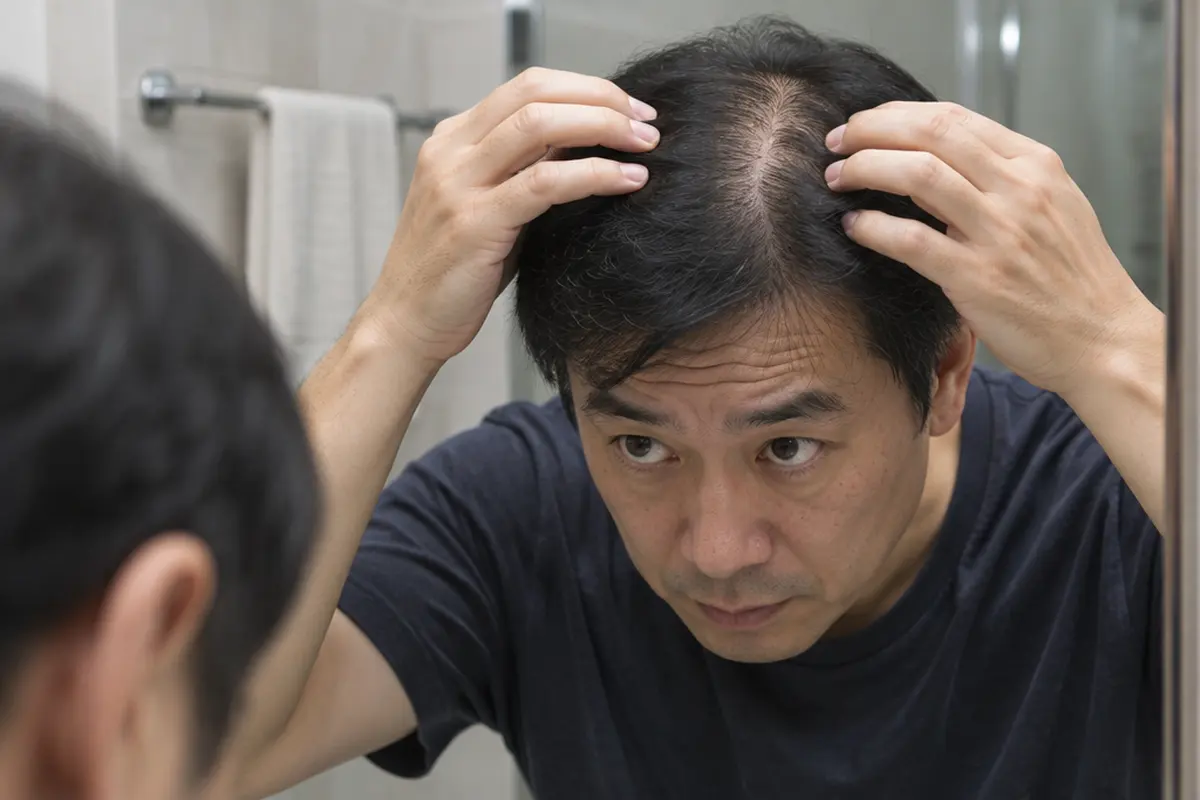
A man running his fingers through his hair at the hairline in front of a mirror
Assessment comes before any device or injectable is chosen.

For zones where follicles are gone, relocation is covered under hair transplant Singapore.

How the hair transplant cost in Singapore compares with the cost of protecting the hair you have is set out on the cost page.

How laser fits alongside medication for a receding hairline is set out in the hairline guide.

H2LT Protocol

01
Laser Wavelength Selection
Specific wavelengths optimised for dermal papilla penetration depth — calibrated to reach the follicle base where the growth signal originates.
02
Scalp Mapping
The pattern and severity of hair loss is mapped before each session — allowing targeted treatment of the most affected zones.
03
Session Protocol
The number of sessions is planned individually at consultation. Before commencing the programme, patients are recommended to check serum zinc, iron and folate levels as part of their routine health screening — deficiencies in these micronutrients are a correctable and often overlooked contributor to hair loss.
04
Maintenance
Whether maintenance sessions follow the initial course, and how they are spaced, is decided at review. For patients on a comprehensive hair loss treatment programme in Singapore, H2LT maintenance is one part of the long-term plan.
05
Combination Treatment
H2LT is often used alongside medical therapy (oral and topical), growth factor treatment and exosome scalp injections — each is aimed at a different aspect of hair follicle health, and response varies.

Hair loss laser vs medication vs micrograft: which route suits which scalp?

This table compares the three routes used for thinning hair at this practice, and the one that is referred on. Each acts on a different part of the problem, which is why they are combined more often than chosen between. The scalp is mapped and the likely cause checked before any of them is proposed.

man in his thirties, short hair, hand at hairline, side-lit
Illustrative image — not a patient.
RouteWhat it acts onWhat it cannot doWho it tends to suitPage
H2LT low-level laserLiving follicles that have miniaturised, through calibrated light at the follicle baseBlock DHT, or revive a follicle that is already goneEarly pattern loss with surviving follicles; people who cannot or prefer not to take medicationH2LT
Medical therapy (oral or topical)The androgen driver, or the hair cycle itself, depending on the classAct on a zone that is bald and shiny; hold its effect once it is stoppedPattern loss where the hormonal driver needs holding, after assessment of suitabilityAnti-hair-loss medications
Regenera Activa micrograftsThinning zones supplied with cells from the person’s own occipital scalpReplace medical therapy or move hair into a bare zoneEstablished thinning with intact donor hair, usually on a treated scalpRegenera Activa
Hair transplant (referred on)Relocation of hormone-resistant donor follicles into bare zonesStop the hair loss behind the graftsFully receded or smooth zones with donor reserve, once the loss is stabilisedHair transplant assessed honestly

Who it suits, who should wait, who is referred on

Tends to suit

  • Early pattern hair loss with surviving follicles
  • Diffuse thinning from shedding, where underlying causes are being addressed
  • People who cannot or prefer not to take hair loss medication
  • Support for native hair after hair transplantation

Better to wait

  • Pregnancy or breastfeeding, where suitability is assessed first
  • Active scalp infection, open wounds or an inflamed scalp
  • Uncorrected deficiencies or medical causes found on screening

Referred on

  • Scarring alopecia or sudden patchy loss → dermatologist assessment
  • Late-stage loss with few surviving follicles → assessment for surgical hair restoration
Who should not have this treatment
  • Active scalp infection, open wounds or inflamed scalp conditions
  • Photosensitising medicines or conditions (reviewed before treatment)
  • Suspicious scalp lesions, which are examined first
  • Pregnancy or breastfeeding (suitability assessed individually)
  • Scarring alopecia, where follicles are already destroyed
  • Uncorrected nutritional or medical causes, such as low iron or thyroid disease

People with scarring alopecia, or long-standing loss with few surviving follicles, tend to respond poorly, because the laser acts on follicles that are still present.

A man in his thirties with short dark hair and a visible hairline (illustrative image, not a patient)
Illustrative image — not a patient.

What happens, step by step

  1. Consultation and examination: scalp mapping and a check of the likely cause of hair loss
  2. Written plan and quote: blood checks for correctable deficiencies are advised and the session plan is set out
  3. Treatment day: laser is applied zone by zone across the scalp, with eye protection
  4. Review and adjustment: response is reviewed at intervals and any maintenance is agreed

Risks, side effects and when to call

H2LT is non-invasive, and the expected effects are mild warmth or a feeling of tightness on the scalp during treatment. Less often there can be temporary redness, scalp tenderness, headache or dryness, and the eyes are protected from the light. Because hair grows in slow cycles, change is judged over months, and some people notice little or no response, particularly where follicles have already miniaturised or been lost. Shedding can also continue while an underlying cause is being corrected. Side effects and expectations are discussed at consultation.

Contact the clinic the same day if
  • Scalp pain, blistering or a burn-like reaction
  • Spreading redness, swelling or signs of infection
  • Persistent headache, dizziness or eye discomfort after a session
  • Sudden patchy hair loss, or a scalp lesion that changes

See what to do if something feels wrong after a treatment.

Aftercare

First 24 hours

  • Resume normal activity and avoid scratching the scalp
  • Wash hair gently if the scalp feels tender

First week

  • Continue any prescribed medicines as directed
  • Attend review and blood checks as planned

Sun

  • Protect the scalp from direct sun with a hat

Skincare

  • Use a gentle shampoo and introduce new scalp products only when the clinic advises

When to call

  • Scalp pain, blistering or a burn-like reaction
  • Spreading redness, swelling or signs of infection
A woman in her forties running her fingers through her dark hair (illustrative image, not a patient)
Illustrative image — not a patient.

Before you book

  • Declare all medicines, including photosensitising medicines, hair loss medication and supplements
  • Tell the clinic if you are pregnant, breastfeeding or planning pregnancy
  • Avoid sunburn and tanning of the scalp before the visit
  • Pause new scalp actives or treatments and tell the clinic what you currently use
  • Bring photos of your parting over time, recent blood results such as zinc, iron and folate, and past treatment records

What determines the fee

The fee depends on the scalp zones treated, the number of passes planned for each zone, the device and consumables used, and whether H2LT is combined with medical therapy or another treatment. A written quote is given at consultation, after Dr Sin Yong has examined the scalp and mapped the pattern of loss. The consultation also decides whether H2LT is advised at all, or whether another cause needs to be addressed first.

A man in his forties checking the scalp in a mirror (illustrative image, not a patient)
The pattern of thinning points to the cause. Illustrative image, not a patient.

How quotes work at this practice: how we quote.

What it is not

  • Not a drug or injection: H2LT is Dr Sin Yong's low-level laser protocol directed at the scalp, used alongside medical management.
  • Not a transplant: there is no incision, graft or anaesthetic, and follicles already lost cannot be regrown.
  • Not for scarring alopecia: suitability depends on the cause, established by scalp mapping and deficiency checks.

Myths we hear in clinic

“Laser can regrow hair in any bald area.”

It acts on follicles that are still present and cannot restore follicles that are already lost.

“Laser alone is a complete hair loss plan.”

Hair loss has several causes, so laser is generally combined with assessment, medical management and correction of deficiencies.

Frequently Asked Questions

Laser hair growth treatment has trial evidence in pattern hair loss, but it acts only on follicles that are still present and response varies. A 2019 meta-analysis of 11 double-blind randomised trials found higher hair density with low-level laser than with sham devices, and a 2025 systematic review of 38 studies reached the same finding for androgenetic alopecia, with too little data for other types of hair loss.
Laser hair growth treatment is not laser hair removal. Low-level laser for hair growth uses red light at low power, around 630 to 670 nm, aimed at the follicle’s cell activity without heating it. Laser hair removal uses much higher energy to heat and disable the follicle. The two are planned for opposite goals, and laser hair removal has its own page on this site.
Hair Hyperstimulation Laser Therapy — Dr Sin Yong's proprietary laser protocol using calibrated energy aimed at stimulating hair follicles to move from the resting phase back into active growth.
No — H2LT is a completely non-drug, non-invasive laser treatment. It is particularly suitable for patients who cannot or choose not to take hair loss medication.
A course planned individually at consultation, with any maintenance decided at review. Response varies between individuals.
H2LT uses a proprietary calibrated protocol that Dr Sin Yong has refined specifically for follicle stimulation, applied by him zone by zone according to each patient’s scalp mapping. How each person responds varies.
Yes — it is usually planned alongside medical therapy. H2LT, oral and topical therapy and growth factors are each aimed at a different aspect of follicle health, and response varies.
The fee depends on the scalp zones treated, the number of passes planned, the device and consumables used, and whether H2LT is combined with medical therapy or another treatment. A written quote is given at consultation, after Dr Sin Yong has mapped the pattern of loss. No price is set beforehand, and the consultation decides whether H2LT is advised at all.
It is worth considering when assessment points to early pattern thinning or shedding with surviving follicles, and you want a non-drug, non-invasive option alongside medical management. It is a poorer fit for scarring alopecia, late-stage loss with few follicles remaining, or an uncorrected medical cause. Response varies, so expectations are set at consultation.
No duration can be promised. Hair grows in slow cycles, and how long any change holds depends on the cause of hair loss, age, hormonal factors, the other treatments used and whether maintenance continues. Pattern hair loss is ongoing, so a maintenance plan is commonly discussed. Review timing and any maintenance are set at consultation.
It acts slowly and response varies, with some people noticing little change. It cannot regrow follicles already lost or treat scarring alopecia, and it is rarely used alone. It needs attendance at sessions, with maintenance discussed, and may cause temporary warmth, redness or scalp tenderness. Blood checks for correctable deficiencies add a step before treatment.
The H2LT laser is Dr Sin Yong's hair hyperstimulation laser therapy protocol, a low-level laser treatment that aims to support thinning hair without surgery. It is planned after a scalp examination and is combined with medical treatment where the cause of hair loss calls for it.

How Laser Hair Growth Works — Photobiomodulation

Low-level laser therapy is thought to act on hair follicle cells through photobiomodulation — specific laser wavelengths (630–670nm) are absorbed by cytochrome C oxidase in follicle mitochondria, which is linked with increased ATP production, reduced oxidative stress and cellular proliferation. The aim is to move follicles from the resting telogen phase back into active anagen growth.

H2LT is applied systematically by Dr Sin Yong in a pattern designed to reach follicles across all stages of the hair cycle, with the dose set for each scalp rather than the fixed low-power dose of at-home devices.

Question not answered here? Ask on WhatsApp, use the enquiry form, or browse 100 questions patients ask.

Key facts
Approach
Laser therapy directed at the scalp, used alongside medical management rather than instead of it
Mechanism
Energy directed at scalp perfusion and the follicular environment, rather than at the androgen pathway
Why that matters
Oral and topical therapy act on circulation and DHT respectively; a light-based approach addresses the follicular environment through a third route
Condition context
Androgenetic alopecia involves DHT-driven follicular miniaturisation; treatment is generally combined rather than single-agent
Non-invasive
No incision, no graft, no anaesthetic
Assessment first
Hair loss has several causes — androgenetic, telogen effluvium, nutritional, autoimmune — which behave differently and are distinguished at consultation

Who Should Consider H2LT

Early androgenetic alopecia — Grade I–III pattern hair loss in men or women. The laser acts on follicles that are still present, so timing is discussed at assessment.

Postpartum hair loss — Suitability during breastfeeding is assessed. Used for postpartum telogen effluvium; response varies. Side effects are discussed at consultation.

Chronic telogen effluvium — Diffuse thinning from stress, nutritional deficiency or hormonal changes. Aims to support the hair cycle while underlying causes are addressed.

Post-transplant maintenance — Aims to support existing native hair and the grafts after hair transplantation.

H2LT is a poor fit for later-stage alopecia where follicles have permanently miniaturised, or for scarring alopecia where follicle destruction has occurred.

“Hair loss has several causes, and they behave differently. Which one you have is the first question, not the last.”

Dr Sin YongOn assessing hair loss

H2LT Protocol & Timeline

Dr Sin Yong applies the laser systematically across five scalp zones — frontal, mid-scalp, vertex and bilateral temporal — spending appropriate time on zones of greatest concern identified from scalp mapping.

A hairbrush with a few strands of hair (illustrative image, not a patient)
Some daily shedding is normal; a change in amount is what matters. Illustrative image, not a patient.

The course and any maintenance are planned individually at consultation. Progress is reviewed at intervals agreed with Dr Sin Yong; response varies between individuals. H2LT is often combined with topical exosome application or the Luminescence Laser depending on each patient's degree of loss and clinical response.

H2LT vs At-Home Laser Devices

Many patients arrive having already tried at-home laser caps or helmets. Consumer devices deliver fixed low-power energy uniformly across the scalp. They are FDA-cleared for safety; the dose is fixed rather than adjusted to areas of pronounced miniaturisation.

H2LT uses medical-grade systems with precisely calibrated fluence levels, applied systematically by Dr Sin Yong according to each patient's scalp mapping. Published studies of medical-grade LLLT have reported changes in hair count and density, and how each person responds varies. H2LT combines these protocols with Dr Sin Yong's experience adjusting parameters to individual patient response over time.

H2LT can be used across hair types and skin tones, recovery is discussed at consultation, and it can be planned alongside hair loss medications.

H2LT as Part of a Comprehensive Plan

H2LT is rarely used in isolation. Dr Sin Yong integrates it into a wider hair loss plan aimed at the contributing factors found at assessment. Depending on the patient's diagnosis, H2LT is combined with topical exosome application, topical therapy, Nourkin TricoVerde® supplementation, Derive Serum exosome topical, and correction of nutritional deficiencies identified on blood tests. What Singapore allows for exosomes, and how they are used on the skin, is on exosome treatment Singapore.

For patients with significant androgenetic alopecia, the Luminescence Laser is Dr Sin Yong's recommended first-line laser therapy. H2LT then builds on this foundation with the hyperstimulation protocol, systematically targeting zones of greatest hair thinning. Blood test monitoring at intervals set at consultation allows objective assessment of nutritional markers alongside clinical hair density evaluation.

SY
Dr Sin Yong
MBBS (NUS, Singapore) · MRCS (Edinburgh)
MSc Practical Dermatology (University of Cardiff, UK) · MSc Aesthetic Medicine with Distinction (Queen Mary University of London)
Graduate Diploma in Sports Medicine (Nanyang Technological University)
Global Key Opinion Leader — CLASSYS | DEKA | HIRONIC | FOTONA | ALMA | LUTRONIC | ILOODA

Medically reviewed by Dr Sin Yong, MBBS (NUS), MRCS (Edinburgh) · Last updated 5 November 2026 · Editorial policy

Related reading
Where Dr Sin Yong consults: 9 Scotts Road, Pacific Plaza #12-01, Singapore 228210 · Orchard MRT · Mon–Fri 10am–8pm, Sat 11am–3pm · WhatsApp +65 8023 7170 · Getting here · How fees are quoted

H2LT Consultation — Dr Sin Yong

Proprietary laser treatment for hair loss — personally designed and performed by Dr Sin Yong.

  1. 1WhatsApp a short note on your concern
  2. 2Consultation and assessment with Dr Sin Yong
  3. 3Options explained, including no treatment

Replies within clinic hours: Mon–Fri 10am–8pm, Sat 11am–3pm · How consultations work · Prefer not to use WhatsApp? · Treatment finder · Call +65 8023 7170 · Map

WhatsApp Dr Sin Yong

References

  1. Female Pattern Hair Loss: A Clinical, Pathophysiologic, and Therapeutic Review — PMC.
  2. Female Pattern Hair Loss — DermNet NZ.
  3. Comparative effectiveness of low-level laser therapy for adult androgenic alopecia: a system review and meta-analysis of randomized controlled trials (Liu KH, Liu D, Chen YT, Chin SY). Lasers in Medical Science, 2019. pubmed.ncbi.nlm.nih.gov
  4. Low-Level Laser and LED Therapy in Alopecia: A Systematic Review and Meta-Analysis (Perez SM, Vattigunta M, Kelly C, Eber A). Dermatologic Surgery, 2025. pubmed.ncbi.nlm.nih.gov
Your next step
  1. 1. MessageWhatsApp +65 8023 7170 with what is bothering you. A reply comes from the clinic, not a bot.
  2. 2. AssessmentDr Sin Yong examines you himself on Orchard Road, with ultrasound where earlier filler is involved.
  3. 3. A plan in writingWhat he would do, what he would not, the fee factors, and the option of no treatment.

Every treatment is performed by Dr Sin Yong personally. Singapore Medical Council registered · invited to share his clinical expertise internationally as a Key Opinion Leader for CLASSYS, DEKA, HIRONIC, FOTONA, ALMA, LUTRONIC and ILOODA · HSA-registered devices · ultrasound-guided correction

Dr Sin Yong's aesthetic clinic in Singapore is on Orchard Road, a short walk from Orchard MRT. More about the aesthetic doctor in Singapore who performs every treatment.

WhatsApp Dr Sin Yong →or use the enquiry form
Follow Dr Sin Yong
InstagramTikTokYouTubeThreadsXLinkedInFacebook
Dr Sin Yong · Ask about hair loss · Doctor-performed
WhatsApp Enquiry