Droopy Eyelid Lift Singapore — Lifted, Not Operated
Medically reviewed by Dr Sin Yong · Last reviewed · 19 min read · Doctor-performed, never delegated · Jump to questions
Dr Sin Yong · MBBS (NUS) · MRCS (Edin) · MSc Aesthetic Medicine with Distinction (Queen Mary, London) · MSc Practical Dermatology (Cardiff) · Global KOL
Many droopy eyelids do not need blepharoplasty at all. If your double eyelid crease is still there and the problem is heavy, hooded skin, energy-based lifting — focused ultrasound and radiofrequency around the brow and eyelid, or precision laser resurfacing of the lid itself — can lift the eye area without a scalpel, without stitches and without changing the eyes you were born with. It starts with an assessment that tells you which category your eyelids are actually in.
A non-surgical eyelid lift raises hooded or heavy upper eyelids without cutting, using focused ultrasound and radiofrequency to lift the brow and periorbital support, and fractional laser to tighten thin lid skin. It suits hooded eyes and brow descent with an intact double eyelid crease; true ptosis, a weak eyelid muscle, is referred for surgery.
Key takeaways
A non-surgical eyelid lift raises hooded or heavy eyelids without incisions, using radiofrequency at the brow and fractional laser on lid skin.
It suits hooded skin and brow descent with an intact double eyelid crease; the assessment decides which applies.
It does not treat true ptosis, a weak eyelid muscle, or create, raise or reshape a crease; these are referred for surgery.
Eyelid skin is very thin, so settings are conservative and eye protection is used throughout.
Dr Sin Yong, an aesthetic physician, performs the non-surgical treatment personally and refers surgical cases on.
Hooded skin (dermatochalasis), brow descent and true ptosis look alike in the mirror and need different answers.
Ptosis threshold
MRD1 under about 2 mm points to a weak levator muscle; that is surgical and is referred.
The protocols
FSX Laser for lax lid and brow skin; VF Lift – Vertical Facelift (Volnewmer monopolar RF) where the brow needs lifting.
Thin skin
Upper eyelid skin is about 0.5 mm thick, so settings are conservative and protective eye shields are used throughout.
Limits
It cannot create, raise or reshape a double eyelid crease, or remove skin and fat as blepharoplasty does.
Non-surgical eyelid lift in Singapore: what it can and cannot do
A non-surgical eyelid lift tightens the skin and the brow-supporting tissue around the eye with energy (laser, ultrasound or RF) so the lid looks less heavy; it does not remove skin or fat the way blepharoplasty does. Dr Sin Yong’s protocol for hooded or droopy lids is the FSX Laser; where the brow has dropped, the VF Lift lifts the brow-supporting fascia. Severe excess skin or a true ptosis (a weak lifting muscle) is referred for surgery.
Why the Assessment Comes First
“Droopy eyelids” is one complaint with three different anatomies. True ptosis is a weakness of the levator muscle that opens the eye — a medical condition, formally assessed by measurements such as MRD1, and treated surgically when significant. Dermatochalasis is hooded, redundant skin folding over an intact crease. Brow descent drops the entire brow complex onto the lid, making healthy eyelids look heavy. Each looks similar in the mirror; each has a different right answer. That is why every patient here is assessed — crease, levator function, brow position and skin quality — before any treatment is proposed.
Lifting Without Blepharoplasty
Where the crease is intact and the diagnosis is hooding or brow descent — which describes a large share of people searching for droopy eyelid surgery — a non surgical eyelid lift treats the cause without an operation. Monopolar radiofrequency (Volnewmer) lifts and tightens the brow and periorbital support (the VF Periorbital Eyelift), while fractional laser resurfacing tightens the thin lid skin itself. No incisions, no sutures, no general anaesthesia — and your natural double eyelid stays exactly as it is. Where assessment shows true ptosis, the honest answer is different: ptosis correction is surgical, and you will be told so plainly and referred appropriately.
Do not settle for surgery when you already have double eyelids. Just lift it.
Blepharoplasty cuts skin away and re-forms a crease. But if your crease is intact and the real problem is descent — heavy brow, hooded skin, loose lid support — cutting solves a problem you do not have. Assessment first. Then lift what needs lifting.
Which Droopy Eyelid Do You Have?
The assessment sorts every “droopy eyelid” into one of three anatomies — and the right treatment follows from the category, not the complaint:
Hooded skin
Dermatochalasis — loose skin folds over an intact crease. The eye opens normally; the lid just looks heavy. Well suited to non-surgical lifting.
Brow descent
The brow complex has dropped, pushing normal eyelids downward. Lifting the brow with focused energy restores the frame around the eye. Well suited to non-surgical lifting.
True ptosis
The levator muscle that opens the eye is weak — the lid margin itself sits low (MRD1 under about 2 mm). This is surgical territory, and you will be told honestly.
Key Facts — The Numbers Behind Eyelid Lifting
~0.5 mm
Upper eyelid skin is the thinnest on the body — why eyelid energy work demands precise, conservative settings.
MRD1 < 2 mm
The margin-reflex distance threshold that points to true ptosis — the measurement that separates lifting candidates from surgical ones.
1.5–4.5 mm
Focal depths of the focused-ultrasound transducers used around the brow and periorbital area — energy placed at chosen depths, not cut.
60–65°C
The dermal temperature band where collagen contracts and remodelling begins — the mechanism of energy-based lid tightening.
10,600 nm
CO2 laser wavelength used for fractional resurfacing of hooded lid skin, with protective eye shields in place throughout.
0 incisions
A non surgical eyelid lift involves no cutting, no sutures and no general anaesthesia — and leaves your natural double eyelid crease untouched.
The Assessment-First Eyelid Lift Process
01
Eyelid Assessment
Crease position, levator function, MRD1, brow position and skin quality are examined — the complaint is sorted into its true anatomy.
02
Crease Check
If your double eyelid crease is intact, surgery is rarely the first answer — lifting is planned around preserving it exactly as it is.
03
Honest Triage
True ptosis is told apart from hooding and brow descent. Surgical cases are told so plainly and referred — not squeezed into a device plan.
04
Energy-Based Lifting
Focused ultrasound and radiofrequency lift the brow and periorbital support; fractional laser tightens the lid skin where indicated.
05
Progressive Tightening
Collagen remodelling builds over the following weeks — the lift develops progressively rather than overnight.
06
Review
The eye area is reviewed and the maintenance interval agreed — conservatively, because eyelid skin rewards restraint.
What lifted eyelids look like
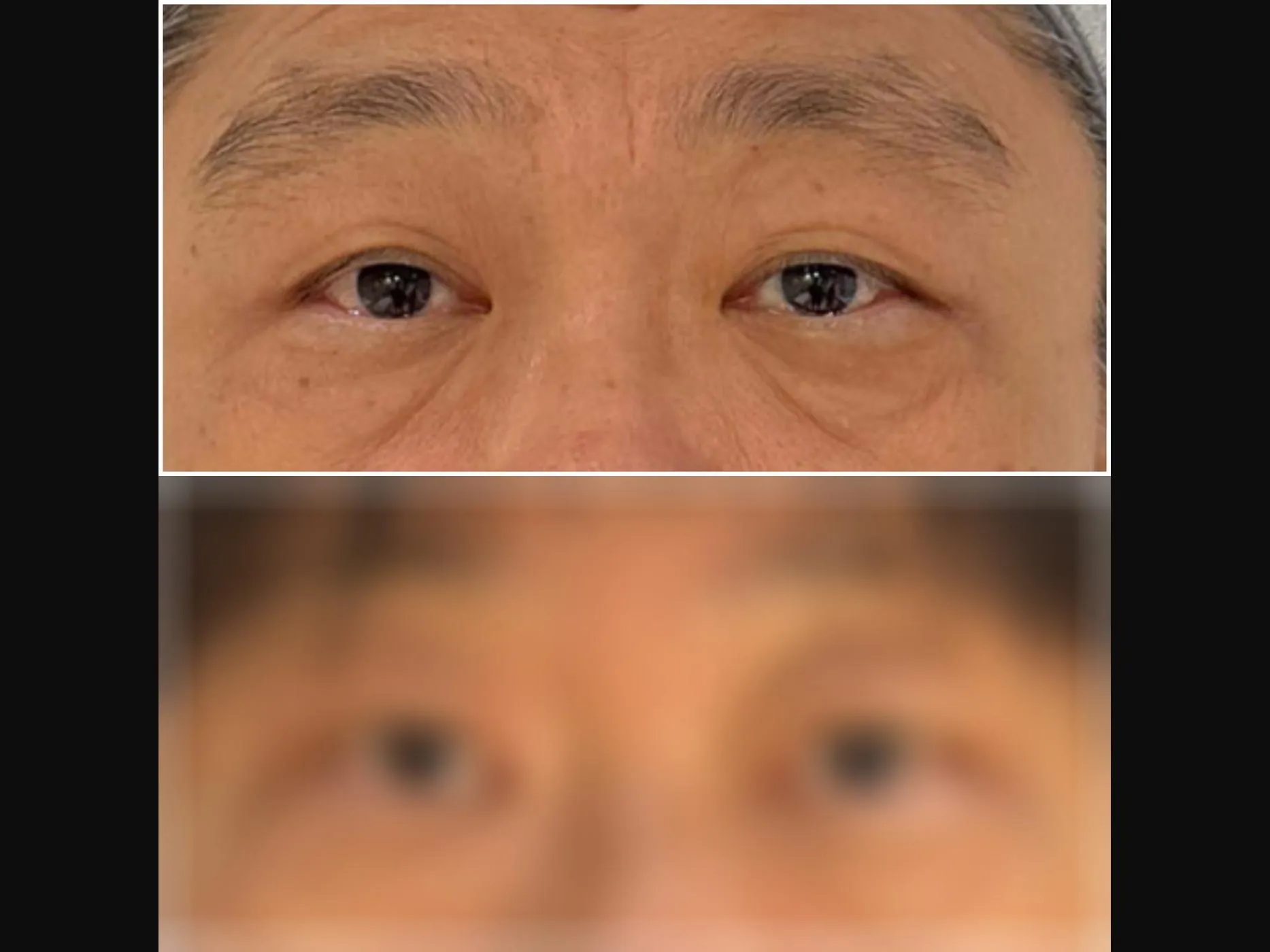
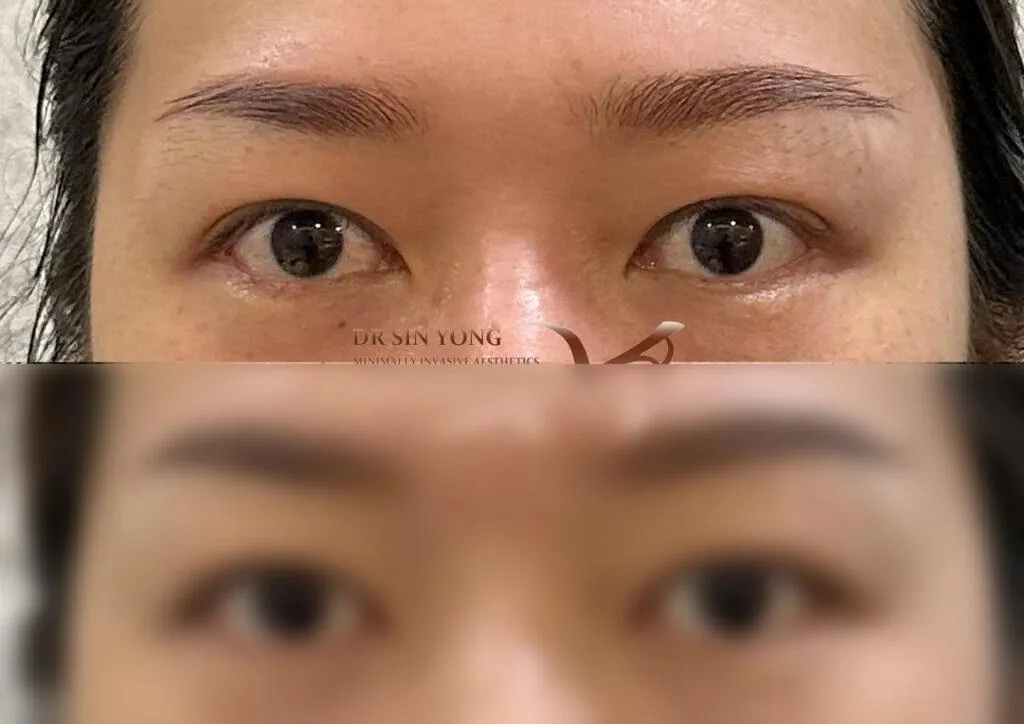
Shown as before-and-blurred composites in line with Singapore advertising guidelines — actual unblurred case photographs can be viewed at the clinic.
VF Periorbital Eyelift — droopy eyelids. Before & blurred-after · view actuals at clinicFSX Laser — non surgical eye lift for droopy eyelids. Before & blurred-after · view actuals at clinic
How do the eyelid lifting routes compare?
Non surgical eyelid lift, laser eye lift, blepharoplasty or ptosis surgery — the assessment decides which column you are actually in. Many patients searching for droopy eyelid surgery discover they belong in the first two.
VF Periorbital Eyelift
Laser eyelid lift
Upper blepharoplasty
Ptosis surgery
Monitor only
What it is
Volnewmer monopolar radiofrequency lifts the brow and periorbital support (no focused ultrasound)
Fractional CO2 laser tightens the hooded lid skin itself
Skin is cut away and the crease re-formed under surgery
The levator muscle is surgically shortened or reattached
The eyelids stay as they are, reviewed over time
Well suited for
Hooding and brow descent with an intact crease
Thin, crepey, hooded lid skin
Heavy skin redundancy beyond what energy can lift
True ptosis — a low lid margin from muscle weakness
Mild hooding a patient prefers to monitor
Your double eyelid crease
Preserved exactly as it is
Preserved
Re-made surgically — it may not look like yours
Altered as part of surgery
Unchanged
Anaesthesia
None or topical
Topical, protective eye shields
Local or sedation
Local or sedation
None
Downtime
Varies — discussed at consultation
A few days of redness and micro-crusting
Sutured wounds; typically 1–2 weeks of visible recovery
Sutured wounds; typically 1–2 weeks
None
What the assessment decides
Confirms crease intact and descent-type droop
Confirms skin-quality hooding
Reserved for redundancy energy cannot address
Triggered by MRD1 and levator findings
Justified when the droop is mild and stable
Indicative comparisons for patient education — suitability, healing course and any surgical referral are determined at consultation for each individual. Dr Sin Yong performs the non-surgical options; surgical blepharoplasty and ptosis repair are referred to the appropriate surgical specialists.
Dr Sin Yong Recommendations on Eyelid Lifting
Energy work millimetres from the eye demands exactly the judgment international device manufacturers invite Dr Sin Yong to share — the same radiofrequency platform behind the VF Periorbital Eyelift:
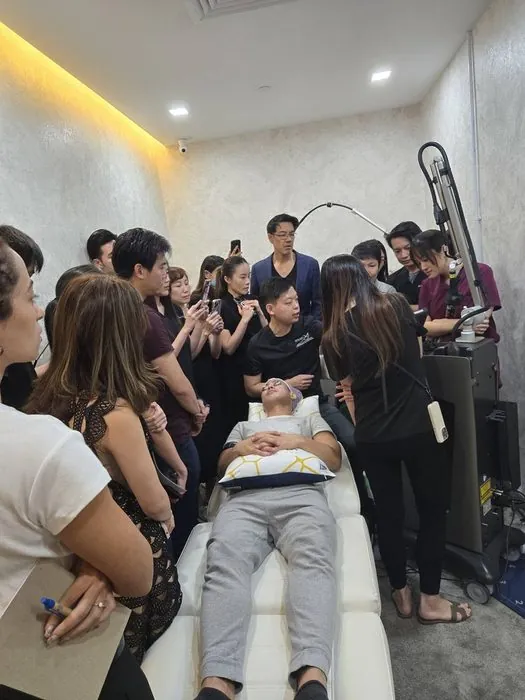
Main-stage lecture — CLASSYS Global Customer Summit, Seoul 2025Invited to share laser technique with visiting physicians — DEKA Tetra ProConference speaker — SAM Conference 2026, SingaporeDEKA certification — advanced CO2 laser platforms
“Hooded skin and a weak eyelid muscle look alike in the mirror — they are different problems with different right answers.”
— Dr Sin Yong
Tapered or parallel double eyelid: can lifting change the shape of the crease?
Lifting does not change the shape of a crease; it uncovers the crease you already have. A tapered double eyelid is a crease that starts narrow near the inner corner, often tucked inside the inner fold, and widens towards the outer corner. A parallel crease runs at a similar height from the inner to the outer corner, sitting above the inner fold. Some eyelids have a crease that is hidden or only partly visible, and some have none, which is usually called a monolid.
Illustrative image — not a patient.
Hooding alters how a crease looks without altering the crease itself. As the skin above it loosens or the brow descends, the fold drapes over the lid: a tapered crease often disappears at the outer corner first, and a parallel crease can start to look narrower or uneven from side to side. The assessment checks whether the crease is still there beneath the hooded skin, and at what height.
Where it is, a non-surgical eyelid lift aims to un-bury it, so the tapered or parallel shape you were born with shows again. Converting a tapered crease into a parallel one, raising a crease or creating one where none exists is a different goal. That is double eyelid surgery, and it is referred to a plastic surgery specialist.
Illustrative image — not a patient.
Who it suits, who should wait, who is referred on
Tends to suit
Hooded upper eyelid skin over an intact double eyelid crease
Heavy-looking lids caused by brow descent
Thin, crepey lid skin that suits fractional laser
A goal of lifting the existing crease rather than changing it
Better to wait
Pregnancy or breastfeeding
Active infection, cold sores or open wounds near the eye
Recent isotretinoin, or a goal that no energy treatment can meet
Referred on
True ptosis or a low lid margin → surgical assessment by an eyelid or plastic surgery specialist
Heavy skin redundancy, or a wish to create, raise or reshape a crease → plastic surgery specialist
Who should not have this treatment
Active infection, cold sores or open wounds near the eye
Pregnancy or breastfeeding
Pacemaker or other implanted electronic device (reviewed before radiofrequency)
Recent isotretinoin or photosensitising medicines (reviewed before laser)
Keloid tendency, or recent tanning of the area
Eye disease, or a goal such as creating a crease that energy cannot meet
People with true ptosis, heavy skin redundancy or a wish to create or reshape a double eyelid crease tend to respond poorly, because energy treatment lifts and tightens what is there and cannot cut or re-form a crease.
What happens, step by step
Consultation and examination: crease, levator function, brow position and skin quality are assessed
Written plan and quote: hooding, brow descent or ptosis is sorted and the plan or referral is set out
Treatment day: radiofrequency at the brow and periorbital support, and fractional laser on lid skin where planned, with eye protection
Review and adjustment: the eye area is reviewed and any further treatment is agreed
Risks, side effects and when to call
Expected effects are warmth, redness and swelling around the eye, and after fractional laser, redness and fine crusting on the lid skin. These usually settle as the skin heals, and recovery varies between people. Less often there can be prolonged redness, pigment change (darkening or lightening, more likely in medium and darker skin), blistering, infection or a cold sore flare. Rarely the eye itself can be irritated, which is why protective eye shields are used. Eyelid skin is thin, so settings are conservative, but risk cannot be excluded entirely.
Contact the clinic the same day if
Pain, or any change in vision
Increasing redness, swelling or discharge suggesting infection
Blistering, or skin that looks broken
Eye irritation, light sensitivity or watering that does not settle
Expect redness and mild swelling, and avoid rubbing the eyes or pressing on the lids
Keep the area clean and apply only what the clinic advises
Avoid heat such as saunas and hot showers on the face
First week
Leave any crusting to shed on its own and do not pick
Avoid eye makeup on treated skin until advised
Attend review as planned
Sun
Avoid direct sun and tanning of the eye area
Use broad-spectrum sunscreen daily and wear sunglasses
Skincare
Use a gentle cleanser and moisturiser
Restart retinoids and acids near the eyes only when the clinic advises
When to call
Pain, vision change, or an eye that stays red or watery
Blistering, discharge or increasing swelling
Before you book
Declare any pacemaker or implanted device, eye conditions, previous eyelid surgery, or fillers near the eyes
Declare all medicines, especially isotretinoin and photosensitising medicines, and any history of cold sores or keloid
Tell the clinic if you are pregnant, breastfeeding or planning pregnancy
Avoid sun exposure and tanning of the eye area before the visit
Bring clear photos, previous treatment records and a list of your eye-area skincare actives
What determines the fee
The fee depends on the area treated (brow and periorbital support, lid skin, or both), the device and consumables used, the number of passes or zones planned, and whether the lift is combined with another treatment. A written quote is given at consultation, after Dr Sin Yong has examined the crease, levator function, brow position and skin quality. The consultation also decides whether a non-surgical lift is advised at all, or whether surgical referral is the more appropriate route.
“Lifting changes the shape of your double eyelid crease.”
It uncovers the crease you already have; creating, raising or reshaping a crease is a surgical goal.
“A droopy eyelid always needs surgery.”
Hooded skin and brow descent can suit non-surgical lifting, while true ptosis from a weak muscle is referred for surgery.
Dr Sin Yong’s approach
Droopy or hooded eyelids. Day in, day out, two protocols do most of this work in Dr Sin Yong's practice: FSX Laser where the heaviness comes from skin texture and laxity of the upper lid and brow, and VF Lift – Vertical Facelift where the brow and upper face need lifting along vertical vectors. True ptosis (a weak levator muscle) is a surgical question and is screened for at assessment, so the right person is referred rather than treated. Concern page: droopy eyelids.
Your next step
1. MessageWhatsApp +65 8023 7170 with what is bothering you. A reply comes from the clinic, not a bot.
2. AssessmentDr Sin Yong examines you himself on Orchard Road, with ultrasound where earlier filler is involved.
3. A plan in writingWhat he would do, what he would not, the fee factors, and the option of no treatment.
Every treatment is performed by Dr Sin Yong personally. Singapore Medical Council registered · invited to share his clinical expertise internationally as a Key Opinion Leader for CLASSYS, DEKA, HIRONIC, FOTONA, ALMA, LUTRONIC and ILOODA · HSA-registered devices · ultrasound-guided correction
Very often, yes. When the assessment shows hooded skin or brow descent with an intact double eyelid crease, a non surgical eyelid lift — focused ultrasound and radiofrequency around the brow and eye, with fractional laser for the lid skin — lifts the area without blepharoplasty. When the assessment shows true ptosis, surgery is the right tool and you will be told so honestly.
I already have double eyelids. Do I really need double eyelid surgery?+
If your crease exists and the problem is heaviness above it, re-creating a crease you already own makes little sense. Double eyelid surgery is for building a crease; lifting is for un-burying one. The assessment tells you which situation is yours before anything is booked.
What is the difference between droopy eyelid surgery and an eyelid lift?+
Droopy eyelid surgery — blepharoplasty or ptosis correction — cuts skin or shortens muscle. A non-surgical eyelid lift uses focused energy to tighten and elevate the tissues that have descended, with no incisions and your own crease preserved. They solve different anatomies, which is why assessment comes first.
What is ptosis, and can it be treated without surgery?+
Ptosis means the lid margin itself sits too low because the levator muscle that opens the eye is weak or stretched. Significant ptosis is corrected surgically — ptosis treatment with devices alone cannot repair a weak muscle. Distinguishing ptosis from hooded eyes is the single most important part of the eyelid assessment.
What are hooded eyes, and are they the same as droopy eyelids?+
Hooded eyes describe skin folding over the lid so the crease disappears when the eyes are open. It is one of the three anatomies patients call droopy eyelids — and the one that tends to respond well to non-surgical lifting, because the eye itself opens normally.
How does the VF Periorbital Eyelift work?+
It uses Volnewmer monopolar radiofrequency around the brow, temple and periorbital area — it does not use focused ultrasound — lifting the frame of the eye and tightening the support the eyelid sits on. The eyelid is lifted by lifting what holds it.
Is a laser eye lift safe so close to the eye?+
Fractional laser work on the eyelid is performed with protective eye shields in place throughout, and with conservative settings suited to the thinnest skin on the body. Safety protocols around the eye are precisely why this treatment belongs with an experienced physician.
How long does a non-surgical eyelid lift take, and what is the downtime?+
A session is typically under an hour. Recovery after ultrasound and radiofrequency lifting depends on the settings and area, and is discussed at consultation, while laser lid resurfacing brings a few days of redness and fine crusting. The lift itself builds progressively over the following weeks as collagen remodels.
How much does an eyelid lift cost in Singapore?+
The cost depends on which anatomy is being treated and which combination of energy devices your assessment calls for, so it is quoted individually at consultation — and always confirmed with you before anything is done.
When is blepharoplasty genuinely the better option?+
When skin redundancy is beyond what energy can retract, or when true ptosis needs muscle repair. In those cases surgery is the honest recommendation and a referral is made — the point of assessment-first care is that you end up with the right procedure, not the available one.
Will lifting change the shape of my eyes?+
No — that is the point. Non-surgical lifting elevates the brow and tightens the lid support while leaving your crease and eye shape exactly as they are. Patients look like themselves, less tired.
Why are no case photographs of eyelid lifting shown online?+
Singapore's medical advertising rules restrict outcome photography online, so this page shows before-and-blurred composites only. Actual unblurred case photographs can be viewed in person during consultation at the clinic.
I have monolids. Can a non-surgical eyelid lift give me a double eyelid?+
No. Energy-based lifting tightens and elevates tissue that has descended; it does not form a fold where there is none. Creating a crease on a monolid is double eyelid surgery, which is referred to a plastic surgery specialist. Where a monolid has become heavier with age, lifting may help the lid look less weighed down, but it remains a monolid.
Do hooded eyes get worse with age?+
Often they do, gradually. Upper-lid skin thins and loosens, the brow tends to descend and the support around the eye softens, so a fold that was barely visible earlier in life can sit lower later on. Some people have hooding from youth simply because of their brow and lid anatomy. The assessment separates inherited hooding from age-related descent, because they do not always respond in the same way.
How much does a non-surgical eyelid lift cost in Singapore?+
The fee depends on the area treated, the device and consumables, the number of passes or zones planned, and whether the lift is combined with another treatment. A written quote is given at consultation, after Dr Sin Yong has examined the eyelids and brow. No price is set beforehand, and the consultation decides whether a non-surgical lift is advised at all.
Is a non-surgical eyelid lift worth it?+
It is worth considering when assessment shows hooded skin or brow descent over an intact crease and you prefer to avoid incisions. It is a poorer fit for true ptosis, heavy skin redundancy, or a wish to create or reshape a crease, which are surgical questions. The assessment sorts out which group you belong to.
How long does a non-surgical eyelid lift last?+
No duration can be promised. Tightening develops gradually through collagen remodelling, and longevity depends on age, skin quality, how much hooding is present, sun exposure and lifestyle. Ageing continues after treatment. Review timing and any maintenance are set at consultation, conservatively, because eyelid skin rewards restraint.
What are the disadvantages of a non-surgical eyelid lift?+
It does not treat true ptosis or change crease shape, and it is not a substitute for blepharoplasty when skin excess is heavy. Expected effects include redness, swelling and crusting after laser, and pigment change is a recognised risk. Change is gradual and varies between individuals, and a plan may need more than one treatment.
Pinch the lid skin: if there is a clear fold of excess you can hold, surgery removes it and energy cannot. If the lid is heavy because the skin has thinned and the brow has drifted down, the FSX Laser and, where needed, the VF Lift are the non-surgical options. Dr Sin Yong says which applies at the consultation and refers on when surgery is the right answer.
Finsterer J. Ptosis: causes, presentation, and management. Aesthetic Plast Surg. 2003;27(3):193-204. PubMed
Pak CS, Lee YK, Jeong JH, Kim JH, Seo JD, Heo CY. Safety and efficacy of Ulthera in the rejuvenation of aging lower eyelids: a pivotal clinical trial. Aesthetic Plast Surg. 2014;38(5):861-868. PubMed
SY
Dr Sin Yong
MBBS (NUS, Singapore) · MRCS (Royal College of Surgeons, Edinburgh) MSc Practical Dermatology (University of Cardiff, UK) · MSc Aesthetic Medicine with Distinction (Queen Mary University of London) Graduate Diploma in Sports Medicine (Nanyang Technological University)
Global Key Opinion Leader — CLASSYS | DEKA | HIRONIC | FOTONA | ALMA | LUTRONIC | ILOODA
Pioneered Protocols Time Freeze Laser LCLR® · VF Lift · RVR ProLift · S3 Resurfacing · FSX Laser · 4K Body Lift · G Lift · Luminescence Laser
A non-surgical eyelid lift in Singapore at Dr Sin Yong's practice always begins with a structured eyelid assessment — crease position, levator function, MRD1 and brow position. Hooded eyes and brow descent with an intact double eyelid crease are lifted with focused ultrasound, radiofrequency and fractional laser without blepharoplasty; true ptosis is identified and referred for surgical correction. This information is educational and is not a substitute for a medical consultation.
Medically reviewed by Dr Sin Yong, MBBS (NUS), MRCS (Edinburgh) · Last updated 5 October 2026 · Editorial policy
Thread Lift Singapore: PDO vs PCL vs PLLA — Thread lift Singapore guide: how PDO, PCL and PLLA cog threads reposition tissue, who suits them, what they cannot do, a…
Thread Lift Limitations Explained — Thread lift limitations explained by a doctor who is invited to share his clinical expertise with other doctors on threa…
Where Dr Sin Yong consults: Orchard Road, Singapore (unit on booking) · Orchard MRT · Mon–Fri 10am–8pm, Sat 11am–3pm · WhatsApp +65 8023 7170 · Getting here · How fees are quoted
Eyelid Assessment & Non-Surgical Lift — Dr Sin Yong
Assessment-first eyelid lifting — hooded eyes and brow descent lifted without blepharoplasty; true ptosis identified honestly.