What do dark underarms look like?
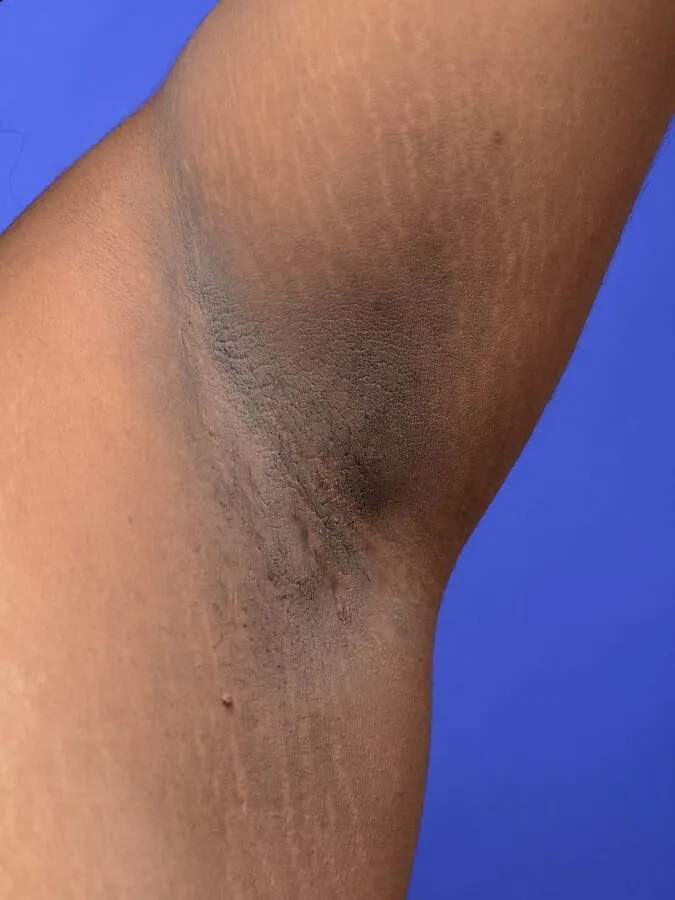
Why do underarms darken?
The axilla is a perfect storm for post-inflammatory pigment: a fold where skin rubs skin all day, shaved or plucked thousands of times over the years, coated daily in products that low-grade irritate some users — on body sites where melanocytes respond briskly to every insult. Histological work on darkened axillary skin supports this chronic-irritation picture [2]. Two impostors join in: the grey shadow of coarse hair sitting beneath just-shaved skin, and — importantly — acanthosis nigricans, a velvety thickened darkening associated with insulin resistance that is a metabolic sign, not a cosmetic stain.
The one version that needs a doctor first
Run a finger across the darkening. Flat, smooth discolouration on normal-textured skin is cosmetic pigment. A velvety, thickened, slightly ridged surface — often with similar patches at the neck folds — suggests acanthosis nigricans, which the medical literature ties to insulin resistance and metabolic syndrome (the same conversation as multiple skin tags, its frequent companion). That version gets simple blood work and a metabolic conversation before any lightening plan — treating the marker while ignoring the message helps no one.
What actually works for dark underarms?
The systematic review of axillary hyperpigmentation treatment supports a combination logic [1]: stop the insults (switch to non-irritating antiperspirant formulations, loosen chronic friction where possible), lighten the pigment (evidence-based topicals — azelaic, retinoid and related agents — under supervision), and use conservative pigment-laser protocols where topicals plateau, with the same restraint rules as any PIH in darker skin. A high-leverage upstream move: laser hair removal, which retires the razor that has been re-injuring the fold for decades and deletes the sub-surface hair shadow in the same course. The whole-axilla picture — sweat, odour, texture, tags — is assessed together in the underarm programme, alongside hyperhidrosis where sweating rides along.
What doesn't work for dark underarms?
Scrubbing — the pigment is not dirt, and friction is a cause, not a cure. 'Whitening' deodorants — mild actives over a continuing irritation cycle. Lemon and baking-soda folk remedies — irritants applied to irritation-pigmented skin, with predictable results. Bleaching creams from unregulated sources — unsupervised strong agents in a friction fold invite damage. And treating acanthosis nigricans cosmetically while skipping the metabolic check — the darkening is the least important thing that patch is telling you.
“Dark underarms are a diary of every shave and every friction day for a decade — soap can't erase a diary, and scrubbing just adds entries.”
— Dr Sin Yong
Dr Sin Yong’s Viewpoint
Dark underarms are a diary of a decade of shaving and friction, not a hygiene failure — and scrubbing just adds entries. My highest-leverage move is usually retiring the razor with laser hair removal, then treating the leftover pigment. And the velvety, thickened version gets a blood test before any cosmetic plan; that patch may be saying something about metabolism.
Prefer Not to Use WhatsApp?
Use the short enquiry form instead →
Leave your name, mobile number and email and the clinic will contact you directly. No obligation.
Prefer a preliminary view first? You can also WhatsApp a photo of the area for Dr Sin Yong to review before you decide on a visit.