Pigmentation and redness: every guide on this site
Medically reviewed by Dr Sin Yong · Last reviewed · 4 min read
Quick answers
What is pigmentation, and how does it form?
Pigmentation is darker skin where melanin builds up, made by pigment cells reacting to sun and visible light, inflammation such as acne, hormones and age. The type, whether sun spots, freckles, melasma, post-inflammatory marks or Hori's naevus, and its depth decide the treatment, so it is diagnosed under a lamp or magnification first.
This hub lists every page on drsinyong.com about pigment and redness: melasma, sun spots, post-inflammatory hyperpigmentation, freckles, Hori’s naevus, rosacea and broken vessels. The protocol Dr Sin Yong uses for pigment with a redness component is R2T2: R2 Glow calms the inflammation that keeps producing pigment, and T2 Frax Radiance is directed at the deposit. Melasma starts with R2 Glow alone or with no laser at all.
DEKA TORO 785 nm picosecond with a thermal mode, directed at deposited pigment
Melasma
Sun protection and medical treatment first; laser, if any, begins with R2 Glow alone
Skin types
Planned for Fitzpatrick III–V
Start here: which pigmentation guide answers your question
Pick the row closest to your question. Each one points to the page to read first and the page to read next, and the last column says what decides the route. Diagnosis comes before any laser, so the first page is usually about the mark, not the machine.
Pigment is identified by type before any laser is chosen. Illustrative image, not a patient.
Table: Start here: which pigmentation guide answers your question
Newer pigmentation and redness guides, October 2026
These pages were added to the pigmentation and redness section in October 2026. Each one answers a narrower question than the guides listed further down, and each links back to the page that owns its topic.
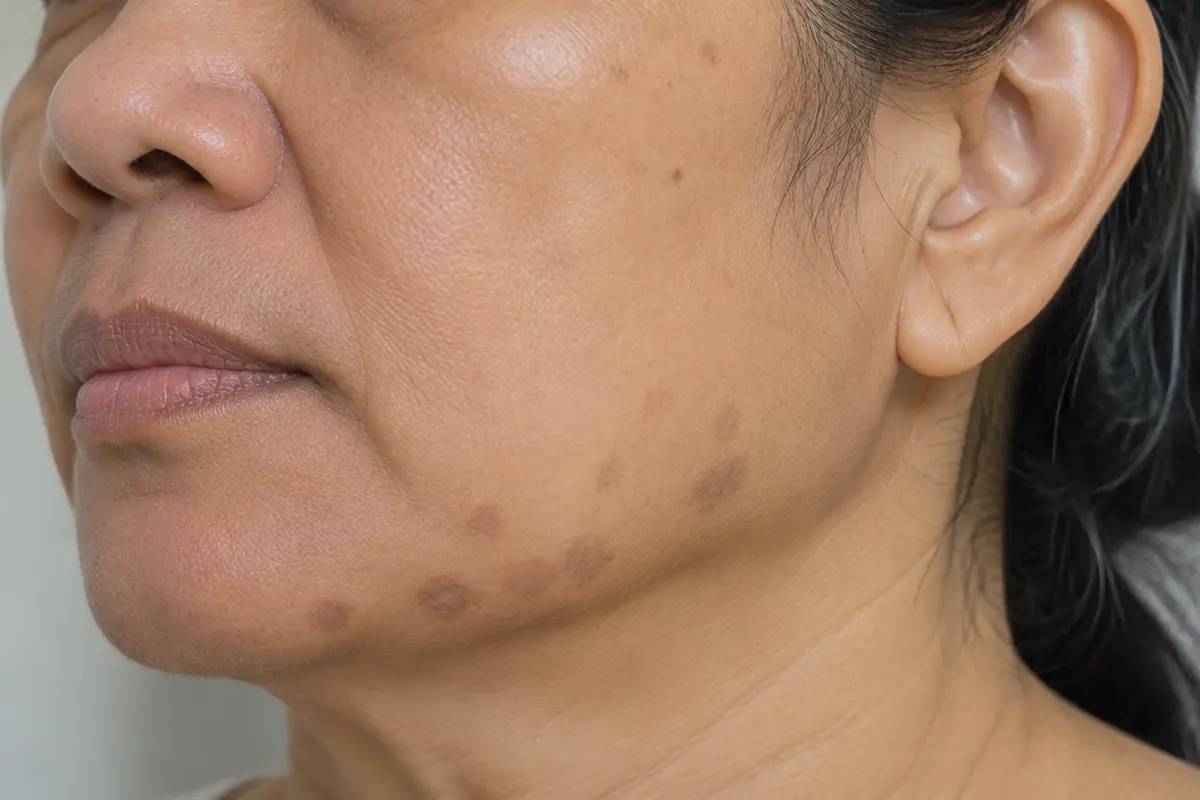
Skin quality is assessed in natural light. Illustrative image, not a patient.Marks left after inflammation fade slowly and can darken with sun. Illustrative image, not a patient.
Pigmentation removal: which laser is matched to which pigment, from spots to inflamed tone to raised lesions.
Laser for dark skin: which lasers are used with more care in Fitzpatrick IV to VI skin, and why test patches matter.
Nd:YAG laser: what the 1064 nm wavelength does, and where it is used for hair, veins and laser toning.
Pico laser for dark skin: why fluence matters more than the device, how PIH risk is managed, and who should wait.
Melasma — Symmetrical brown patches on the cheeks, forehead or upper lip that darken with sun and keep returning: melasma explained in depth —…
Brown Patches on the Face — Brown patches on the face may be melasma, sun spots, post-inflammatory marks or freckles; diagnosis comes before any laser.…
Post-Acne Marks (PIH) — Dark marks left behind by acne, insect bites, eczema or procedures: PIH explained — why Asian skin is prone, epidermal vs dermal…
Sun Spots & Freckles — Discrete brown spots on the cheeks, temples and hands: solar lentigines explained — how they differ from melasma, why they respond so well…
Hori’s Naevus (ABNOM) — Hori's naevus (ABNOM) is dermal cheek pigment often mistaken for melasma: why creams fail, how it is told apart, which wavelengths reach…
Dark Underarms — Underarm darkening often comes from shaving, friction or deodorant reactions, and can flag insulin resistance. The causes and the…
Redness and vessels
Rosacea & Facial Redness — Rosacea vs acne, perioral dermatitis and Demodex: how each looks, its triggers, what helps, what makes it worse, and why a diagnosis comes…
Facial Thread Veins — Vbeam and other vascular lasers for red veins on the face: how pulsed dye, KTP, long-pulsed Nd:YAG and IPL seal thread veins, and who tends…
Red Acne Marks (PIE) — Acne PIE is the flat red mark left after a pimple heals: dilated vessels, not pigment. How to tell PIE from brown PIH and what vascular…
Perioral Dermatitis — Small red bumps around the mouth, nose or eyes that flare every time you stop the steroid cream? Perioral dermatitis explained: causes, the…
Leg Veins — Bulging rope veins vs fine spider veins: chronic venous disease explained — the CEAP spectrum, when legs need a vascular…
Skin and lasers
R2T2 — R2T2 is Dr Sin Yong’s name for running his two tone protocols as one plan. R2 Glow uses long-pulsed 755 nm alexandrite and 1064 nm Nd:YAG…
FSX Laser — FSX Laser is Dr Sin Yong's Flawless Smooth Skin protocol in Singapore, using 1540 nm and 1927 nm wavelengths for pores, texture, fine lines…
Luminescence Laser — Skin tightening Singapore — Luminescence laser for skin, scar & hair. Dr Sin Yong, Orchard Road. WhatsApp +65 8023…
R2 Glow Laser — R2 Glow Laser Singapore — a non-ablative long-pulsed laser directed at the inflammation behind dull, uneven tone. Dr Sin Yong, Orchard…
Pico Laser — What picosecond laser does for sun spots, freckles and texture in Singapore, why pigment can darken afterwards in Asian skin, and who…
T2 Frax Radiance — Pico laser for pores in Singapore: what picosecond and thermal modes can and cannot do for pores, texture and pigment, and how T2 Frax…
少女光 Laser — 少女光 laser in Singapore with Dr Sin Yong: the DEKA RedTouch Pro at 675 nm, absorbed by collagen rather than water, used for redness, pores…
Alexandrite Laser — Long-pulsed 755 nm Alexandrite laser in Singapore by Dr Sin Yong — laser hair removal and selected pigmented…
Laser Toning — Skin brightening treatment in Singapore with laser toning: low-fluence 1064 nm Nd:YAG for uneven tone, PIH and melasma, and why it is not…
Melasma Treatment — Melasma is managed, not cured: diagnosis, heat and light control, daily photoprotection and cautious staged care. Doctor-performed, Orchard…
Pore Reduction — Enlarged pores treatment in Singapore, honestly framed: nothing shrinks a pore permanently, but lasers and skin care can refine…
Laser Hair Removal — Laser hair removal reduces regrowth by heating pigmented hair follicles; 755 nm or 1064 nm is chosen by skin type. Doctor-performed,…
Tattoo Removal — How laser tattoo removal works in Singapore: ink colours and wavelengths, why treatment is staged, skin type and pigment change, risks and…
Mole Removal — Mole Removal Singapore: every mole is scoped with a dermatoscope first. ABCDE warning signs, red moles, removal options and when histology…
Acne Treatment — Acne treatment starts with grading: comedonal, inflammatory or cystic. Dr Sin Yong explains the ladder from skincare to prescription to…
Back Acne Treatment — Bacne treatment starts with telling acne from fungal folliculitis, because they need different medicines. Doctor-performed, Orchard…
Pigmentation: what causes it, how it is diagnosed and prevented
Why pigmentation forms
Pigment cells make more melanin when skin is exposed to sun, heat and visible light, after inflammation such as acne, with hormonal changes and with age. In Asian skin, pigment cells react strongly, so dark marks form easily and fade slowly.
How the type is diagnosed
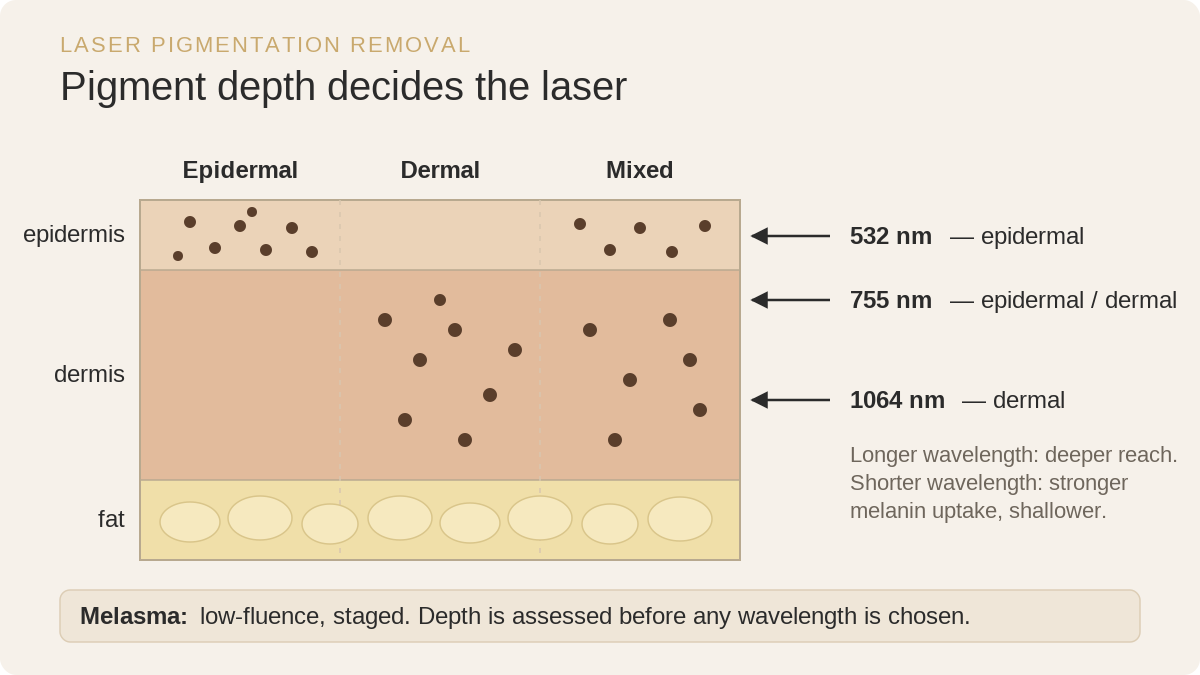
A doctor looks at the colour, pattern and depth, often under a Wood’s lamp or magnification. Brown pigment sits higher in the skin; grey-blue pigment sits deeper. The type decides whether creams, lasers or both are used.
Preventing new pigmentation
Daily broad-spectrum sunscreen with re-application, tinted sunscreen that blocks visible light, hats and shade, treating acne early and avoiding picking or harsh scrubs. Without prevention, treated pigment tends to return.
Ask about Pigmentation and redness
Leave your name, mobile number and email and the clinic will contact you directly.
Thank you — your enquiry has been received. The clinic will contact you during opening hours (Mon–Fri 10am–8pm, Sat 11am–3pm).
The wrong laser makes it worse. I see people whose pigmentation is worse after treatment than before it. Here's how that happens. Melasma responds badly to heat and aggression. Turning the energy up feels like progress and often triggers rebound, darker than the starting point. That's why I'm conservative here and take it slowly. If your pigmentation got worse after a session, stop, and get it reassessed before booking the next one.
Transcript of Dr Sin Yong's video, lightly edited for reading.
When to see a doctor about pigmentation
Any spot that is new, changing in size, shape or colour, has an irregular border, itches or bleeds should be examined by a doctor before it is lasered, because a laser can hide a lesion that needed a biopsy.
Darkening that spreads over the body, appears with tiredness or weight change, or follows a new medicine should be assessed medically before any cosmetic treatment.
Pigmentation treatment: how the options compare
Pigmentation treatment is matched to the type and depth of pigment, so a cream, a laser or a combination may be right for different spots on the same face.
Prescription creams
Lightening creams calm pigment production and suit melasma and marks after acne; they work over months and need sun protection alongside.
Pico laser
The Fotona PQX pico laser, from $450 here, breaks sun spots, freckles and deeper pigment into fine particles the body clears; most spots need one to three sessions, and melasma is treated only at gentle settings.
Sun protection and maintenance
Daily broad-spectrum sunscreen, hats and shade keep results; without them, most pigment returns.
Table: Sun protection and maintenance
Treatment
Tends to suit
Sessions
Downtime
Prescription lightening cream
Melasma, marks after acne
Daily for months
Mild dryness or irritation
Pico laser (Fotona PQX)
Sun spots, freckles, deeper pigment
Often 1 to 3
Darkening and flaking for about a week
Low-energy pico laser
Melasma, alongside creams
A series
Mild redness for hours
Pigmentation disorders, explained · Dr Sin Yong · reviewed 20 November 2026
Skin pigmentation disorders: darker patches, lighter patches and the treatment for each
Pigmentation disorders are conditions in which skin turns darker (hyperpigmentation) or lighter (hypopigmentation) than its surroundings. Most darker patches are harmless and treatable; lighter patches need a different assessment, because some are medical conditions.
Sun exposure, hormones, inflammation and genetics prompt pigment cells to make more melanin, which collects in the upper skin or deeper in the dermis; deeper pigment is slower to treat.
02
Maintenance and prevention
Daily broad-spectrum sunscreen, reapplied outdoors, with hats and shade, is the foundation; without it, most pigment returns. Maintenance laser or creams keep melasma in check.
03
Oral medication
Oral tranexamic acid can help some people with stubborn melasma. It is prescribed only after checking for clotting risks and only when it suits you.
04
Q-switched, ruby and pico lasers
Q-switched and ruby lasers break pigment with nanosecond pulses; pico lasers use shorter picosecond pulses with less heat. Here, pigment is treated with the Fotona PQX pico laser, from $450 per session.
Common pigmentation conditions
Condition
What it looks like
Main treatments
Melasma
Symmetrical brown patches on the cheeks, forehead or upper lip
Sun protection, creams, oral tranexamic acid where suitable, gentle laser
Sunspots (solar lentigines)
Flat brown spots on sun-exposed skin
Pico laser and sun protection
Freckles
Small light-brown spots that darken in the sun
Pico laser and sun protection
Post-inflammatory hyperpigmentation
Dark marks after acne, injury or eczema
Creams, gentle laser and treating the cause
Hori's naevus (ABNOM)
Blue-grey or brown spots on the cheeks, deeper in the skin
Some spots, such as sun spots and Hori’s naevus, can clear well. Melasma and post-inflammatory marks can be lightened but may return, so maintenance is part of the plan.
Identify the type first: freckles, sun spots, melasma, post-acne marks or Hori’s naevus each need a different plan. Daily sunscreen is the base. Creams, pico laser and peels are then chosen by type and skin colour, as the wrong laser can darken some pigmentation.
Most pigmentation comes from sun exposure. Hormones drive melasma, inflammation from acne or injury causes post-inflammatory marks, and genetics plays a part in freckles and Hori’s naevus.
Some does. Post-acne marks often fade over months. Sun spots, Hori’s naevus and melasma usually persist without treatment, and melasma tends to return without maintenance.
Pigmentation is the colour of the skin from melanin. When people talk about pigmentation they usually mean hyperpigmentation: patches or spots darker than the surrounding skin.
R2T2, his combined laser protocol: R2 Glow for the inflammation that drives pigment, T2 Frax Radiance for the deposit. The map of the pigment under polarised light at the first visit decides whether both halves, one half or no laser is used.
Cautiously. Melasma starts with sun protection and medical treatment; if laser is used at all it begins with R2 Glow alone, because aggressive laser can darken melasma.
Start with the pattern: patchy brown on both cheeks suggests melasma, small flat spots suggest sun spots or freckles, marks after acne suggest post-inflammatory hyperpigmentation, and redness suggests a vascular cause. A doctor confirms the type.
Sun, hormones, inflammation and ageing.
Many types can be lightened or removed; some recur.
Lasers, creams, peels and strict sun protection.
Daily sunscreen, hats and avoiding peak sun.
Yes. Asian skin has more active pigment cells, so it tans readily and is more prone to melasma, post-inflammatory marks after acne or injury, and Hori's naevus. It also reacts more to aggressive lasers, which is why settings are chosen conservatively.
For sun spots and freckles, a pico laser usually shows the quickest change, often within one to three sessions. Melasma responds more slowly and needs creams, gentle laser and strict sun protection.
It depends on the type: pico laser for sun spots and freckles; combined creams, oral tranexamic acid and gentle laser for melasma; and time with gentle treatment for post-acne marks. Pico laser here is from $450 per session.
Sun spots can lighten within one to two weeks after a pico laser session. Melasma and post-inflammatory marks fade more slowly over weeks to months, and rushing with strong treatment can make them darker.
Vitamin C serums lighten mild pigmentation gradually and help protect against oxidative damage, but they rarely clear established spots on their own.
With frequent low-energy laser toning, brightening ingredients such as niacinamide and tranexamic acid, and strict sun protection; aggressive treatment is avoided to prevent rebound darkening.
They are conditions in which skin becomes darker or lighter than its surroundings, such as melasma, sunspots, freckles and marks after acne, or white patches such as vitiligo. Darker patches are usually harmless; lighter patches need medical assessment.
Often, if the cause continues: sun exposure brings back sunspots and freckles, and hormones and heat bring back melasma. Daily sun protection and maintenance treatment keep it under control.
Hyperpigmentation is skin darker than its surroundings, from extra melanin; hypopigmentation is lighter skin, from less melanin or fewer pigment cells. They have different causes and treatments.
It cannot be judged reliably from a photo. Freckles, sun spots, melasma, post-acne marks and Hori's naevus can look alike and often overlap. Dr Sin Yong examines the skin under magnification and good light to identify the type before recommending treatment.
Expected effects are redness, mild swelling and temporary darkening or fine crusting of the treated spots. The main risks in Asian skin are post-inflammatory hyperpigmentation and, less often, lighter patches, which is why settings are matched to pigment type and skin tone.
References
Torbeck RL, Schilling L, Khorasani H, Dover JS, Arndt KA, Saedi N. Evolution of the picosecond laser: a review of literature. Dermatol Surg. 2019;45(2):183-194. doi:10.1097/DSS.0000000000001697. source
Chan JC, Shek SY, Kono T, Yeung CK, Chan HH. A retrospective analysis on the management of pigmented lesions using a picosecond 755-nm alexandrite laser in Asians. Lasers Surg Med. 2016;48(1):23-29. doi:10.1002/lsm.22443. source
Mese Say E, Okan G, Gökdemir G. Treatment outcomes of long-pulsed Nd:YAG laser for two different subtypes of rosacea (n=66). J Clin Aesthet Dermatol. 2015;8(9):16-20. source
Peer-reviewed papers on this topic, listed for background reading. They report published research in general and are not a statement about results at this clinic.
Kaufman BP, Aman T, Alexis AF. Postinflammatory Hyperpigmentation: Epidemiology, Clinical Presentation, Pathogenesis and Treatment. Am J Clin Dermatol. 2018;19(4):489-503. PubMed 29222629 · DOI
Sarkar R, Desai SR, Sinha S, et al. Delphi consensus on melasma management by international experts and pigmentary disorders society. J Eur Acad Dermatol Venereol. 2026;40(4):680-692. PubMed 40996222 · DOI
Auffret N, Leccia MT, Ballanger F, et al. Acne-induced Post-inflammatory Hyperpigmentation: From Grading to Treatment. Acta Derm Venereol. 2025;105:adv42925. PubMed 40263971 · DOI