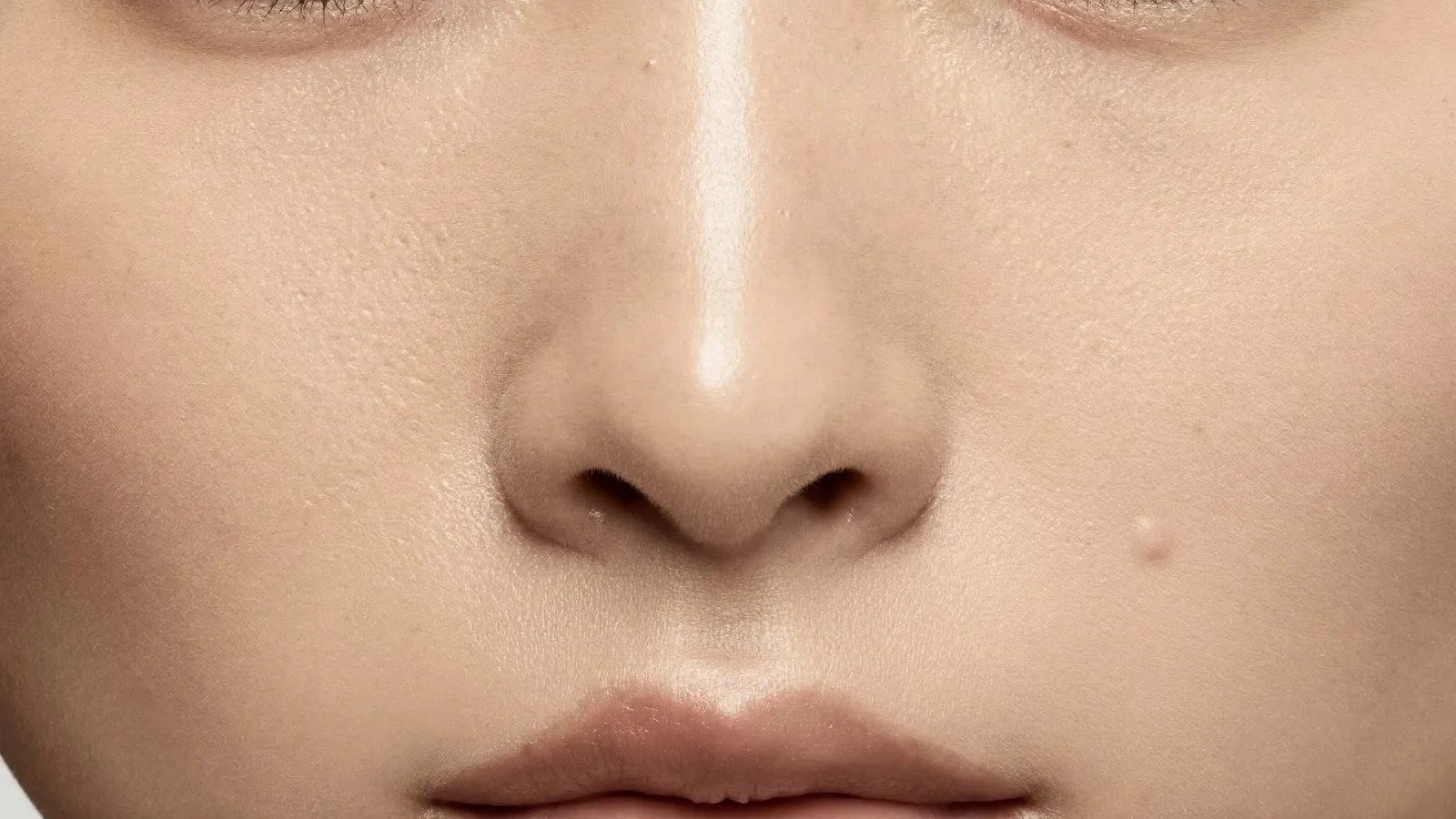
Nothing shrinks a pore: it is the fixed opening of a hair follicle and its oil gland, and its baseline size is largely genetic. What helps is making each opening less visible by controlling oil and debris, repairing an over-cleansed surface, protecting from sun and rebuilding the collagen that holds pores taut, with fractional laser or RF microneedling in clinic.
Key facts
- What a pore is
- The surface opening of a pilosebaceous unit — the follicle and its sebaceous gland
- Baseline size
- Largely genetically determined; pores are anatomy, not a flaw that appears with neglect
- Sebum
- Higher sebum output is associated with greater pore visibility — oil distends the opening from within
- Perifollicular support
- Collagen around each follicle holds the opening taut; loss of that support lets pores read larger with age
- Barrier disruption
- Over-cleansing and over-exfoliation inflame the surface and can increase oil activity — the opposite of the intent
- FSX dual wavelengths
- 1540 nm reaching the dermis and 1927 nm acting superficially — two depths addressed in one fractional protocol
- Fitzpatrick III–V
- The predominant skin types in Singapore, where conservative fractional settings guard against post-inflammatory pigmentation
Nothing shrinks a pore — start there
Any honest page about enlarged pores treatment in Singapore has to open with the sentence the industry avoids: nothing shrinks a pore. A pore is not a blemish that appeared and can be persuaded to leave. It is the surface opening of a pilosebaceous unit — the follicle and the sebaceous gland that serves it — and it is a fixed, necessary piece of anatomy. Skin without pores would be skin without oil delivery, and it does not exist.
Baseline pore size is largely genetically determined. Some skins are simply built with more prominent openings, particularly oilier skins and often more so in the central face — and no cleanser, primer, laser or promise rewrites that inheritance. When a product claims to shrink pores, it is describing a temporary optical effect: swelling the surrounding surface slightly, sitting in the opening, or blurring light. The anatomy underneath is unchanged.
None of this means the complaint is untreatable. It means the treatable thing is not the pore itself but everything around and inside it — how far the opening is stretched, and how much the surrounding skin holds it taut. That reframing sounds like pedantry. It is actually the entire plan.
“Nothing shrinks a pore. Anything claiming to is selling you the appearance of one.”
Dr Sin YongOn the claim the industry avoids testing
What actually changes how a pore looks
Three variables do most of the work. The first is what fills the opening. Sebum output correlates with pore visibility — a productive gland distends its opening from within, and oxidised debris sitting in the opening draws the eye to it. This is why pores read larger in oilier skin, in humid months, and through the central face where glands are densest.
The second is what surrounds the opening. Each follicle is held taut by the collagen around it — perifollicular support. As dermal collagen declines with age and ultraviolet exposure, that support slackens, and openings that were once held tight begin to gape and lengthen. This is the reason pores seem to enlarge through the forties and fifties even when oil output is falling: the frame is loosening, not the opening growing.
The third is the surface the light lands on. A smooth, hydrated surface reflects evenly and understates its own texture; a rough, dehydrated or inflamed one exaggerates every irregularity, pores included. The same anatomy can read very differently from one month to the next depending on the condition of the skin around it — which is precisely the lever honest treatment pulls.
The over-cleansing trap, and the company pores keep
The commonest self-treatment for pores is also the most counterproductive: scrubbing, stripping and exfoliating the area into submission. A disrupted barrier is a dehydrated, low-grade inflamed surface — exactly the surface that exaggerates texture — and stripped skin frequently answers with more oil activity, not less. The harder the routine works, the worse the pores read. If your regimen for pores keeps escalating and the mirror keeps disappointing, the regimen is usually the problem. The first prescription is often subtraction, and it is one nobody profits from.
It is also worth naming the company pores keep. Prominent pores and acne scarring frequently arrive together on the same cheeks, because both trace back to the same oily, inflammation-prone follicular units — and the two complaints are routinely tangled in the mirror, dilated openings sitting beside true atrophic scars. They are different problems with different mechanics, and separating them changes the plan: scarring calls for its own assessment and scar-by-scar approach, while pore visibility follows the levers above. Treating one while calling it the other is a common reason people conclude that nothing works.
What treatment can honestly offer
Sensible treatment works the three levers, not the pore. Oil and debris respond to measured, boring consistency — appropriate cleansing, evidence-based topicals where indicated, and restraint. The surface responds to hydration and barrier repair. The frame — perifollicular collagen — is where clinic treatment earns its place: fractional laser resurfacing provokes a collagen response in the dermis around the follicles, so firmer skin holds each opening tighter and the whole field reads finer.
In my practice that dermal work is done with the FSX protocol, which pairs a 1540 nm wavelength reaching the dermis with a 1927 nm wavelength acting superficially — support and surface addressed in one plan. Where pigment irregularity sits alongside texture, a picosecond fractional approach such as T2 Frax Radiance may be the better fit. In Fitzpatrick III to V skin, settings stay deliberately conservative, because provoked pigmentation is a worse problem than the pores were. Response varies between individuals and is assessed rather than promised.
What I will not offer is smaller pores. Less visible is achievable and worth pursuing; smaller is not on the menu, here or anywhere else — and a clinic that promises it has told you something useful about its relationship with mechanism.
Why this page has no before-and-after images
Pore treatment marketing leans heavily on imagery, so the absence here deserves a direct answer.
Under Singapore's Healthcare Services Act, before-and-after imagery in advertising for licensable healthcare services is prohibited. No consent form or disclaimer creates an exemption, and after-only images fall under the same rule. This applies identically to every licensed clinic in Singapore — a site displaying such images is not demonstrating better results, only weaker compliance. It is worth adding that pore photography is uniquely easy to manipulate with lighting and focus, which makes the rule less of a loss than it seems.
What can be done instead is an examination of your own skin under magnification, where oil, debris, support and any coexisting scarring can be separated in person.
What determines the cost
Prices for licensable healthcare services cannot be advertised in Singapore, including as ranges or “from” figures. What can be set out is what the cost depends on.
The factors are the area being treated, what the assessment finds — how much of the complaint is oil and surface, how much is lost perifollicular support, and whether acne scarring coexists — whether a single modality or a staged combination is indicated, and how the plan is sequenced over time. A localised textural complaint and a combined plan addressing pores, scarring and pigment together are not comparable pieces of work. Fees are set out in full at consultation, once there is something specific to cost.
The part worth saying first
A pore is anatomy, and its baseline size is largely inherited. What treatment can honestly change is how far each opening is stretched — by oil and debris from within, and by slackening collagen support around it — and how the surrounding surface presents it to the light. Less visible is a real and reasonable goal; smaller is a marketing claim.
The useful consultation separates oil, support, surface and any coexisting scarring before recommending anything. Dr Sin Yong — MBBS (NUS), MRCS (Edinburgh), MSc Aesthetic Medicine with Distinction (Queen Mary, London), MSc Practical Dermatology (Cardiff) — examines the skin personally on Orchard Road, and will say plainly which part of your complaint is treatable mechanics and which part is simply your anatomy, working as designed.