Acne scar facial in Singapore: what a facial can and cannot do for a scar
Medically reviewed by Dr Sin Yong · Last reviewed · 8 min read
Published 13 October 2026 · Reviewed by Dr Sin Yong
An acne scar facial Singapore salons and spas advertise works on the surface of the skin, and an acne scar sits in the dermis beneath it, which is why a facial cannot treat a scar. That is not a criticism of facials: cleansing, light exfoliation, hydration and sun protection keep the surface comfortable and help the flat marks between scars. What they cannot do is change the depth of a pit, release a tether or rebuild a scar floor; that is where medical acne scar removal Singapore begins.
Short answerA facial acts on the epidermis and the uppermost dermis. A depressed acne scar is a structural change in the dermis, a missing column of tissue, a tethered band or a narrow tract, below where a facial reaches. Facials can help texture feel smoother and support pigment maintenance between medical sessions; they cannot treat the scar itself. The acne scar treatment Singapore guide sets out what does.
Acne scar facial Singapore: the boundary in one sentence
A facial works on the surface; a scar is in the dermis. Everything else on this page follows from that. Facials are a legitimate part of skin care, and many people with old acne find them worthwhile for comfort, hydration and the feel of the skin. But the word scar describes a structural change in the dermis: a narrow tract where a column of collagen was lost, a flat-floored box where tissue was punched out, a broad dip held down by a fibrous band in the subcutaneous plane (Jacob 2001). None of those sits where a facial reaches. A facial advertised as acne scar removal, acne scar treatment or scar reduction is promising a change in a layer it does not touch. The acne scar treatment Singapore guide sets out what does reach that layer; this page draws the line between the two.
What a facial actually does
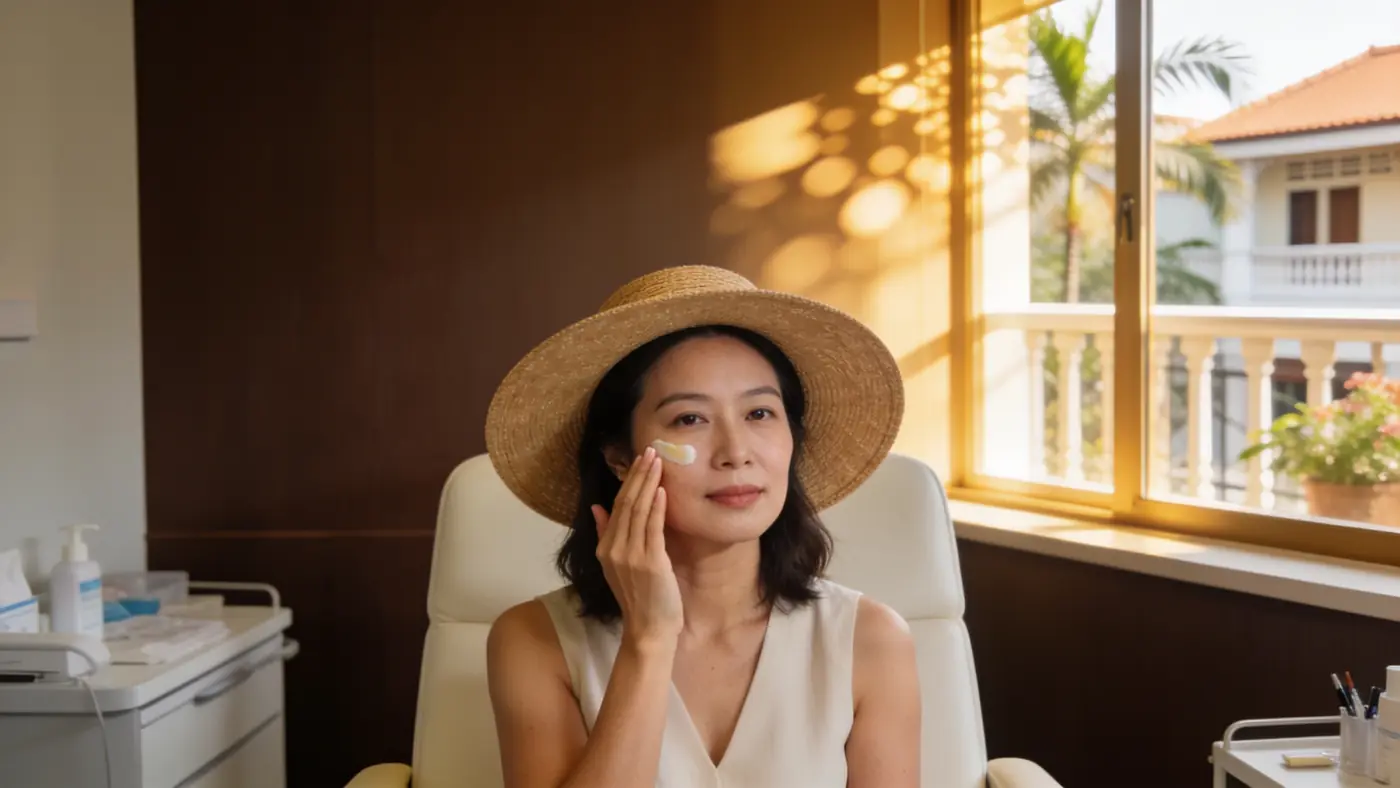
A facial cleanses, exfoliates the outermost layer of dead cells, hydrates, and may include steam, extraction of comedones, massage and a mask. Light chemical exfoliation in a facial loosens surface cells to a shallow depth; it brightens and smooths the surface but does little for dermal collagen. Some facials add light-based or device steps marketed for scars; the useful question for any of them is which layer they reach and at what energy, because a treatment gentle enough to be done without a doctor is, by design, acting on the surface. None of this is useless. Skin that is clean, hydrated and protected from the sun looks better and feels better, and the flat brown or red marks that sit between scars fade more readily on well-cared-for skin. It is maintenance, and it should be called that.
Daily sun protection is the one part of maintenance that every scar plan depends on, between stages and after them.
Why a facial cannot treat a scar
Because the three things a scar needs all happen below the surface. A tethered rolling scar is held down by a band beneath the dermis, and the only thing that changes it is dividing the band, which is what subcision does with a needle through a puncture under local anaesthetic (Orentreich 1995). An ice-pick scar is a well deeper than it is wide, and nothing applied across the surface reaches its floor; TCA CROSS places a microdroplet of high-strength acid into the pit itself (Lee 2002). A boxcar has a step at its edge and a floor below the skin, and softening the step means controlled injury into the dermis, which is what fractional laser does, with the S3 Resurfacing Lift for deep scars and FSX Laser for superficial ones, where its shorter recovery than S3 matters. Each of these is a medical procedure performed by a doctor, with local anaesthetic, defined recovery and defined risks. A facial has none of those, which is exactly why it cannot do what they do.
What a facial can do for texture and pigment maintenance
Where facials earn their place is around the edges of a medical plan. Between stages, when the skin has healed from a resurfacing session and is waiting for the next, gentle cleansing, bland hydration and daily sun protection are what the aftercare asks for anyway, and a facial that does only those things is compatible with it. The flat marks that outlast acne, brown post-inflammatory hyperpigmentation and red post-inflammatory erythema, are pigment and vessel problems rather than scars, and while they are treated medically with picosecond and vascular settings, their maintenance is surface care and sun avoidance, which a facial can support. Fine surface texture that is roughness rather than scarring can feel smoother after exfoliation. What should not happen is strong exfoliation, heat or active treatment on skin that is still healing from resurfacing or still bruised from subcision; the clinic says when actives and treatments can resume, and a facial should wait for that.
Facial versus medical acne scar treatment: what reaches which layer
Facial
Medical acne scar treatment
Layer reached
Epidermis and surface
Dermis and subcutaneous plane
Changes scar depth
No
Yes: subcision, TCA CROSS, S3 Resurfacing Lift, FSX Laser, RF microneedling, by scar type
Helps flat brown or red marks
Supports fading with sun protection and surface care
Picosecond 785 nm for pigment; vascular settings for redness
Helps surface roughness
Yes, temporarily, by exfoliation and hydration
Yes, structurally, by remodelling the dermis
Releases a tether
No
Subcision
Who performs it
Therapist or beautician
Dr Sin Yong himself
Anaesthetic, recovery, risks
None of note
Local anaesthetic; defined recovery; defined risks explained beforehand
Role in a scar plan
Maintenance between and after stages, when the skin has healed
The plan itself
Where medical treatment starts
Medical acne scar treatment starts with an examination, not a device: each scar is graded under side light with the skin stretched, sorted into ice-pick, boxcar, rolling and raised, and assigned to the step it needs. The sequence for mixed scarring is Dr Sin Yong’s 4D Scar Reconstruction: release by subcision, support with Radiesse where volume is lost, TCA CROSS into ice-pick pits, then resurfacing by depth with the S3 Resurfacing Lift or FSX Laser, with RF microneedling on the Secret DUO staged where the surface calls for it (Syder 2023). Active acne is controlled first. Every step is performed by Dr Sin Yong himself on Orchard Road, and the plan is written down with its fee factors before anything begins; what a scar visit on Orchard Road involves and what sets the fee describe the visit and the fee. Who treats acne scars in Singapore, and what to check, is on the who treats acne scars in Singapore page.
The honest boundary
There is one question that sorts facials from scar treatment: which layer does this reach? If the answer is the surface, it is maintenance. It may be good maintenance, it may make the skin feel and look better for a while, and it may be exactly what you want. It is not scar treatment, and a place that sells it as scar treatment is describing a layer it does not touch. Equally, a medical scar plan does not replace surface care: sun protection, gentle cleansing and bland hydration are part of every stage’s aftercare, and the flat marks between scars depend on them. The two belong to different layers and different hands, and knowing which is which is most of the decision. The full index of every acne and scar guide on this site is one click away.
“Ask what layer it reaches. A facial reaches the surface. A scar lives below it.”
Dr Sin YongOn facials and acne scars
Dr Sin Yong explains
I am not against facials. Clean, hydrated, sun-protected skin is what I ask for between every stage of a scar plan, and if a facial gives you that, good. What I will not do is let the word scar be attached to something that works on the surface. The scars I treat are in the dermis and below: a band I have to cut with a needle, a well I have to put acid into, a box I have to resurface with the right laser for its depth. No facial does any of that, and no one should tell you it does. If you have had facials for your scars and the texture of your skin is better but the dimples are the same, that is not a failure of the facial. It is the boundary, and the next step is an examination.
Your next step
1. MessageWhatsApp +65 8023 7170 with what is bothering you. A reply comes from the clinic, not a bot.
2. AssessmentDr Sin Yong examines you himself on Orchard Road, with ultrasound where earlier filler is involved.
3. A plan in writingWhat he would do, what he would not, the fee factors, and the option of no treatment.
Every treatment is performed by Dr Sin Yong personally. Singapore Medical Council registered · invited to share his clinical expertise internationally as a Key Opinion Leader for CLASSYS, DEKA, Fotona, HIRONIC and ILOODA · HSA-registered devices · ultrasound-guided correction
No. A facial works on the epidermis and surface; a depressed acne scar is a structural change in the dermis, a tethered band, a narrow tract or a punched-out floor, below where a facial reaches. Facials can keep the surface comfortable and support the fading of flat marks, but changing scar depth needs subcision, TCA CROSS or fractional laser, performed by a doctor.
As maintenance, yes. Gentle cleansing, hydration and sun protection are what scar aftercare asks for anyway, and the flat brown or red marks between scars fade more readily on well-cared-for skin. A facial should not include strong exfoliation or heat on skin still healing from resurfacing or bruised from subcision; the clinic says when treatments can resume.
The layer reached. A facial cleanses, exfoliates and hydrates the surface. Medical acne scar treatment works in the dermis and below: subcision releases tethers, TCA CROSS rebuilds ice-pick floors, the S3 Resurfacing Lift or FSX Laser resurfaces by depth and RF microneedling remodels the dermis. The former is performed by a therapist; the latter by Dr Sin Yong himself.
Flat brown marks are post-inflammatory pigment rather than scars. They are treated medically with picosecond settings, and their maintenance is surface care and daily sun protection, which a gentle facial can support. Harsh exfoliation or heat on pigment-prone skin can darken marks, so gentleness matters.
After resurfacing or subcision the skin needs gentle cleansing, bland moisturiser and sun protection only, with scabs left to shed and no actives, heat or strong exfoliation until the clinic says the surface has healed. A facial that respects that can resume once you are told actives may restart; Dr Sin Yong advises on timing at review.
With an examination. Each scar is graded under side light with the stretch test and sorted by type, then assigned to subcision, TCA CROSS, the S3 Resurfacing Lift, FSX Laser or RF microneedling. Active acne is controlled first. The plan is written down with its fee factors and every step is performed by Dr Sin Yong on Orchard Road.
References
Jacob CI, Dover JS, Kaminer MS. Acne scarring: a classification system and review of treatment options. J Am Acad Dermatol. 2001;45(1):109-117. doi:10.1067/mjd.2001.113451. source
Orentreich DS, Orentreich N. Subcutaneous incisionless (subcision) surgery for the correction of depressed scars and wrinkles. Dermatol Surg. 1995;21(6):543-549. doi:10.1111/j.1524-4725.1995.tb00259.x. source
Lee JB, Chung WG, Kwahck H, Lee KH. Focal treatment of acne scars with trichloroacetic acid: chemical reconstruction of skin scars method. Dermatol Surg. 2002;28(11):1017-1021. doi:10.1046/j.1524-4725.2002.02095.x. source
Syder NC, Chen A, Elbuluk N. Radiofrequency and radiofrequency microneedling in skin of color: a review of usage, safety, and efficacy. Dermatol Surg. 2023;49:489. doi:10.1097/DSS.0000000000003733 (PMID 36826381). source