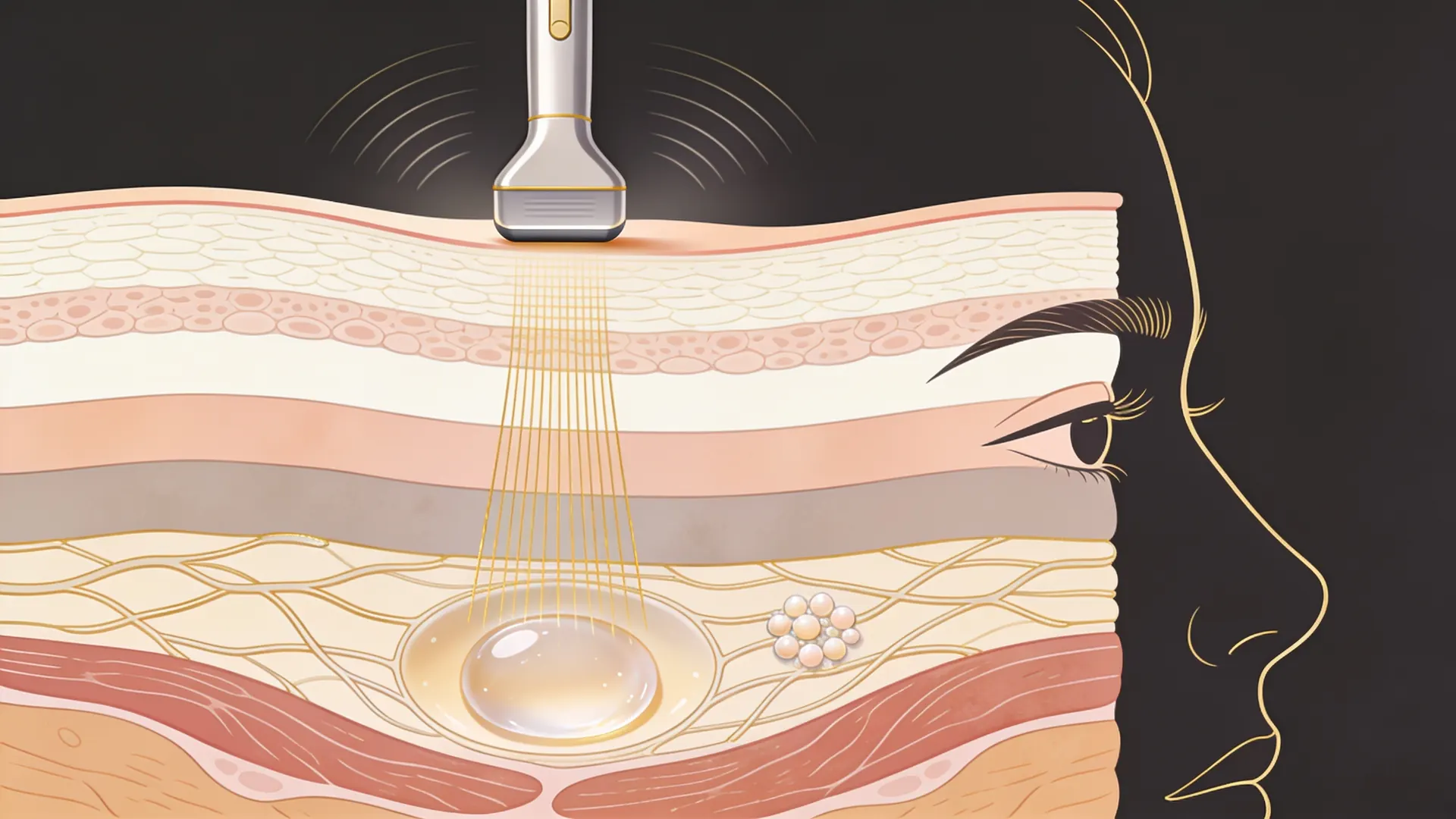
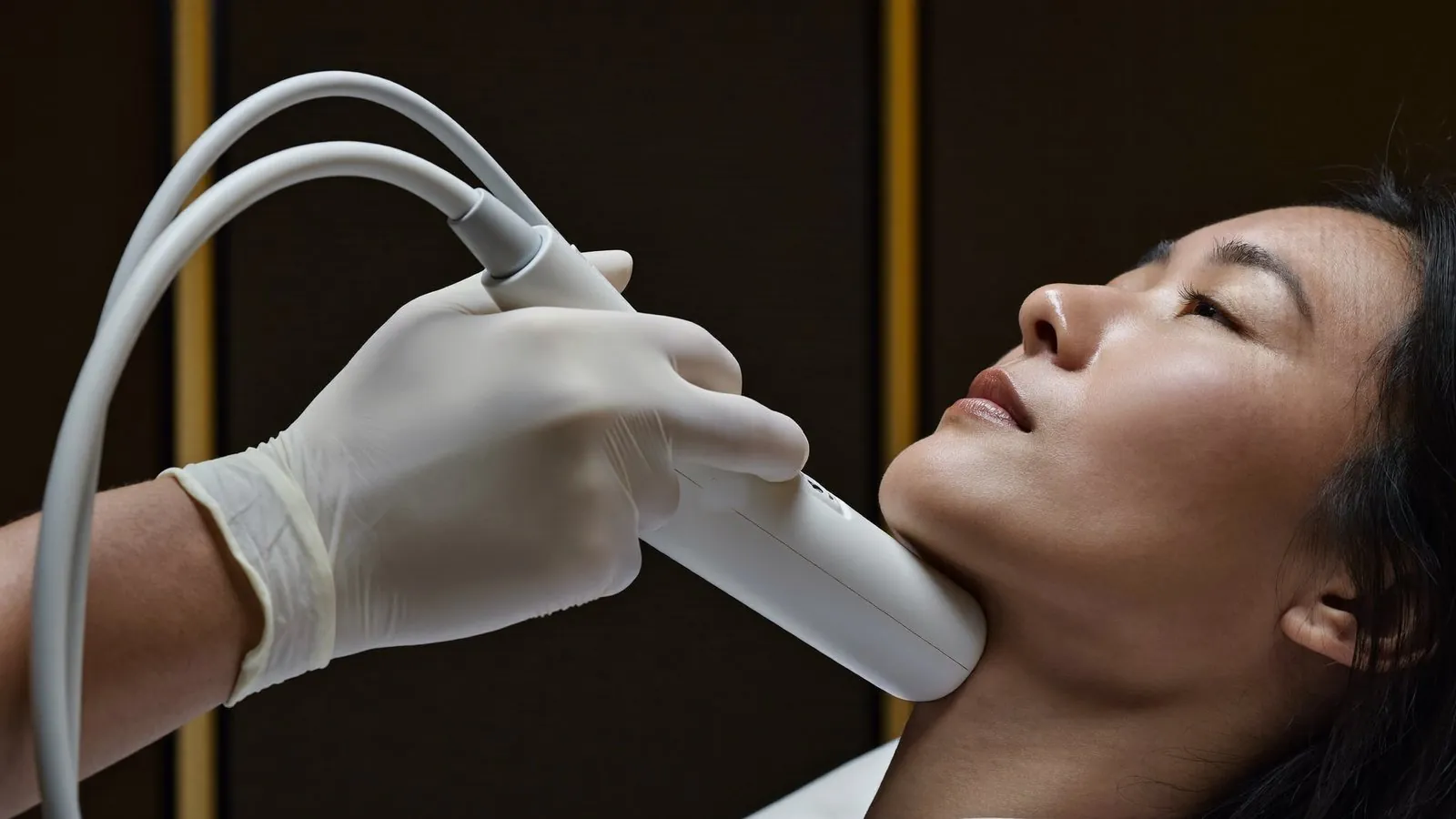
HIFU vs radiofrequency is not a contest between rivals, because they heat tissue differently. High-intensity focused ultrasound places discrete thermal points at set depths, down to the SMAS layer, while monopolar radiofrequency heats the dermis broadly. Which suits a face depends on whether the problem is deeper support, skin quality and laxity, or both.
Key facts
- HIFU delivery
- High-intensity focused ultrasound converged to a point, producing discrete thermal coagulation zones at fixed depths
- HIFU focal depths
- Transducers focused at 1.5 mm, 3.0 mm and 4.5 mm — the deepest reaching the SMAS layer
- Temperature at the focus
- Approximately 60–70°C at each coagulation point — the threshold for collagen denaturation — with tissue between points spared
- SMAS
- The superficial musculoaponeurotic system — the fibromuscular layer tightened in surgical facelifts
- Monopolar RF delivery
- A 6.78 MHz electrical field heating the dermis volumetrically — broad, bulk heating rather than discrete points
- RF effective depth
- Heating concentrated in the dermis and subdermal tissue, to roughly 4.3 mm depending on tip and technique
- Imaging
- Ultrasound-visualised platforms (such as Ultherapy) display the tissue layers before energy is delivered
- Shared endpoint
- Controlled thermal injury → collagen denaturation → new collagen formation over the months that follow
Why "which is better" is the wrong question
Comparison articles on this subject usually build a table — pain, price, downtime — and crown a winner. That framing fails at the first step, because it assumes the two technologies compete for the same tissue.
They do not. High-intensity focused ultrasound places small, discrete points of heat at precise depths, down to the layer a facelift tightens. Monopolar radiofrequency spreads heat broadly through the dermis, treating skin quality and laxity as a volume rather than a set of points. One is an awl; the other is an iron. Nobody asks which of those two tools is better — they ask what needs doing.
I say this from an unusual position: I am an international key opinion leader for manufacturers in both categories, invited to share my clinical expertise, and I use both in my own clinic. I have no commercial reason to talk one technology down, and no intention of doing so. What I refuse to do is pretend they are interchangeable.
“HIFU or radiofrequency is the wrong question. They do not do the same job.”
Dr Sin YongOn the commonest comparison request
What focused ultrasound actually does
HIFU works on the same principle as a magnifying glass focusing sunlight. Ultrasound passes harmlessly through the surface and converges at a focal point, where the concentrated energy produces a small zone of thermal coagulation — roughly 60–70°C, the temperature at which collagen denatures and contracts. Everything between the surface and the focus is largely spared.
The transducers are built to fixed focal depths — typically 1.5 mm for the superficial dermis, 3.0 mm for the deep dermis, and 4.5 mm to reach the SMAS, the fibromuscular layer that surgical facelifts tighten. The foundational work by White and colleagues demonstrated precisely this: discrete thermal injury zones created within the SMAS using focused ultrasound, without opening the skin.
That depth is HIFU's defining capability. No cream, no surface treatment and no broad dermal heating reaches the SMAS. When the assessment finds laxity at that structural layer, focused ultrasound is one of the few non-surgical tools with a mechanism that plausibly addresses it. On imaging-guided platforms such as Ultherapy, the tissue layers are visualised on ultrasound before energy is delivered, so each line of treatment is placed where the anatomy actually is rather than where an applicator assumes it to be. How I use these platforms is set out on my HIFU page.
What monopolar radiofrequency actually does
Radiofrequency takes the opposite approach to the same underlying biology. Instead of converging energy to a point, a monopolar device such as Thermage passes a 6.78 MHz electrical field through the tissue; resistance to that current generates heat within the dermis itself, while the surface is protected by cooling. Nothing is focused, because nothing needs to be — the target is the layer as a whole.
The result is volumetric heating — a broad, bulk warming of the dermis and the tissue immediately beneath it, effective to roughly 4.3 mm depending on the treatment tip and technique. Rather than a grid of discrete injury points at one depth, RF conditions a whole volume of dermal collagen: immediate contraction of existing fibres, followed by a longer remodelling response as fibroblasts lay down new collagen.
That makes dermal quality RF's natural territory — skin that is thinning, crepey or loosely draped, where the problem is distributed through the layer rather than concentrated at a structural plane. It is also why the two technologies pair logically rather than compete: one addresses the deeper support layer with points, the other conditions the dermal envelope as a volume. My approach to monopolar RF is set out on the Thermage page.
HIFU vs monopolar radiofrequency at a glance| Feature | HIFU (focused ultrasound) | Monopolar radiofrequency |
|---|
| Heating pattern | Discrete thermal points at focal depths; tissue between is spared | Broad volumetric heating of the dermis, surface protected by cooling |
| Depth | 1.5, 3.0 and 4.5 mm; the deepest reaches the SMAS | Dermis and tissue beneath, to roughly 4.3 mm |
| Tissue problem it matches | Laxity at the SMAS and deeper support layer | Thinning, crepey or loosely draped skin |
| Sensation | Brief, deep points of heat or ache per line | Waves of surface-protected warmth |
| Neither suits | Volume loss, which heating cannot refill | Volume loss, which heating cannot refill |
| How they fit together | Addresses the deeper support layer with points | Conditions the dermal envelope; staged with HIFU where both are found |
| Decided by | Examination of which layer is failing | Examination of which layer is failing |
Different tissue problems, so assessment picks the device
Loose skin is not one diagnosis. Under examination, what a patient calls sagging separates into distinct findings: laxity at the SMAS and deeper support, laxity within the dermis itself, volume loss masquerading as looseness, and skin-quality change that is really texture rather than descent. Each points somewhere different, and two faces describing the identical complaint can need entirely different plans.
Laxity concentrated at the structural layer argues for depth — focused points reaching the SMAS. Dermal thinning and crepiness argue for volumetric conditioning of the layer that is actually failing. Many faces show both, which is why staged combinations exist. And a face whose real issue is volume loss may be better served by neither device — deflation cannot be lifted, only refilled, and heating it harder does not change that.
This is the honest answer to the comparison question: the device is chosen by the finding, not the finding by the device. A clinic that owns only one machine will tend to discover that every face needs that machine. An independent analysis of where your laxity actually sits — before any technology is named — is the step that protects you from that. For a closer look at how the imaging-guided and non-imaging ultrasound platforms differ, I have written a separate comparison of Ultherapy and HIFU.
Response to either technology varies between individuals — collagen remodelling depends on the tissue doing the remodelling — and is assessed individually rather than promised in advance.
Why this page has no before-and-after images
Lifting treatments are heavily marketed with photographs elsewhere in the world, so the absence here deserves a direct explanation.
Under Singapore's Healthcare Services Act, before-and-after imagery in advertising for licensable healthcare services is prohibited. No consent form or disclaimer creates an exemption, and after-only images fall under the same rule. The prohibition applies identically to every licensed clinic in Singapore — a site displaying such images is not demonstrating better results, only weaker compliance.
What can be discussed is your own face, in person, where the layer responsible for the laxity can actually be examined.
What determines the cost
Prices for licensable healthcare services cannot be advertised in Singapore, including as ranges or "from" figures. What the cost depends on can be set out plainly.
The factors are the area treated — full face, lower face, neck — what the assessment finds the laxity to be, whether one technology or a staged combination is indicated, and how the plan is sequenced over time. Focused work on one structural layer and a combined programme addressing both depth and dermal quality are not comparable undertakings.
Fees are set out in full at consultation, once the assessment has established what would actually be treated.
The part worth saying first
HIFU and monopolar radiofrequency are both legitimate, well-characterised technologies — one placing focused thermal points at depth, down to the SMAS; the other conditioning the dermis as a volume. Neither is the answer to every lax face, and the choice between them is an anatomical finding, not a preference.
Dr Sin Yong — MBBS (NUS), MRCS (Edinburgh), MSc Aesthetic Medicine with Distinction (Queen Mary, London), MSc Practical Dermatology (Cardiff), and an international KOL invited to share his clinical expertise on both ultrasound and radiofrequency platforms — examines the face first on Orchard Road, and will tell you plainly which layer is failing and which tool, if any, fits it.