Medically reviewed by Dr Sin Yong · Last reviewed · 3 min read
Main guideThermage Singapore — what it treats, who it suits, sessions, downtime and what decides the cost, by Dr Sin Yong.
Published 13 October 2026 · Reviewed by Dr Sin Yong
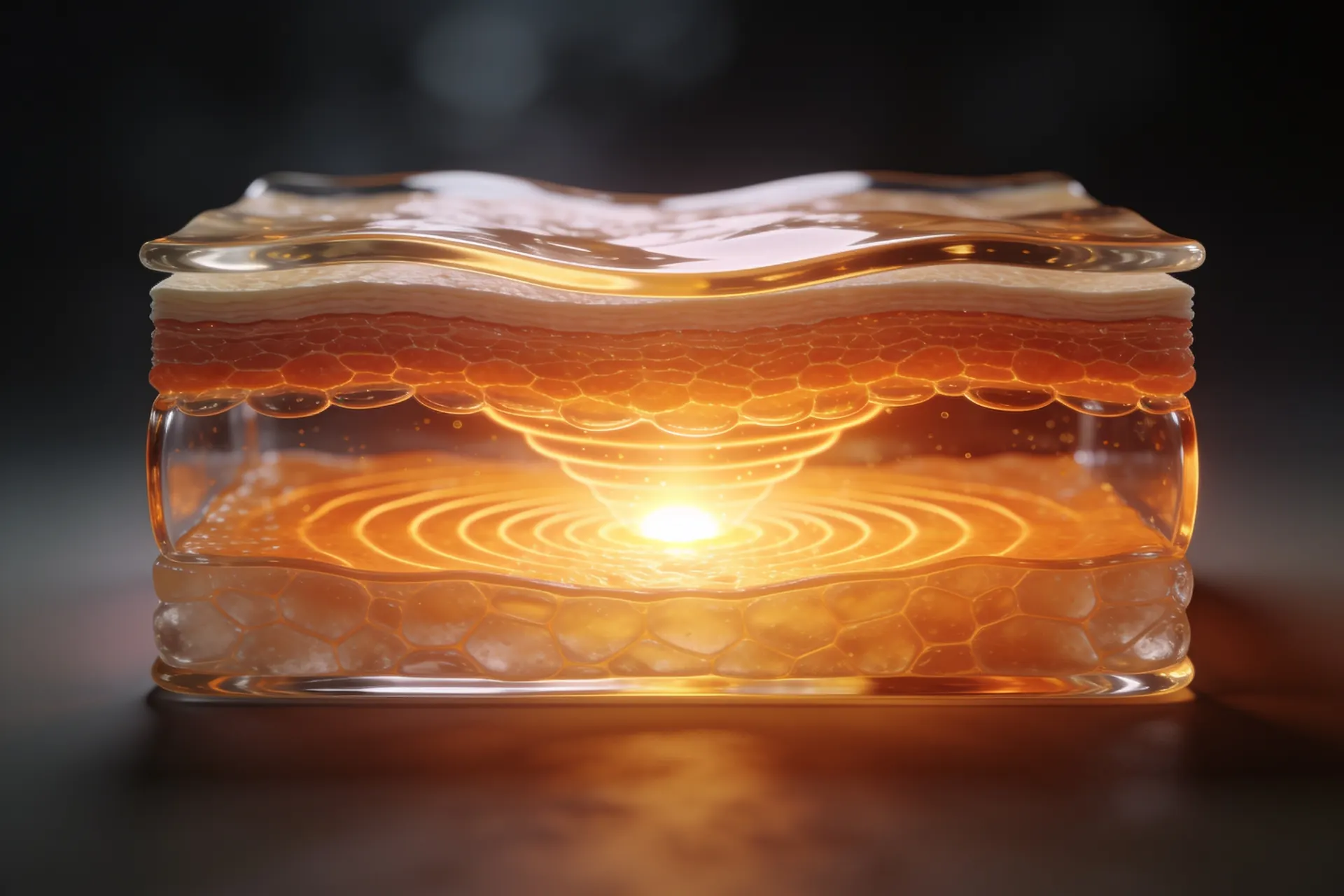
Thermage is a monopolar radiofrequency skin-tightening platform from Solta Medical. The current FLX generation delivers capacitively coupled radiofrequency at 6.78 MHz with cryogen cooling of the skin surface, heating the deep dermis and fibrous septae so that collagen contracts and remodels over the following months. It is used for mild to moderate laxity of the face, eyelids, neck and body. It does not add volume, reduce fat or remove excess skin.
Key facts
Technology
Monopolar, capacitively coupled RF at 6.78 MHz; Solta Medical; FLX is the fourth-generation applicator
Cooling
Cryogen spray to the epidermis before, during and after each pulse
Target
Dermal collagen and subcutaneous septae, not the SMAS reached by focused ultrasound
Same class as
CLASSYS Volnewmer: 6.78 MHz monopolar RF with continuous water cooling
Illustrative image, not a patient.
Where Thermage matters on this site
Thermage is radiofrequency, not light, so it has no wavelength and no chromophore: 6.78 MHz current heats the dermis and subcutaneous septae by resistance across a field, with the surface cooled by cryogen. It is the reference device for monopolar RF, and this site uses it mainly as the comparison point for the protocol Dr Sin Yong runs on the same class of platform.
Thermage heats a field and ultrasound heats a point; I decide which the face needs before I decide which machine.— Dr Sin Yong
Thermage FLX: the treatment page, covering what the FLX generation does and where it stops.
Thermage vs Volnewmer: the head-to-head between cryogen cooling and continuous water cooling at the same frequency.
Thermage is one brand of one class of device, and most of the confusion comes from treating it as a synonym for tightening.
Ultherapy and HIFU. Focused ultrasound, which heats points at set depths down to the SMAS. Thermage heats a field in the dermis and does not place focal heat in the SMAS.
Volnewmer. Same class and frequency, cooled with water rather than cryogen; the platform of the VF Lift – Vertical Facelift. A lookalike device, not a lookalike result.
RF microneedling. Radiofrequency delivered through needles, usually bipolar, into the dermis at chosen depths. Different delivery, different indication.
Bipolar RF and "lifting facials". Shallow surface RF between two electrodes on a handpiece, with none of the depth of a monopolar return-pad system.
The term monopolar radiofrequency, and why the return pad matters, is defined under monopolar radiofrequency.
What decides whether Thermage matters for you
Monopolar RF suits a specific picture: laxity in the dermis and septae without a volume problem or heavy skin excess. These are the questions that settle it.
Where is the laxity? Dermal and subcutaneous looseness answers to field heating; a lax SMAS along the jawline is a focused-ultrasound question.
Is there unwanted volume? Radiofrequency does not reduce a fat pad. Where descent comes with fullness, Dr Sin Yong weighs the Time Freeze Laser LCLR® instead or alongside.
Is there volume loss? Tightening a deflated face can make it look more hollow, so fat and filler are mapped with ultrasound first.
Skin excess. Heavy, redundant skin is not retracted by any energy device, and that is said plainly at consultation.
Pain and cooling. Cryogen and water cooling feel different; the Thermage side effects page covers what is expected and what is not.
VF Lift – Vertical Facelift is Dr Sin Yong's protocol on this class of device; whether the picture suits it is decided in person.
Where it fits
Thermage is the reference device for monopolar radiofrequency, with two decades of published literature behind the mechanism of bulk dermal heating. Dr Sin Yong's VF Lift – Vertical Facelift runs on Volnewmer, a platform of the same class and frequency that cools the surface with water rather than cryogen; in a randomised split-face trial in 22 Asian women the two gave comparable lifting with significantly less pain on Volnewmer (Roh, Ann Dermatol 2025). Neither is HIFU: radiofrequency heats a field, focused ultrasound heats points at set depths. Full page: Thermage FLX in Singapore; the head-to-head on Thermage vs Volnewmer; the protocol it is most often compared with on VF Lift – Vertical Facelift.
They are the same class of device: 6.78 MHz monopolar radiofrequency with surface cooling. Thermage FLX cools with cryogen spray; Volnewmer cools with continuous water. A randomised split-face trial in Asian women found comparable lifting with less pain on Volnewmer. Dr Sin Yong runs his VF Lift – Vertical Facelift on Volnewmer; the comparison, not a ranking, is on the Thermage vs Volnewmer page.
No. Thermage heats the dermis and subcutaneous septae across a field by resistance to radiofrequency current; it does not place focal heat at 4.5 mm in the SMAS the way micro-focused ultrasound does. The two address different layers, which is why some faces are assessed for one, some for the other and some for both in sequence. Neither adds volume or removes excess skin.
No. Thermage is monopolar radiofrequency that bulk-heats the dermis and its septae; HIFU is focused ultrasound that heats discrete points at set depths, reaching the SMAS. They are different mechanisms chosen for different presentations.
They share the technology class and frequency, 6.78 MHz monopolar radiofrequency, and differ mainly in surface cooling: cryogen on Thermage, continuous water cooling on Volnewmer. A randomised split-face trial found comparable lifting and less pain with Volnewmer.
References
US FDA 510(k) summary K170758 — Thermage FLX (Solta Medical), 2017: 6.78 MHz; indications include non-invasive treatment of wrinkles and periorbital wrinkles. source
US FDA 510(k) summary K240248 — Volnewmer (CLASSYS), 2024: monopolar RF, 6.78 MHz; indication: electrocoagulation and haemostasis of soft tissue; predicate Thermage FLX. source
Roh H, Lee YI, et al. Monopolar radiofrequency with water cooling versus cryogen cooling: a prospective randomised split-face trial in 22 Asian women. Ann Dermatol. 2025;37(6):397-407. doi:10.5021/ad.25.166. source
Multicenter study of noninvasive radiofrequency for periorbital tissue tightening. Lasers in Surgery and Medicine (PubMed), 2003. pubmed.ncbi.nlm.nih.gov
Treatment of Facial Skin Laxity by a New Monopolar Radiofrequency Device. Journal of Cutaneous and Aesthetic Surgery (PMC), 2011. pmc.ncbi.nlm.nih.gov
Efficacy and Safety of Monopolar Radiofrequency for Tightening the Skin of Aged Faces. Cosmetics, 2024. www.mdpi.com
The Landscape of Radiofrequency Technology for Skin Rejuvenation. Health Science Reports, 2025. pmc.ncbi.nlm.nih.gov