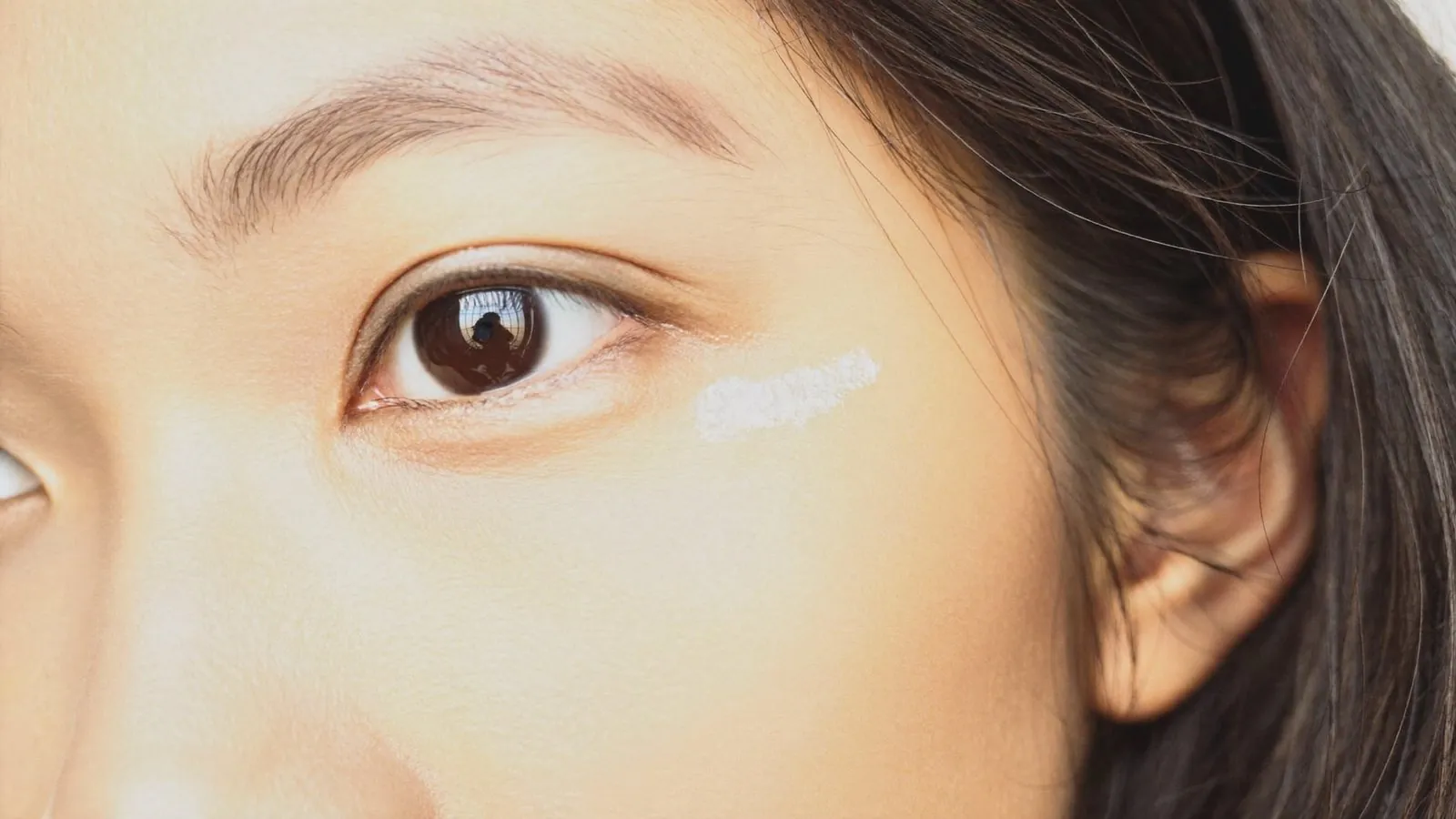
Eye bags is one name for three different problems: a bulge of orbital fat pushing forward, a hollow along the orbital rim, or a shadow or pigment change in thin lower-lid skin. They are treated almost nothing alike, so the under-eye is assessed by fat, ligament, skin and pigment before any treatment is discussed.
Key facts
- Orbital fat
- Sits behind the orbital septum in three lower-lid compartments — medial, central and lateral. A “bag” is usually this fat pushing forward as the septum weakens
- Tear trough ligament
- A true osteocutaneous ligament tethering skin to the bone of the orbital rim — the anatomical floor of the under-eye hollow
- Eyelid skin
- Among the thinnest on the body, in the region of 0.5 mm — the least forgiving canvas on the face for any injectable
- The hollow
- A deficit of volume and support along the orbital rim, not an excess of anything — the structural opposite of a bag
- Pigment vs shadow
- Stretch the skin gently: true pigment stays brown; a shadow from contour largely disappears. Overhead versus frontal lighting separates them the same way
- Fitzpatrick III–V
- The skin types predominant in Singapore, in which genuine periorbital pigmentation is common and behaves independently of any contour change
- Filler behaviour here
- Hyaluronic acid attracts water; in thin under-eye skin a product with low hydrophilicity and low placement is required, and even then it suits some anatomies and not others
Three different problems called “eye bags”
Searches for eye bags in Singapore mostly assume there is one condition and a menu of treatments for it. Clinically, the term covers at least three separate findings. The first is a true bulge — orbital fat pushing forward where the septum that restrains it has weakened. The second is a hollow — a groove along the orbital rim where volume and support have thinned, casting a trough between eyelid and cheek. The third is discolouration — genuine pigment in the skin itself, which is common in the skin types we see most in Singapore.
The reason the distinction matters is not academic tidiness. Each of the three has a different mechanism, and so a different answer. Fat that has herniated forward cannot be dissolved by a cream or lifted by a laser. A hollow cannot be improved by removing anything — it is a deficit, not an excess. And pigment does not care what the contour under it is doing; it needs to be treated as pigment, which is a subject of its own covered in our dark eye circles guide.
Many people have two of the three at once, and some have all three. That is why the under-eye rewards examination more than almost any other area of the face — and why treatment chosen from a photograph or a product name so often disappoints.
“Filler helps one under-eye problem, worsens another, and does nothing for the third.”
Dr Sin YongOn why diagnosis precedes treatment
The bulge: when orbital fat pushes forward
Behind each lower eyelid sit three small compartments of orbital fat — medial, central and lateral — held in place by a thin sheet called the orbital septum. With age, and in some families from surprisingly early adulthood, that septum stretches. The fat it restrains pushes forward, and the lower lid develops a convexity: the true bag.
This is the version people usually mean when they say the bags are there even after a good night’s sleep. Fluid and salt can make it fluctuate day to day, but the underlying structure is anatomical, not lifestyle. It is also the version least suited to being treated with more volume — adding filler in front of a fat bulge tends to enlarge the very contour the patient wants gone.
Where the herniation is genuine and significant, the honest conversation includes the fact that repositioning or removing that fat is a surgical decision, and I will say so when it is. What non-surgical work can sometimes do is address the transition around a modest bulge — the assessment on the eye bag treatment page sets out how that judgement is made, and it is made case by case.
The hollow and the shadow: two impostors
The tear trough is a groove running from the inner corner of the eye diagonally down and out across the top of the cheek. It exists because of a real structure — the tear trough ligament, which tethers the skin to the bone of the orbital rim. As the fat compartments of the midface deflate and descend with age, the tethered line stays put, and a hollow deepens above it. Under most indoor lighting, that hollow casts a shadow — and a shadow photographs exactly like a dark circle.
Then there is pigment: melanin in the skin itself, often familial, often present since the teens, and common in Fitzpatrick III to V skin. There is a simple way to begin separating the two at home. Gently stretch the under-eye skin sideways, or look at your face lit from directly in front rather than from above. A shadow thrown by contour largely disappears when the contour is flattened or the light source moves. True pigment stays brown whatever you do to the geometry.
That small test changes everything about the plan. A shadow from a hollow is a structural problem, addressed — where appropriate — along the lines described on the tear trough refinement page. Pigment is a dermatological problem, and no amount of volume will lighten it.
Why filler helps one, worsens another, and does nothing for the third
Here is the summary that saves people the most money and regret. Filler can be a reasonable answer for the hollow — a true tear trough with good skin and a modest, well-defined deficit — because a deficit is the one problem that adding volume logically addresses. Even then, the under-eye is the least forgiving territory on the face: the skin is around half a millimetre thick, hyaluronic acid attracts water, and a product placed too superficially or chosen with too much hydrophilicity can sit visibly, or swell, for a long time. Product selection and depth matter here more than anywhere else.
Filler tends to worsen the bulge. If the primary finding is herniated orbital fat, volume placed nearby usually adds convexity to a region that already has too much, and the result reads as heavier, not fresher. This is the commonest version of under-eye filler regret I see — a correct technique applied to the wrong diagnosis.
And filler does nothing for pigment, because melanin is not a contour. The same is true in reverse: no laser or lightening programme fills a hollow. When someone has a mixture — which is often — the components are treated separately, in a deliberate order, and sometimes the right advice for one component is to leave it alone.
Response to any of this varies with anatomy, skin and age, which is why nothing on this page is a recommendation for your face. It is the framework a proper assessment works through before recommending anything.
Why this page has no before-and-after images
People search for under-eye before-and-after photographs, so the absence is worth explaining rather than leaving unspoken.
Under Singapore’s Healthcare Services Act, before-and-after imagery in advertising for licensable healthcare services is prohibited. No consent form or disclaimer creates an exemption, and after-only images fall under the same rule. The prohibition applies identically to every licensed clinic in Singapore — so a site showing such images is not demonstrating better results, only weaker compliance. What can be examined is your own under-eye, in person, under proper lighting, where a bulge, a hollow and pigment can actually be told apart.
What determines the cost
Prices for licensable healthcare services cannot be advertised in Singapore — not as figures, ranges or “from” amounts — so no numbers appear here.
What can be set out is what the cost depends on: which of the three problems the assessment actually finds, whether one is present or several, whether treatment is injectable, energy-based, dermatological or a staged combination, and how conservatively the plan is sequenced over time. A single well-defined tear trough and a mixed picture of bulge, hollow and pigment are not comparable pieces of work. Fees are set out in full at consultation, once there is a specific finding to plan around.
The part worth saying first
The under-eye is the area where I most often decline the treatment a patient arrives asking for — not because nothing can be done, but because the named request and the actual finding so frequently do not match. A bag, a hollow and a shadow share a nickname and almost nothing else.
The useful consultation begins with a stretch of the skin and a change of lighting, not with a syringe. Dr Sin Yong — MBBS (NUS), MRCS (Edinburgh), MSc Aesthetic Medicine with Distinction (Queen Mary, London), MSc Practical Dermatology (Cardiff) — examines the under-eye personally on Orchard Road, and will say plainly which of the three problems you have, which are worth treating, and which are not.