Published 26 October 2026 · Reviewed by Dr Sin Yong
Juvelook and Rejuran are both injected into the skin, but they are different materials. Juvelook is a collagen stimulator: poly-D,L-lactic acid microspheres in hyaluronic acid. Rejuran is a skin booster: polynucleotide purified from salmon DNA. They work differently and suit different skin. Neither the microspheres nor the polynucleotide is dissolved by hyaluronidase, and a lump after either can still be treated without an incision.
Short answerThe difference is the material. Juvelook places poly-D,L-lactic acid microspheres, in a hyaluronic acid carrier, that prompt the skin to build its own collagen gradually; a review describes the polymer in use for skin firmness, wrinkles and scar remodelling (Lee 2024). Rejuran places polynucleotide, directed at skin repair, with no particles or volume; in a systematic review, polynucleotide side effects were generally mild and transient (Lampridou 2024). Neither is better in general. Juvelook's microspheres and Rejuran's polynucleotide are not dissolved by hyaluronidase, and Dr Sin Yong treats a lasting lump of either without an incision.
Poly-D,L-lactic acid (PDLLA) microspheres in a non-cross-linked hyaluronic acid carrier, made by VAIM in Korea; a collagen stimulator that sits between a skin booster and a filler.
Rejuran
Polynucleotide purified from salmon DNA, about 20 mg/mL in Rejuran Healer, made by PharmaResearch in Korea; a skin booster that adds no volume and does not lift.
Published figures
In 20 people treated with Juvelook for the folds beside the nose and mouth, only temporary swelling and bruising were reported up to 3 months after the last session (Yi 2026); in a systematic review of 9 polynucleotide studies with 219 patients, side effects were generally mild and transient (Lampridou 2024). No study cited here compared the two products in people.
Dissolving
Hyaluronidase acts on hyaluronic acid only. Juvelook's own carrier is absorbed in the weeks after treatment, and the PDLLA microspheres and polynucleotides are not dissolved by hyaluronidase; a lasting lump after either can still be treated without an incision.
Not normal after either
A lump that stays or appears later (have it scanned); heat, pus or a fever (a doctor the same day; if no doctor can see you today, A&E); pale, dusky or mottled skin, or pain that is getting worse (urgent assessment by the doctor who injected you, or at A&E, now); a change in vision or eye pain (call 995 now).
Before surgery for a lump
Get assessed. Dr Sin Yong maps it with ultrasound and treats what cannot be dissolved with the Sculpting mode of Time Freeze Laser LCLR®, without an incision.
Juvelook vs Rejuran: what each is, and the difference
Juvelook and Rejuran are both injected into the skin of the face, and both are talked about as skin treatments, so they are often weighed against each other. What is in the syringe is different, and that decides how each works, what it is used for and what can be done if something goes wrong.
Juvelook is a collagen stimulator made by VAIM in Korea: microspheres of poly-D,L-lactic acid (PDLLA), a biodegradable polymer, in a carrier of non-cross-linked hyaluronic acid, supplied as a powder and mixed with liquid before injection. A clinical study describes it as PDLLA with hyaluronic acid (Yi 2026). It sits between a skin booster and a filler. Juvelook Volume, sold internationally as Lenisna, carries more PDLLA in each vial and is used for volume rather than skin quality. More on the product is in Juvelook in Singapore.
Rejuran is a skin booster made by PharmaResearch in Korea: chains of polynucleotide purified from salmon DNA, filtered and sterilised so that what is injected is the polymer, not genetic information. Rejuran Healer, the facial preparation, carries polynucleotide at about 20 mg/mL. It contains no particles and adds no volume. The range also includes Rejuran I, a thinner preparation for the skin around the eyes; Rejuran S, a thicker one placed into and around scars; and Rejuran HB, which combines polynucleotide with hyaluronic acid. More on the range is in Rejuran in Singapore.
Put simply, Juvelook leaves particles in the skin that the body responds to by laying down collagen, and Rejuran leaves no particles and is directed at how the skin repairs itself. The table sets the two side by side.
Swipe sideways to see the whole table.
Juvelook
Rejuran
What it is
A collagen stimulator that sits between a skin booster and a filler
A skin booster directed at skin repair; not a filler
What it is made of
Poly-D,L-lactic acid (PDLLA) microspheres in non-cross-linked hyaluronic acid; Juvelook Volume (Lenisna) has more PDLLA in each vial
Polynucleotide purified from salmon DNA, about 20 mg/mL in Rejuran Healer; no particles
What it is used for
Fine lines, texture, enlarged pores and shallow acne scars, where some hydration on the day and a gradual collagen response are wanted; Juvelook Volume for volume
Texture, fine lines, elasticity, and thin, damaged or red skin, including skin recovering from acne; Rejuran I for crepey skin around the eyes; Rejuran S in and around acne scars
How it works
The hyaluronic acid holds water on the day and is absorbed; the body responds to the PDLLA microspheres by laying down its own collagen around them, gradually
Acts on the repair environment of the skin: fibroblast activity, matrix turnover and inflammatory signalling; it does not fill and does not lift
What is normal afterwards
Small raised bumps at the injection points, swelling, redness, tenderness and bruising, easing as the area settles; some early fullness is the liquid it is mixed with
Small raised bumps at each injection point, swelling, redness, tenderness and bruising, more so around the eyes; the bumps flatten as the swelling settles
What is not normal, after either
A bump that stays once the swelling has gone, or a firm lump that appears later: have it scanned. A red, hot, painful, swollen or draining lump, or a fever: a doctor the same day; if no doctor can see you today, A&E. Pale, dusky or mottled skin, or pain that is getting worse: urgent assessment by the doctor who injected you, or at A&E, now. A change in vision or eye pain: call 995 now. Difficulty breathing, a tight throat, swelling of the tongue or throat, or swelling that spreads quickly across the face: call 995 now
Can it be dissolved?
Only the hyaluronic acid carrier, which is absorbed in the weeks after treatment; the PDLLA, the part that forms firm nodules, is not dissolved by hyaluronidase. A lasting lump can still be treated without an incision
Polynucleotides are not dissolved by hyaluronidase (in Rejuran HB, only the hyaluronic acid part is). A lasting lump can still be treated without an incision
What is done for a lasting lump, after either
An ultrasound scan first. A red, hot or tender lump needs a doctor the same day (A&E if no doctor can see you today) and is treated medically first. Hyaluronic acid from a filler or booster in the same area is dissolved only if the lump is the hyaluronic acid itself, after a skin test. Dr Sin Yong treats what cannot be dissolved with the Sculpting mode of Time Freeze Laser LCLR®, without an incision
When a reaction after Juvelook or Rejuran cannot wait
Most reactions after Juvelook or Rejuran are the expected ones described below. Both are injected into the face, though, and any injection into the face can rarely block a blood vessel. The warning signs are the same as after filler:
Urgent: a change in vision or eye pain after filler: call 995 now. Skin that turns pale, dusky or mottled, or pain that is getting worse, needs urgent assessment by the doctor who injected you, or at A&E, now. See the warning signs of a blocked blood vessel after filler.
Signs of a stroke (new weakness of the face, an arm or a leg, or slurred speech): call 995 now, and do not travel to a clinic first. For any of these signs, do not wait for a reply to a message or for a booked review.
Skin that is dying after a blocked blood vessel (necrosis) is an emergency. It needs urgent, more intensive care than a lump does, starting now. A blocked blood vessel is never treated with the Sculpting mode or any other laser.
Hyaluronidase acts on hyaluronic acid only. In an emergency such as a blocked blood vessel it is not delayed for a skin test, and it acts on the hyaluronic acid in Juvelook's carrier or in Rejuran HB, but the poly-D,L-lactic acid microspheres and polynucleotides are not dissolved by hyaluronidase, so care is also urgent and supportive, with referral where needed.
These reactions are not for waiting out either:
Redness that is spreading, with a fever; feeling faint, confused or very unwell; or swelling around the eye with pain: call 995 or go to A&E now.
Difficulty breathing, a tight throat, swelling of the tongue or throat, or swelling that spreads quickly across the face, after any injection, including hyaluronidase, can be a serious allergic reaction: call 995 now. Itch, hives or swelling that spreads beyond the treated area: contact the clinic that injected you the same day.
A red, hot, painful, swollen or draining lump, or a fever: possible infection or inflammation. See a doctor the same day; if no doctor can see you today, A&E. It is treated medically first, before any device and before any talk of surgery.
Until you are seen, do not squeeze, massage or try to drain a red or painful lump yourself, and do not have more product injected into the area.
“For hard lumps from mixed products, I use one tool, Time Freeze Laser LCLR®, to target the material without surgery.”
Dr Sin YongOn hard lumps from mixed fillers and skin boosters
How Juvelook and Rejuran work
Juvelook: particles that prompt collagen
Juvelook has two parts that behave differently. The hyaluronic acid carrier holds water and gives some hydration on the day, and the body absorbs it. The PDLLA microspheres are the active part: the body responds to them by laying down its own collagen around them while the polymer slowly breaks down. A review of PDLLA in dermatology describes it as biodegradable and biocompatible, used for skin firmness, wrinkles and scar remodelling (Lee 2024). Because the change depends on the body's own collagen response, it builds gradually rather than appearing on the day.
Where microspheres gather in one place, the same response that builds collagen can build a lump. That is why placement, depth and even mixing matter with Juvelook, and why a lump that lasts is scanned before anything is decided.
Rejuran: a repair signal, with no particles
Rejuran works on the repair environment of the skin rather than on its bulk. Two effects are described: an influence on fibroblast activity and the turnover of the matrix around them, and signalling through adenosine A2A receptor pathways, which is also the route of its described anti-inflammatory action. The polynucleotide also holds water in the tissue. It changes no dimension of the face: it does not fill, does not lift and does not remove pigment, and skin that is signalled to repair still has to do the repairing.
A systematic review of polynucleotides in aesthetic medicine found 9 studies, with 219 patients, of low and moderate quality; injections improved wrinkles, texture and elasticity in several of them, and the authors call for more rigorous studies (Lampridou 2024).
Side by side in one laboratory study
In a laboratory and mouse study, PDLLA, a polynucleotide filler and a calcium hydroxylapatite filler each raised collagen-fibre density, skin elasticity and signals of new blood-vessel growth in aged mouse skin (Oh 2023). That was in mice, not people, and it does not show how either product behaves in a face. No study cited on this page compared Juvelook with Rejuran in people.
What each is used for: fine lines, texture, acne scars and under the eyes
Both are skin treatments, so their uses overlap at the edges, but they are chosen for different reasons. Neither is a lift: sagging is a different problem, and more product is not the answer to it.
Fine lines, texture and pores
Juvelook is used where skin quality is the concern and a gradual collagen response is wanted: fine lines, texture and enlarged pores, with some hydration from its hyaluronic acid on the day. Rejuran is used for texture, fine lines, elasticity and skin that is thin, damaged or red, where repair rather than volume is wanted. A pore is a fixed opening and no injection shrinks it; what can change is how the skin around it looks.
Acne scars
Acne scars are several different things: rolling scars tethered to deeper tissue, boxcar scars with fixed walls, ice-pick tracts, and redness or pigment that is not scarring at all. Neither product releases a tether or reshapes a fixed wall; that is the work of subcision, resurfacing or TCA CROSS. Within a scar plan, Juvelook is considered where fine lines sit over shallow scars and a slow collagen response is wanted, and a review lists scar remodelling among the uses of PDLLA (Lee 2024). Rejuran S, the thicker polynucleotide, is placed beneath depressed scars to support the skin-quality part of the plan, alongside structural scar work. Which, if either, fits depends on the scar type. More is in acne scar treatment and Rejuran S for acne scars.
Under the eyes
Under the eyes the skin is thin, and different problems look alike: crepey skin, a hollow, pigment and an eye bag. Rejuran I is a thinner polynucleotide preparation made for the skin around the eyes, used for crepey skin and fine lines; it does not fill a hollow, treat a bag or remove pigment, and bruising is more likely there. With Juvelook, microspheres placed close to the surface of thin skin can show as bumps: in one case report, firm nodules appeared 3 weeks after Juvelook was injected into the tear troughs (Seo 2025). Granulomas, a reaction of the body to the material, are a different problem: in one case after PDLLA around the eyes, with the product not named, they formed in both lower eyelids of a 67-year-old woman (Garlaschi 2026). Dr Sin Yong can use Juvelook under the eyes, but he prefers energy-based treatment there (FSX Laser for the skin, and the Restore arm of the VF Lift for hollow areas); if Juvelook is used, it is decided only after examination and a scan of any earlier filler. The cause under the eye is diagnosed before anything is chosen. More is in FSX Laser, the VF Lift, Rejuran I for under-eye skin and dark eye circle treatment.
Who each tends to suit, and who should wait
Who each suits follows from what the skin is short of, decided at examination rather than by the name on the enquiry.
Juvelook tends to suit
Skin that needs some hydration on the day and a gradual collagen response: fine lines, texture, enlarged pores and shallow acne scars.
Someone prepared for gradual change, and for a decision that cannot be fully reversed, because the PDLLA is not dissolved by hyaluronidase; a lump can still be treated without an incision.
It does not suit someone who wants an immediate change, whose main problem is sagging, or for whom reversibility matters most: a hyaluronic acid filler or booster is the category that can be dissolved.
Rejuran tends to suit
Thin, fragile, damaged or textured skin, fine lines and reduced elasticity, where repair rather than volume is wanted.
Skin recovering from acne, as one part of a wider plan; and, with Rejuran I, crepey skin around the eyes once the cause has been diagnosed.
It does not suit someone who wants volume, a lift, pigment cleared or a scar released. Because it is purified from salmon DNA, a fish or salmon allergy is asked about directly, and a different skin booster may be chosen.
Who should wait, or be assessed carefully, for either
Pregnancy or breastfeeding: treatment is deferred.
Active infection, a cold sore, an acne flare or inflamed skin at the injection sites: settled first.
Blood-thinning medicines or a bleeding tendency, and a tendency to keloid scarring where injecting near scars: weighed and discussed first. Never stop a prescribed medicine on your own for a cosmetic treatment.
A history of granulomatous reactions: caution with any particle-based product, Juvelook included.
Lumps, heaviness or unevenness from earlier injections: an ultrasound scan of what is already there comes before anything is added.
Both are placed as a series of small injections, and the skin reacts straight away. The first reactions look alike; what changes later, and what is judged at review, is different.
After Juvelook
Small raised bumps at the injection points, swelling, redness, tenderness and bruising are expected, and they ease steadily as the area settles. Some of the early fullness is the liquid the powder is mixed with, and swelling, so the look on the day is not what is judged: the collagen response comes later and is judged at review. In a study of 20 people treated with Juvelook for the folds between the nose and the mouth, only temporary swelling and bruising were reported, with no nodules, granulomas or delayed reactions up to 3 months after the last session (Yi 2026).
After Rejuran
Small raised bumps at each injection point are expected, with redness, swelling, tenderness and sometimes bruising, more so around the eyes where the skin is thin. The bumps flatten as the swelling settles and the polynucleotide is taken up, and changes in texture develop gradually rather than on the day. In a study of polynucleotide injections into the lips of 30 people, every one had swelling 30 minutes afterwards, 90% had pain and 77% redness, and the reactions were mostly mild and transient (Rho 2025). The two studies looked at different areas at different times, so their figures cannot be compared with each other.
What is not normal, after either
What is not normal is a reaction that lasts, builds or changes character:
A bump that has not flattened once the rest of the area has settled, or a firm lump that appears later: have it reviewed and scanned. After PDLLA, a lump can appear months later: in one published case, with the product not named, swelling and granuloma-like nodules began 4 months after injections along the jawline and cheeks (Perez-Willis 2024).
A red, hot, painful, swollen or draining lump, or a fever: a doctor the same day; if no doctor can see you today, A&E. It is treated medically first.
Pale, dusky or mottled skin, or pain that is getting worse: urgent assessment by the doctor who injected you, or at A&E, now. A change in vision or eye pain: call 995 now.
Difficulty breathing, a tight throat, swelling of the tongue or throat, or swelling that spreads quickly across the face, after any injection, including hyaluronidase, can be a serious allergic reaction: call 995 now. Itch, hives or swelling that spreads beyond the treated area: contact the clinic that injected you the same day.
Side effects and complications: what the published evidence shows
No injection is free of risk. For both products, most side effects are temporary injection reactions, and the serious risks are those of any injection into the face: infection and, rarely, a blocked blood vessel or a serious allergic reaction, whose signs and what to do are set out above. The published evidence on both is small.
Juvelook and other PDLLA
A clinical study. In 20 people treated with Juvelook, only temporary swelling and bruising were reported, up to 3 months after the last session (Yi 2026).
A review. A review of PDLLA in dermatology flags granulomas and non-inflammatory nodules as possible complications that need monitoring and early intervention (Lee 2024).
An expert consensus. Brazilian experts who set out how to reconstitute, place and dose the PDLLA microspheres of another brand, Aesthefill, not Juvelook, name nodules and granulomas as the problems to keep to a minimum, and note that clinical trials remain limited (Magacho-Vieira 2024).
Case reports. Firm nodules under the eyes 3 weeks after Juvelook (Seo 2025); swelling and granuloma-like nodules 4 months after PDLLA along the jawline and cheeks, where ultrasound showed several nodules (Perez-Willis 2024); and granulomas in both lower eyelids after PDLLA that did not settle with saline, radiofrequency or medical treatment injected into them, and needed two operations (Garlaschi 2026). The second and third reports do not name a product.
Rejuran and other polynucleotides
A systematic review. Across 9 studies of low and moderate quality, with 219 patients, side effects of polynucleotide injections were generally mild and transient (Lampridou 2024).
A lip study. After polynucleotide injections into the lips of 30 people, swelling, pain and redness were common at 30 minutes and mostly mild and transient (Rho 2025).
What else can happen. Less often, nodules form where material sits unevenly or too close to the surface, and infection can follow any injection. Allergic reaction is rare; a fish allergy is asked about directly because Rejuran is purified from salmon DNA.
Case reports show that a problem can happen, not how often it happens. The published evidence does not yet show how often lumps follow either product.
Can Juvelook or Rejuran be dissolved?
Hyaluronidase, the enzyme used to dissolve hyaluronic acid filler, acts on hyaluronic acid only.
Juvelook: hyaluronidase can dissolve the hyaluronic acid carrier, but the PDLLA microspheres are not dissolved by hyaluronidase, just as poly-L-lactic acid (Sculptra) is not. The carrier is absorbed in the weeks after treatment, so a firm lump that lasts is usually the microspheres.
Rejuran: polynucleotides are not dissolved by hyaluronidase. Where a preparation also contains hyaluronic acid, as Rejuran HB does, the enzyme acts on that part only.
So neither can be reversed the way a hyaluronic acid filler can. Material that cannot be dissolved can still be treated without an incision: Dr Sin Yong treats it with the Sculpting mode of Time Freeze Laser LCLR®, as set out below. Many polynucleotide bumps settle on their own as the swelling goes; one that stays is scanned before anything is decided. How hyaluronidase is used is explained in hyaluronidase.
A lump that lasts: ultrasound first, then treatment without an incision
A lump that lasts after Juvelook or Rejuran can be product gathered in one place, hyaluronic acid from another filler or booster, a granuloma, fluid, infection or something unrelated, and from the outside they can feel the same. Juvelook's own hyaluronic acid carrier is absorbed in the weeks after treatment, so a lump that lasts is rarely the carrier. Ultrasound shows where the product sits, how deep it is and how far it has spread, and what it is likely made of; it does not prove what a lump is, and where it does not look like product, further tests are arranged. An international consensus of 15 experts calls ultrasound mandatory for managing filler complications (Velthuis 2025). Dr Sin Yong performs the scan himself, and then:
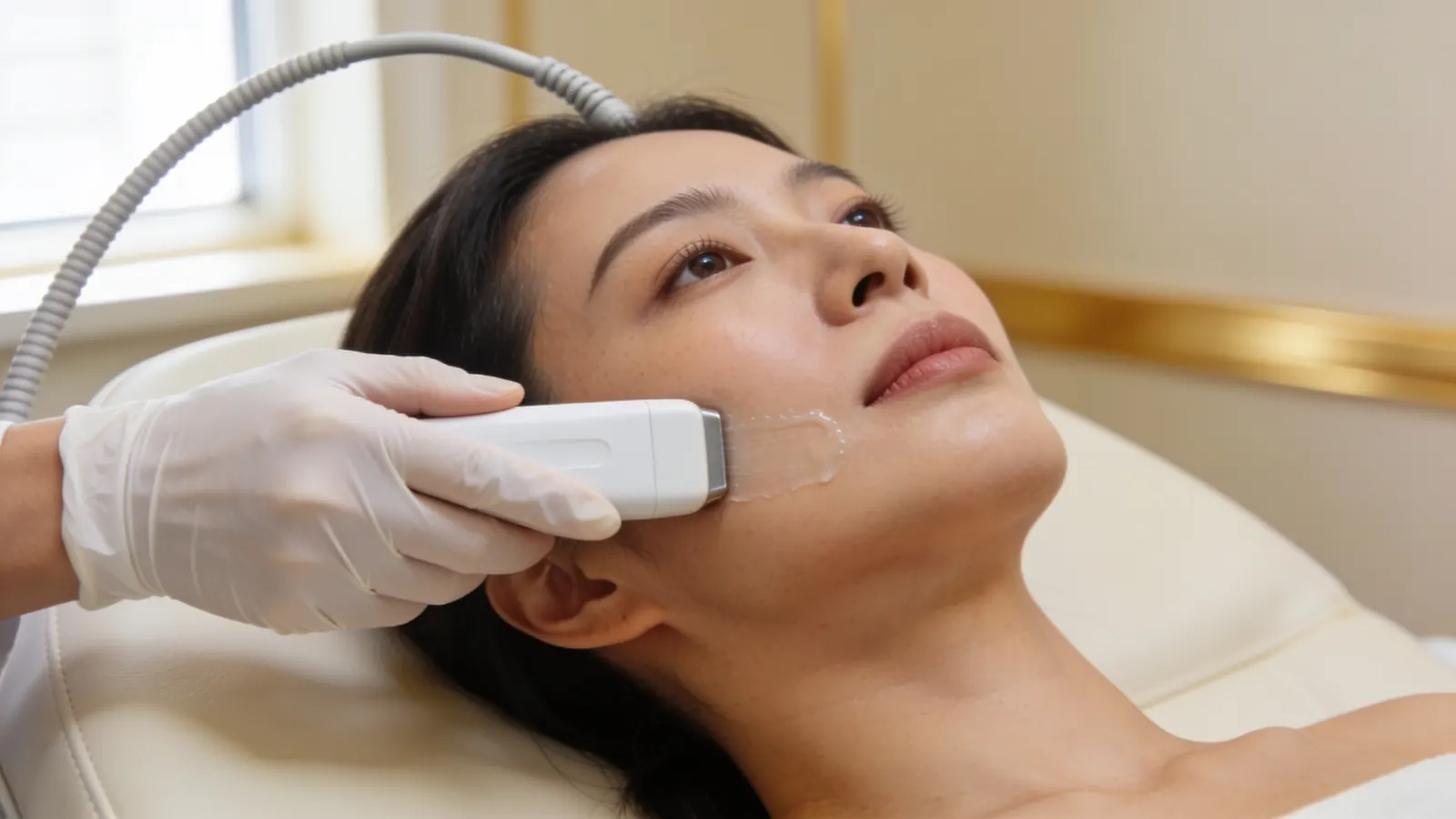
Illustrative image — not a patient.
Red, hot, tender, swollen or draining: a doctor the same day (A&E if no doctor can see you today). It is treated medically first, before any device and before any talk of surgery. Hyaluronic acid is dissolved only once an infection is under control, and no laser or other device is used on an active infection.
Hyaluronic acid, usually from a filler or booster in the same area, is dissolved only if the lump is the hyaluronic acid itself, after a skin test. Before planned dissolving, Dr Sin Yong always does a skin test: a small amount of hyaluronidase is injected just under the skin to check for a reaction. A small first dose follows, reviewed at about 48 hours, because dissolving more than the excess can leave a hollow. In an emergency such as a blocked blood vessel, hyaluronidase is not delayed for a skin test, but the PDLLA microspheres and polynucleotides are not dissolved by it; see when a reaction cannot wait, above.
What cannot be dissolved: Dr Sin Yong treats lasting lumps of PDLLA or polynucleotide, and lumps where several products sit together, with the Sculpting mode of Time Freeze Laser LCLR®, his own protocol on a long-pulsed 755 nm and 1064 nm laser platform, without an incision. Like any laser, it can cause blistering or a change in skin colour, so settings are chosen for your skin. Under the eyes, settings are kept conservative and the eyes are protected. Where hyaluronic acid sits with other material, the two are planned in order. A blocked blood vessel is never treated with the Sculpting mode or any other laser.
A small lump that cannot be seen can sometimes be left alone and reviewed; the scan decides.
A lump after Juvelook or Rejuran, and only offered surgery? Get assessed first
Some patients with a lump after Juvelook or Rejuran are told that it has to be cut out, or that nothing can be done because the product cannot be dissolved. It is true that the PDLLA in Juvelook and polynucleotides are not dissolved by hyaluronidase. Material that cannot be dissolved can still be treated without an incision. Before you agree to an operation, know what it means:
A scar. Every cut through the skin of the face heals with a scar.
A dent. Cutting out a lump takes tissue with it, and the area can heal hollow or uneven.
Nerve injury. Nerves that give the face feeling and movement run close to where filler sits. An injured nerve can leave numbness, or weakness in a smile, a lip or a brow.
Product left behind. Filler spread through tissue is hard to remove completely.
No way back. Tissue that has been cut out cannot be put back.
In one published case, PDLLA granulomas in both lower eyelids needed two operations (Garlaschi 2026).
In Dr Sin Yong's practice, almost every hard lump is treated without surgery. If yours is one of the few that needs surgery, you are told plainly, and why. Inflammation and infection are treated medically, hyaluronic acid is dissolved after a skin test if it is the lump itself, and Dr Sin Yong treats what cannot be dissolved with the Sculpting mode of Time Freeze Laser LCLR®, without an incision.
Surgery has a place. An abscess may need draining, which is a smaller procedure than cutting a lump out, and a lump that does not look like product on the scan may need a tissue sample. The point is the order: scan first, decide after. Being scanned first closes no door: an operation can still be done later if it is ever needed, but once done it cannot be undone. If you have already been offered one, Dr Sin Yong can scan the lump and give you a second opinion before you decide. What removal surgery involves is set out in filler removal surgery, and lumps after any filler or skin booster in hard lumps after filler or skin boosters.
Tried other treatments and almost given up?
Many patients who come to see Dr Sin Yong about lumps after Juvelook or Rejuran tell him they have tried almost everything else and had given up hope. Having tried other treatments does not mean nothing more can be done: what is done next depends on what the scan shows.
That history is useful. Knowing what was injected, when, and what has already been tried often explains why a problem has stayed: hyaluronidase acts only on hyaluronic acid and only where it reaches, some fillers are not hyaluronic acid at all, and swelling or fluid can look like filler. Ultrasound shows which of these applies, and the plan starts from there. For material that cannot be dissolved, Dr Sin Yong uses the Sculpting mode of Time Freeze Laser LCLR® for nodules large and small, without an incision. How each person responds varies.
If you have been told nothing more can be done, it is still worth having the area scanned: ultrasound shows what is there, and the plan is made from that. Bring any records of past treatments, product names and dates if you have them. More on this is in when filler dissolving has not worked.
How Dr Sin Yong approaches Juvelook and Rejuran
Dr Sin Yong offers both on Orchard Road and performs every injection himself. He starts with what the skin is short of: hydration and a gradual collagen response, repair of thin or damaged skin, volume, or lift. Juvelook and Rejuran answer only some of these, and sagging is a lifting problem. He asks what has been injected before, and where earlier filler or boosters are involved, he scans the area with ultrasound before anything is added: the PDLLA in Juvelook and the polynucleotide in Rejuran are not dissolved by hyaluronidase, although a lump after either can still be treated without an incision. Fish allergy, pregnancy, active skin infection and any keloid tendency are asked about first.
The preparation, placement and number of visits are set after examination; this site does not publish session counts or intervals. A consultation can end with either product, a different treatment or no treatment. He also manages lumps after either product: you do not need to have been treated here. He developed the Time Freeze Laser LCLR® protocol himself and has been invited to share his clinical expertise in Seoul, Dubai, Bangkok and São Paulo, including as a Global Key Opinion Leader. Choosing between skin boosters more generally is covered in which skin booster suits me and Profhilo vs Rejuran.
Your next step
Not for emergencies. A change in vision or eye pain after filler: call 995 now. Pale, dusky or mottled skin, or pain that is getting worse: go now to the doctor who injected you, or to A&E. Do not message or book for these signs.
1. MessageWhatsApp +65 8023 7170 with what is bothering you. A reply comes from the clinic, not a bot.
2. AssessmentDr Sin Yong examines you himself on Orchard Road, with ultrasound where earlier filler is involved.
3. A plan in writingWhat he would do, what he would not, the fee factors, and the option of no treatment.
Every treatment is performed by Dr Sin Yong personally. Singapore Medical Council registered · invited to share his clinical expertise internationally for CLASSYS, DEKA, Fotona, Hironic and Ilooda.
Juvelook is a collagen stimulator: poly-D,L-lactic acid microspheres in a hyaluronic acid carrier, which prompt the skin to lay down its own collagen gradually. Rejuran is a skin booster: polynucleotide purified from salmon DNA, directed at skin repair, with no particles and no volume. Juvelook's poly-D,L-lactic acid and Rejuran's polynucleotide are not dissolved by hyaluronidase. A lasting lump after either can still be treated without an incision.
Many of the patients Dr Sin Yong sees have tried other treatments first. A treatment that did not help can still leave options open: hyaluronidase may not have reached the filler, the filler may not be hyaluronic acid, or what looks like filler may be swelling or fluid. Ultrasound shows which applies, and the plan follows what it finds.
Neither is better in general; they are different materials doing different jobs. Juvelook's poly-D,L-lactic acid prompts a gradual collagen response, with some hydration on the day from its hyaluronic acid. Rejuran's polynucleotide is directed at skin repair and adds no volume. No study cited on this page compared the two in people. Which suits depends on what the skin is short of, any fish allergy, earlier filler and how much reversibility matters, decided at examination.
Neither releases a tethered scar or reshapes a fixed-wall scar; that needs subcision, resurfacing or TCA CROSS. Within a scar plan, Juvelook is considered where fine lines sit over shallow scars and a slow collagen response is wanted, and a review lists scar remodelling among the uses of poly-D,L-lactic acid (Lee 2024). Rejuran S, a thicker polynucleotide, is placed beneath depressed scars to support the skin-quality part of the plan. The scar type decides which, if either, is used.
Rejuran I, a thinner polynucleotide for under-eye skin, is used for crepey skin and fine lines; it does not fill a hollow or treat a bag. Dr Sin Yong can use Juvelook under the eyes, but he prefers energy-based treatment there (FSX Laser for the skin, and the Restore arm of the VF Lift for hollow areas); if Juvelook is used, it is decided only after examination and a scan of any earlier filler: the skin is thin, and one case report describes firm nodules 3 weeks after Juvelook in the tear troughs (Seo 2025). A hollow, pigment or an eye bag is diagnosed first. A change in vision or eye pain: call 995 now.
Not quite. Juvelook sits between a skin booster and a filler: its hyaluronic acid gives some hydration on the day, and its poly-D,L-lactic acid microspheres prompt a gradual collagen response; Juvelook Volume carries more of the microspheres and is used for volume. Rejuran is a skin booster: polynucleotide with no particles, directed at repair, adding no volume. Unlike a hyaluronic acid booster, neither the poly-D,L-lactic acid nor the polynucleotide is dissolved by hyaluronidase, although a lasting lump after either can still be treated without an incision.
Only partly, in Juvelook's case. Hyaluronidase acts on hyaluronic acid only. It dissolves Juvelook's carrier, but the carrier is absorbed in the weeks after treatment, so a firm lump that lasts is usually the poly-D,L-lactic acid, which is not dissolved by hyaluronidase; nor are polynucleotides. Hyaluronic acid filler in the same area is dissolved only if the lump is the hyaluronic acid itself, after a scan and a skin test. Dr Sin Yong treats what cannot be dissolved with the Sculpting mode of Time Freeze Laser LCLR®, without an incision.
After both: bumps at the injection points, swelling, redness, tenderness and bruising, which settle; a lasting or late lump is scanned. Published reactions were mostly mild and temporary (Yi 2026; Lampridou 2024), though the evidence is small. Heat, pus or a fever: a doctor the same day; if no doctor can see you today, A&E. Pale, dusky or mottled skin, or pain that is getting worse: urgent assessment by the doctor who injected you, or at A&E, now. A change in vision or eye pain: call 995 now.
Juvelook contains no salmon DNA; it is a lactic acid polymer in hyaluronic acid. Rejuran is purified from salmon DNA, so a fish or salmon allergy is asked about directly, and it is a reason to assess carefully or choose a different skin booster. Whether Juvelook suits instead depends on what the skin needs; its own cautions include a history of granulomatous reactions. Difficulty breathing, a tight throat, swelling of the tongue or throat, or swelling spreading quickly across the face after any injection: call 995 now.
No duration can be promised for either. Juvelook works through the body's own collagen response, which differs between people, and the published Juvelook studies have short follow-up. Rejuran works on how the skin repairs itself, and changes develop gradually rather than on the day. How long a change holds depends on the skin, age, sun exposure and smoking, so plans are reviewed rather than fixed in advance, and this site does not publish durations, session counts or intervals.
Usually not. Get assessed first. Inflammation is treated medically, and Dr Sin Yong treats what cannot be dissolved with the Sculpting mode of Time Freeze Laser LCLR®, without an incision. Cutting a lump out leaves a scar, can leave a dent, injure a nerve or leave product behind, and cannot be undone. In Dr Sin Yong's practice, almost every hard lump is treated without surgery. If yours is one of the few that needs surgery, you are told plainly, and why.
Pale, dusky or mottled skin, or worsening pain: urgent assessment by the doctor who injected you, or at A&E, now. A change in vision or eye pain, new weakness of the face, an arm or a leg, slurred speech, difficulty breathing, a tight throat, swelling of the tongue or throat, or swelling spreading quickly across the face: call 995 now; do not travel to a clinic first. Spreading redness with a fever; feeling faint, confused or very unwell; or swelling around the eye with pain: 995 or A&E now.
References
A Clinical Study on the Efficacy and Safety of Injectable PDLLA for Nasolabial Fold Correction: Juvelook treatment for Nasolabial fold. Journal of Craniofacial Surgery, 2026. source
Poly-d,l-lactic Acid (PDLLA) Application in Dermatology: A Literature Review. Polymers, 2024. source
Poly-D,L-Lactic Acid Stimulates Angiogenesis and Collagen Synthesis in Aged Animal Skin. International Journal of Molecular Sciences, 2023. source
The Effectiveness of Polynucleotides in Esthetic Medicine: A Systematic Review. Journal of Cosmetic Dermatology, 2024. source
Energy-Based Device Management of Nodular Reaction Following Poly-D, L-Lactic Acid Injection for Tear Trough Rejuvenation. Journal of Cosmetic Dermatology, 2025. source
Complex Surgical Management of PDLLA-Induced Lower Eyelid Granulomas. Journal of Craniofacial Surgery, 2026. source
Clinical Efficacy and Safety of a Highly Purified Polynucleotide for Dry and Chapped Lips: A Prospective, Multicenter Study. Journal of Cosmetic Dermatology, 2025. source
Granuloma after the Injection of Poly-D,L-Lactic Acid (PDLLA) Treated with Triamcinolone. Case Reports in Dermatological Medicine, 2024. source
Consensus Recommendations for the Reconstitution and Aesthetic Use of Poly-D,L-Lactic Acid Microspheres. Clinical, Cosmetic and Investigational Dermatology, 2024. source
The use of ultrasound imaging in aesthetic injectables: A modified Delphi consensus. Journal of Plastic, Reconstructive & Aesthetic Surgery, 2025. source
About this page: written and medically reviewed by Dr Sin Yong, MBBS (NUS), MRCS (Edinburgh) · Last reviewed 26 October 2026 · Illustrative images only, not patients · Editorial policy
Not for emergencies. A change in vision or eye pain after filler: call 995 now. Pale, dusky or mottled skin, or pain that is getting worse: go now to the doctor who injected you, or to A&E. Do not message or book for these signs.