Medically reviewed by Dr Sin Yong · Last reviewed · 5 min read
Quick answers
What is microliposuction?
Microliposuction is small-volume liposuction through fine tubes, used for areas such as the chin, jowls or excess grafted fat. It is still surgery, with swelling, bruising and a risk of dents. Dr Sin Yong does not perform it; he uses Time Freeze Laser LCLR® for a similar reduction of small fat pockets without incisions.
When loose neck skin is the worry, chin liposuction in Singapore sets out what is normal after surgery and what helps.
When a result is uneven, how liposuction revision is planned, and who performs it, is set out separately.
How small-volume liposuction compares with tumescent, Vaser and HD liposuction is set out in the liposuction guide.
Main guideLiposuction Singapore — what it treats, who it suits, sessions, downtime and what decides the cost, by Dr Sin Yong.
Microliposuction is liposuction on a small scale: fat is removed through fine cannulas from a small area such as the chin, jowls, a residual pocket after earlier liposuction, or an area of excess grafted fat. It is surgery, and in Singapore it is regulated as liposuction, so it may only be performed by doctors accredited by the Ministry of Health, in a hospital or an approved surgical centre.
Removes fat through fine cannulas from a small area
Common areas
Chin and neck, jowls, residual pockets after liposuction, excess grafted fat
What it cannot do
Tighten loose skin, or fill a dent
In Singapore
Regulated as liposuction: MOH-accredited doctors, hospital or approved Ambulatory Surgical Centre, seven-day cooling-off period
In brief
Microliposuction, in plain terms, is a small-volume surgical procedure, not a non-surgical alternative to one. It is chosen for a contained pocket of fat, such as under the chin or a residual area after earlier liposuction. In Singapore the rules for liposuction apply: accredited doctors, approved premises and a cooling-off period. Dr Sin Yong explains it and refers. He was previously involved in liposuction and facelift cases as part of a surgical team; today he gets comparable results for many patients with Time Freeze Laser LCLR® without surgery, and refers to an accredited doctor where surgery is still the answer.
Microliposuction takes out a small pocket of fat; it does not tighten the skin over it or fill the dent beside it.— Dr Sin Yong
Illustrative image, not a patient.
How it differs from standard liposuction
The technique is the same: tumescent fluid is introduced and fat is suctioned through a cannula. The cannulas are finer and the areas smaller, so it is used for refinement rather than large-volume removal. Surgeons have described it for the chin, neck and jowls, and for revising areas where too much fat was grafted, including MRI-guided removal of excess forehead fat graft (Huang, Aesthetic Plast Surg 2026).
How Singapore regulates it
Singapore regulates liposuction by procedure, not by volume. Doctors who perform it must be accredited by the Accreditation Committee on Liposuction, and it may only be done in a hospital or in a clinic approved as an Ambulatory Surgical Centre with separate approval for liposuction. A seven-day cooling-off period applies, and removal of more than one litre of fat, general anaesthesia or deep sedation, a BMI above 28, or a repeat procedure over the same region must be done as an inpatient (Ministry of Health). The page does not exempt small-volume or facial procedures.
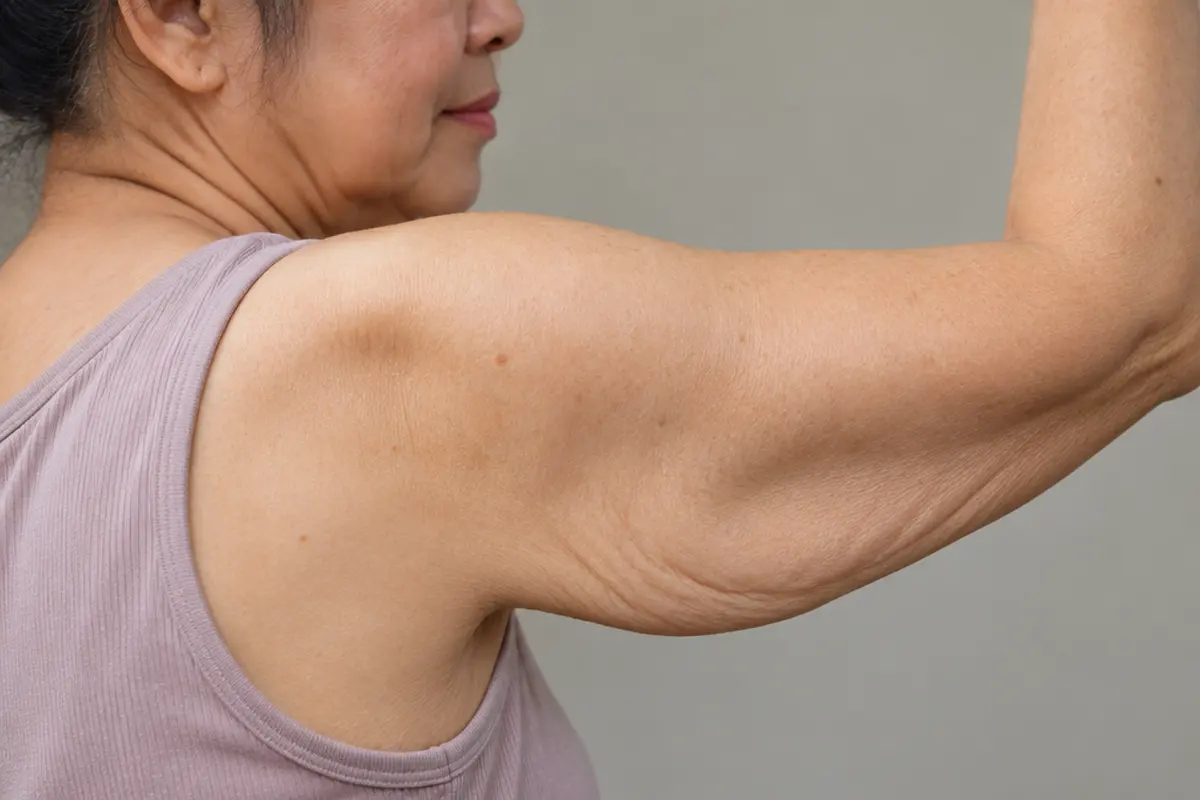
Loose skin and fat at the upper arm are assessed separately. Illustrative image, not a patient.
What it cannot do
Microliposuction removes fat. It does not tighten skin, and removing fat from under loose skin can make laxity look worse. It also cannot fill a hollow where too much fat was removed. Those are separate problems with separate answers: skin tightening such as VF Lift – Vertical Facelift, or support and restoration of volume.
Micro laser liposuction is not the same as a surface laser
“Micro laser liposuction” usually describes laser-assisted liposuction, in which a laser fibre is passed under the skin through a cannula. It is invasive and regulated as liposuction. Time Freeze Laser LCLR® is different: it is applied from the surface, with no cannula, anaesthesia or incisions, and its lipo-remodelling arm acts on superficial fat in selected zones while the collagen arm tightens the skin.
A microliposuction-like effect without surgery: Time Freeze Laser LCLR®
For a small, superficial pocket of fat, such as under the chin, along the jowls or beside an earlier liposuction site, Dr Sin Yong uses the Time Freeze Laser LCLR® to give a microliposuction-like effect without surgery. The laser is applied from the skin surface: its lipo-remodelling arm acts on superficial fat in the selected zone, and its collagen arm tightens the skin over it.
It is not liposuction, and no fat is removed through a cannula. It suits contained, superficial fullness; a large or deep pocket may still need surgery, and he refers to an accredited doctor when that is the case. How a surface laser differs from laser-assisted liposuction is set out in micro laser liposuction or surface laser.
How Dr Sin Yong uses the term in clinic
Patients often ask for microliposuction for a heavy chin, jowls, an overfilled fat graft or a pocket left after liposuction. He assesses first whether a non-surgical route fits: Time Freeze Laser LCLR® for superficial excess, VF Lift for lifting and contour. Where the excess is large, deep and stable and microliposuction is the right tool, he says so and refers to an accredited surgeon. See fat grafting correction and loose skin after liposuction.
Microliposuction: recovery, risks, and who it suits
Microliposuction removes small amounts of fat through tiny incisions, usually under local anaesthetic, and is a surgical procedure.
Recovery
Swelling and bruising for one to two weeks, a compression garment for a few weeks, and a final contour at about three months.
Risks
Irregular contour, loose skin, numbness, infection and, rarely, more serious complications; it is done only by accredited doctors in licensed settings.
Who it suits
People near their usual weight with a small, stubborn pocket and good skin; where the skin is loose, Time Freeze Laser LCLR® can give a microliposuction-like effect with tightening and no incisions.
Frequently Asked Questions
Yes, in technique and in regulation. It uses finer cannulas on smaller areas, but in Singapore it falls under the same Ministry of Health liposuction framework: accredited doctors, approved settings and a seven-day cooling-off period.
It is one of the routes described for excess grafted fat, including MRI-guided removal in the forehead. It tends to suit a large, well-defined and stable excess. Smaller or superficial excess is often reduced first without surgery, with Time Freeze Laser LCLR®.
No. It removes fat. Removing fat under loose skin can make laxity look worse, which is why skin tightening, such as VF Lift, is considered separately.
No. It passes a laser fibre under the skin through a cannula. Time Freeze Laser LCLR® is applied from the surface, with no cannula, anaesthesia or incisions.
For a small, superficial pocket of fat, Dr Sin Yong uses the Time Freeze Laser LCLR® to give a microliposuction-like effect from the skin surface, with no cannula or incision. It is not liposuction and does not suit a large or deep pocket, which may still need surgery by an accredited doctor.
No. Dr Sin Yong no longer performs liposuction, including microliposuction. He assesses and treats excess fat and laxity without surgery, and refers to an accredited surgeon when microliposuction is the right tool.
Micro liposuction is small-volume liposuction that removes localised fat through very fine cannulas, typically from areas such as the chin, jowls or small body pockets, under local anaesthesia. It removes fat but does not tighten skin, so skin quality is assessed beforehand.
Swelling and bruising usually last one to two weeks, a compression garment is worn for some days, and the final contour is judged after about three months. The small incisions heal to fine marks.
The fat cells removed do not regrow, but the remaining fat cells can still enlarge with weight gain, so a stable weight keeps the result.
References
Huang Z, Zhang X, Jiang C, et al. Forehead overfilling after autologous fat grafting: literature review and retrospective evaluation of MRI-guided microliposuction for revision. Aesthetic Plast Surg. 2026;50(11):4151–4166. source
Ministry of Health Singapore. FAQ on the revised licensing conditions for liposuction (ambulatory surgery). source
Ministry of Health Singapore. Liposuction regulatory framework. source
Peer-reviewed papers on this topic, listed for background reading. They report published research in general and are not a statement about results at this clinic.
Fakhouri TM, El Tal AK, Abrou AE, et al. Laser-assisted lipolysis: a review. Dermatol Surg. 2012;38(2):155-69. PubMed 22093156 · DOI
Kanapathy M, Pacifico M, Yassin AM, et al. Safety of Large-Volume Liposuction in Aesthetic Surgery: A Systematic Review and Meta-Analysis. Aesthet Surg J. 2021;41(9):1040-1053. PubMed 33252626 · DOI
Tierney EP, Kouba DJ, Hanke CW. Safety of tumescent and laser-assisted liposuction: review of the literature. J Drugs Dermatol. 2011;10(12):1363-9. PubMed 22134559