Volnewmer vs Ultherapy: radiofrequency or ultrasound?
Medically reviewed by Dr Sin Yong · Last reviewed · 3 min read
Main guideUltherapy Singapore — what it treats, who it suits, sessions, downtime and what decides the cost, by Dr Sin Yong.
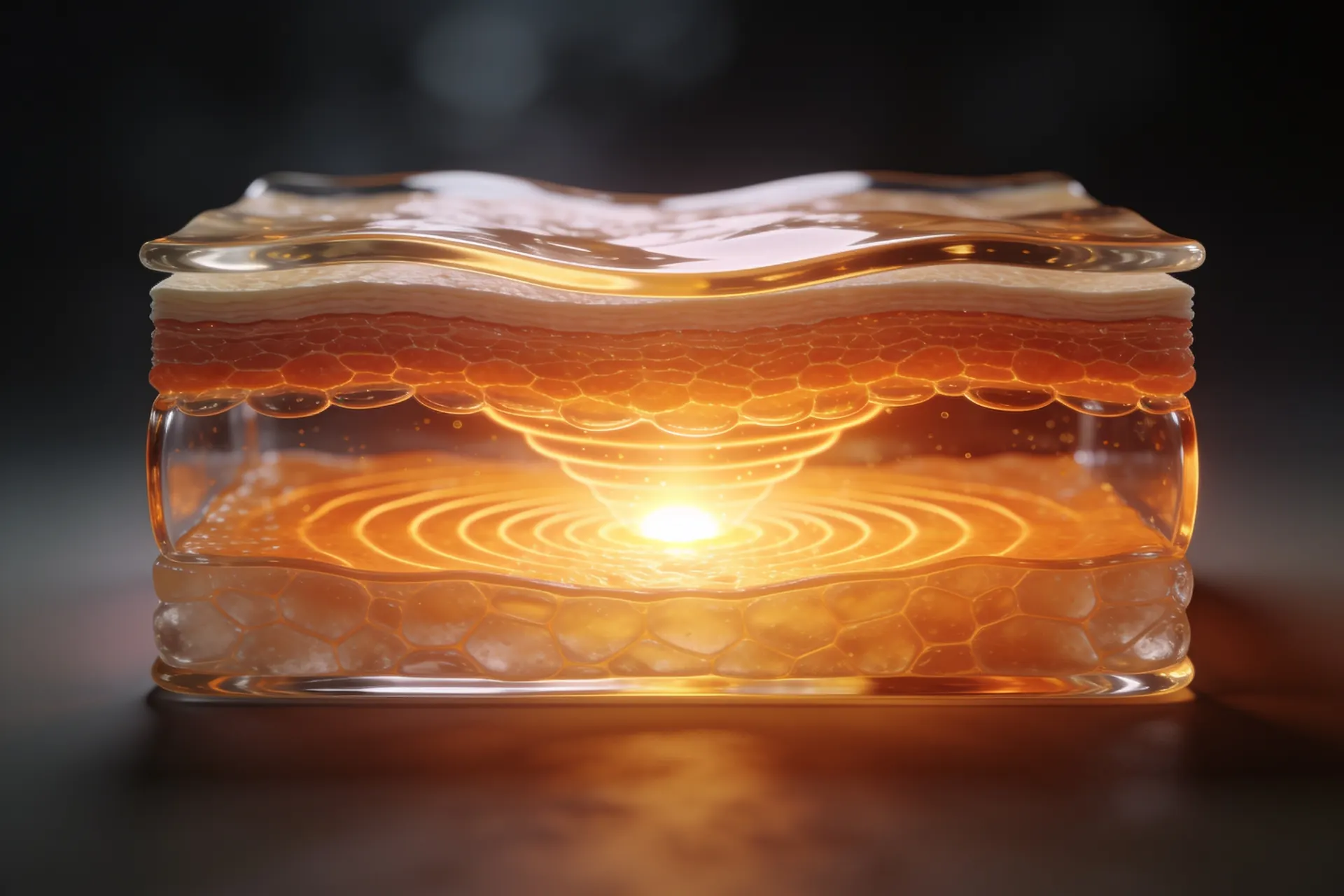
Volnewmer and Ultherapy are often compared, but they use different energies. Volnewmer is monopolar radiofrequency at 6.78 MHz: it heats the dermis and the fibrous septae as a layer, with water cooling on the surface. Ultherapy is micro-focused ultrasound with imaging: it places small points of heat at set depths, down to the SMAS. One conditions a layer of skin; the other places heat deeper at points. Dr Sin Yong’s VF Lift – Vertical Facelift protocol is built on Volnewmer.
Dr Sin Yong presenting VF Lift at the CLASSYS APAC Symposium.
Key facts
Volnewmer
Monopolar RF, 6.78 MHz; volumetric dermal heating; water cooling
Ultherapy
Micro-focused ultrasound with imaging; points at 1.5, 3.0 and 4.5 mm
Volnewmer is considered for
Skin laxity and quality across face and body; VF Lift protocol
Ultherapy is considered for
Early descent of brow, jowl and under-chin with a deeper component
Both
Non-surgical; change develops over months; neither adds volume
Brow, under-chin, neck, décolletage (FDA-cleared); jowl also treated
Maker
CLASSYS
Merz Aesthetics
Volnewmer vs Ultherapy mechanism: what each energy does inside the tissue
The Volnewmer vs Ultherapy question is a question about mechanism before it is a question about brands. Volnewmer passes monopolar radiofrequency through the whole thickness of tissue under its tip and warms the dermis as a layer. Ultherapy converges ultrasound to small points at fixed depths and leaves the tissue between those points largely unheated. The table compares the two mechanisms line by line, including what each cannot do.
Volnewmer warms a layer and Ultherapy places points; asking which one is stronger misses that they are not doing the same job.— Dr Sin Yong
Illustrative image — not a patient.
Aspect
Volnewmer (monopolar radiofrequency)
Ultherapy (micro-focused ultrasound with visualisation)
Energy source
Alternating electrical current at 6.78 MHz, from a single treatment tip to a return pad on the body
Sound energy focused by a transducer to a small focal zone below the surface
How heat is produced
Tissue resists the current; the resistance generates heat through the full depth under the tip
Vibration at the focal point produces a discrete coagulation point; the beam path above it is not the target
Heating pattern
Volumetric: the whole treatment zone warms together, dermis and fibrous septae included
Point by point: lines of small thermal coagulation points at set depths
Layers reached
Dermis and the subdermal fibrous septae; no discrete points at the SMAS
Transducers at 1.5, 3.0 and 4.5 mm, the deepest reaching the SMAS layer
Surface protection
Continuous water cooling across the skin surface during delivery
Energy is focused below the surface, so the epidermis is bypassed rather than cooled
Imaging
None; the zone is planned from examination and tip placement
Real-time ultrasound imaging shows the layer before each line is delivered
What it cannot do
Cannot place energy at the SMAS; cannot add volume, remove fat or resurface the skin
Cannot condition the dermis as a continuous layer; cannot add volume, remove fat or resurface the skin
Why the heating pattern is the real difference
Monopolar radiofrequency is bulk conditioning. Because the current has to travel through everything under the tip to reach the return pad, the heat is produced as a volume, and the collagen in that volume contracts and is then remodelled. The monopolar radiofrequency entry explains the circuit; the point for a patient is that the dermal envelope is treated as a sheet. Ultherapy does something different. Its transducer focuses sound to a tiny zone where the tissue is heated to a coagulation point, then moves on, so the treatment is a pattern of points rather than a warmed layer. The imaging is what lets those points be placed on the intended layer rather than on bone or a vessel.
What neither device does
Neither adds volume, so a face that has deflated will not look fuller after either. Neither removes fat, so a heavy jowl made of fat is the wrong target for both. Neither resurfaces the skin, so texture, pores and pigment are separate conversations. Both prompt collagen remodelling that develops over time rather than at once, and both are non-surgical, which means heavy redundant skin is referred for a plastic surgery opinion rather than treated with either machine. The Volnewmer and Ultherapy pages carry the full detail on each platform.
Who suits Volnewmer and who suits Ultherapy?
Who suits Volnewmer and who suits Ultherapy is decided by the layer that has changed and by the shape of the face around it, not by which name is more familiar. Dr Sin Yong examines the face first, maps what is laxity, what is fat and what is volume loss, and only then matches an energy to the layer. The patterns below are the ones that come up most often in the room.
Skin laxity across a wide area
Where the complaint is loose, crepey or lax skin over a broad zone, including the neck, the body and the backs of the arms, the dermal envelope itself is the problem. That is the reason radiofrequency is considered: Volnewmer warms that envelope as a layer, and the VF Lift – Vertical Facelift plans the zones along vertical vectors. Points at the SMAS do little for a sheet of lax skin.
Early descent with a deeper component
Where the brow has dropped, the jowl has started to slide over the jawline or the under-chin has softened, and the skin itself is still of reasonable quality, the deeper fibrous layer is where the change has happened. That is the reason focused ultrasound is considered: Ultherapy places its points at the SMAS, with imaging confirming the layer. This is also where HIFU in general is assessed, with the platform chosen at consultation.
The lean face
A slim face with little fat under the skin asks a different question. Tightening alone, from any device, can read as hollowing when there is no support beneath the envelope. In these faces Dr Sin Yong tends to lean towards the radiofrequency protocol, because the VF Lift is planned with a restore arm for the areas that are deflating, and he is cautious about placing deep ultrasound points over thin fat compartments. The four-way comparison sets out the slim-face rule in full.
The fuller or puffy face
Where the heaviness is fat rather than loose skin, or where an earlier Sculptra, Ellansé or fat graft has left an area overfull, neither device is the first tool. Both tighten; neither takes volume away. Here the assessment usually turns to Time Freeze Laser LCLR®, which is built to reduce the excess from the surface, with lifting energy added afterwards if the face still needs it.
Who should look elsewhere
A pacemaker or other implanted electronic device, metal implants in the field, pregnancy and active infection in the area rule out Volnewmer; the Ultherapy page lists its own exclusions. Marked, redundant skin that would need excision is referred to a plastic surgery specialist rather than treated with either energy. Where the real concern is volume loss, the conversation moves to fillers or biostimulators, and the tightening question is parked until the support is there.
Combining Volnewmer and Ultherapy, and where VF Lift – Vertical Facelift fits
Combining Volnewmer and Ultherapy makes sense only when the face has two problems on two layers: a lax dermal envelope and a descended deeper layer. Then the two energies are not rivals but are placed on different layers at different times. When the face has one problem, one energy is enough, and adding the second adds cost and heat without adding a reason.
VF Lift – Vertical Facelift is radiofrequency, not ultrasound
The protocol Dr Sin Yong presented at the CLASSYS APAC 2026 symposium is built on Volnewmer monopolar radiofrequency and uses no focused ultrasound at all. It is planned zone by zone along vertical vectors, with the energy in each zone calibrated to one of three aims: lift for laxity, reduce for excess puffiness, and restore where the face is deflating. Because it is radiofrequency, it conditions the dermis and the fibrous septae as a layer; it does not place points at the SMAS, and it is not a HIFU treatment with a different name. The body version of the same thinking is VF Lift – Vertical Figure Lift.
How a combined plan is sequenced
When both layers need attention, the order is decided from the examination rather than from a menu. The usual logic is that the deeper, point-placed treatment and the layer-conditioning treatment are separated in time so that the tissue response to one can be judged before the other is added, and so that heat is not stacked on the same zone in one sitting. Which goes first depends on which layer is contributing more to the look of the face. The pairing of focused ultrasound with the radiofrequency protocol is described on HIFU with VF Lift, and the aftercare for each platform is on Volnewmer aftercare and Ultherapy aftercare.
What a combination is not
Two tightening energies do not add volume, so a deflated face does not become a candidate for both by being treated with both. They do not remove fat, so a fuller face is not made leaner by stacking them. And doubling the energy does not double the change; the collagen response has its own pace, and more heat on the same layer mainly raises the risk of swelling and tenderness. Where a prior plan has already tightened a face that needed support instead, the next step is restoring support, not another round of tightening.
What the consultation decides
Dr Sin Yong examines the face in person, including an ultrasound look at what is fat, filler or tissue where that is in doubt, and then says which layer has changed, which energy addresses it, and whether no treatment is the honest answer for now. Device names come last. The Volnewmer vs Thermage page covers the radiofrequency-only comparison for readers deciding between the two monopolar platforms.
Illustrative image — not a patient.
Which one, for whom
Where the concern is skin laxity and texture over a wide area, including the body, radiofrequency is the reason Volnewmer is considered. Where early descent with a deeper component is the main concern, focused ultrasound is the reason Ultherapy is considered. Some plans use both, at different times. Neither treats volume loss. Separately, where earlier Sculptra or Ellansé has over-stimulated an area, VF Lift – Vertical Facelift is built to target Sculptra and Ellansé and take away the excess; suitability is decided at assessment.
Treatment of Facial Skin Laxity by a New Monopolar Radiofrequency Device. PMC (NCBI), 2011. pmc.ncbi.nlm.nih.gov
A Systematic Review of the Efficacy of Microfocused Ultrasound for Facial Skin Tightening. PMC (NCBI), 2023. pmc.ncbi.nlm.nih.gov
Customized Treatment Using Microfocused Ultrasound with Visualization: Pan-Asian Adaptation of the Expert Panel Recommendations. PMC (NCBI), 2021. pmc.ncbi.nlm.nih.gov
The Landscape of Radiofrequency Technology for Skin Rejuvenation. PMC (NCBI), 2025. pmc.ncbi.nlm.nih.gov
Alam M, White LE, Martin N, et al. Ultrasound tightening of facial and neck skin: a rater-blinded prospective cohort study. Journal of the American Academy of Dermatology, 2010. pubmed.ncbi.nlm.nih.gov
Consensus Recommendations for Combined Aesthetic Interventions Using Botulinum Toxin, Fillers, and Energy-Based Devices. Dermatologic Surgery, 2016. pubmed.ncbi.nlm.nih.gov